fbpx

February 26, 2026

By Your Command – A poem for Parsha Tetzaveh

Tetzaveh — command (Exodus 27:20–30:10)

I don’t like to take commands
but my bosses like to issue them
and my mortgage likes to get paid.

I say I don’t like to take commands,
but I’m a rule follower – No one jaywalks
on my watch without getting judged.

I don’t like to take commands or even
issue them. I say let love rule, and will
do whatever love commands me to do.

I’m a freeform command follower.
Oxygen takes its own path into my lungs.
My blood flows at its discretion.

I might say your wish is my command
but only because I’m in the service industry
and did I mention my mortgage?

I find this performance commanding.
I find this command performative.
I find signs on the street that say

call this number, but I never do.
When God commanded Moses to
command the people to

build a holy place in the desert
everyone did what they were told.
I probably would have too

if I were there. My tradition tells me
I was there. So I’m assembling
my own breastplate of judgment.

I’m taking the dress code seriously.
Two onyx stones? Got ‘em.
Twelve gems on the breastplate?

Say no more. Loaves of unleavened
bread at the tabernacle entrance?
Hand me your finest flour, and

I implore you. Do not think of it again.
It is done. It what I have been
commanded to do.


Rick Lupert, a poet, songleader and graphic designer, is the author of 29 books including “God Wrestler: A Poem for Every Torah Portion.” Visit him at www.JewishPoetry.net

By Your Command – A poem for Parsha Tetzaveh Read More »

Local NCSY Girls to Attend the 4G Convention, a Meaningful All-Girls Shabbaton

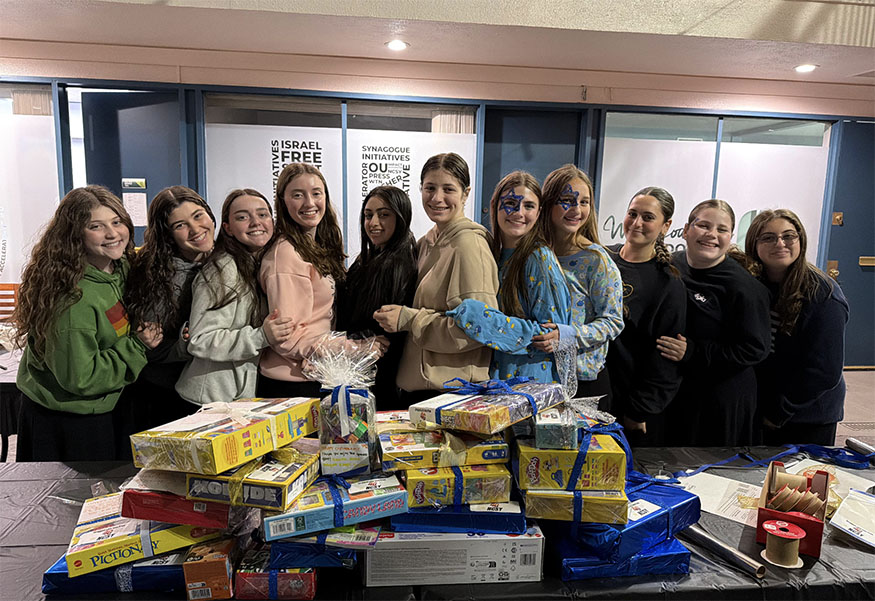
For one extended weekend, 42 high school girls from Los Angeles will attend NCSY’s 4G Convention in New Jersey. The highlight of the event, which is taking place in New Jersey, is a Shabbaton filled with connection, inspiration, and personal growth.

According to Sarah Simpser, Los Angeles 4G director, the trip is an opportunity for 350 girls from around the United States, including cities like LA, Las Vegas, New York, New Jersey, Chicago, Baltimore, and Milwaukee, to “get together for an entire Shabbat experience and maximize it. They will learn, ‘How can we better ourselves and grow?’”

This year, the theme for NCSY – which is an Orthodox Union youth movement designed to empower Jewish teens – is ownership of your Judaism.

“Even though we are born into it, we still have to choose it for ourselves,” Simpser said. “In today’s day and age, the biggest thing I’ve felt from most of the girls is finding depth and meaning in their day-to-day interactions and being mindful of everything they are a part of.”

The girls’ trip starts with a gathering on a yacht in New York, and then during Shabbat, they will hear from speakers flown in from around the world. They will share meals together, learn Torah, and connect with one another. The last day, on Sunday, they will go to American Dream Mall, which is owned by a Jewish family, the Ghermezians.

Every week, the 42 girls, who go to Jewish private schools throughout LA, come together in Pico-Robertson to learn Torah with a partner, a chavruta, do community service, and eat in local kosher restaurants.

“Our out of school programming enhances the girls’ Jewish identity,” said Simpser. “We teach them about being more intentional about the things they’re doing on a daily basis, and we’re providing that extra level of support and excitement around being a Jewish teenage girl.”

Along with NCSY, the West Coast Orthodox Union office, located on Pico Boulevard, also offers JSU, the Jewish Student Union. The latter program is for public and private school students and was created so that Jewish students could meet other Jewish students and learn about their culture and heritage. They strengthen their connection to Israel, as well as their Jewish identity. NCSY and JSU participants are offered the chance to go to Israel and learn about Jewish opportunities on their future college campuses, as well as in their communities.

At the NCSY girls’ program in LA, there are issues that are addressed, such as friendship situations, their relationships with their parents, and family and school crises. NCSY is there for guidance—no matter what.

“We are able to help and work with these teens,” Simpser said. “A lot do seek extra mentorship. They think, ‘Who can I talk to who isn’t biased?’ We are there to support our teens and meet them where they’re at.”

Local NCSY Girls to Attend the 4G Convention, a Meaningful All-Girls Shabbaton Read More »

A Moment in Time: “Cleared for Kindness”

Dear all,

As we observed my father’s yahrzeit last week, I found myself returning to the bond we shared through aviation. Dad was a private pilot; my passion leaned toward commercial flight. As a teen I collected airline timetables, and from my twenties until today, I’ve never lost the thrill of boarding a plane.

We took a few flying expeditions together. One brought us from Anchorage to Adak, out in the Aleutian Islands. Our ticket on Alaska Airlines gave us only about 35 minutes on the ground in Adak.

When we stepped off the plane, the station manager greeted us at the door: “You must be the Shapiros—you’re the only non-military passengers on the flight. Welcome to Adak.” Then she handed us her car keys. “Here—take my car and drive around the island.”

Dad and I exchanged an excited glance. “What if we miss the flight out?” we asked.

She smiled. “Trust me—you won’t miss it.”

Her car was waiting out front. We explored what we could, grabbed a quick snack at the island store, then returned the car—keys still in the ignition—and boarded with a moment in time to spare.

I have never forgotten her kindness. In that brief encounter, she lived a core Jewish value: to welcome the stranger.

We live in complicated times. Yet moments of simple humanity still bridge time and space with holiness.

With love and Shalom,

Rabbi Zachary R. Shapiro

A Moment in Time: “Cleared for Kindness” Read More »

Humility, the Torah and Washington DC

George W. Bush, a US president whose intellectual ability

is not the greatest quality by which he seems to have been apparently endowed,

identifies President George Washington’s humungous humility

as the quality that made him the greatest member of the US presidential crowd,

thereby linking him to  Israel’s greatest leader, Moses, whose outstanding

humility is mentioned in a narrative in the Bible which tells that he was attacked

by both his siblings in a democratic criticism, both demanding

an approbation equal to his, demonstrating that humility was a quality which, like our present president, they both lacked.

In fairness to Miriam and Aaron, it should be noted that both Washington and Moses allowed

their names to be immortalized, the name of the former given to

the United States’s capital, Washington DC, and of the latter to the Torah that’s endowed

to Moses, called Torat Moshe, Moses’ Torah, by every Jew.


In “From One President to Another, a Love Letter With an Edge,” NYT, 2/16/26, Jennifer Schuessler writes:

For American politicians, there is nothing more uncontroversial than a Presidents’ Day tribute to George Washington, the upright Virginian who may (or may not) have chopped down that cherry tree but otherwise stands as the embodiment of leadership and virtue.

But in an essay published on Monday, a more recent George W. is putting a little 2026 edge on the subject.

“Few qualities have inspired me more than Washington’s humility,” former President George W. Bush writes in the essay, which was released as part of a new nonpartisan history project.

“Our first president could have remained all-powerful, but twice he chose not to,” Mr. Bush writes, referring to Washington’s decision to relinquish leadership of the Army after the American Revolution, and then to step down from the presidency after two terms.

By “relinquishing power rather than holding onto it,” Mr. Bush continues, “he ensured America wouldn’t become a monarchy, or worse.”


Gershon Hepner is a poet who has written over 25,000 poems on subjects ranging from music to literature, politics to Torah. He grew up in England and moved to Los Angeles in 1976. Using his varied interests and experiences, he has authored dozens of papers in medical and academic journals, and authored “Legal Friction: Law, Narrative, and Identity Politics in Biblical Israel.” He can be reached at gershonhepner@gmail.com.

Humility, the Torah and Washington DC Read More »

A Bisl Torah — The Light You are Commanded to Bring

The Torah begins its description of lighting the lamps in the Tabernacle with the word “T’tzavveh” — “you shall command” or “you shall instruct.”

That opening word echoes another familiar word: mitzvah.

How do we understand what it means to do a mitzvah?

In one of my classes, we explored that very question. For some, a mitzvah means being commanded by God. For others, it is a bridge between ancient ritual and modern life — a way of linking ourselves to generations past. When we perform a mitzvah, we join a chain that stretches backward and forward, binding Jews together across time through a single sacred act. For many, a mitzvah is ultimately about connection — to Jewish practice, to community, to values, and to God.

Whatever definition resonates most, a mitzvah creates holy attachment: attachment to divine expectation, to our own Jewish identity, and to one another.

The Torah’s structure here is striking. It does not first describe the light and then label it a mitzvah. The command — the connection — comes first. Only then comes the light.

The message is profound: whenever we engage in a mitzvah, we create connection — and from that connection, light emerges: a light that transcends generations and a light that anchors us in a story and a purpose larger than ourselves.

Each mitzvah opens us to the possibility of becoming bearers of that light. What a beautiful, bright, illuminating task.

Shabbat Shalom


Rabbi Nicole Guzik is senior rabbi at Sinai Temple. She can be reached at her Facebook page at Rabbi Nicole Guzik or on Instagram @rabbiguzik. For more writings, visit Rabbi Guzik’s blog section from Sinai Temple’s website.

A Bisl Torah — The Light You are Commanded to Bring Read More »

Print Issue: Choosing to Be Chosen | February 27, 2026

CLICK HERE FOR FULLSCREEN VERSION

Print Issue: Choosing to Be Chosen | February 27, 2026 Read More »

Jewish Hockey Star Jack Hughes’ Overtime Goal Propels U.S. to Historic Gold Medal in Olympic Hockey

Jewish hockey star Jack Hughes scored the game-winning goal Sunday to clinch a gold medal for the U.S. men’s hockey team, its first since 1980.

The New Jersey Devils star center, who had scored twice in Team USA’s semifinal win, sent the puck between the legs of Canadian goaltender Jordan Binnington 1:41 into overtime to give the American team a 2-1 win.

“This is all about our country right now. I love the USA,” Hughes told NBC. “I love my teammates.”

The win broke a 46-year Olympic drought for Team USA, which had not taken gold since the famous “Miracle on Ice” team that upset the Soviet Union on its way to gold in 1980. The United States also won in 1960.

“He’s a freaking gamer,” Quinn Hughes, Jack’s older brother and U.S. teammate said, according to The Athletic. “He’s always been a gamer. Just mentally tough, been through a lot, loves the game. American hero.”

Quinn Hughes is a defender for the Minnesota Wild and a former captain of the Vancouver Canucks who won the NHL’s top defenseman award in 2024. He was also named the best defender in the Olympic tournament by the International Ice Hockey Federation after scoring an overtime goal to send the U.S. team to the semifinals.

The third Jewish member of the U.S. team, Boston Bruins goaltender Jeremy Swayman, won the one game he played, a Feb. 14 preliminary-round victory over Denmark.

The Hughes family — rounded out by youngest brother Luke, who also plays for the Devils — has long been lauded as a Jewish hockey dynasty. They are the first American family to have three siblings picked in the first round of the NHL draft, and Jack was the first Jewish player to go No. 1 overall. They are also the first trio of Jewish brothers to play in the same NHL game and the first brothers to earn cover honors for EA Sports’ popular hockey video game.

Jack, who had a bar mitzvah, has said his family celebrated Passover when he was growing up. Their mother, Ellen Weinberg-Hughes, who is Jewish, represented the U.S. women’s hockey team at the 1992 Women’s World Championships and was on the coaching staff of the gold-medal-winning women’s team in Milan. Weinberg-Hughes is also a member of the International Jewish Sports Hall of Fame.

Hughes’ golden goal ushered in a burst of Jewish pride on social media, with one user calling it “the greatest Jewish sports moment of all time.” The Hockey News tweeted that Hughes was “​​the first player in hockey history to have a Bar Mitzvah and a Golden Goal! Pretty cool!”

Jewish groups and leaders also jumped on the praise train. “Special shout out to @jhugh86 on scoring the game-winning goal!” tweeted Jonathan Greenblatt, CEO of the Anti-Defamation League. “Beyond his incredible skill on the ice, Jack makes history as a proud representative of the American Jewish community, reminding us that the Jewish people are interwoven into America in her 250th year! Mazel Tov, Jack!” 

Jewish Hockey Star Jack Hughes’ Overtime Goal Propels U.S. to Historic Gold Medal in Olympic Hockey Read More »

It’s Not Trash – It’s Compost!

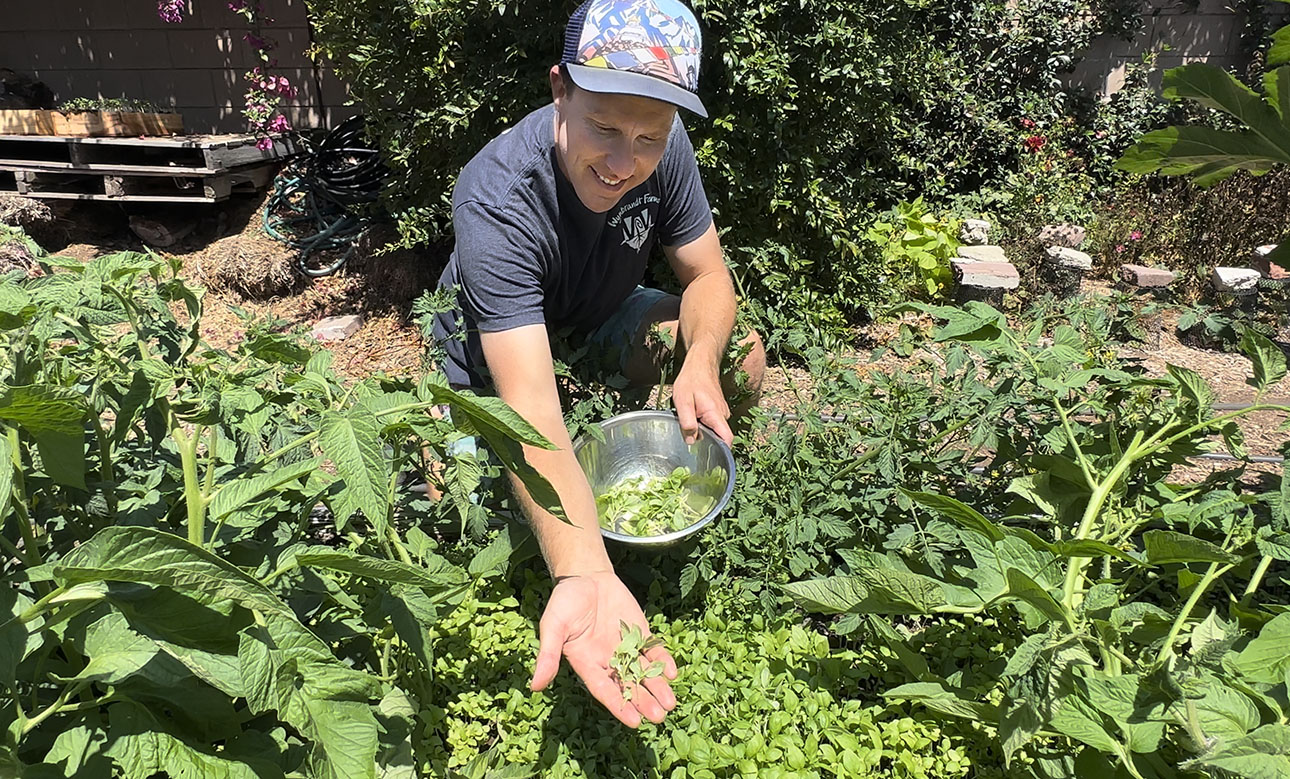
At Pressman Academy, today’s lunch becomes tomorrow’s garden treasure. Nothing goes to waste. Just steps from the cafeteria, banana peels, pizza crusts, and half-eaten apples aren’t destined for the trash — they’re transformed into nutrient-rich compost, thanks to California farmer and composting pioneer Steven Wynbrandt.

His innovative on-site system, known as The Wynbrandt Method, turns food waste into a hands-on lesson in sustainability.

There are few things Wynbrandt enjoys talking about more than composting. Passionate about his work, he can go on endlessly about the method he developed — one that eliminates everything people typically associate with composting: unpleasant smells, pests and labor.

The first school he convinced to participate in the program was the Wesley School in North Hollywood.

“They took a huge leap of faith,” Wynbrandt said. “They saw what I’d done and said, ‘We’re going to take this risk and step into the unknown with you.’ They’ll always have a special place in my heart — they signed on when no one else was doing it.”

Pressman Academy became the first Jewish school to adopt the program during the 2024-25 school year. Last month, students, families, and community members gathered to celebrate the first harvest, adding compost created on campus directly into the school’s garden beds.

“The idea for our garden started a few years before we met Steven Wynbrandt,” Yonatan Rosner, Judaic Studies Principal told The Journal. “There are social and emotional benefits to working with the land. The routines involved in caring for the land and animals help students learn about themselves and build resilience.”

After the school committee adopted the Wynbrandt Method, the entire community became involved — students, families, teachers, and members of Temple Beit Am, the synagogue with which the school is affiliated.

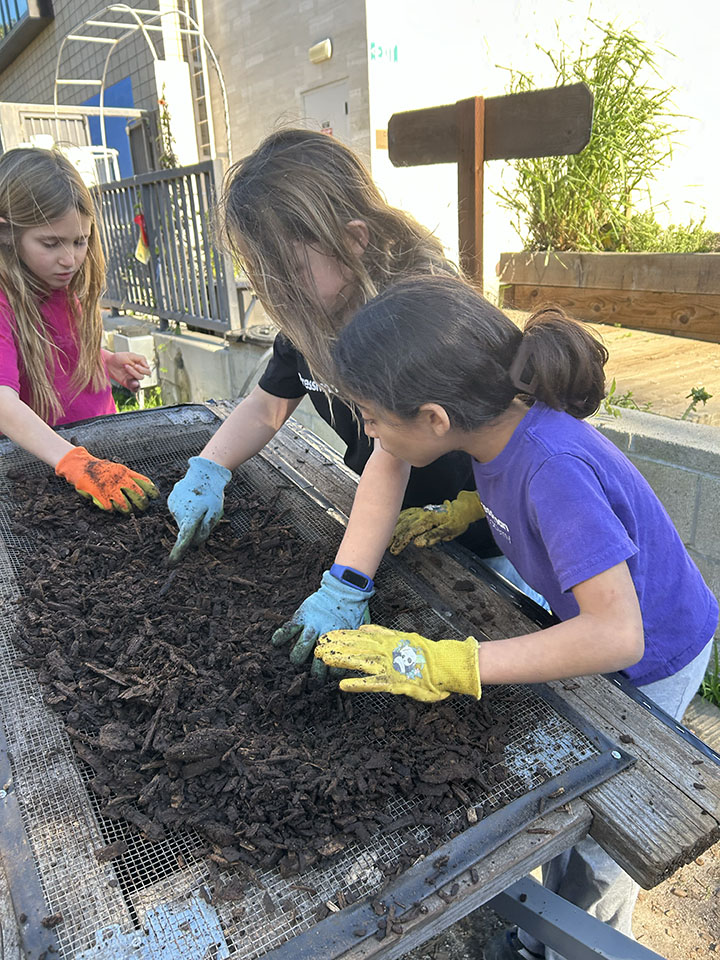
“We started with three compost containers, and now we have four,” Rosner said. “We’re able to compost between 2,000 and 3,000 pounds of food waste.” Rosner explained that the containers are tightly sealed, which keeps pests and insects out. Following Wynbrandt’s instructions, wood chips are added to the mix — they help maintain airflow, absorb excess moisture and provide a slow-release carbon source that feeds the compost over time and improves its texture.

Wynbrandt’s compost program is designed as a turnkey, on-site solution for schools and organizations seeking to eliminate food waste. The system promises a no-turn, low-tech approach — requiring no moving parts or electricity — while still being capable of composting 100% of the school’s food waste.

Steven Wynbrandt shows schools how to turn lunch scraps into garden treasures

Students learn early on the importance of composting and how it contributes to creating healthy soil for the garden, which in turn helps grow fruits and vegetables. A group of students manages the composting twice a week, while a synagogue group takes over on Sunday mornings.

Composting has been steadily gaining popularity in the U.S. as more people realize that food waste doesn’t have to end up in landfills — it can become a valuable resource. Unlike typical store-bought soil or synthetic fertilizers, compost made from food scraps is packed with nutrients and microbes that naturally enrich the earth. It improves soil structure, helps retain water, and creates an environment where plants can thrive. Essentially, it turns what would have been trash into a powerhouse for healthier gardens, stronger plants, and more sustainable growth.

Despite its benefits, many people are hesitant to compost. The biggest concerns are the smell, the mess, and the pests — nobody wants a pile of rotting food attracting flies or rodents in their backyard. It can also feel complicated: what can go in, what can’t, and how often do you have to turn it? For these reasons, composting has often been seen as a time-consuming chore rather than a fun or useful project.

Wynbrandt is trying to change this concept and make it as effortless as possible.

He started his professional composting career around 2012, producing over a million pounds of compost by hand in his Los Angeles backyard. The LA Times featured him in a 2012 story calling him “The King of Compost,” and a decade ago, the subject of The Jewish Journal. As he expanded to farmlands in the Santa Monica Mountains and Sonoma County, Wynbrandt honed his artisanal techniques with heavy machinery, always keeping quality and sustainability front and center.

Today, Wynbrandt Farms is recognized across California for some of the state’s highest-quality compost, and in 2022, it launched the first and only hand-composted, Demeter-certified biodynamic compost available commercially in the U.S.

According to Wynbrandt, the compost he creates is nutrient-rich and strong, helping plants grow bigger and more nutritious. It also improves the soil’s ability to hold carbon, making it better for the environment and a natural tool against climate change. Wynbrandt treats the compost like a fine wine or aged cheese, letting it mature for a full year to ensure it’s rich and ready to use, and capable of growing food directly in it. “The healthier the soil, the more nutrient-dense the plants we grow in it.”

“At the end of the process,” he said, “when we hold the compost in our hands, we say, ‘Oh my God, we can’t believe this was the last bite of a hamburger or a bit of burrito mush,” said Wynbrandt. “Now it’s just like medicine that restores and heals the living skin of the earth.” He also emphasizes the environmental impact: “This high-quality compost makes the soil healthier, which in turn allows it to store more carbon — an incredibly effective strategy against climate change.

Pressman Academy sees composting not only as something good for the environment, but also as a way to teach students how to grow a garden and perform mitzvahs by sharing the produce with those in need.

“Our Judaic values remind us of both our blessings and our responsibilities — of caring for others and giving back,” said Rosner. “We wanted our garden to be more than a resilience project; we wanted it to be a sustainability effort that serves the community around us. After the pandemic, as we continued to see the challenges of homelessness, poverty, and hunger, we committed to growing food not only for ourselves, but to share with those in need.”

It’s Not Trash – It’s Compost! Read More »

JewBelong: ‘Jewish Students Don’t Need Your Pity. Just Your Spine.’

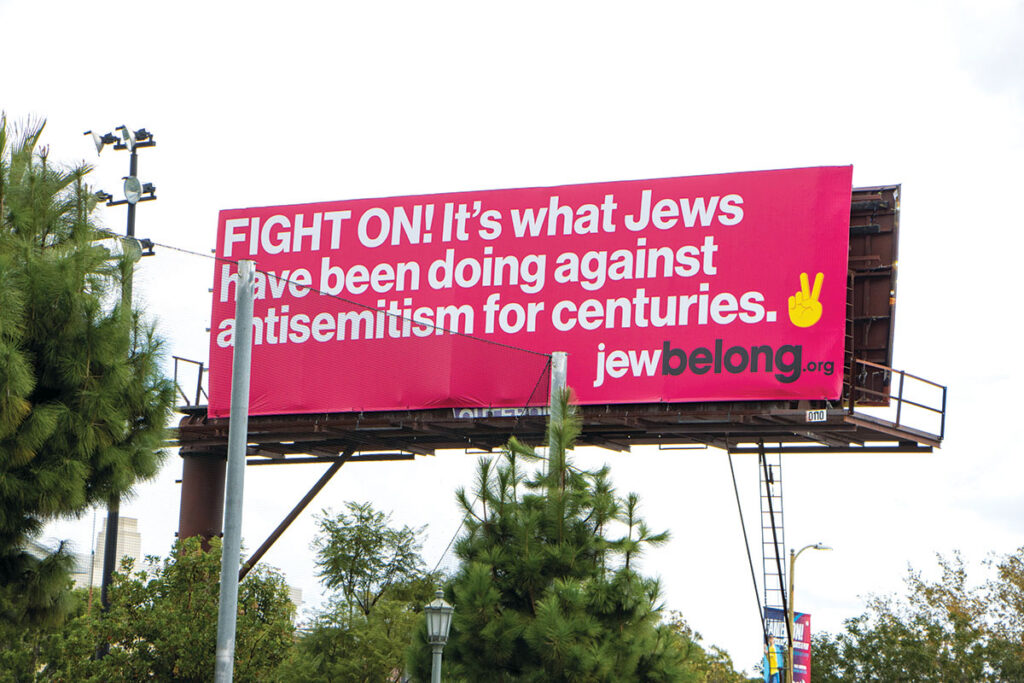
Steps away from USC, a bright pink billboard declares: “Being Jewish shouldn’t require campus security.” A similar sign stands just outside UCLA and outside other campuses. The message didn’t sit well with someone, who defaced one billboard with “End Zionism!” graffiti.

JewBelong, the nonprofit behind the campaign, posted a photo of the vandalized sign on Instagram with the caption: “A message about safety was met with hate. This is antisemitism.” The organization said it would replace the billboard.

The hot-pink billboard campaign began five years ago with humorous messages: “So, you eat bacon? God has better things to worry about.” And “We don’t care which half of you is Jewish.”

With the rise of antisemitism in the United States, the message has shifted to more serious slogans such as: “Jewish students don’t need your pity. Just your spine,” and “If you think turbulence is scary, try wearing a Jewish star.”

The goal of these billboards, co-founder Archie Gottesman told The Journal, is to raise awareness and get people talking about antisemitism. “Me and my co-founder Stacy Stuart were always sort of interested in what the world is talking about,” Gottesman said in a Zoom interview. “By the world I mean people who are not in the Jewish bubble, and billboards are a fantastic vehicle to speak with people who just don’t care that much about the issue and get them talking about it.”

Gottesman and Stuart approached the art of creating eye-catching, smart and provocative billboards almost like a science. They conducted surveys with non-Jewish participants, presented different messages, tested which ones resonated most and then placed them on billboards across the U.S.

“Most of our billboards aren’t in New York, LA or Florida. The goal is to be out of the echo chamber and to talk to the 98% of the population who is not Jewish, because that’s what the other side has done so well —  I’m talking about the anti-Jewish and antizionists.”
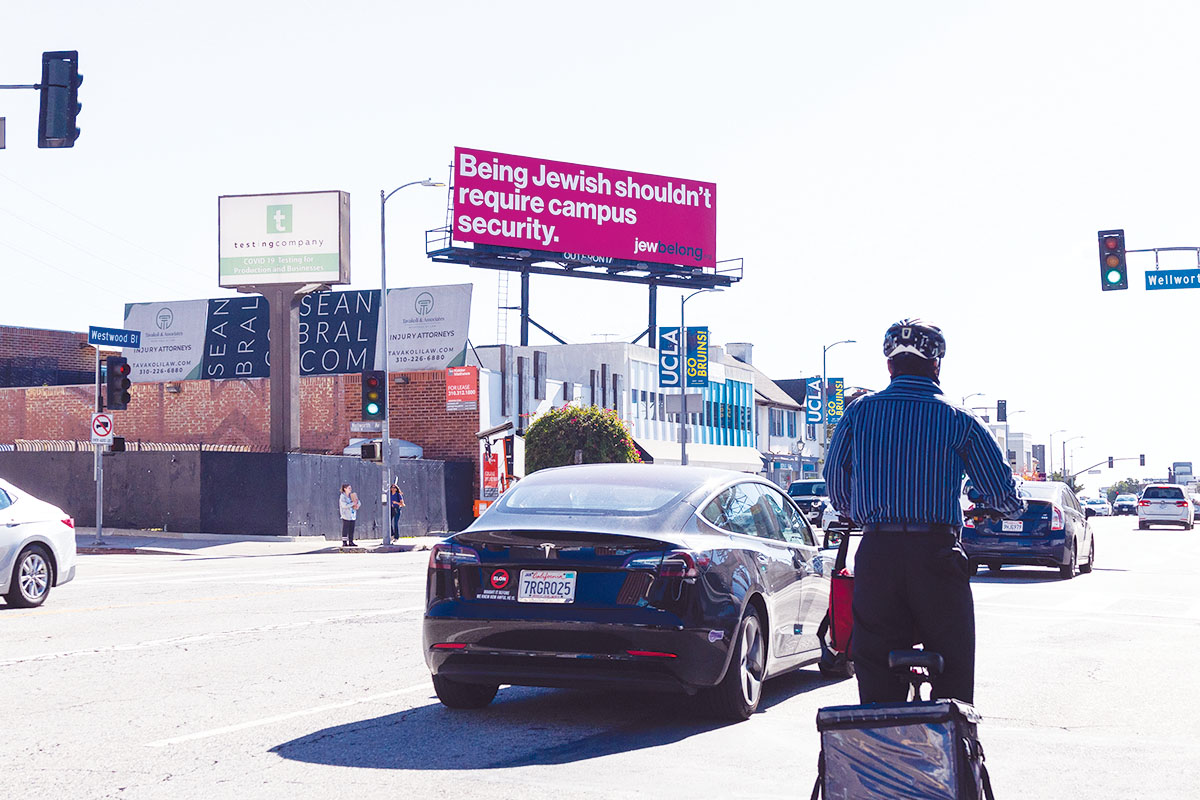
JewBelong has billboards in 42 states, including in places with small Jewish populations, such as in Tennessee, Ohio, Mississippi and Oregon — places where the average resident may not know any Jews and may be exposed to antisemitic rhetoric and misinformation.

“The sources we rely on for news, dictates the reality we see,” said Gottesman. “For example, my social media feed looks very different from someone else’s. The messages I’m getting really depends on which news media I’m watching. We’re almost living in separate news silos. So having those billboards might be the only way we can bring these messages to people who would never see them otherwise.”

Before Gottesman and Stuart founded JewBelong in 2017, they worked together in the self-storage business, Manhattan Mini Storage. They had billboards all over Manhattan that became known for their funny messages.

“We used any topic to get New Yorkers to look at our billboards and they did,” said Gottesman.  “They were very successful. People didn’t always rent from us, but we always got inquiries because we were everywhere.”

The idea behind JewBelong was to make Judaism more accessible and welcoming, especially to people who feel disconnected from Jewish life, but a few years later, in mid-2021, the organization shifted toward explicitly combating rising antisemitism in the U.S. and began placing large, bright pink billboards.

The co-founders paid attention to the Black Lives Matter movement or Stop Asian Hate campaign and saw how well they were able to raise awareness. They got people talking by gaining attention through huge billboards and advertisements. It was difficult to ignore them. They wanted to do the same for Jews in America.

When asked how effective the billboards are, Gottesman said they receive a lot of positive feedback. Surveys also show how it influences people to think about antisemitism and understand how big the problem is. “People constantly reach out to us. Many say things like, ‘I’m from Tennessee, I’m not Jewish, but I love your billboard,’ or ‘I’m so happy to see the Jews are finally speaking out.’ So, we know we are reaching many non-Jews, which is our main goal.”

Recently, JewBelong started a NYC campaign featuring digital taxi toppers on 4,000 cabs, along with a large-scale physical billboard in the Bronx. One reads: “Totally willing to hide my Jewish star for a free bus ride,” referring to one of Mayor Zohran Mamdani campaign promises. “In the past two years I actively noticed that it’s not safe being Jewish in New York. I live in the West Village and there is still graffiti. The other day I was in a taxi with my daughter, who served as a lone soldier in Israel. I mentioned something about going to Israel and she hushed me. She didn’t want me to mention Israel.”

Despite her worry about the new mayor, Gottesman believes Jews in the U.S. have many allies in the Christian community. Some churches even said they wanted to collaborate with JewBelong on a billboard. A few churches in Colorado Springs reached out and asked how they can help, so she “went for an interview with a Christian network and the love that I felt there was incredible, people told me, ‘We are praying for Israel.’ It was amazing. They are worried about what’s happening to the Jewish community because they feel that’s what going to happen to the Christian community too.”

Not all billboards are approved by the companies that own them. One that read, “Let’s be clear, Hamas is your problem too,” was rejected. The word “Israel” also will not be found on any billboard, as it would likely be rejected as well.

Gottesman said there are still people who are unsure whether Hamas is a terror organization, despite its Oct. 7 (2023) attacks and its long-standing designation as such by the United States. That confusion, she argues, is part of a larger problem: the speed at which misinformation spreads and how easily people with little background knowledge can be mobilized.

“We are not shy saying that JewBelong believes in a safe and secure Israel,” Gottesman said. “What the other side has been skilled at, is being able to gather people to their side. Someone who couldn’t find Israel on the map is suddenly marching for ‘Free Palestine.’ It’s really important that the Jewish community and our allies speak out to those people we call the ‘mushy middle,’ those who don’t know and don’t care, but also aren’t aware.”

She often thinks about the conversations she had as a child when she learned about the Holocaust. She asked her parents and her grandma: “What did you do during the ’40s?” Wondering if they did anything while Jews in Europe were taken to the gas chambers.

They replied: “We didn’t really know.”

The truth is, she said, that “people didn’t do much, for whatever reason. They felt hopeless, kind of like today. But we are not hopeless when we know what’s going on,” said Gottesman. “I don’t have grandchildren yet, but when I will, and they ask me, ‘What did you do in 2026?’ I don’t want to say I didn’t do anything. We need good people not to stay silent.”


JewBelong: ‘Jewish Students Don’t Need Your Pity. Just Your Spine.’ Read More »

Favorite, Festive Purim Cookies

Our friend (Queen) Esther bakes the most amazing ma’amul cookies. Ma’amul are a traditional shortbread semolina cookie filled with dates, nuts and spices that originated in the Levant. They are very popular for every family celebration and festive holiday, but especially for Purim. The hidden filling represents the Persian Queen Esther, whose Jewish identity was hidden within the walls of the Palace of Achashverosh in the Purim Megillah.

Our Esther has a mouthwatering recipe and she uses the most beautiful wooden molds passed down from her grandmother to form these delectable stuffed treats. (She also has a very open door policy — we know that we can call her and tell her that we want to bake with her and she’ll drop everything for us.)

This year, instead of bothering Esther, we invited our friend Tarlan Rabizadeh, a rabbi from the American Jewish University, to come bake in the kitchen with us. And instead of using the wooden molds to make ma’amul, we were inspired to create an easier version — Date and Pecan Roll Cookies.

We made a dough with flour, parve Earth Balance, fresh orange juice, vanilla and orange zest. We made a filling with date paste, crushed pecans and a little powdered cinnamon.

We had so much fun showing Tarlan how to roll out the dough and spread a thin layer of the date paste. We showed her how to use the parchment paper to roll the dough into tight logs and how to score the tops of the logs, to make it easier to cut the logs into individual cookies.

We especially enjoyed biting into the warm cookies topped with a generous sprinkling of powdered sugar. Although we laughed a lot while we were baking, we had poignant moments hearing the stories of Tarlan’s family — their escape from Iran and their fervent hope for the liberation of their beloved homeland.

We hope you are inspired to bake these cookies for your Purim Seudah and Mishloach Manot.

Purim Sameach!

—Sharon

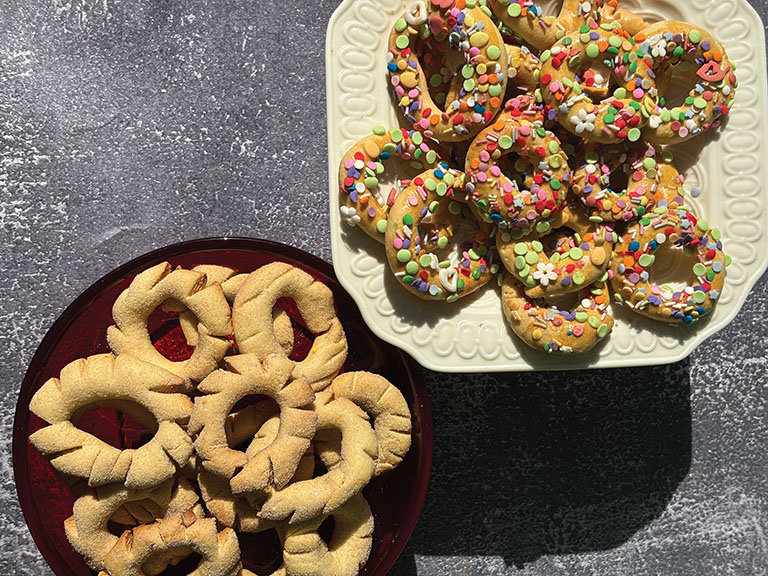
Biscochos (pronounced biz-ko-chos) are a slightly sweet, lightly flaky, crispy ring cookie. A favorite of the Ladino kitchen, the recipe for this traditional cookie dates all the way back to medieval Spain.

Each Sephardic community has their own twist on the recipe. Some form the dough into rings, then cut lines into the outer edges to make a decorative design, others twist them into a rope bangle. Some biscochos are dipped in cinnamon sugar, others are garnished with sesame seeds before baking.

In the spirit of Purim fun, Tarlan, Sharon and I also made Biscochos topped with festive colored sprinkles.

Tarlan really enjoyed learning about these cookies and she couldn’t wait to dip them in tea!

Purim Allegre!

—Rachel

Easy Date and Pecan Rolled Cookies

Dough

4 cups all purpose flour, sifted

1/2 cup powdered sugar

2 tsp baking powder

Pinch of salt

7 oz cold butter or parve shortening, cubed

1/4 cup avocado oil

2/3 cup orange juice

1 tsp vanilla

1/2 tsp orange zest

Filling

1 lb date baking paste

1 cup crushed pecans

1 tsp cinnamon powder

1 tsp extra virgin olive oil

In the bowl of a stand mixer, combine the flour, powdered sugar and salt. Add the chilled butter and beat slowly, until the mixture resembles coarse breadcrumbs.

Add the oil, orange juice, vanilla and orange zest, mix on a slow speed until dough is soft and sticky. Do not overwork the dough.

Wrap the dough in plastic wrap and chill overnight.

Preheat oven to 350°F.

Divide the dough into 3 equal portions. Roll one ball out on floured parchment paper into a thin rectangle. Spread an even layer of date mixture over the surface.

Use the parchment paper to roll the dough into a tight log. Transfer the log to a parchment lined baking sheet. Use a sharp knife to make shallow slits along the top of each log.

Repeat with the remaining dough.

Bake for 20-25, until the logs are a very pale golden color.

Make sure not to overbake, so that cookies remain soft and crumbly.

Dust warm cookies generously with powdered sugar. Let them cool for 10 minutes, then before slice fully through the pre-scored marks to make 1-inch cookies.

Notes:

Store cookies in an airtight container for up to 1 week at room temperature. Baked cookies can be frozen.

Nutella, halvah, pistachios or another filling of your choice can be substituted for the date filling.

Biscochos Recipe

4 eggs

1 cup sugar

2/3 cup oil

1 teaspoon vanilla

5 cups cake flour

2 tsp baking powder

2 tsp vanilla essence

Pinch of salt

1/4 tsp baking soda

Toppings

1/4 cup fine sugar

2 teaspoon cinnamon

Or

Color sprinkles

1 egg, beaten with 1/2 tsp water

Preheat oven to 350°F.

In a stand mixer, beat all the ingredients at slow speed until the dough comes together and forms a ball. (If dough is too sticky, add a few tablespoons of flour until it no longer sticks to fingers).

Place dough on a work surface and gently knead for about a minute, until dough is smooth and pliable.

Break off pieces of the dough and roll into walnut-sized balls. Take a ball and roll into a thin 4-5 inch strand, then close into a ring. Dip into the cinnamon sugar and place on a parchment lined baking sheet.

To decorate with sprinkles, brush the ring with egg wash, then drop sprinkles on top.

Bake biscochos for about 20 minutes, until firm and golden brown.

Remove cookies from the oven and allow to cool.

Lower oven temperature to 200°F.

Biscochar (crisp) the cookies by leaving in the oven for one hour.

Transfer to a wire rack and allow to cool. 


Sharon Gomperts and Rachel Emquies Sheff have been friends since high school. The Sephardic Spice Girls project has grown from their collaboration on events for the Sephardic Educational Center in Jerusalem. Follow them
on Instagram @sephardicspicegirls and on Facebook at Sephardic Spice SEC Food. Website sephardicspicegirls.com/full-recipes.

Favorite, Festive Purim Cookies Read More »