
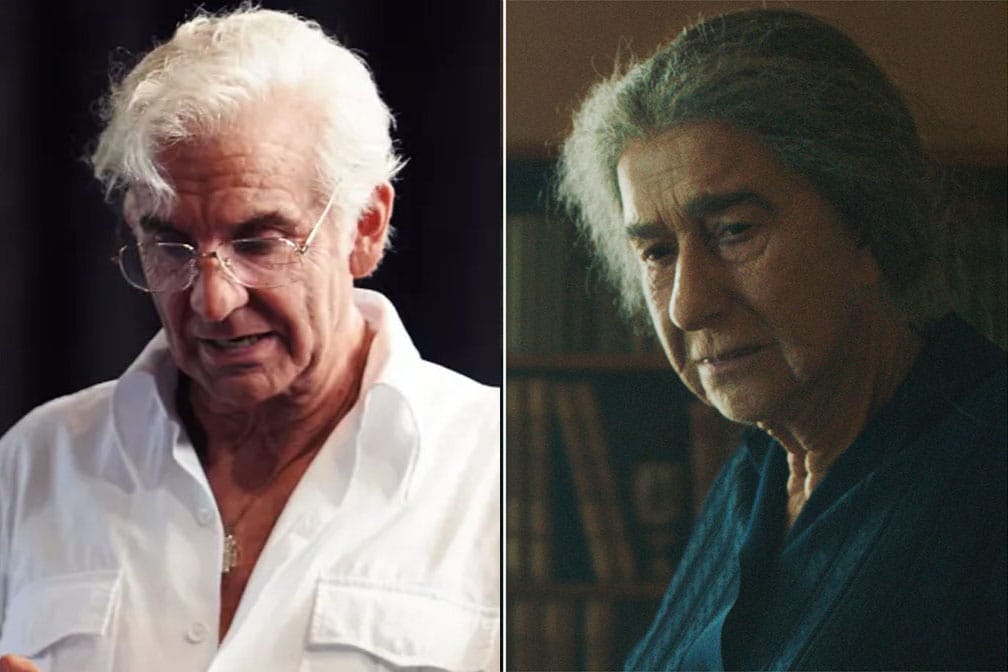
Right on cue, the Jewish Whiner Brigade has jumped on Bradley Cooper for his use of a prosthetic nose in his depiction of legendary composer and conductor Leonard Bernstein in the upcoming movie, “Maestro.”
Curiously, these serial kvetchers have hardly uttered a word about another non-Jew, Helen Mirren, who also had her nose accentuated in her depiction of Golda Meir in “Golda.” Maybe they saw or heard about Mirren’s extraordinary performance and decided it would be petty or shameful to attack her for playing a Jewish legend with such brio.
In any case, the whiners attacking Bradley are not waiting for the film to come out. They’ve seen his face and that’s enough.
“Hollywood cast Bradley Cooper — a non Jew — to play Jewish legend Leonard Bernstein and stuck a disgusting exaggerated ‘Jew nose’ on him,” the activist group StopAntisemitism said on X, in one of many examples of Jews lashing out at Cooper on social media.
Writing for The Independent, Noah Berlatsky criticized Cooper’s decision and said that using prosthetics “effectively turns Jewish people into their physical characteristics. It makes us caricatures.”
Some critics couldn’t even accept the endorsement of Cooper from Bernstein’s three children, who issued this statement on Instagram: “It happens to be true that Leonard Bernstein had a nice, big nose. Bradley chose to use makeup to amplify his resemblance, and we’re perfectly fine with that.”
“They may be ‘fine’ with that—but that’s part of the problem,” Malina Saval shot back in Newsweek. “Whatever their reasons for being ‘fine’ with it—internalized shame, self-hatred—their support of prosthetic noses sends a dangerous signal that spinning Jewish characters into caricatures is socially acceptable.”
Notwithstanding her unseemly speculation about the children’s motives, even if we grant some truth to that “dangerous signal,” Saval and other chronic critics have once again overlooked that spinning American Jews into a paranoid, thin-skinned, insecure bunch of scolds brings its own dangers.
For one thing, it reinforces the dangerous antisemitic stereotype of powerful Jews who love to throw their weight around any time something upsets them.
For another, it turns Jews from winners with a sense of humor into whiners with a self-righteous trigger. One of the best parts of the Jewish story in America has been our ability to give back so much to a country that invited us to partake in the American Dream. America turned us into winners, not whiners. Leonard Bernstein was one of hundreds of prominent Jews who contributed to American society across all fields, from science, art and literature to music, medicine, comedy and the fight for social justice.
So, when a famous non-Jew and Hollywood superstar like Bradley Cooper decides to tell the story of one of our prominent Jews, the least we could do is show him some gratitude and respect for his art.
We should never ignore the threat of antisemitism, but that doesn’t mean we should allow it to define us. I know from reliable sources that Bradley Cooper does not have an antisemitic bone in his body. It’s shameful to get on his case for playing the part of a great Jewish artist the best way he can.
One of the fallouts of the pervasive and ubiquitous “fight against antisemitism” is that it has come to dominate the Jewish brand in America. Our contributions to this amazing country go way, way beyond this fight. We’re grateful creators who want to help this country a lot more than indignant fighters who just want to help our own. Indeed, the Jewish value of gratitude itself should be one of our major contributions.
The Jewish value of gratitude itself should be one of our major contributions.
So, Mr. Cooper, if you read this, know that there are plenty of Jews out there who are grateful for your dedication to tell Leonard Bernstein’s American story, and we can’t wait to see the film.