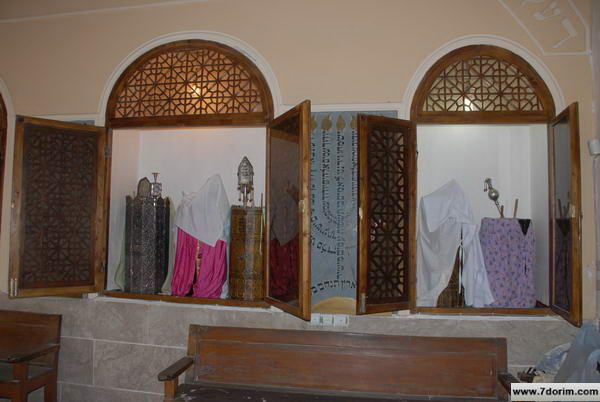
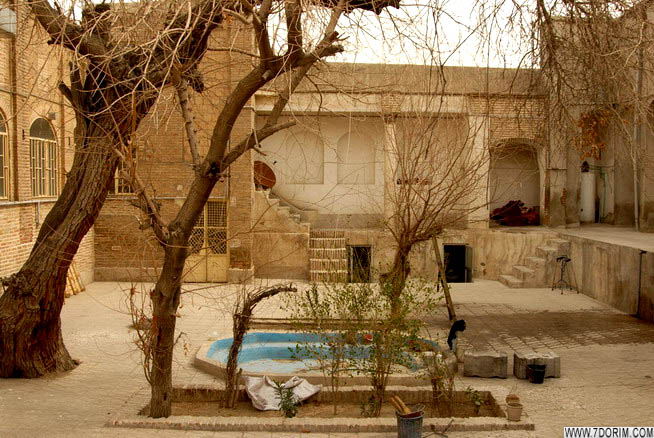
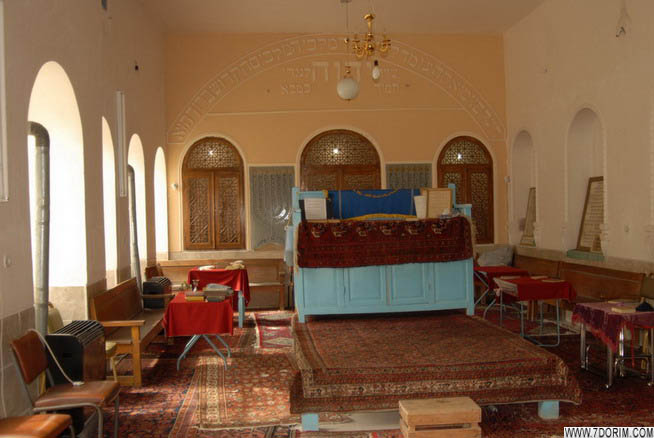
Iranian Jewish community leaders in the U.S. have confirmed reports that on Feb. 28 three antique Torah scrolls were stolen by unknown thieves from the centuries-old Ezra Yagoub synagogue located inside Tehran’s Jewish ghetto.
While the Iranian regime has not launched any official investigation into the incident and state-run media outlets have not reported on it, a statement released by the Los Angeles-based Iranian American Jewish Federation (IAJF) indicated that their organization is unaware of any specific motive behind the theft of the Torahs.
“The Iranian American Jewish Federation is deeply concerned and anxious about this incident and will be looking closely to learn the results of the investigation by the authorities and the law enforcement,” stated Susan Azizzadeh, president of the IAJF in the statement.
Shahram Yaghoubzadeh, chairman of the Iranian American Jewish Federation of New York, said his group “hopes that the governmental authorities in Tehran will do the right thing and use their vast intelligence and power to ensure the apprehension of the perpetrators and return of these sacred scrolls to the synagogue”.
The modest synagogue which is a little more than 500 square feet was established 125 years ago after an affluent Jewish merchant Ezra Yagoub bequeath funds for the formation of the synagogue at his deathbed. Likewise, the synagogue’s Torah scrolls are from the same time period and encased in ornate wood and metallic cases with metallic ornaments on top called “rimonim”.
According to Habib Levy’s book “Comprehensive History of the Jews of Iran: The Outset of the Diaspora” (Mazda Publishing, 1999), during the 1930s the Ezra Yagoub synagogue briefly housed Jews who had fled Afghanistan and the Iranian city of Mashhad when travel in route to make Israel their final home. Iranian Jewish activists in Los Angeles said the synagogue also temporarily housed Jews who had fled Nazi-controlled Poland during WWII.
Additionally, Iranian Jews in Los Angeles and New York said the synagogue was in full use up until 60 years ago when Jews gained great freedoms as well as wealth which prompted them to moved out of the Tehran’s Jewish ghetto during the Pahlavi dynasty. Since that time and until today the synagogue has been maintained by members of the Tehran Jewish Committee as a historic Jewish site.
Iranian Jewish leaders in L.A. said in recent years, Parviz Yeshaya, the former national chairman of the Jewish Council in Iran, has only kept the synagogue open for Saturday services for small groups of Jews visiting Tehran from other Iranian cities.
Prior to the 1979 Islamic revolution, nearly 80,000 Jews lived in Iran and thousands during the last 40 years have left or escaped the country due to threats to their lives as well as bias laws against religious minorities living in Iran.
Leaders in Iranian Jewish communities in Southern California and New York have remained mostly quiet about the theft of the three antique Torahs for fear that what they say may be used as an excuse by the Iranian regime to retaliate against the estimated 5,000 to 8,000 Jews still living there.
Yet individual Iranian American Jewish activists said they are speaking out against the regime. Activists maintain that the Iranian regime’s officials have repeatedly claimed to be tolerant and benevolent to Iran’s Jews to Western news media outlets, but in reality, have turned a blind eye to recent incidents of vandalism of Jewish sites in Iran and appropriation of historic Jewish burial grounds throughout Iran.
“The condition of the Iranian Jewish community should also be watched carefully and incidents like this should not be taken lightly”, said George Haroonian, an Iranian Jewish activist based in Los Angeles.
Haroonian said many Iranian Jews in America are concerned that their brethren in Iran are in danger because of the escalating conflict between Israel and Iran’s terrorist proxies in the region.
“With the worsening of the political situation between Israel and Iran– such as in Syria, Lebanon and the Palestinian territories, our community is an easy target for direct or indirect attacks and harassment,” Haroonian said. “The regime and its adherents may extract revenge on Iran’s Jews for the losses of the regime in Syria”.
The theft of the Torahs from the Ezra Yagoub synagogue is just the latest incident against Iran’s Jewish community. In late December 2017 two synagogues located in the southwestern Iranian city of Shiraz were vandalized by unknown assailants who left a total of five Torah scrolls and numerous prayer books damaged or totally destroyed. Likewise, Tsedaka charity boxes were also stolen from the synagogues. The incident was never investigated by the regime’s authorities and no arrests were made in connection with the crime.
Moreover, in November 2012, Toobah Nehdaran, a 57-year-old married Jewish woman, was strangled, then repeatedly stabbed to death, and her body was mutilated in a ritual manner by thugs who had broken into her home located inside the Jewish ghetto within the Iranian city of Isfahan. Nehdaran’s gruesome murder was never investigated by Iranian authorities and suspects were never arrested in connection with her murder.
Also in January 2011, the Iranian student Basiji militia, of the Abu-Ali Sina/Avicenna University in the western Iranian province of Hamadan rioted outside the entrance of the Esther and Mordechai tomb and threatened to destroy it if Israel destroyed the Al-Aqsa mosque in Jerusalem. The Iranian state-run media news reported at that time that Basiji militia had removed the mausoleum’s entrance sign, covered the Star of David at the mausoleum’s entrance with a welded metal cover and demanded the site be placed under the supervision of the local Islamic religious authority. In the end the tombs, were not damaged nor destroyed.
Calls for comment to the Permanent Mission of the Islamic Republic of Iran to the United Nations in New York were not returned.