fbpx

March 20, 2019

Rosner’s Torah Talk: The Megillah with Rabbi Jill Jacobs

Rabbi Jill Jacobs is the Executive Director of T’ruah: The Rabbinic Call for Human Rights. She is the author of Where Justice Dwells: A Hands-On Guide to Doing Social Justice in Your Jewish Community and There Shall Be No Needy: Pursuing Social Justice through Jewish Law and Tradition.

This week we speak about Purim and the story of the Megillah. Is Esther a feminist, should we feel uncomfortable about Jews killing their enemies, is the King a villain?


And… don’t miss Rosner’s Podcast with Rabbi Mishael Zion, on The Book of Esther – A New Israeli Commentary.

Rosner’s Torah Talk: The Megillah with Rabbi Jill Jacobs Read More »

N.J. School Athletic Director Sorry for Calling Hitler ‘Good Leader’

An athletic director at a New Jersey high school apologized on Tuesday for calling Adolf Hitler a “good leader” in a presentation.

Joe Piro, the athletic director of Nutley High School in Essex, New Jersey, gave the presentation at a Madison High School assembly on March 16 about unity and leadership, which featured a slide of pictures of Martin Luther King Jr. and Hitler together. Piro issued an apology over the matter.

“My intentions during the presentation were to make a point that a leader could have strong leadership skills and influence people in a negative way,” Piro said. “As a 20-year educator who has worked with a wide variety of students that come from very diverse and unique backgrounds, I fully understand and recognize that Adolf Hitler was an evil man who acted in a horrific manner.”

Piro added that he would remove the Hitler reference from future presentations.

In a March 17 letter to parents, Madison High School Superintendent Mark Schwarz wrote, “It was unnecessarily provocative and insensitive for the speaker to include the image of a criminal whose legacy includes the systematic torture and slaughter of millions of Jews, the disabled, and others in Eastern Europe.”

“If the speaker intended to highlight an example of an effective leader with misguided intentions, a less emotionally-charged example would have been more effective and appropriate,” Schwarz said.

Schwarz added that the school would vet any presentations from outside speakers going forward.

Julie Glazer, the superintendent of Nutley Public Schools, called Piro’s Hitler reference “insensitive” in a statement.

“We believe in using this incident as an opportunity to highlight cultural responsiveness and sensitivity within our schools, curriculum and community,” Glazer said.

A spokesperson for the Nutley district declined to comment to The Daily Caller when asked if they would discipline Piro.

N.J. School Athletic Director Sorry for Calling Hitler ‘Good Leader’ Read More »

Wiesenthal Center Asks Rep. Omar to Condemn Imam In Her District Who Spoke on ‘Zio’ Agenda’

Simon Wiesenthal Center Associate Dean Rabbi Abraham Cooper called on Rep. Ilhan Omar (D-Minn.) to condemn an imam in her district who preached against a “Zio-Crusader agenda” in a recent sermon.

The Middle East Media Research Institute (MEMRI) reported that Imam Shaaban Aboubadria said in a March 15 sermon at the Minneapolis Masjid Al-Huda Islamic Center that Egyptian President Abdel Fattah Al-Sisi is “carrying the Zio-Crusader agenda.” The term “Zio” is an anti-Semitic slur that has been popularized by former Ku Klux Klan Grand Wizard David Duke.

Throughout history, he has been carrying out the agenda of the Zionists, and the agenda of the tyrannical and criminal Templar Crusaders, and yet he claims to be a Muslim,” Aboubadria said.

Aboubadria also reportedly said that “Western civilization is built on shedding blood, killing, and terrorism.”

“Who is the one that is killing Muslims in Syria? Isn’t it Russia? Are the Russian planes dropping chocolate on the innocent and unarmed civilians? Or are they dropping lethal and destructive incendiary bombs on them?” Aboubadria said. “And what about the bombs that criminal Israel is dropping on Gaza… we went to sleep with the bombing of Gaza, and woke up with the crime in New Zealand.”

Cooper told the Journal in a statement via email, “Congresswoman Omar will be in Southern California this Saturday and Sunday to speak at a CAIR [Council for American Islamic Relations] event and appear at a fundraiser on her behalf. This week, The Washington Post published an op-ed bearing her name trying to step away from her virulent anti-Israel and anti-Semitic rants.”

“Congresswoman Omar, now is the time to let your constituents and concerned Americans know whether you condemn or endorse these views delivered to your community from the pulpit of a Minneapolis mosque,” Cooper said.

Omar will be speaking at a CAIR-LA banquet at the Woodland Hills Hilton hotel on March 23. The congresswoman’s office did not respond to the Journal’s requests for comment.

Wiesenthal Center Asks Rep. Omar to Condemn Imam In Her District Who Spoke on ‘Zio’ Agenda’ Read More »

Pompeo: ‘We Are Committed to Israel’s Security and Its Right to Self-Defense’

Secretary of State Mike Pompeo met with Israeli Prime Minister Benjamin Netanyahu on March 20 and re-iterated the United States’ commitment to protecting Israel.

The Jerusalem Post reports that Pompeo said in a joint press conference with Netanyahu, “With the threats of annihilation that Iran is making against Israel, we are committed to Israel’s security and its right to self-defense. With rocket threats from Gaza and threats from the North, we are proud to stand by your side.”

Netanyahu voiced his appreciation for the United States’ support, especially when it comes to Israel’s efforts to combat Iran, touting the Trump administration’s decision to leave the Iran nuclear deal.

There is no limitation to our freedom of action and we appreciate very much the fact that the United States backs up our actions,” Netanyahu said.

Netanyahu also urged Pompeo to recognize Israel’s sovereignty over the Golan Heights, arguing that without Israel’s presence in the Golan, Iran would be “on the shores of the Sea of Galilee.” While Pompeo didn’t comment on the matter, according to the Associated Press, the Trump administration is expected to announce Israel’s sovereignty over the Golan next week. Netanyahu will be visiting the White House on March 25 and 26.

Pompeo is not expected to meet with other Israeli prime minister candidates while he is in the country. Israel’s Knesset election is April 9.

Pompeo: ‘We Are Committed to Israel’s Security and Its Right to Self-Defense’ Read More »

The Whole Megillah

A wise biblical literature professor of mine frequently reminded us, “If anyone ever read this, they’d ban it.” It is both a hilarious and poignant statement that I find myself thinking about as I get ready for my favorite holiday of the year, Purim. Like most Jewish kids, I grew up with the pretty tame Purim story, usually acted out by the synagogue clergy and staff in a schmaltzy shpiel. As I grew older I eventually read “The Whole Megillah” and understood not only the meaning of that phrase, but how the Book of Esther is anything but tame.

Let us start with the most obvious—King Ahasuerus was an idiot who partied too much. Three years into his reign, he threw a party for his servants for one hundred and eighty days and then another one the people of Shushan for a week after that (Esther 1:4-5). Essentially, he partied for six months and did so while his showing off his gold and silver. As if that was not enough, he then orders Vashti to come before his friends so he can show off how beautiful a queen he has. What exactly is meant by her refusal to “show the peoples and the princes her beauty” (1:11), as well as her being banished from the kingdom, are matters of numerous interpretation, but she clearly stood up for herself and refused to be made a mockery by blindly obeying her husband. A feminist way ahead of her time! Why then is Vashti not regarded with the same heroism as Esther? Did I miss that part of the shpiel?!?!

One could argue that Ahasuerus was merely drunk or living as a king would in that time period, but then along comes Haman (shake those groggers!) and Ahasuerus’ blind approval to annihilate the Jewish people (chapter 3). Unlike Vashti, Ahasuerus does what he is told without a second thought. So not only should we be celebrating Vashti (and Esther, of course!), but we should also remind ourselves to NOT be like Ahasuerus, showing off our wealth, expecting others to blindly do what we tell them and in return, not participating in something without stopping to truly understand what it is we are doing. To say nothing of the later violence and commentary about the sexual innuendos regarding what happened when Esther appeared before the King. This is obviously not a part of Jewish education for young children!

To be fair, children should probably not be taught the “Whole Megillah” as described above. However, I do believe there are critical messages all ages can get from the story of Purim:

  1. Stand up for what you believe is right. Whether it is protecting your individual honor and dignity (Vashti) or that of your people (Esther) or just not standing idly by while someone else is made to suffer (don’t be like Ahasuerus!), be like the two feminine heroines of the story.
  2. Be proud of who you are. Being a minority is difficult, but we should all remember the strength of Esther, Moses, Judah Maccabee and Jewish martyrs throughout history who embraced their Judaism and gave us the freedom to put on those ridiculous costumes we will wear tonight.
  3. A recent article from the Jewish Telegraphic Agency (JTA) also parallels Esther’s coming out as a Jew to those in the LGBTQ community. The costumes serve as a metaphor for hiding one’s true identity with the hope that after the holiday is over, they will be shed and one’s true identity will be unmasked.

Finally, I would be remiss if I did not note that tomorrow is also a joyous holiday for our Hindu friends, Holi. While sharing a calendar date, it is also remarkable how much these two holidays share in common. Like Purim, Holi celebrates the victory of good over evil and is celebrated with great joy (colors and bonfires). It is a celebration of spring and a time to relax and be with friends.

So as those in the Jewish and Hindu communities celebrate tonight and tomorrow, I think it is important to continually note we are more alike than different and all can come together to celebrate the good in the world. It sure is a lesson we all need now, no matter how old or how young we are.

Hag Sameach!


Lisa Rothstein Goldberg is a social worker and Jewish educator, currently working at Ivy Tech Community College in Sellersburg, Indiana. She and her husband, Matt, JCRC Director in Louisville, live in Louisville with their two young daughters.

The Whole Megillah Read More »

Rep. Adam Schiff Discusses Israel at Temple Emanuel

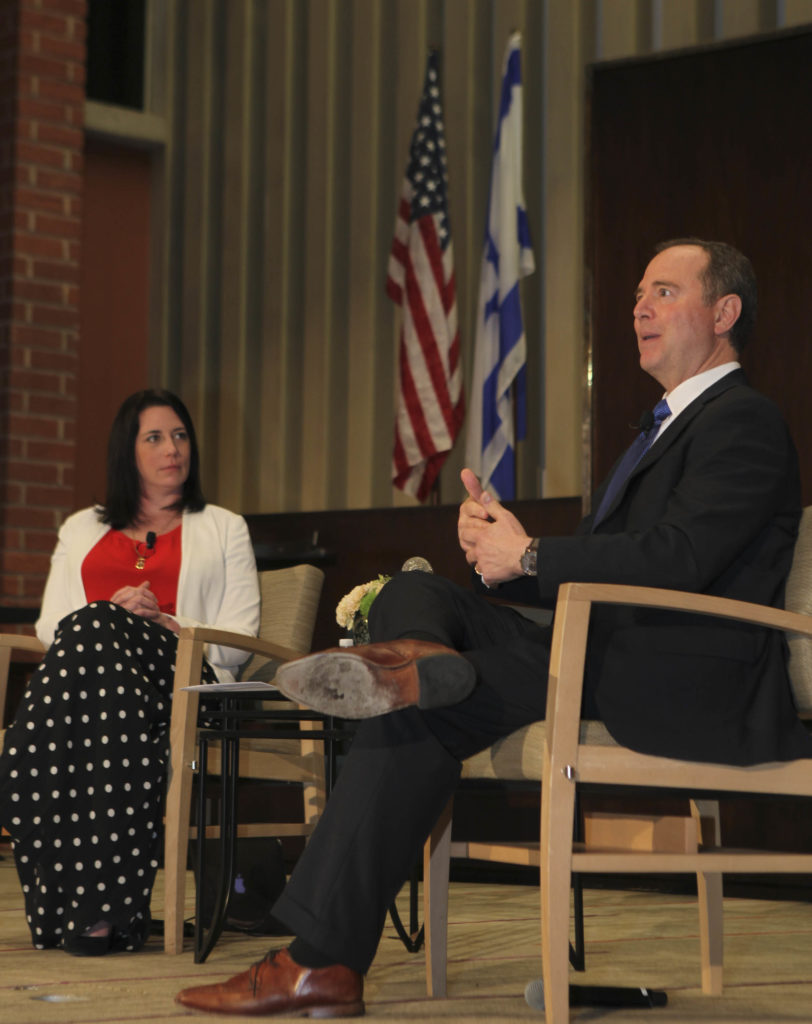
Although many view Democrats as having turned away from Israel, Rep. Adam Schiff (D-Burbank) has been a consistent voice of support for the Jewish state. “The Jewish state is held to a completely different standard than any of its neighbors,” the Jewish congressman said during a March 19 discussion at Temple Emanuel of Beverly Hills (TEBH) with TEBH Rabbi Sarah Bassin.

Schiff represents California’s 28th district and chairs the House Intelligence Committee, which is investigating possible collusion between President Donald Trump and the Russians during the 2016 presidential election campaign. During the Trump presidency, Schiff has become one of the most prolific faces in the Democratic Party.

Thus, the night of his appearance, people turned out in droves at the Beverly Hills synagogue to hear the 58-year-old congressman. Closed-circuit TVs were set up near the rear of the sanctuary for those seated far from the bimah as Bassin kicked off the evening by highlighting her synagogue’s advocacy efforts around anti-gun violence. Speaking about the recent mass shooting at the mosques in New Zealand, she asked Schiff his thoughts about the epidemic of gun violence.

Schiff said the United States was reaching a “tipping point” regarding gun policy thanks in part to the activism of the Parkland, Fla., students who experienced a mass shooting in 2018 resulting in 17 deaths.

Would that lead to gun safety legislation passed by the U.S. House and the Senate and signed by the president? Schiff said he could only hope so.

“I refuse to accept this is the best we can do,” Schiff said.

During the wide-ranging conversation, Schiff spoke about the dramatic changes social media have brought on society, not all positive. He compared the advent of the internet to the printing press, adding that people’s ability to have access to instantaneous information from their phones, coupled with social media, have had “unintended consequences,” including contributing to a society where “lies travel far faster than truth.”

He was speaking, of course, from personal experience. In his role on the House Intelligence Committee, Schiff has investigated how the Russians have used the internet to spread misinformation and sow division in the U.S.

The current world is one of “deepfakes,” he said, where the tech-savvy can take someone’s face, place that person in a video and have that person make statements they never said. For an outsider, it would be nearly impossible to distinguish between real and fabricated, he said.

“There is no easy fix for this,” Schiff said.

He spoke about global authoritarianism and dangers posed by Syrian President Bashar Assad, Philippines President Rodrigo Duterte and Turkish President Recep Tayyip Erdogan.

“The very idea of liberal democracy around the world is at risk,” Schiff said.

And Trump hasn’t done his part to remind the world that the U.S. is a force of good against evil, Schiff said. He expressed some of his deepest frustrations not with the president, however, but with the Republicans who haven’t taken a stronger stance against Trump.

“I think when this chapter of history is written, some of the most damning language will be for Republicans who did nothing when democracy was under attack,” Schiff said.

Asked by Bassin what message Schiff would like from the Democrats in the 2020 presidential election, Schiff spoke about the economy. He said that although employment figures are strong, people are not earning enough to keep up with the high cost of living.

The audience’s reception to Schiff was warm, with Bassin frequently reminding them to hold their applause until the end of the event — outside the synagogue, however, not so much. As people waited in line to enter the synagogue for the discussion, a protest of about 20 people on the opposite side of the street denounced Schiff’s stance on child vaccinations.

“Vaccines are not kosher,” a sign plastered to the side of a parked car said.

Recently, Schiff urged Google, Facebook and Amazon to remove content from their platforms promoting misinformation about vaccinations. He has also introduced a resolution in the U.S. House declaring that vaccinations save lives.

Bassin denounced the protestors at the start of her discussion with Schiff. She said that although Judaism values minority opinions, those who deny their children vaccinations are wrong.

Schiff took a more humorous approach, saying he was accustomed to demonstrators targeting him for his positions.

“I’m trying to branch out from the pro-Trump people who picket me often,” he said.


Rep. Adam Schiff Discusses Israel at Temple Emanuel Read More »

Hollywood Writer Michael Tolkin on Judaism, Awards and Global Warming

Hollywood filmmaker and novelist Michael Tolkin, 68, has won a slew of awards for his work. His 1992 adaptation of his novel “The Player” won the Writers Guild Award, the BAFTA Award for Best Adapted Screenplay, the PEN Center USA West Literary Award, and the Edgar Allan Poe Award for Best Crime Screenplay and was nominated for an Oscar.

Not one to rest on his laurels, more recently he’s been a consulting producer and writer for the Showtime series “Ray Donovan,” and co-wrote the 2018 Showtime limited series, “Escape at Dannemora.” 

Born Moredchai Leib Tolchinsky, Tolkin’s late father, Mel Tolkin, was one of the great TV comedy writers. His mother, Edith, was a film executive and a lawyer.  The apple didn’t fall far from the tree. 

Of his prolific and diverse body of work, Tolkin said, “My subjects seem to choose me. ‘The Player’ started as a joke: A studio exec is killing writers who have pitched to him but nobody suspects there’s a serial killer because everyone in the city has a screenplay in the drawer.”

Howard Rosenman: Was being born into showbiz aristocracy an advantage or a hindrance? 

Michael Tolkin: My father worked steadily from 1948 until 1980, and went from sketch comedy to sitcom to writing one-liners for Bob Hope and then back to situation comedy on “All in The Family.” So I had the advantage of seeing the need to keep up with the times.

HR:  How does your Jewish background and values impact your work?

MT:  There’s the art of Jews, a cultural expression, and the art of Judaism, which is to say that Philip Roth may write brilliantly about Jews, but he knows nothing of the religion. My third novel, “Under Radar,” asks and answers a question that I thought of as essentially Jewish: After you’ve made teshuvah and done your best to repair the damage you’ve done to the world, what remains still broken?

HR: What was your Jewish upbringing like? 

MT: My mother’s Romanian parents grew up in homes where the piety was drained of joy, and once married, never practiced. My father survived pogroms in the Ukraine, hiding in the cellar for three days. His parents were nominally Orthodox but passed nothing on to him. My mother never went to a seder until after I was born. When I was eight — we were living in Westchester, New York — I got beaten up by a neighborhood friend who must have been recently dosed with Jew hatred by his father, and after that my mother sent me to a synagogue for a little bit of Hebrew school. I liked the atmosphere. 

We moved to LA, and we joined Temple Emanuel. After my Bar Mitzvah I was confirmed there, in a terrific program, so I had a good basic affectionate connection. In the early ’90s I was one of many wandering Jews who found his way back to Shabbat in Temple, and over the years had the privilege of studying with many great rabbis and teachers, across the spectrum. Of particular importance in those years were Rabbi Mordechai Finley of Ohr Hatorah, and Rabbi Daniel Landes at B’nai David Judea. I took a weekly study class with him there. I’m not Orthodox but I came to love the traditional liturgy.

HR: Your wife, Wendy Mogel, is also a well-known writer. How did you meet? 

MT: Wendy and I met at Bard College, and then I followed her to Middlebury College in Vermont, when she transferred. Her first book, “The Blessings of a Skinned Knee,” translated Jewish parenting wisdom into an approach that has been accepted from Beijing to every major city in the country. 

HR: What are your political views on the current state of America?

MT: Someday soon, in 100 years, the fact of irreversible global warming will be undeniable. The latest projection is that the insects are disappearing and will be gone in a hundred years. With that, the food chain is destroyed; crop propagation is destroyed. We’re told that at Sinai, where we all stood together, the mountain of history was held over our heads and we were told to accept it or perish. Right now the mountain is being held over our heads again, in the ice melt that flows from the glaciers into the oceans. Either we accept this truth and work to globally react to the danger, or condemn our descendants to the hell we already feel in global migration pressure. 

This is my un-coy way to say that the energy spent on fighting the political, theological, territorial and ethnic battles of our time is going to look like insane vanity.  To those who say that the scientific consensus is a fraud, I can only respond: “Where is the evil in prudent caution when the consensus of the experts is against you?” And in what way is that caution not Jewish? Despair is antithetical to Judaism, so I choose hope but not optimism.

HR: What does the future hold for you?

MT: “Escape at Dannemora” was a great success and, as Gary Cooper said about longevity in Hollywood, “One out of three keeps the bicycle wheels turning.” My father’s last words, at age 93, were perfect for a writer: “I have no more ideas.” I still have them.


Howard Rosenman has produced more than 43 movies, including
“Call Me by Your Name.” He founded Project Angel Food. 

Hollywood Writer Michael Tolkin on Judaism, Awards and Global Warming Read More »

Five Crafting Tools that Changed My Life

March is National Craft Month, everyone! It’s hard for people to imagine, but I haven’t always been a crafter. Growing up, I was more into academics than art. And when I began my career in advertising, I was a market researcher, and then a writer — but never a designer. It wasn’t until I bought a house and began decorating it that I got to flex the artsy part of my brain. 

I took a do-it-yourself approach to decorating, but I still didn’t dabble in crafts per se until I started my show “Style With a Smile,” which aired on YouTube as well as the Home+ network in Israel. For the show, I had to come up with easy arts and crafts projects that anybody could do. Now I consider myself more of a crafter than a decorator. 

Part of the fun of being a crafter is shopping for supplies. It’s tempting to buy everything you see at the crafts store, especially when you have 40 percent-off coupons, but I wanted to share with you the crafting game changers that have really made a difference for me. Some may already be part of your arsenal, while others may be unknown to you. 

Die Cutting Machine
If you are not familiar with die cutting, it is a process in which you can cut out the same shapes over and over again perfectly without using scissors or knives. Think of the dies as the crafting equivalent of a cookie cutter. The way it works is there are dies for practically any shape — simple ones like circles or squares, but also complex ones like three-dimensional boxes — and you run the die through the die cutting machine with paper, and the machine cuts out the shape. Say, for example, you are a teacher who needs to create multiple menorah shapes for a Hanukkah card-making class. You start with a menorah-shaped die (yes, they sell them), place it in the die cutting machine with paper, and crank the handle. Out comes a perfectly cut menorah. The die cutting machine I use is the Sizzix Big Shot, and Sizzix manufactures a huge assortment of dies in every conceivable shape.

Scoring Board
If you make homemade cards, the Martha Stewart Scoring Board helps you make perfect folds every time. I know you’re thinking, “Why do I need a tool to fold paper?” With a scoring board, your folded lines will be crisp and flawless. There’s also a ruler built into the board so you can get exact measurements. I find the scoring board to be particularly useful when doing accordion folds. 

Sewing Machine
I am horrible on a sewing machine. I freak out whenever I need to change the bobbin or thread the needle, and I can do only a straight stitch (no zippers or buttons, please). But my basic knowledge is good enough to help me with most simple home décor and fashion projects. To reduce the intimidation factor, I have this cute orange sewing machine made for beginners like me. It goes only one speed (super slow-mo), and I actually appreciate that limitation.

Joe’s Sticky Stuff
I found out about Joe’s Sticky Stuff when I hosted a web series for Disney, and the set decorators used it on many tasks, ranging from mounting signs on walls to attaching decorative patches to my clothing. It works like a super-sticky double-sided tape, except it has a thick, gummy consistency. What I love about it is that it provides a strong adhesive bond, but is also removable. For holding pieces in place temporarily, it’s perfect. But the hold is so strong that I often just leave the sticky stuff on my projects and it stays there for good.

Xyron Creative Station
When applying an adhesive coating to the back of paper, I used to use spray mount. Glue sticks aren’t very reliable, and liquid glue makes the paper lumpy, and I liked how spray mount gave me a nice, even coating of adhesive. But if you’ve ever used spray mount, you know it gets everywhere — including your lungs. I looked all around for an alternative solution and was delighted to find the Xyron Creative Station. It puts a sticky back on any piece of paper. The nine-inch Creative Station will accommodate a standard piece of letter-sized paper.  

Five Crafting Tools that Changed My Life Read More »

Hal Blaine, Wrecking Crew Drummer, 90

You might not know the name Hal Blaine, but you’re probably familiar with his work. Blaine, who was Jewish and died March 11 at the age of 90, was the drummer for the fabled Wrecking Crew, a collection of first-call Los Angeles session musicians who played on some of the biggest hits of the 1960s and ’70s.

He is credited with playing on more than 35,000 songs, including more than 150 top-10 hits, of which 40 reached No. 1. That list includes the Beach Boys’ “I Get Around” and “Good Vibrations”; Simon and Garfunkel’s “Mrs. Robinson”; the Byrds’ “Mr. Tambourine Man”; and Frank and Nancy Sinatra’s “Somethin’ Stupid.”

Blaine would be assured a spot in music history if only for four notes — the “Boom Ba-boom POW” that kicks off the Ronettes’ 1963 classic “Be My Baby.” According to Blaine, that famous lick resulted from an accident during a rehearsal, when he dropped a stick and added an extra beat. “One of the things you learn is that when you make a mistake, if you do it every four bars, it becomes part of the song,” he once told the Percussive Arts Society. It’s a mistake that’s been imitated by drummers for more than 50 years.

Hal Blaine was born Harold Simon Belsky on Feb. 5, 1929, in Holyoke, Mass., the son of Russian Jewish immigrants Meyer and Rose Belsky. In 1936, the family moved to Hartford, Conn., where Blaine became interested in the drums after watching the fife and drum corps at the Roman Catholic school across the street from his Hebrew school. He was soon drumming with that band. 

When he was 16, Blaine dropped out of high school to join the Army, where he was assigned to the band. He was so proficient that Pfc. Blaine was soon drumming in the officers band. After his discharge in 1948, he moved to Chicago and began studying with Roy C. Knapp, who was also Gene Krupa’s teacher. To supplement his income, he started playing club dates around town. He moved back to California, where he landed jobs in jazz bands backing singers such as Tommy Sands, and occasionally filled the drum seat in the Count Basie Orchestra. 

“May he rest forever on 2 and 4.” — Blaine family

But it was in the studio where Blaine found his true calling. A quick study who could sight-read music charts, he set himself apart from his jazz and big band contemporaries in his acceptance of pop and rock music. He became part of the group of musicians who made up record producer Phil Spector’s “Wall of Sound.” Blaine claimed to have first called the group the “Wrecking Crew” because the older, more conservative musicians believed the younger, informally dressed players — who included Glen Campbell and Tommy Tedesco on guitar, Carol Kaye on bass, and Leon Russell and Larry Knechtel on keyboards — would “wreck the business.”  Blaine was especially in demand because of his versatility and his ability play a song perfectly from the first take.

Blaine’s personality also might have been a factor in his successful career, Michael Ackerman, an entertainment lawyer and drummer told the Journal. He met Blaine in 1992, when they bonded over “drumming and bad divorces,” and Blaine “was funny and such great company,” Ackerman said. 

By the mid ’70s, session work was dying out, and Blaine found work on commercials and TV, where he played on theme songs for shows such as “The Brady Bunch” and “Three’s Company.” Married and divorced five times, by the 1980s he was forced to make a living as a security guard. Danny Tedesco’s 2014 documentary on the Wrecking Crew helped bring some recognition, and Blaine became a regular at trade shows. 

Declining health led him to curtail his public appearances, although he did make an appearance at a concert in honor of his 90th birthday. As he explained to Ackerman in one of his all-caps emails, “I HATE TO DISAPPOINT FOLKS WHO WANT A MEET AND GREET BUT I SEEM TO HAVE LOST MY YOUTHFUL STAMINA… GO HOLLER AT FATHER TIME!!”  Even so, he ended the message on a positive note: “KEEP ON SMILING !!!” 

He is survived by his daughter, Michelle Blaine, and seven grandchildren.

Announcing the death on his Facebook page, his family wrote, in reference to the common four beats per measure: “May he rest forever on 2 and 4.”

Hal Blaine, Wrecking Crew Drummer, 90 Read More »

A Man’s Search Leads Back to His Flock

Nathan Englander was born and raised in an Orthodox community in New York, but he reinvented himself as one of America’s leading Jewish authors (“For the Relief of Unbearable Urges” and “What We Talk About When We Talk About Anne Frank,” among other works) by writing about the points of friction between religious practice and secular life. And that’s exactly what is going on in his latest novel, “Kaddish.com” (Knopf), a sharp-edged and slyly comic account of a Jew who finds himself bouncing back and forth between the many competing versions of contemporary Judaism.

The story he tells in “Kaddish.com” focuses on a young man named Larry. Like the author, Larry is no longer observant; he embraces “Zazen mindfulness” and various other beliefs and practices that his father dismisses as “narrishkeit and bunk stuff,” but he’s also a kind of updated Portnoy, searching the internet for “the world’s filthiest filth.” As an advertising man, he spends his days “selling junk” and his nights “trying to catch an STD.” 

When his father dies, Larry dutifully sits shivah in his sister’s home in Memphis, Tenn., but he is so estranged from the traditional obligations of a son in mourning that “he keeps raising his hand to the top of his head, checking for the yarmulke, sitting there like a hubcap for all its emotional weight,” as Englander puts it. But the weightiest challenge is the duty of an only son to say Kaddish eight times a day for a full year. “Tell me you get that the Kaddish is on you,” warns his older sister, Dina.

Dina is dubious that Larry will carry the burden, and she turns to her rabbi in despair. “Fix it, Rabbi,” Larry says. “Let’s see what you’ve got.” The rabbi, in fact, comes up with a solution: “You could assign a kind of shaliach mitzvah — like an emissary. A proxy to say it in your stead.” And Larry “begins googling his way toward a solution for all that ails,” quickly finding his way to kaddish.com, “a website based in Jerusalem, and behind that website was a yeshiva, and behind that place of study was a group of deeply committed students who — for a fee — would say the Mourner’s Prayer.” As Englander jokes, kaddish.com “was like a JDate for the dead.”

Thus does Englander invite us to follow Larry down the rabbit hole into a series of comic and tragic encounters with Judaism. “I do not share the story to brag, or show off, or even to make excuses for all the years of lost time,” Larry is made to muse out loud. “I only share it to say, it’s never too late to live one’s true life.”

“What Shuli finds — and what he does — will come as a shock to the reader, a blow to the heart that leaves a lump in the throat.”

Larry’s true life, or so he believes, is his old life. He adopts his Hebrew name and returns to the study of Torah and Talmud, and we come to see him as Rebbe Shuli, a charismatic rabbi and teacher. But even so, “all his years of t’shuvah, a lifetime of redemption had … done nothing.” Suddenly, and shatteringly, he plumbs the depth of the deal he had made so many years ago when he signed up at kaddish.com. “Shuli was living a ghost life,” Englander writes. “After all the years of teaching and outreach, all the effort dedicated to t’shuvah, it was as if he’d been saving money for twenty years only to find that he’d been depositing it into someone else’s account.”

Larry — or Shuli, as we now know him — finds himself tortured by his memories of Chemi, the yeshiva student who had been assigned by kaddish.com to say the Mourner’s Prayer for Larry’s father. He is no less tortured by the plight of one of his students, a boy named Gavriel, who is also troubled by the duty of saying kaddish for his late father. Between these two sources of affliction, Shuli is confronting yet another crisis. “Gavriel is the one to tip you over,” warns Shuli’s wife, “but I’ve watched, for too long, as you teeter on the edge.” Yet it is Gavriel, an expert in navigating the internet, turns out to be Shuli’s savior: “Here, it all waits to be plucked out of the air by a child.”

Now Shuli experiences yet another revelation. “Shuli recognizes the source of it all,” Englander writes. “The flashes of pure energy through cables under the ocean, soaring up, and making their way to satellites turning in the heavens. All the world’s understanding transformed into waves of light and sound, to modulated impulse and frequency, everyone’s deepest desires broadcast in an ever-expanding and invisible net.” It is the internet, “a singular Godlike mind,” that holds the answer to Shuli’s quest for meaning and connection.

At the climax of Englander’s book, we follow Shuli to Jerusalem, where he hopes and prays to find Chemi. “He watches everyone darting about with their plastic shopping bags, filled with hippy-dippy Tzfat candles, and DON’T WORRY AMERICA, ISRAEL’S GOT YOUR BACK T-shirts, and candy bars with Hebrew names,” Englander writes. “If he was going home without the one thing he’d come for, at least he should bring gifts.” What Shuli finds — and what he does — will come as a shock to the reader, a blow to the heart that leaves a lump in the throat.

“Kaddish.com” is funny but also profound, a saga of spiritual transformation that is deeply rooted in Jewish thought and practice. Englander seeks to explain the real function of religious observance. “This is what ritual does,” Larry/Shuli says. “It binds us from chaos.” Amid the chaos in which we all live nowadays, “Kaddish.com” is a bright light in a dark world.


Jonathan Kirsch, author and publishing attorney, is the book editor of the Jewish Journal.

A Man’s Search Leads Back to His Flock Read More »