fbpx

March 20, 2019

The Zionist Lebanese-Christian Refugee

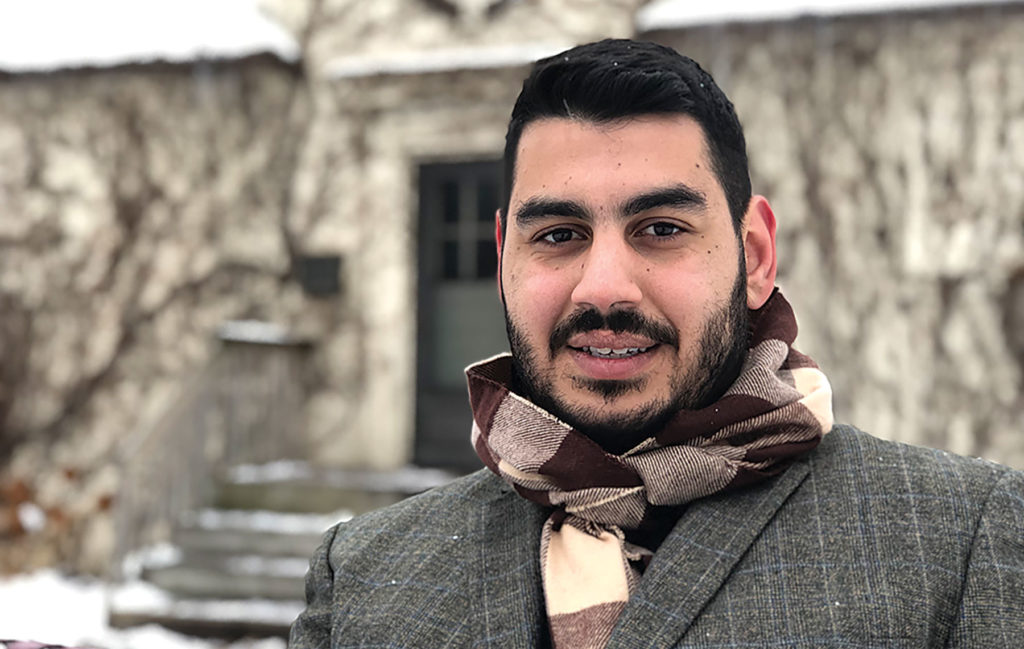
Twenty-six-year-old Jonathan Elkhoury is a Lebanese Christian who became an Israeli citizen and now fights anti-Zionist activists on U.S. college campuses. 

During the course of his work, he’s been accused of being a Mossad agent, a child-killer and an apartheid enabler. Some insults, he said, are so absurd they are frankly amusing. Such as the time he was accused by an American activist for Students for Justice in Palestine (SJP) of “stealing” the Arabic language. 

Others, however, cause Elkhoury profound consternation. When liberal elites label him a “token Arab” or a “pet” of Israel’s public relations machine, Elkhoury’s rarely ruffled feathers are positively rankled. “They tell me, ‘You’re only doing this because you want to justify yourself to the Jews,’ ” he said. “I’m always surprised that these kinds of comments come from people who advocate free thinking and freedom. What do they think? That I’m brainwashed? That I don’t have my own mind to decide what to think for myself?”

Elkhoury arrived in Israel from Lebanon when he was 9. His father had been an officer in the South Lebanon Army, Israel’s primary ally in the struggle against Hezbollah in the 1980s. When Israeli forces withdrew from southern Lebanon in 2000 and the Lebanese militia disbanded, Elkhoury’s father was forced to flee to Israel. A year and a half later, Elkhoury, his mother and older brother joined him, escaping Lebanon via passage through Cyprus. Elkhoury was told only that the family was taking a vacation to the United States, but he knew something was afoot when his grandparents and uncles came to see them off at the airport. “It wasn’t a regular goodbye. Everyone was crying,” he said. 

Under Lebanese law, it is illegal to have any interaction with Israelis. Fearing imprisonment or worse, the Elkhourys severed all ties with the rest of their family.

After graduating from high school, Elkhoury did two years of national service at Rambam Medical Center in his hometown of Haifa, where he was awarded the prestigious Health Minister’s shield. Today, Elkhoury advocates for Arab Christians and other minorities to join the army or national service programs. 

“During the course of his work, he’s been accused of being a Mossad agent, a child-killer and an apartheid enabler.

He is also a project coordinator for Reservists on Duty, a nongovernmental organization that was established to combat the boycott, divestment and sanctions (BDS) movement. Together with other minority representatives, he travels to the U.S. to counter some of the vitriol on campuses, especially during Israeli Apartheid Week, an annual series of university lectures and rallies, which has been held on campuses in February or March annually since 2005. 

Pressed on hot-button issues like whether he believes Israel can be both a Jewish and democratic state, Elkhoury is unflinching. “Is it a problem? Not at all. It is a Jewish state but I, as a minority, enjoy full rights to express myself and to criticize the government when needed.

“One thing I won’t accept is the discussion about Israel’s right to exist,” he said. “Of course the Jewish people have the right to their own state.” 

During a UC Irvine event in May 2017 hosted by Students Supporting Israel (SSI), Elkhoury and his fellow panelists were escorted out by police after dozens of SJP activists violently stormed the event.

But Elkhoury shrugs it off. “We will never be afraid to speak out,” he said. “What’s shameful is the unwillingness to engage in discussion. When else would they have the opportunity to listen to a Muslim, a Druze, a Bedouin and a Christian [citizen] of Israel and ask them the hard questions?”

Still, it’s not all bleak. He’s been approached many times by SJP members who heard him speak. “I call it planting the benefit of the doubt,” he said. “It’s not an overnight change. But it’s enough for them to go out and question and try to discover the truth.”

The Zionist Lebanese-Christian Refugee Read More »

Delivering Kindness to Iranian Senior Center on Purim

Candice Hakimianpour is looking forward to spending this Purim in the company of an older man.

For 29-year-old Hakimianpour, this Purim, she’ll forgo her usual Purim parties with fellow young professionals to spend her time with the septuagenarians and octogenarians at the Iranian Jewish Senior Center in Beverly Hills.

Hakimianpour is a member of a group of current and alumni members of 30 Years After’s Maher Fellowship program who will be delivering Purim baskets to center’s residents.

Established in 2014, the six-month fellowship is the nation’s only leadership program for young Iranian-American Jews. The program promotes leadership in American civic, political and Jewish life through bimonthly sessions that focus on topics ranging from the history of Persian Jewry to Israel advocacy and the imperative for philanthropy. This weekend, fellows are headed to the annual American Israel Public Affairs Committee Policy Conference in Washington, D.C. 

All of the residents of the senior center fled Iran after the revolution in 1979. 

“I see this visit to the senior center as visiting a significant piece of our past,” Hakimianpour said. “We can learn from it, gain wisdom with each conversation, and shape our future by heeding their advice.” 

Kevin Delijani, 25, said, “I grew up as a Persian Jew in Los Angeles because the generations that came before me built a community here 40 years ago. Whether there is still a Persian-Jewish community here in 40 years depends on my generation, and there is no better way to learn how we can make it thrive than from the people who built it.” 

Daniella Cohan, 26, who helped make Purim baskets for the seniors several days before the event, said, “I’m grateful to be able to give back to those in the community who sacrificed so much to build better lives for our generation.” 

Ilana Yazdi, the senior center’s general manager, told the Journal that the Maher Fellows will be the first group of young professionals to visit the facility since the center’s founding in 2003. 

“This is so important,” she said. “For our seniors, they need this kind of attention, and youthful energy always uplifts and encourages them. The visitors can remind our residents of themselves and their children when they were young. And for the young people, when they visit here and see that they, too, will one day grow very old, they’ll be reminded to be a little kinder — both to themselves and to their parents.”

The organization 30 Years After plans to also visit the Iranian Jewish Senior Center next month to help residents welcome Shabbat with challah, grape juice, songs and stories. 

“Elie Wiesel once said that in Jewish history, there are no coincidences,” said 30 Years After President Sam Yebri. “That our community survived persecution in ancient Persia and again in modern Iran is no coincidence. Only by breaking bread with our elders can we find meaning and purpose in our survival.”


Tabby Refael is a Los Angeles-based writer and former co-founder and executive director of 30 Years After. She currently serves as director of the Maher Fellowship. 

Delivering Kindness to Iranian Senior Center on Purim Read More »

Purim Spiels: Going Behind the Curtain

 Several months before most Jews start to think about Purim, there are those who pay special attention to the world around them, the cultural themes and products of the moment, the politics and social proclivities. These Jews are the comedically inclined creatives who feel Purim approaching in their kishkes. They are the ones who craft sketches, song parodies and Purim-based satire to entertain their communities.

Longtime spieler and comedy writer Rob Kutner first caught the spiel bug while studying at the Pardes Institute in Jerusalem between college and the start of his professional comedy writing career, making him perhaps “the only person in history to be studying Mishnah while simultaneously writing a spec script for ‘Frasier,’ ” he said. The Pardes spiel was “a way to join the two halves of my brain,” he said. “It was my ad d’lo yada (“until you don’t know the difference”) moment, except instead of conflating Haman and Mordechai, it was ‘sacred text’ and ‘funny sketch.’ ”

When Kutner moved to New York in the early 2000s to write for “The Daily Show,” he had to leave his L.A. spiritual home, “my beloved Shtibl Minyan,” and “hit upon the idea of staging my own spiel (The Shushan Channel) with professional actors and writers as a way to create my own community. You know the saying: ‘If you grog it, they will come,’ ” he said.

Thanks to Kutner’s “Daily Show” connections, he was able to recruit guest performers like Stephen Colbert, Rob Corddry and Ed Helms to read the Purim story and deliver an unfiltered comic take on the Megillah in a segment called “The Goyish Rebuttal.” One year, he had his “Daily Show” colleague, comedian J.R. Havlan, do the rebuttal, except he forgot to tell Havlan what happens when you say “Haman.” 

Jews are people of the book. We are storytellers. Coming together for Purim to laugh and play and remember is exactly what we’ve done forever to keep our spark alive.” — David Schwartzbaum

“This is literally my office-mate from work, he’s doing me a favor and I put him in front of a crowd who’s repeatedly booing him at what seem like random times!”

A few years in, I became involved in Kutner’s production, first as a volunteer, then as a writer and “sort-of” (not very good) very occasional actor. My spiel journey has continued for the past several years at IKAR; our writers convene at Bibi’s Bakery about six weeks before the holiday, so that resident baker and funny man Dan Messinger can be part of the comedy collusion. Our table has writing and production alumni of TV shows past and present, and a few comedy civilians, either recruited or self-selected into the creative company. 

Actress Rena Strober, who directed and performed in last year’s Temple Israel of Hollywood spiel, is helping to create this year’s spiel at Wilshire Boulevard Temple, where she will play “The Marvelous Mrs. Shooshan.”

“I love telling Jewish stories through song, scene and sometimes comedy and dance,” Strober said. “It makes it more enjoyable for people of all ages to connect to the people of our past.” 

Lizzie Weiss, Cantor at Temple Emanuel of Beverly Hills (TEBH), called the spiel “one of the best tools of engagement” because it’s supported by kids and parents alike. This year TEBH’s musical theme is Bruno Mars; previous spiels have featured the music of the rock group Queen or the Broadway musical “Hamilton.”  

“In a Reform congregation, we are cognizant that people aren’t always aware of the Megillah,” Weiss said. “The music of ‘Hamilton’ was the magnet we needed to attract kids to this awesome community event and ‘sneak’ in the wonderfully tumultuous story of Esther.” 

“Jews are people of the book. We are storytellers,” said comic and actor David Schwartzbaum, who will be spieling this year at Open Temple in Venice and Temple Israel of Hollywood. “We’ve passed down our story for thousands of years. Judaism is a communal religion and we come together in times of grief and in times of joy. Coming together for Purim to laugh and play and remember is exactly what we’ve done forever to keep our spark alive.” 

Jenna Turow, a student at and spieler for the Ziegler School of Rabbinic Studies at American Jewish University, started spieling after years of writing and acting in sketches and song parodies at camp and in United Synagogue Youth (USY). 

“It makes me feel more connected because it’s a chance to get everyone to laugh, especially at themselves,” Turow said. “I love making people laugh, and encouraging people to not take themselves too seriously. Plus, I feel that I can properly toe the line between appropriate jokes and pushing the limit, [which is what] Purim is all about.”

Turow also found spieling, and Purim in general, to be really helpful while dealing with her mother’s terminal illness. “It is a blessing to be given the responsibility to cause joy for myself and others,” she said. 

Spielers are divided on their approach to incorporating politics. Weiss recalled the 2018 Purim season, which came at the height of #metoo-related conversations. TEBH Senior Rabbi Jonathan Aaron created a monologue by Vashti as “a pivotal teaching moment,” she said, which addressed “what it meant when Vashti said ‘no’ and when Esther used her femininity to further the cause of the Jewish people. Although Purim can be a time of blurry-eyed drunkenness and hysterical laughter,” she said, “there are always teaching moments for our kids and teens.”

Turow tries to avoid politics in the spiel, “because I’d rather focus on things that we can laugh at more recklessly, without the worries of everyday life creeping in,” she said. 

Kutner includes political references, but avoids entirely political spiels.

“Not to avoid taking a side,” he said, “but because I feel we’re already drowning in that, and Purim is supposed to be an escape.”

Purim Spiels: Going Behind the Curtain Read More »

Vegan Halvatashen for Fierce Queens

Queen Esther may have saved our people from Haman’s evil plot but that’s not the only thing she’s known for.

The beautiful bride of the king of ancient Shushan, who foiled the dastardly adviser’s scheme to kill the Jewish community in Persia, was probably vegan. According to legend, because Esther’s Uncle Mordecai believed that anti-Semitism abounded in the ancient land, he advised her to hide her identity. Because the palace didn’t serve kosher food, Esther subsisted on seeds and grains, fresh fruit and vegetables and, some say, also “seedpods,” which are thought to be legumes. In this way, she kept her identity a secret and managed to steal the king’s heart. 

When the courageous queen found out that the future of her people was at stake, she quickly devised a scheme of her own: honesty. Yes, she admitted she was Jewish and told the king that Haman was plotting against her community. We know the rest of the story: Haman and his mean sons were hanged and Queen Esther lived to rule her vegan palace — and we are stuck eating hamantashen on Purim until the end of time.

Ask the average Israeli where to find the best hamantashen, and you’ll get a blank stare. The word hamantashen, used to describe traditional Purim cookie, is thought to be derived from the German and is a puny take on Haman’s pockets and ears and perhaps even his satchel. In Hebrew, the words “Oznei Haman” (Haman’s ears) reflect the Jewish sense of humor and the way Jews coped with living as outcasts by turning something evil into something sweet. Historian Gil Marks wrote, “The tradition forged by life in exile and a vital element in dealing with it particularly manifests itself on Purim, a time when joking and frivolity is encouraged.” 

In Tel Aviv in particular, Purim is all about the party, the costumes, celebrating, drinking and eating, the last two in the extreme. All bakeries break out their Oznei Haman usually starting a few weeks before the holiday. Queen Esther’s predilection for seeds made poppy seed-filled cookies the standard and,  until about 10 years ago, poppy seed, chocolate, apricot and raspberry were the only flavors you could find. Now, of course, Israeli pastry chefs, trying to outdo one another creatively, have made savory Oznei Haman with stuffings of spinach, goat cheese, and caramelized onion just as common as sweet varieties. Pistachio cream, ricotta, candied fruit, chocolate dulce de leche, and vanilla lavender are but a few of the contenders in Israel’s cutting-edge bakeries, as are hundreds of other varieties. 

“Taking inspiration from the mysterious and sensuous Persian kitchen can turn bemoaning wasted calories into a new addiction.”

The cookie-filling variations aside, many hamantashen recipes in the United States open with a disclaimer along the lines of “I never really liked this cookie …” or “Most hamantashen are bland, dry and overly sweet.” I can’t argue with those sentiments. In fact, to me, most of the Ashkenazi versions of Jewish pastries such as rugalach, honey cake and hamantashen fall firmly in the “calories wasted on nostalgic foods you don’t actually like” category. But taking inspiration from the mysterious and sensuous Persian kitchen can turn bemoaning wasted calories into a new addiction. 

Because Iranian Jews on Purim tend to eat Persian halvah, a delectable combination of saffron and cardamom sugar-scented butter, flour and tahini studded with nuts and roses, why not riff on that theme and create a halvah hamantashen that even Queen Esther could fit into her beauty regimen? Absent from this recipe is butter and loads of sugar but it’s replaced by a lightly sweetened and tender crumbed vegan dough made with coconut oil and a touch of rosewater and filled with a simple orange and cardamom-scented halvah interior that encapsulates the very essence of the exotic. 

Sure, a week ago there were rockets fired into Tel Aviv but you can be sure that this week, the Purim revelry will go on boldly and unabashed. After all, we are celebrating the courage and principles of a Persian queen without whose heroism our people may have perished before we ever had the chance to be brave ourselves.

VEGAN HALVATASHEN

For the dough:
2 cups all-purpose flour, plus more for dusting
1 tablespoon baking powder
1/2 teaspoon sea salt
4 tablespoons powdered sugar
1/4 cup room-temperature coconut oil (not melted)
1 teaspoon rosewater (optional)
1 teaspoon vanilla extract
1/4 cup almond milk (or other vegan milk)
1 tablespoon orange rind

For the filling:
1 cup raw tahini (sesame paste)
1 cup powdered sugar
1 tablespoon orange juice
1 tablespoon honey
1/4 teaspoon cardamom powder
1/4 cup water, or as needed

Sesame seeds, chopped pistachio nuts, chopped candied orange peel, candied                          
rose petals for garnish (all optional)

Place flour, baking powder, salt and sugar into a food processor and pulse to blend dry ingredients. Add the room-temperature coconut oil and continue to pulse until mixture becomes crumbly.

Add rosewater and vanilla extract and gradually the milk, only until the mixture comes together into a soft ball. Pulse in the orange rind. Do not over process.

Removed ball of dough from the food processor, wrap in cling film and place in refrigerator until thoroughly chilled — at least 2 hours up to overnight.

To make the filling, mix together tahini, powder sugar, orange juice, honey, cardamom and then add cold water one tablespoon at a time until the mixture is smooth and the consistency of peanut butter. You want a thick filling — do not add too much water. Set filling aside until ready to assemble. 

Preheat oven to 350 F.

Remove dough from refrigerator and place on a lightly-floured surface. Roll out dough to 1/8-inch thickness. Using a 3-inch glass rim or cookie cutter, cut dough into circles. Place 1 teaspoon of filling in the center of each circle. 

Fold top of circle toward the center, left side toward the center and bottom of circle toward the center creating a triangle shape. Pinch dough tightly at edges of triangle and make sure the middle of the circle with the filling is showing. 

Place on parchment paper-lined baking sheet. Brush with a bit of vegan milk or water and sprinkle with sesame seeds or finely chopped pistachio pieces (if using.)

Place baking sheet in refrigerator for about 1 hour before baking so that cookies will hold their shape. 

Bake for approximately 15 minutes or until light golden brown. Rotate the baking tray back to front halfway through baking.

Cool thoroughly on a rack and use a fine sieve to decorate with a touch of powdered sugar before serving.

Makes 24.


Yamit Behar Wood, an Israeli-American food and travel writer, is the executive chef at the U.S. Embassy in Kampala, Uganda, and founder of the New York Kitchen Catering Co. 

Vegan Halvatashen for Fierce Queens Read More »

This Purim, Stand With All Who Stood With Us

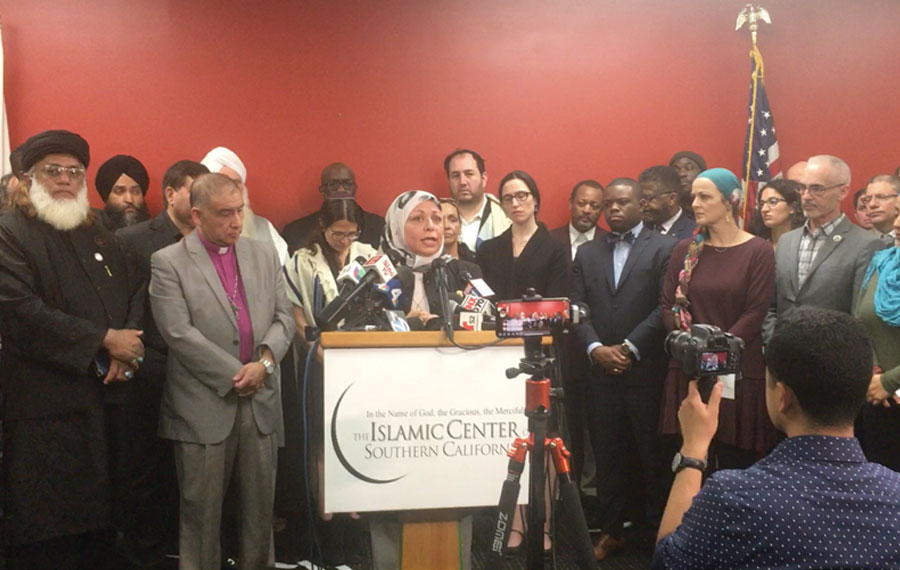
Our interfaith press conference and vigil at the Islamic Center of Southern California on March 15 felt something like returning home. We were responding to the hideous massacre of Muslims at prayer in Christchurch, New Zealand, and all of us — Jews, Sikhs, Christians and just good people who couldn’t bear to be anywhere else right then were received so graciously and with so much love by our Muslim siblings that it was not at all clear who was comforting whom.

It’s the most cosmopolitan house of worship I’ve ever attended — where everyone from great-grandparents to toddlers smiles at one another; where people of every shade, size and style of dress, who come from six continents and speak multiple languages, unite in prayer.

We’d been there before: after the Muslim ban was announced; after the 2016 election; after the Orlando massacre of Latino gay men by a man who professed Islam; and after Pittsburgh.

So many of the Muslim people we prayed with at the recent Christchurch vigil had come to stand with us at our vigil after the Pittsburgh massacre. Women from my interfaith support group who share stories and food and sewing and art making — Catholics, Protestants, Muslims and Jews — were there, embracing, not from an abstract sense of human fellowship but because we belong to one another. We love one another. We felt the pain, the wrenching body ache, one feels when someone hurts the people we love. It is the price — and the glory — that comes from reaching out to, making friends with, and building personal stakes in the well-being of people we have been told to distrust.

Also at the vigil were social justice organizations like Bend the Arc, the Muslim Public Affairs Council, L.A. Voice, and Clergy and Laity United for Economic Justice. There were priests and rabbis, ministers and imams. There was Los Angeles Mayor Eric Garcetti, City Attorney Michael Feuer, City Councilman Mitch O’Farrell, and Wilshire Center-Koreatown Neighborhood Council member Jarin Maruf.

Each speaker, in addition to offering words of comfort and shared grief, addressed some hard, necessary truths. Several reminded us that, like the Pittsburgh shooter, the accused killer in New Zealand wrote about Muslims and immigrants as “invaders,” deploying a trope that emanates from the highest office of our country.

“We have a bitter version of the story to retell. … we name the Haman who walks among us still.”

The very next Shabbat after the massacre was Shabbat Zachor, the Sabbath of Remembrance which comes before Purim, the holiday in which we celebrate our own deliverance from a massacre. We remember Amalek, the ones who attack from behind and were the first, our Torah teaches, to attack the people Israel had after they had been liberated from slavery and entered the desert wilderness. We are told that Amalek attacked the old and very young, and those too weak or ill to fight. In our tradition, Amalek is conflated with Haman of the Purim story, the one who incites genocide, the one who wants to destroy an entire people or religion out of hatred and fear.

We will hear our Torah in synagogue and we will be asked to remember. “Remember what Amalek did to you on the road…” (Deuteronomy/Devarim 25:17). Remember our implacable opposition to the genocidaire, to all the Amaleks and Hamans, to the Hitlers and inquisitors and crusaders; all of those for whom difference is an unconscionable affront to be punished with extinction.

Then comes Purim. The holiday is fun for kids, but, at its core, it is a holiday for adults. Purim plunges us to the depths of our humanity, the mess and vulnerability that comes with being flesh and having partial knowledge, tethered to the Divine by the thread of our souls.

The narrative in our Megillah, which we are commanded to hear, is not really a story for children. It’s a tale of Diaspora Jews threatened with imminent extermination, who are saved at the last minute by a Jewish harem queen married off to a drunken fool, coached by her unmarried uncle and his best friends, the eunuchs.

Purim is a holiday in which Diaspora Jews celebrate their situation as insiders/outsiders. The emotional climax of the story puts the protagonists on opposite sides of doors and walls. Esther, the secret Jew, is married to a drunken, malleable king, who has been persuaded through bribery by a bigoted vizier to authorize the extermination of the Jews. The Jews, Haman the genocidaire explains, are a dangerous ethnic minority who persist in their own religion and customs. They are disrupters — invaders even.

Esther is confined to the harem. Mordecai, the known Jew, is making a public performance of grief, wailing immoderately just outside the city gate (where public conversations were known to happen). Mordecai is engaged in very serious performance art — clothed in sackcloth and ashes, he cries out his grievance, making sure that no one in the capital city of Shushan could say that, whatever happened to the Jews, they knew nothing about it.

The go-between who connects Esther with Mordecai is Hatach, a eunuch — a person who can slip between gendered worlds and between the inside and outside of the palace and the city. It is he who serves as the vital link through whom Esther and Mordecai can plan their resistance. The Jews and the eunuch act in solidarity to create change. They are insiders and outsiders, dependent on one another.

On Purim we celebrate deliverance with excess — first we fast, then we feast. It’s a mitzvah (only to be observed by those who don’t risk their health or life to do so) to get too hammered to know our best friends from our enemies.

There are four mitzvahs to fulfill on Purim. There’s the bit about drunkenness, to be enjoyed in the course of a festive meal. The others are to hear the story of Purim read from the Megillah once at night and once during the day, to give gifts of food to friends, and to give gifts to the poor.

Our custom is to celebrate with masquerade and song; to dress up in costumes (many rabbis allow and even encourage cross-dressing on this night); and to put on Purim spiels, satirical plays that retell the story, often in light of current events. This is Jewish carnival, a chance to lampoon and to wear those masks that reveal hidden truths about who we are and wish to be.

This year, we have a bitter version of the story to retell. This year, we name the Haman who walks among us still. As Rabbi Sharon Brous said at the Islamic Center, “I lift up all who suffer at the hands of white supremacy — a hateful, radical ideology that has wreaked havoc and devastation across generations and oceans.”

This year, as we celebrate the worth of keeping our religion and culture while being true to the larger communities and polities in which we live, we remember how vulnerable we are. We remember who was there to hold us when we mourned, and with whom we must identify if we are all to survive what’s in store.


Rabbi Robin Podolsky teaches at Cal State Long Beach, writes for Shondaland, and serves as a Jewish Community Engagement Fellow at J Street. 

This Purim, Stand With All Who Stood With Us Read More »

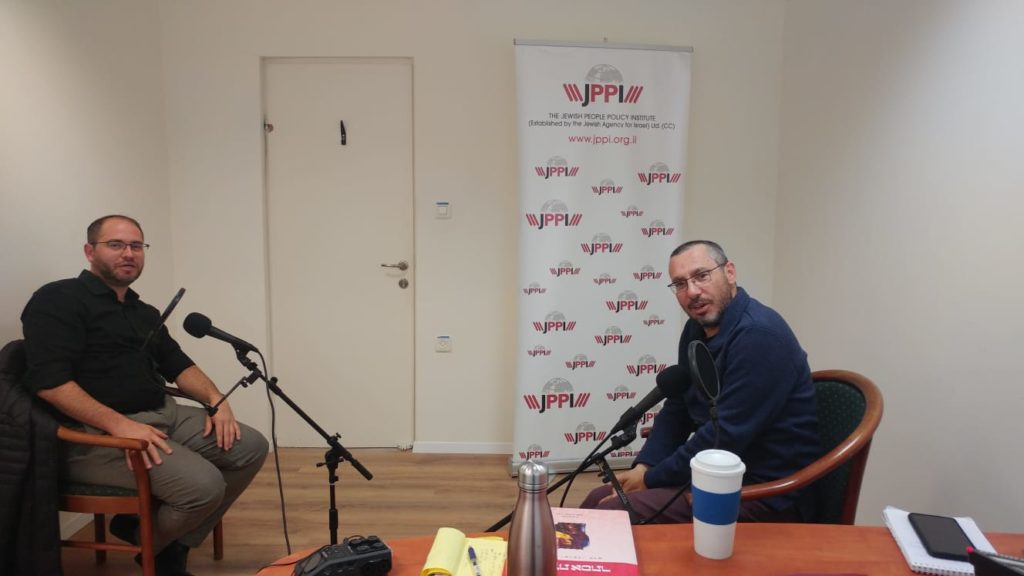
Rosner's Domain Podcast

Rabbi Mishael Zion: A Special Purim Episode

Shmuel Rosner and Rabbi Mishael Zion discuss his latest book, “The Book of Esther – A New Israeli Commentary.”

Rabbi Mishael Zion, an educator and community entrepreneur, is the director of the Mandel Program for Leadership in Jewish Culture.
He is the author of Esther: A New Israeli Commentary and, together with his father, Noam Zion, the author of Halaila Hazeh: An Israeli Haggadah and A Night to Remember: The Haggadah of Contemporary Voices. He has served as a faculty member at the Shalom Hartman Institute in Jerusalem and the Skirball Center for Adult Jewish Learning in New York, and has been a visiting scholar at the New York University School of Law. He is one of the founders of the Klausner Minyan, a partnership minyan in Jerusalem.

Rabbi Mishael Zion

Follow Shmuel Rosner on Twitter.

Rabbi Mishael Zion: A Special Purim Episode Read More »

Breaking Free of the Esther/Vashti Complex

Call it the “Esther/Vashti Complex” — the perennial Purim impulse to define Esther and Vashti against each other as foils, opposites, rivals, or enemies.

They were none of these. This false dichotomy has been superimposed on the narrative, enduring through the ages, reducing the women to two-dimensional figures, robbing them of the dignity of human complexity. It obscures a story of female empowerment behind a mask of misogyny. 

For 25 centuries, scholars, rabbis and other thinkers have tried to pit two courageous women against each other, depicting Vashti as wicked and Esther as angelic, venerating Esther by vilifying Vashti. 

But Harriet Beecher Stowe praised Vashti as early as 1878 for standing up for women’s rights, and Elizabeth Cady Stanton applauded Vashti’s defiant resistance in 1898. In recent decades it has become increasingly fashionable to vindicate Vashti and even to devalue Esther with faint praise or outright scorn. “Vashti fights for her modesty and her honor, while our heroine Esther is willing to work through the bedroom,” writes Rabbi Ruhama Weiss. Isabel Kaplan derides Esther for having “slept her way to the top.” Scriptural slut-shaming seems particularly ill-advised and retrograde. 

Not only were Esther and Vashti never adversaries, there is historical evidence to suggest they were the same woman. The next time you thumb through ancient secular sources such as “The Histories” by Herodotus or Plato’s account of Socrates’ dialogue with Alcibiades, you’ll notice they name only one woman, Amestris, as the wife of Xerxes, the Persian king identified with Ahasuerus.  

Drop the “V” from Vashti and the “Am” from Amestris, and it’s not much of a stretch from the remaining “ashti” and “estris” to “Esther.” Etymologies reaching back to ancient Greek, Persian, Babylonian and Hebrew are complex and uncertain at best. Esther derives from Ishtar, a Greek goddess and “star.” Vashti and Amestris also share roots. 

Esther and Vashti contend with the same husband, the same patriarchal authority. They never appear together, or even at the same time. For interpretive purposes, we may conclude that they were two women of valor. Or one. 

Ahasuerus throws a party, a six-month government shutdown to energize his base.  Wine is served in vessels of gold. The décor is garish. 

Later, the king convenes a smaller party of cronies, patrons, sycophants and generals while Queen Vashti fêtes the real housewives of Shushan’s noblest families. 

The king orders Vashti to abandon her female posse and her dignity, and dance naked in front of the men. Vashti refuses.

Ahasuerus can have Vashti brought to him by force. But he needs her to appear voluntarily so he can seem like a benevolent husband with a loving, compliant wife. Vashti’s refusal shatters the illusion. 

Ahasuerus spins his personal embarrassment as a political question. He asks his advisers what to do. Vashti’s defiance — a courageous declaration of self-ownership — terrifies the king’s men. They fear that Vashti’s chutzpah will inspire their wives to rebel and disobey.

Vashti is banished. Details are sketchy. Perhaps she is simply relegated to the king’s harem, hidden from the public and banned from the royal bedroom.

Ahasuerus is left embarrassed and alone.

A search for Vashti’s replacement commences with young women commanded to compete for the role, sequestered in the palace, bathed in frankincense and myrrh. Each woman spends a night on the king’s casting couch. There can be only one leading lady. After, uh, auditioning them all, the king will anoint his favorite. 

This process is described as a beauty contest. The winner will wear the royal crown that provided no honor and no protection to Vashti. These women will be raped and enslaved as concubines. (How strenuously we must avert our attention from these sordid details to maintain the fairy-tale illusions we associate with this happy holiday.)

Esther is conscripted into this beauty contest by her cousin and guardian Mordecai. She is the orphaned daughter of his uncle. Having raised Esther from childhood, Mordecai offers her to the king. This act is troubling, to put it mildly.

But Esther is a strategic thinker. She enters the contest without protest. Esther gives Ahasuerus what Vashti refused him — in private, not in front of an audience. What she chooses to reveal is superficial. She conceals her Jewish identity. 

The king requires Esther to agree to remain obedient, an ironic legacy of Vashti’s refusal. Esther formally consents. Perhaps this is a sadder but wiser Vashti, transformed into the savvy Esther, pursuing a new strategy. 

Ahasuerus decrees a festival to honor the new queen. He never asks Esther to dance. To win popularity, he cuts taxes.

Meanwhile, Haman wants the world to bow to him. Mordecai won’t bow. And when Mordecai discovers a plot to assassinate the king, he sends a warning through Esther, earning the king’s gratitude and Haman’s wrath. Haman then plans to kill all the Jews. 

Mordecai wants Esther to get the king to prevent the pogrom. But even the queen may not visit the king unless he summons her. Aware of what happened to Vashti, Esther hesitates to approach the erratic king. Mordecai argues that self-preservation and Jewish solidarity compel her to act.

So, Esther presents herself to the king. He invites her to approach and kiss his scepter. She complies. We pretend not to understand. The visit is conjugal. It’s been a month since husband and wife last saw each other. 

As it turns out, the king is delighted that his wife took the initiative. The now-uxorious Ahasuerus protects Esther as he failed to protect Vashti. Esther has won a victory on the metaphorical battlefield where Vashti fell.

Haman is then hung from the gallows he built for Mordecai. Enabled by Esther, the Jews defend their lives. 

Esther takes the baton of female empowerment passed by Vashti. Or, if you prefer, Vashti reemerges as Esther. The Jewish people get a seat at the table of power. The tradition of matrilineal descent in intermarriage affords Esther the prospect of bearing children who will be Jewish Persian royalty. 

On Purim we drink wine until we cannot tell the difference between Mordecai and Haman. Better to drink wine until we cannot tell the difference between Esther and Vashti, and break free of the Esther/Vashti Complex.


Alan Robert Ginsberg is a historian and the author of “The Salome Ensemble.”

Breaking Free of the Esther/Vashti Complex Read More »

Muslims, Jews Need to Support Each Other

By now we know that hateful rhetoric provides the scaffolding upon which extremists justify their violent acts. But often, we fail to recognize when the rhetoric of our public discourse crosses the line from legitimate critique into these hateful tropes. 

It’s why many Jews find Rep. Ilhan Omar’s tweets and statements abhorrent, even as many Muslims struggle to understand why what she said was so bad. Muslims hear a thoughtful critique of the Israel lobby.  Jews hear the Cliff’s Notes version of “The Protocols of the Elders of Zion” — rife with undertones of financial control and global conspiracy. 

But Omar and her Muslim defenders are not the only ones to cross this line from legitimate critique into stereotype-ridden language. We in the Jewish community are often guilty of the same. To many Jews the common criticism of Muslim leaders and organizations rests on solid reasoning, even as Muslims mentally check the box of almost every recognizable Islamophobic trope. Linking Muslim public figures to terrorism no matter how many degrees of separation? Check. Accusations of Muslim intent to govern America by Islamic law? Check. Contorting and curating facts to paint a narrative that a Muslim elected official is actually a terrorist plant? Check. 

There are real communal disagreements between Muslims and Jews. I personally get frustrated with our differences. In recent months, the Council on American-Islamic Relations (CAIR) — a Muslim-American civil rights organization — spearheaded an effort with the American Civil Liberties Union (ACLU) for Los Angeles to refuse federal funds allocated under the umbrella of “Countering Violent Extremism.” They claimed these social programs serving the needs of at-risk youth and resettling refugees were a back door for the government to keep tabs on the Muslim community. (Fact check: They weren’t). I was heartbroken for the extraordinary organizations that did not receive needed funding because CAIR’s campaign worked. I also disagree with what I consider to be CAIR’s lack of a nuanced view of the Israel-Palestine conflict and how they wielded it as a divisive wedge at the Women’s March. I question whether such confrontational tactics are ultimately the best strategy for furthering the rights and interests of Muslim Americans.

“What will it take for us … to stand shoulder to shoulder against the rhetoric that targets us both as unwanted minorities?”

But I recognize the difference between political acts I disagree with and political acts that are acts of terror. Calling CAIR or any other Muslim organization or leader who participates legitimately in the American public discourse “terrorists” crosses the line into Islamophobia. These accusations are no less problematic than the ones leveraged against Jews of controlling American foreign policy with our money and our influence.

 The deepest irony of the public conversation between Muslims and Jews is that we share the same fear — the questioning of our loyalty to America. And yet, we fail to recognize how freely we engage in this accusation of treason against each other.

In spite of our commonalities as minorities in the United States, we too have inherited and internalized the anti-Semitic and Islamophobic suspicions of the larger culture around us. We have become almost obsessively enraged with each other. 

Maybe we do it because we subconsciously think that if the other is considered to be the threat, then we won’t be. Maybe we believe that our country and western civilization has to have an enemy and we’re all touching our noses to say, “Not it! Look at them!”

Muslims and Jews can continue to have the same accusation-hurling conversation over and over, but I fear that leaves both of our communities vulnerable. I fear that we feed into the rhetoric that violent extremists from Pittsburgh to Christchurch thrive off of. How many more mosque and synagogue shootings do we need before Muslims and Jews are willing to do some collective self-reflection about the stereotypes we hold of each other? What will it take for us to work through our disagreements to stand shoulder to shoulder against the rhetoric that targets us both as unwanted minorities?

Muslims and Jews alike will be better served when we do the work to examine and question our deeply held stereotypes of the other and stop contributing to the rhetoric that tears the other down. Because, when we do, we actually just tear down ourselves.


Rabbi Sarah Bassin is the associate rabbi at Temple Emanuel of Beverly Hills.

Muslims, Jews Need to Support Each Other Read More »

Two Jews, Three Judaisms

Tucked deep amid a sea of 700 teens sitting outside a college campus in Israel, I stood up to take the pulse of what was happening around me. Some of my peers were laughing, others hugged as if it were the last time they would see each other. I tried to catch my breath. We had accomplished so much together in just three short weeks. Despite my friends feverishly tugging on my shirt, urging me to sit down and join the festivities, I had to snap this mental picture. 

A key element of the Diller Teen Fellowship is teaching participants that effective leaders assume the helm while simultaneously valuing diverse opinions. This is crucial when discussing one’s beliefs with people from various cultures and backgrounds. One of the core pillars of Diller is pluralism: embracing diversity and seeking to understand different opinions in order to coexist. This open discourse was epitomized one morning in a program called “Philosophical Shabbat,” where 30 international students (including me) gathered in a room to dispute various philosophers’ views on Judaism and God. 

The morning began with an activity icebreaker during which teens were given a notecard with a philosophical question on it. We were instructed to walk up to one another, ask the question and then trade cards. Typically, when teens — particularly American teens — interact for the first time, they aren’t questioning anything remotely as weighty as the other person’s religious beliefs. However in Diller, this is simply a normal introduction. With notecard in hand, I approached a tall, broad-shouldered boy. We exchanged pleasantries. I learned he was from Montreal. Then abruptly, he got more substantive. “Do you believe in God?” he asked. Here was an absolute stranger cutting right to the core. How forthright was I going to be with a person I ‘d literally just met? Was I going to reveal my internal struggles with my beliefs? 

Every Jew prays in a different way and connects to what it means to “be Jewish”
in a different way.

After the icebreaker, we formed groups with four strangers who lived in other parts of the world. In my group was an Orthodox boy from Melbourne, Australia; an atheist from Cape Town, South Africa; a Conservative from Baltimore; and me, a Reform Jew from Los Angeles. 

Our adviser gave us a passage from a Jewish philosopher who wrote about what he imagined to be the “Jewish God.” Simply put, he theorized that whatever is written in the Torah is 100 percent factual.

This philosophy resonated with the Orthodox student from Melbourne, who couldn’t fathom how Jews didn’t believe in and strictly adhere to the Torah’s teachings. Not surprisingly, the atheist challenged this notion, arguing one doesn’t have to believe in God to be Jewish. Moreover, he found no meaning in prayer because he believed everyone prays to a God. Despite his atheism, he considered himself Jewish because the teachings, values and traditions still resonated with him. 

What I appreciated about this was the gray area: In Judaism there is no clear-cut definition or belief one must obtain. Every Jew prays in a different way and connects to what it means to “be Jewish” in a different way. As we continued our discussion, I couldn’t help but appreciate the civil way we defended our differing religious beliefs. While we all hailed from vastly different geographic, socioeconomic and cultural backgrounds, we connected with one another on a personal level. 

Through my countless conversations with people of various cultures and beliefs, I’ve learned the difference between hearing and listening to someone — namely, when you listen, the information truly resonates. In society, it is common for people to label one another by their political party, race, gender or religious beliefs. In our conversations in Israel, we were emotionally stripped down and were able to look past these one-dimensional labels to find ways to accept and respect one another rather than adopting any preconceived notions.


Ashley Lifton is a current senior at New West Charter and was a member of the Los Angeles Diller Teen Fellows from 2017-18.

Two Jews, Three Judaisms Read More »