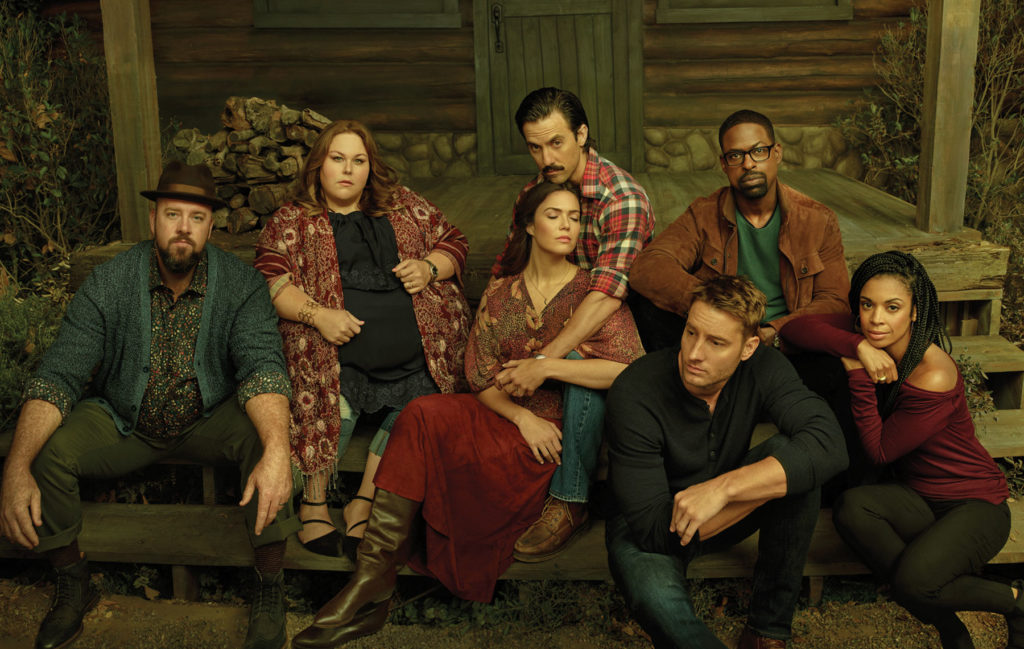
With its relatable characters, time-shifting storylines, unexpected twists and plenty of Kleenex-worthy moments, “This is Us” has been both a ratings juggernaut and a fan favorite since it premiered in September 2016.
During a visit to the set last month, creator Dan Fogelman gave some hints about the upcoming final two episodes in the third season and revealed a little of what viewers can expect next season.
“Now that we know how Jack died, probably the No. 1 question I get is, ‘Are Randall and Beth going to make it?’ ” Fogelman said. “That means people are invested in their marriage, which is a good thing. We’ve kind of put them in a washing machine [this season] and we’ll see how they come out.”
Fogelman wouldn’t divulge details about the identity of an ailing female referred to only as “her” in a flash-forward that aired in January. However, he said that the April 2 season finale is titled “Her” and “there are a lot of answers given; a lot of the stuff that people have been waiting for,” he promised.
Fogelman and his writing team are already at work on Season 4. “Most shows go on hiatus for four or five months, but we don’t take a hiatus,” he said. “That allows us to get a head start on the next season and plan for multiple seasons. Because of the way we play with time, you can make one little decision and you don’t think it’s that important, but when you get to 14 episodes from then you realize you’ve pinned us in by making that decision. I learned very early on not to put ourselves in that position.”
“Now that we know how Jack died, probably the No. 1 question I get is, ‘Are Randall and Beth going to make it?’ That means people are invested in their marriage, which is a good thing.
— Dan Fogelman
Crafting those flash-forward episodes requires a light hand when it comes to setting the scene and two sets of growing children require Fogelman to shift accordingly. “Now our teenagers are college kids and we get to show that transition in their lives, going to college and reinventing themselves after their father died. The little kids are entering puberty and adolescence, which gives us different stories to tell,” he said. “All that is really interesting for us.”
Season 4 will continue to explore Kevin’s battle with alcohol and drugs. “You’re never done grappling with addiction and that’s one of many things we explore this season and the next,” Fogelman said.
Despite patriarch Jack’s death last season, he will remain a key part of “This is Us” in flashbacks. “We love doing the Milo [Ventimiglia] with the moustache period, with the little kids,” Fogelman said. “And we can do more [parallel] episodes like we did with Jack tracking down his brother while the older kids track down their Uncle Nicky.” No decision has been made about having Michael Angarano or Griffin Dunne (who play Nicky at different ages) return, Fogelman said. “But we love both actors and love what it does for Kevin’s storyline and the family’s story.”
There also will be more to come about the beginning of Rebecca and Miguel’s relationship. “They got together not right after Jack’s death but a couple of years after,” Fogelman said. “That’s a different time period and, when we enter new time periods, we like to do it gently so we don’t give the audience whiplash. But we will get there.”
Fogelman also promised some cast additions next season. “Some things will be happening that affect characters in a very exciting way. We don’t have the actors yet,” he said. So far, none is Jewish. But as he told the Journal in 2017, “You can see my Jewish family in these WASP-y characters.”
He emphasized that he has an endgame for the series in mind, but wouldn’t reveal exactly when it would play out. “We don’t want to stay past our welcome. We have a plan for the entire show, for what will happen to each character and, roughly, when. We always had a plan. We weren’t making up stuff as we went along.”
Fogelman has rarely strayed from that plan. “It was difficult to kill off Ron Cephas Jones’ character [William] in the first season,” he said, “but it was always the plan because it informed Sterling [K. Brown]’s character and the plan for multiple seasons.”
Fogelman resists tailoring plots to audience desires, but won’t write a twist just for shock value, either. “I’m not going to make Randall and Beth get divorced just to mess with people, and I’m also not going to keep them together just because it pleases everybody,” he said. “If we’ve changed anything, it’s because we came up with a better idea, not because we felt pressured into doing that.”
However, he added that he fully expects the plot questions to persist, especially where deaths are concerned. “I know that until we see everyone happy and healthy in the future, I will keep getting questions about it.”
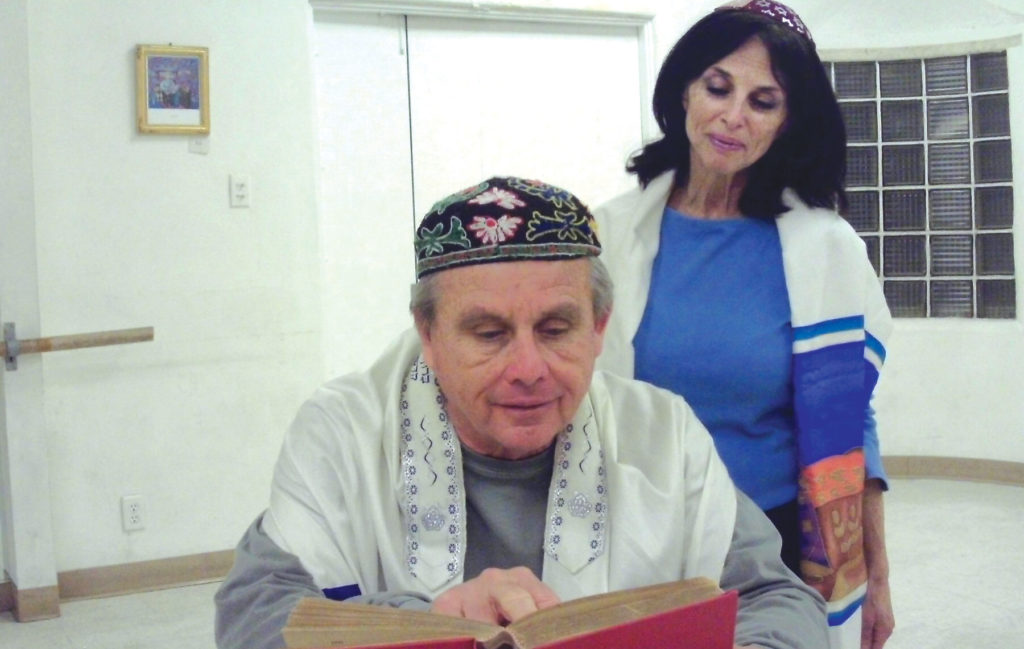
A secular Jew finds his faith while a rabbi struggles to hold onto hers in the West Coast Jewish Theatre’s “Bar Mitzvah Boy,” a comedy-drama opening March 22 at the Miles Memorial Playhouse in Santa Monica.
The story follows Joey Brant (R. Emmett Lee), a divorce lawyer and secular Jew who lied about having had a bar mitzvah, and seeks to make it right before his grandson’s bar mitzvah. To prepare for the ceremony, he persuades Rabbi Michael Levitz-Sharon (Pamela Heffler) to give him private lessons. As he reconnects to Judaism, she finds her strong faith challenged as she struggles to deal with her daughter’s terminal illness and the breakup of her marriage.
The 2017 winner of the Jewish Plays Project Award, it raises provocative questions with poignancy and humor, about belief and what it means to be Jewish, while exploring such themes as tikkun olam and the importance of community and ritual.
West Coast Jewish Theatre (WCJT) Artistic Director Howard Teichman said he chose to produce “Bar Mitzvah Boy” because “it asks all the right questions and deals with things Jews deal with.” He also liked the redemptive nature of the story and the fact that the rabbi is female. “There are so many things we can learn from this play,” he said after a rehearsal. “We are here not only to entertain but educate, and through these kinds of plays, we find ways to connect as Jews and give an opportunity to Jewish writers, whether they’re known or hardly known.”
Victoria, B.C.-based playwright Mark Leiren-Young took his inspiration from several real-life sources: a friend’s admission that he didn’t feel Jewish because he didn’t have a bar mitzvah, the female rabbi that bat mitzvahed his niece, and the niece questioning God’s existence when her friend was diagnosed with a terminal disease. That last element coalesced the narrative he’d been working on for years. “I knew Joey was going to find his faith but it never occurred to me until that moment what it would take for the rabbi to lose hers,” Leiren-Young said in a phone interview.
“We are here not only to entertain but educate, and through these kinds of plays we find ways to connect as Jews and give an opportunity to Jewish writers, whether they’re known or hardly known.”
— Howard Teichman
Leiren-Young consulted with rabbis to make sure everything was kosher. “One of my oldest friends is married to a rabbi and we had long discussions about what the Torah portion should be. She vetted all the arguments and discussions to make sure there was nothing a rabbi would object to,” he said.
Raised in a “fairly religious” home, Leiren-Young had a Jewish day school education. On the day of his bar mitzvah, the family’s car was sideswiped in a snowstorm on the way to the synagogue. “The connection [to Judaism] has gotten even stronger since writing the play,” he said. “I’ve found myself going back to shul more.”
For Teichman, a Holocaust survivor’s son who was raised Orthodox, he turned to his faith last year when he nearly died from pulmonary blood clots, which left him blind in his right eye. “I’m here for a reason,” he said.
Heffler had never played a Jewish character before Rabbi Michael, and was eager to do so. She has fond memories of growing up in a Conservative Jewish family in Maryland, where she was bat mitzvah, confirmed, and led services as a junior cantor. “I hope [audiences] think about their faith in God and connect with the humor and also dealing with loss,” she said.
Emmett Lee’s experience with Judaism was limited to a few bar mitzvahs that he attended while growing up in Chicago and Gary, Ind., but he “related to the idea of spiritual quests and the journey toward faith.” Although he didn’t know what tefillin are and reciting Hebrew has been a challenge, particularly the throaty ‘ch’ sound, he’s now “getting the hang of it,” he said. He’s a church-going Lutheran and is glad that his grandchildren are, too. “I believe in God,” he said. “It’s good for a kid to know that there’s something bigger than him.”
For future WCJT productions, Teichman is considering “The German Party,” set in 1933 before Hitler seizes power about a dinner that devolves when a non-Jewish woman and Jewish man announce their plans to marry. Another possibility is “Three Coconuts,” a comedy Teichman wrote based on an incident from his Chicago childhood. “We didn’t know that a pimp had a whorehouse upstairs. The police came and took us to jail,” he said. “They thought my mother was the madam.”
Teichman said he hopes that “Bar Mitzvah Boy” audiences come away “asking questions about faith and what God means in their lives and what it means to be Jewish. “The beautiful thing about Judaism is you can be any kind of Jew you want,” he said. “It all leads down the same path to HaShem. No matter what kind of Jew you are, you can find a way to embrace Judaism.”
“Bar Mitzvah Boy” runs March 22-May 12 at the Miles Memorial Playhouse. Bring a bar or bat mitzvah photo for a $5 rebate. Visit wcjt.tix.com for tickets.
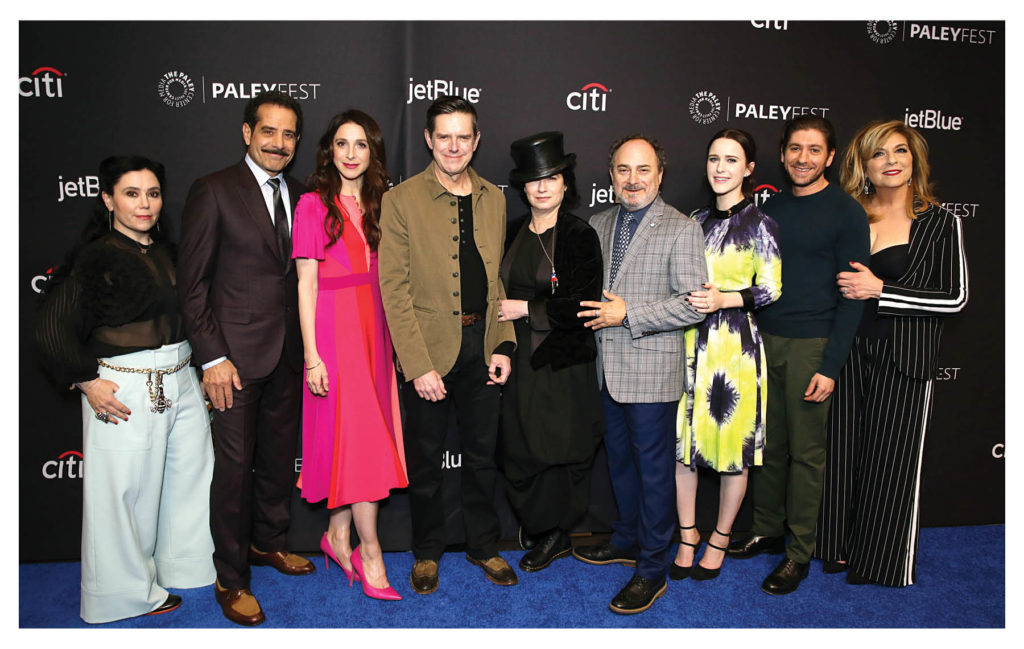
For the opening night of the annual PaleyFest LA television festival at the Dolby Theatre in Hollywood on March 15, the cast of “The Marvelous Mrs. Maisel” and its creators Dan Palladino and Amy Sherman-Palladino delighted attendees with wisecracks, character insights and a few hints about the show’s third season.
The lively, hour-long event featured a panel discussion moderated by Patton Oswalt that kept the packed house in stitches. Clad in black boots and signature top hat, Sherman-Palladino shared childhood memories about her stand-up comedian father, “a 6-foot-4 Jew from The Bronx” who is the inspiration for the series’ protagonist, Miriam “Midge” Maisel. Sherman-Palladino said she chose the1950s milieu because she loved the colors and cars, and “didn’t ever want to hear the word Snapchat.”
Rachel Brosnahan (who plays the titular Mrs. Maisel) said there wasn’t much time between accepting the role of Midge and starting production on the pilot. “I got a crash course in comedy,” she said, adding that she was filming the series and appearing on stage in “Othello” at the same time.
Tony Shalhoub talked about the inspiration for playing Abe Weissman’s reaction to his daughter’s stand-up career and his wife Rose’s newfound independent streak. “I have a lot of rage,” he deadpanned. “I’m the father of two daughters that are around the age Miriam is. You think you know who they are and then they turn out to be completely different people. They’ve become amazing human beings in spite of what my wife and I have tried to teach them.”
Comparing herself to her character, Susie, Midge’s lovably abrasive manager,
Alex Borstein said, “We’re very similar creatures in many ways. There’s a lot of Amy in Susie, also very much my grandmother, a Holocaust survivor, and my mother. But she exists in her own bubble, not informed by anything.”
“Susie is a tough broad, but she is terrified that she’ll lose everything that’s important to her,” Sherman-Palladino said. “The interesting thing about the dynamic between [Susie and Midge] is they’re not going to get where they need to go without each other, and that’s key to the series.”
According to Dan Palladino, viewers can expect some revelations about Susie’s past. “There’s a 10-year period in Susie’s life that we haven’t even delved into,” he said. “We find out things like she’s a very talented classical pianist.”
Michael Zegen, who previously “kicked people in the face” as gangster Bugsy Siegel on “Boardwalk Empire,” said that he has had far more negative reactions to his role as Midge’s husband, Joel Maisel. “On this [show], all I get is, ‘You’re trash!’ ” he said. “I’ve leaned into him being the villain.”
“The interesting thing about the dynamic between [Susie and Midge] is they’re not going to get where they need to go without each other, and that’s key to the series.” — Amy Sherman-Palladino
“You have the hardest role in the show because there’s nothing harder than being the guy who dumps the girl that everyone loves,” Sherman-Palladino said to Zegen. “But for the audience to give a [expletive] about Rachel, they have to see what she saw in him, for them to care that she lost him.”
Filming on the first episode of the third season in New York City is underway, and Sherman-Palladino characterized it as “a bigger show because the story has to push out.” Midge will be on the road and “dealing with audiences that aren’t her people. That is going to bring its own story twist to it,” she said. “We’re definitely going to some different places in Season 3.”
Miami is one of the rumored locations, but that topic was not brought up at the panel, and neither was the possibility of Sterling K. Brown playing a guest-starring role.
When asked what historical situations they’d like to see their characters in, the cast gave some surprising answers. “I’d like to see interaction with the birth of the feminist movement,” Brosnahan said of Midge. “’I’d also like to see her drop acid.” Shalhoub agreed with the last part, saying he’d like to see scientist Abe “tiptoe toward the whole Timothy Leary thing.”
“I would like to see Susie bang Elvis. A young, firm Elvis,” Borstein said. Zegen fantasized about Joel being at Woodstock, at Roger Maris’ 61st home run game, or opening a club where the Beatles could play. And Kevin Pollak, who plays Zegen’s father Moishe, posited this scenario: “Moishe makes a suit for [John F.] Kennedy, goes to the White House and steals an ashtray.”
The evening’s other comedic highlights included a discussion of the romper Abe wore to do his morning calisthenics. “I have it on underneath,” Shalhoub quipped. “It should be in the Smithsonian,” Dan Palladino said.
“I have no life,” Sherman-Palladino said when asked how she knows all the pop culture references in the show. She added that she has a storehouse of books and records at home, but calls upon a research librarian for tricky research questions.
As the session drew to a close, Sherman-Palladino had the last word, and used it to praise her cast, in typically profane fashion. “You can have a wonderful script and beautiful costumes and a gorgeous set,” she said. “But if you don’t have the right people, you’re [expletive].”
“The Marvelous Mrs. Maisel” is now on Amazon Prime.
Although Rep. Adam Schiff wasfirstelected to represent his Southern California district in Congress in 2000, and has been re-elected nine times, he didn’t become a household name until President Donald Trump took office in 2016.
The 58-year-old Jewish congressman who represents the 28th Congressional District, was thrust into the national spotlight as the Democrats’ Ranking Member of the House Intelligence Committee, where he struggled against the committee’s GOP leadership to conduct inquiries into Russian interference in the last presidential election. In January, he became the committee chair after Democrats took control of the House following the November midterm elections.
Over the past two years, Schiff has regularly appeared on cable news to talk about the importance of investigating the Russians’ interference and whether the Trump campaign was involved with it. As a result, he has become a target for Trump, who on Twitter has called him a “political hack,” “sleazy” and even “Little Adam Schitt” — a moniker the president later claimed was a misspelling.
“I would say my typical day over the last two years has been anything but typical of the preceding decade in office,” Schiff said during a recent telephone interview with the Journal, ahead of his March 19 talk at Temple Emanuel of Beverly Hills. “Going from minority to chair hasn’t changed the length of my days, which are already really long, or the nature of my work, except that it allows me to be in the driver’s seat of our investigation, rather than a passenger protesting that the driver isn’t serious about getting to the truth. So we now have the opportunity to bring in witnesses that we didn’t before, we have the ability to compel answers we couldn’t before, but we also have an adversary in the Oval Office determined to attack us and obstruct us in every way.”
Schiff said he is determined to have the committee’s investigation leave no stone unturned.
“The evidence of collusion has been hiding in plain sight for a long time,” he said. “The only way you can avoid seeing it is if you are willfully unwilling to look at the plain evidence.”
Schiff said he draws on his Jewish values in his work.
“My religious and cultural upbringing has instilled in me a respect for our institutions, a respect for fundamental decency and integrity, and appreciation of how much character matters,” he said. “And this is why I am so aghast at not only the occupant of the Oval Office, but how his fundamental lack of decency and morality has affected the whole of government.”
“There have been a lot of stresses and strains on the bipartisan nature of support for Israel. I think this is an enduring challenge we have yet to meet.”
— Rep. Adam Schiff
On Feb. 26, the House Intelligence Committee convened its first open hearing under Schiff’s leadership, during which former Secretary of State Madeleine Albright, among others, testified about the rise of authoritarianism.
“There’s a real rise of autocracy around the world,” Schiff said, “and I think that my Jewish background has really made me keenly aware of history, of the dangers of authoritarianism, of the toxic mix of economic disruption and a xenophobic brand of populism, where populist leaders can blame ‘the other’ for any economic distress. Jews have often been the most vulnerable victims of authoritarianism, but it is a danger for any minority.”
It’s also why, Schiff said, bipartisan support for Israel is more important than ever.
“We have to make every effort to ensure the U.S.-Israel relationship is nonpartisan, that it is strong, irrespective of who is in the Oval Office or the prime minister’s office,” he said. “And there have been a lot of stresses and strains on the bipartisan nature of support for Israel. I think this is an enduring challenge we have yet to meet.”
Schiff made these comments to the Journal on March 7, hours before the House of Representatives passed a resolution condemning anti-Semitism, Islamophobia and other forms of bigotry.
“I think [the resolution] properly identifies a number of anti-Semitic tropes and helps educate the public about the history of them and why they are pernicious,” he said. “I think it’s an appropriate response to the debate we’ve been having about a number of comments made the past few weeks.”
The House drafted the resolution following anti-Israel statements made by Rep. Ilhan Omar (D-Minn.). The ensuing controversy prompted Trump to remark that Jews and supporters of Israel were leaving the Democratic Party because of such comments. Schiff called Trump’s criticism of Omar cynical and hypocritical.
“I think the president is trying to exploit this situation for partisan purposes, which is singularly unhelpful after his comments equating people on both sides of the Nazi march in Charlottesville,” he said. “I don’t think he is in a position to weigh in on this credibly.”
Schiff also discussed his concerns regarding the relationship between Trump and Israeli Prime Minister Benjamin Netanyahu, coupled with Netanyahu’s aligning with a far-right, racist party before Israel’s upcoming parliamentary elections.
“I am concerned that the prime minister’s embrace of these far-right parties is only going to further alienate a segment of the American-Jewish community, not to mention progressives outside the Jewish community,” Schiff said.
While Schiff is now a player on the national stage, he’s still a champion of local issues.
Earlier this month he introduced the Rim of the Valley Corridor Preservation Act, co-sponsored by Senators Dianne Feinstein and Kamala Harris. If passed, the legislation would add more than 191,000 acres of mountain lands bordering the San Fernando, La Crescenta, Santa Clarita, Simi and Conejo valleys to the Santa Monica Mountains National Recreation Area and increase residents’ access to protected nature and wildlife in Los Angeles County.
Schiff also recently urged Facebook, Google and Amazon to remove content promoting misinformation about vaccinations from their platforms.
“So, on all these issues, these are very high priorities for my constituents and obviously quite far afield from the Russia investigation,” he said.
Regarding the upcoming 2020 presidential election, Schiff said the Democrats’ chances of unseating Trump were strong, but he declined to endorse any candidates.
“I think we’re going to have a very talented field running,” he said. “I’ve been very impressed with my home-state senator, Kamala Harris. I think she is doing a phenomenal job. I’m looking to hold off as long as I can to make a judgment.”
He also declined to speculate on whether he would one day seek higher office.
“It’s always flattering to be asked the question, ‘Will you run for president?’ I’ve had a lot of those questions over the last year or two,” he said. “People are urging me to run and people are urging me not to run because they want me to remain focused on my day job. In terms of what is in my future, the honest answer is, I really don’t know.”
One verse, five voices. Edited by Salvador Litvak, Accidental Talmudist
It shall be made with oil on a shallow pan, after bringing it scalded and repeatedly baked; you shall offer a meal offering of broken pieces, [with] a pleasing aroma to the Lord. –Leviticus 6:14
Miriam Yerushalmi CEO, SANE
Why offer broken pieces? Wouldn’t a whole offering be more honorable?
There’s a Chasidic saying: “Nothing is more whole than a broken heart.” This verse seems to hint at a step-by-step process to achieve that state of a perfect offering to HaShem.
First, “it shall be made with oil”: Oil represents the wisdom of HaShem, of Torah, the essential ingredient in our offerings and our lives.
“In a pan,” a vessel: In Chassidus, prayer is the vessel which prepares our body to contain the holiness of our soul, Torah and mitzvot.
“Shallow”: a minimal level of prayer is enough to start the purification process.
Then “scald” with boiling water: Water is Torah; by learning and fulfilling the Torah until its waters boil within us, we wash away our negative traits.
After that, bake repeatedly: Our learning has to “bake” long enough to become ingrained — we have to learn Torah thoroughly, again and again, so that we don’t come away with a half-baked understanding.
“Repeatedly baked”: There are three progressively more complete ways of bringing an offering. First, folded — the ingredients are combined, but not intrinsically, i.e., awareness of the mitzvoth. Second, baked — the surface is golden but the inside remains soft, we do the mitzvot without complete commitment. Third, fried —the oil permeates everything, the Torah’s wisdom reaches our inner soul.
Finally, “offer it as broken pieces”: With our feelings of negativity broken away, detached and powerless, we are made wholesome. Now, humble and refined, we give off “a pleasing aroma” to HaShem.
Shaindy Jacobson Director, Rosh Chodesh Society (JLI)
It is dawn on Friday. I am in my kitchen preparing to host a large number of guests for Shabbat dinner. The shallow pan glistening with oil, the pretzel challah dough scalded in a salty baking-soda solution, the twice-baked biscotti cooling in the corner, the broken pieces of chocolate almond bark artistically arranged on a platter. The incredibly pleasing aroma fills my kitchen, wafting toward every nook and cranny within the walls of my home, and beyond … to the garden, the backyard, the courtyard … to the courtyard of God’s home, the holy Temple.
This is my meal offering. This is the meal offering of every Jewish woman tasked with the duty of building a mini sanctuary within her very heart — birthed in the privacy of her family’s home and blessed to extend across continents.
As I contemplate the timeless meal offerings of our collective generations of upright, remarkable women, I am reminded of what we are taught in Deuteronomy (8:3), “Not by bread alone does man live, rather from that which emanates from the mouth of God …”
While in the Diaspora, the pan may be shallow, the dough scalded, repeatedly baked, the pieces broken — yet, we are forever uplifted by the glistening oil and the knowledge that the aroma we produce is pleasing to our creator.
For every meal we offer is but a reflection of acknowledgment that our relationship with God embraces each and every physical and spiritual offering that He extends to us in his supreme kindness.
Salvador Litvak AccidentalTalmudist.org
How can scalding and repeatedly baking flour create an aroma that pleases the source of all being? Apparently, humans also are capable of causing pain to the Almighty: “And the Lord regretted that he had made man upon the earth, and he became grieved in his heart.” (Genesis 6:6)
This is the ultimate act of humility. God is infinitely greater than any mortal, yet a) God feels pleasure/pain from our actions, and b) God wants us to know we have this power.
Why?
Every parent grants power to children. When they hurt, we hurt. When they cause pain, we hurt even worse. When they do the right thing, we feel pleasure. When they do the right thing because we ask, we kvell even more. Indeed, Rashi explains the pleasing aroma of a sacrifice in just this way. See Leviticus 1:9.
The only way to avoid these emotions is not to have kids. God took on this burden when God created us, and in fact, it’s a much greater burden than we can imagine. We see the pain our children feel and hurt because of it. God experiences our pain. Every single pain felt by every single person.
And that is why we must take God’s emotions seriously. We need to have compassion for the eternal. The commandment to love God isn’t just about reciting the Shema twice a day. It’s about shouldering some of God’s pain, and giving God any pleasure we can by doing the right thing, just because God asked.
Rabbi Gabriel Botnick Mishkon Tephilo, Venice
Two grain offerings unique to the Kohanim are discussed in this chapter: a standard grain offering, which is baked as matzah and then eaten; and this special offering for when a Kohen is anointed. This offering is not only baked, but also fried in small pieces — and then burned instead of consumed.
These two offerings speak to the nature of the priesthood and what it means to be a spiritual leader. The plain matzo represents the humility required. Refraining from eating the baked and fried pieces alludes to the necessity of self-restraint. The brokenness of the offering not only warns the priests to be sensitive to the broken spirits of the people Israel, but also serves as a reminder of their own brokenness — for indeed, no leader should consider themselves entirely without flaw.
Any leader who fails to embrace these traits not only fails to serve his or her people, but also fails to serve God. And even though we may not all be spiritual leaders, each of us is expected to strive for such spiritual excellence. Surely we will stumble in our endeavors, and few of us will ever achieve our goals, but remaining committed to the task is precisely the service that God desires — despite our failures, we are not free to desist from the struggle.
The aroma of these grain offerings may indeed be pleasing to God, but certainly not as pleasing as the air of humility we can attain by internalizing the lessons they teach.
Rabbi Miriam Hamrell Ahavat Torah Congregation
Why is the Torah so meticulous about this meal offering? This verse not only tells us what type of baking pan we should use, but also how to cook it. Rashi writes that it has to be boiled, baked, and finally broken into pieces and fried in a special pan. At the end, this priestly offering should be presented not “well done” or “raw,” but rather “medium.” Amazing balance!
Raphael Hayyim Basila, in 1560 in Italy wrote in Minhat Shai 78, that this is the only place in the Torah we read about such a practice. This is a Korban Toda-Mandatory Thanksgiving Offering, and it is done only by Aaron, the high priest, and his sons during the consecration rites of the Tabernacle. Keli Yakar, in 1580, adds that this is similar to Hametz, which has to be burned before Pesach. Hametz is equivalent to our Yetzer H’rah, evil inclination, our pride. He writes that, “from all the Midot, our character dimensions, this is the most important.” Why? Too much or too little is not good. We must find the balance. Hazal agrees and adds that this is similar to the thread of a spider. First, we barely see or feel it, but then it creates an impenetrable web.
Just like Aaron, when we come to consecrate our Tabernacle, our Mishkan with God, we find the balance and we leave our egos out. This should be followed not only with God but also with every person in our life. Amen.
The California State University (CSU) system on March 20 agreed to a settlement in a 2018 lawsuit that includes issuing a statement acknowledging Zionism’s importance to Jewish identity.
The case,Volk v. Board of Trustees, was filed on Jan. 30, 2018, in San Francisco Superior Court, and involved one recent graduate from San Francisco State University (SFSU), Charles Volk, and current SFSU student Liam Kern, alleging that SFSU and the CSU Board of Trustees discriminated against them when the campus Hillel was excluded from participating in the campus “Know Your Rights” fair in February 2017, whose goal was to inform students on possible threats to their rights on campus. Volk and Kern were regular attendees at Hillel events and wanted to participate in the fair as part of the organization. SFSU acknowledged in July 2017 that the fair’s organizers deliberately excluded Hillel from the fair; no action was taken against the organizers. Volk and Kern each filed a complaint to CSU’s Risk Management and Public Safety Department on May 2017 and August 2017, respectively, on the matter; both were denied.
Volk and Kern, who were represented by the Lawfare Project, argued Hillel’s exclusion from the fair and that the lack of action from SFSU and the CSU system constituted a violation of California’s Unruh Civil Rights Act, which states “that government entities, including state universities, refrain from taking actions that suppress the rights of students or deprive any students of full and equal accommodations, advantages, facilities, privileges, or services based on their religion, race, ancestry, or certain other characteristics,” according to the original lawsuit.
According to a copy of the settlement obtained by the Journal, CSU will issue a statement stating that it will protect the rights of all students at SFSU, including Jewish and pro-Israel students, and will acknowledge that “for many Jews, Zionism is an important part of their identity.”
SFSU also will be required to hire a Coordinator for Jewish Student Life within the Division of Equity and Community Inclusion, refer any cases of religious discrimination to an outside investigator, and allocate $200,000 toward “educational outreach efforts to promote viewpoint diversity (including but not limited to pro-Israel or Zionist viewpoints) and inclusion and equity on the basis of religious identity (including but not limited to Jewish religious identity).”
As part of the settlement, the June 2017 Mandel v. Board of Trustees federal lawsuit, which alleged that SFSU enabled anti-Semitism on campus and hence violated Title VI of the 1964 Civil Rights Act, will be dropped.
“We are pleased that we reached common ground on steps for moving forward.” — Mary Kenny
Volk told the Journal in a phone interview that he was “in shock, in a great way” about the settlement.
“I can’t believe it’s actually happened,” Volk said, adding that he hoped to see “the changes on San Francisco State’s campus, as well as other campuses that have the same issue.”
Brooke Goldstein, executive director of the Lawfare Project, told the Journal in a phone interview, “You can no longer say, ‘I’m not anti-Semitic, I’m just anti-Zionist’ and for that to be OK and for that to be an excuse to then target and harass and violate the civil rights of Jewish students. That will no longer be tolerated.”
“The school [SFSU] should have come to the table a long time ago,” Goldstein said. “But now, obviously after everything and all the efforts that were made, because they saw that they were going to lose and the discrimination was blatant and they did the right thing by settling with us and coming to terms with the issue.”
Goldstein added that it would be “bizarre” if other CSU schools didn’t follow suit and protect Zionist students on campus.
“They [the CSU system] would be opening themselves up for further litigation and they would lose because it’s on record — public record — that they’ve admitted that this is wrong,” Goldstein said.
SFSU spokeswoman Mary Kenny said in a statement to the Journal, “Today’s settlement in the Volk v CSU case brings an end to what has been a very emotional and challenging issue for all parties involved. We are pleased that we reached common ground on steps for moving forward.
“The settlement emphasizes the importance of improving student experiences and student lives,” Kenny added. “It allows S.F. State to reiterate its commitment to equity and inclusion for all — including those who are Jewish — and reaffirms the values of free expression and diversity of viewpoints that are so critical on a university campus.”
The CSU Board of Trustees did not respond to the Journal’s request for comment.
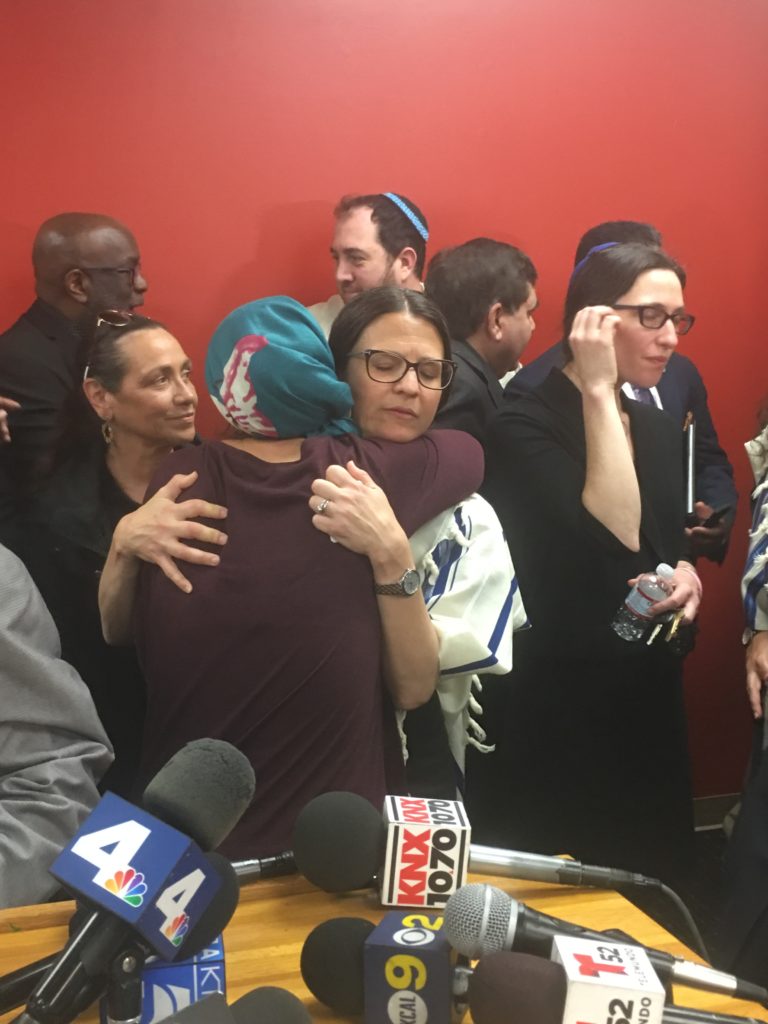
After the deadly attacks at the Masjid Al Noor mosque and the Linwood Islamic Centre in Christchurch, New Zealand, last week, Los Angeles interfaith leaders and elected officials quickly convened a press conference at the Islamic Center of Southern California (ICSC) in Koreatown on March 15.
Close to 100 people attended the gathering, including Jewish LGBTQ leaders; members of modern Orthodox congregation B’nai David-Judea and egalitarian community IKAR; clergy from Wilshire Boulevard Temple and Beth Shir Shalom, and American Jewish University faculty and students.
“We are a city that is called ‘the City of Angels’ and today I feel those wings stretched out and joining together,” Los Angeles Mayor Eric Garcetti told attendees. “Our angels weep today as well for our brothers and sisters in New Zealand, for an attack on the most basic human impulse that we have — to talk to ourselves and to our God.”
IKAR Senior Rabbi Sharon Brous denounced the role Islamaphobia, anti-Semitism and other forms of bigotry play in mass violence.
“Today we lift up all the survivors of violent hatred, from the Tree of Life to Sutherland Springs, to Mother Emanuel, to Oak Creek,” Brous said. “Today we lift up all the survivors and all of those who have lost loved ones to gun violence in this country and around the world, including some in our own family, who stand here today.”
ICSC Civic Liaison Hedab Tarifi said the way to prevent further acts of violence was for people of different faiths to unite. “We have no choice but to come together and work together in protecting the human family,” she said, “and working against and exposing that there is no one race that takes over and is supreme to the others. God created us all as one human family. It is our responsibility to protect that human family and keep the world safe for new generations.”
Tarifi added that she was annoyed after hearing that following the attacks, the mosques in New Zealand had been closed. “They need to come to L.A. to learn from example we have,” she said.
Tarifi made her comment after Los Angeles Police Department encouraged everyone to visit their various places of worship over the weekend to send a message that they will not let acts of hatred deter them from freely practicing their religions.
“The way we show the world our humanity, the way we show that this will not stand and the cowardliness of it, is by leaning into our faith, by leaning into our ability to demonstrate that the good of this world far outweighs the evil,” Moore said.
Salam Al-Marayati, president of the Muslim Public Affairs Council, said pluralism has the power to combat hate. “We are calling on our congregants to stand tall against hate, stand together as one country and one people,” he said.
Beth Shir Shalom Rabbi Neil Comess-Daniels chose to share his message via song, calling on everyone to fight hate with love. “Love, only love with all your heart; love, only love with all your soul,” he sang, finger picking the guitar strapped across his body.
“We needed that,” American Muslim leader Edina Lekovic said, thanking Comess-Daniels.
Rachel Simmons, a third-year rabbinic student at American Jewish University and a rabbinic intern at Shomrei Torah Synagogue, told the Journal that when she learned about the attack she cried. She then reached out to her teacher, Rabbi Aryeh Cohen, asking what to do.
Cohen, a professor of rabbinic literature at American Jewish University, told her about the gathering and they attended together. “The only way we to get through this is if we have each other’s backs,” Cohen told the Journal.
Simmons agreed. “For me, one of the holiest things you can do is accompany someone in their grief,” she said. “My duty is to show Muslims their pain is my pain.”
“See,” Cohen said. “She is my student.”
For many Jews, the gathering was also an opportunity to repay the favor after last year’s shooting at the Tree of Life synagogue in Pittsburgh, when Muslim community members raised funds for the families of the 11 victims and even offered to stand guard outside synagogues on Shabbat.
“For me, one of the holiest things you can do is accompany someone in their grief. My duty is to show Muslims their pain is my pain.” — Rachel Simmons
“I saw the amount of support the Jewish community was shown with Pittsburgh,” Wilshire Boulevard Temple (WBT) Cantor Lisa Peicott told the Journal, “and I just knew I had to be here to show the Muslim community we are in full support and we stand together against all kinds of hate and intolerance.”
“As Jewish people, we are standing up for those who are dealing with such horrible acts of violence, showing that we not only are thinking of them, but we are here standing and reaching out, as they have done with us,” WBT Rabbi Susan Goldberg said.
And as Jewish communities come together to support their Muslim brothers and sisters, the Tree of Life congregation in Pittsburgh currently is raising funds for families of the New Zealand victims. As of press time, it had raised nearly $16,000 of its $100,000 goal.
“We stand with our Muslim brothers and sisters and mourn alongside the families and friends who have lost loved ones in this unconscionable act of violence,” Tree of Life said in a statement. “We will continue to work toward a day when all people on this planet can live together in peace and mutual respect.”
Los Angeles-based NewGround: A Muslim-Jewish Partnership for Change also issued a statement, saying, “As we begin another week here at NewGround, our team is thinking of the families mourning in New Zealand. We are also thinking about how our emphasis on understanding and plurality becomes more relevant by the day.”
Michael Jeser, president and CEO of the Jewish Federation of San Diego County, also issued a statement saying, “Today, our Jewish community should say, unambiguously, that these acts of murder cannot be tolerated. Today, we reaffirm our core belief that the hate and bigotry that fuel such acts must be challenged, confronted and condemned in every corner of our society.”
“We thought we were the last heaven on Earth but we woke up to a new reality.”
Rabbi Natti Friedler, senior rabbi of Auckland Hebrew Congregation (AHC) in New Zealand, is attempting to sum up the shock waves that have ricocheted through a country with a population of barely 5 million in the aftermath of the March 15 shootings at two mosques in Christchurch that killed 50 people and injured scores more.
Speaking with the Journal by telephone on Sunday afternoon, March 17 (Monday evening New Zealand time), the Israeli-born Friedler, who has been in New Zealand for the past 4 1/2 years, said for the country’s Jewish population, which is only between 8 and 10,000, the horrific attack on a minority group by an alleged white supremacist has left the community on edge.
“We very much felt like what happened in the [Tree of Life synagogue] Pittsburgh shooting,” he said. “God forbid there is another crazy attack. In Pittsburgh, the man was also a white [supremacist]. We were all shaken.”
Friedler explained that there are only four shuls in New Zealand (not counting separate, small Chabad centers). They are situated in the two main populated areas of the country: Auckland in the north and Wellington in the south. Friedler’s Orthodox AHC is the largest synagogue in the country, with approximately 600 members. He said in Christchurch, there’s just a Chabad rabbi that comes in the summertime.
In the immediate aftermath of the attacks, the news spread that New Zealand closed its synagogues over Shabbat in solidarity with the Muslim community. However, Friedler said, the decision was made by the police, who feared for the Jewish community’s safety.
AHC is also home to Kadima elementary school and the only Jewish school in New Zealand. “We have the Jewish Community Security Group (CSG),” Friedler said, “and straight after the shootings they were in touch with the police. The police had to send most of their forces to Christchurch. Because [the police] couldn’t secure our shul, we had to close.”
The shul remained closed over the weekend and the school was shut down on Monday, March 18. By Monday evening, AHC and Kadima were given the all-clear to open their doors.
“We’ve had two security guards outside the shul for at least the last 20 years,” Friedler said, “but the guards aren’t armed. They’re mostly a [deterrent]. Most police officers don’t have guns here, only those in special units.”
Now, however, Friedler said he believes these laws will be re-examined. “I think things are going to have to change in that regard,” he said. Friedler made his comments shortly after New Zealand Prime Minister Jacinda Ardern promised major gun reforms in the wake of the worst attack on New Zealand soil.
Although they had to keep the synagogue closed, Friedler held services over Shabbat in his own home. “The [New Zealand Jewish] community is 150 years old and this would have been the first time in the history of the shul had we not had services,” Friedler said. “That was very important for us and to say Am Yisrael Chai.”
So Friedler rushed into the shul to bring home siddurim, Chumashim and a sefer Torah. “We had 20 people on Friday night and around 50 people on Shabbat morning. As you can imagine, the Shabbat before Purim is a very busy one,” he said.
The decision [to close synagogues] was made by the police, who feared for the Jewish community’s safety.
Given that New Zealand is part of the Commonwealth of Nations, the community recited the prayer for Queen Elizabeth II, the government and the people of New Zealand as it does every Shabbat. And because it was Shabbat Zachor — when the Jewish people remember Amalek — Friedler said, “We really felt like Amalek is still alive and kicking.”
Friedler hastily cobbled together his sermon about the power of Amalek and the connection to the Purim story and the greater world at large (see sidebar).
The importance of taking care of all people is something Friedler feels very strongly about. Over the years he has built up a strong relationship with the local Muslim community at Auckland’s Ponsonby mosque, just 10 minutes from AHC’s premises.
“About three years ago, we invited both the male and female mosque leaders on a special tour of our synagogue,” Friedler said. “We had a brand new sefer Torah written — the first ever by a local New Zealand scribe. We invited the mosque leaders to join us celebrating the dedication. They came and danced with the sefer Torah. It was incredible.”
On the Sunday after the attacks, Friedler, together with Rabbi Ariel Tal of the Wellington Jewish Community Centre sent the following letter to the imams of the mosques that were attacked in Christchurch.
Dear Imam Ibrahim Abdelhalim and Imam Gamal Fouda
The Jewish Community of New Zealand mourns the cold-blooded murder of the innocent worshipers at the Masjid Al Noor and Linwood Masjid in Christchurch. We condemn those responsible and offer our deepest sympathy to the grieving families. We pray for the speedy recovery of the wounded.
We stand together against this horrific attack on the Muslim community of New Zealand. An attack on a mosque is an attack on a synagogue. It is an attack on the most sacred place both religions share. A holy place that should reflect our connection to God. We are all created in His image.
Instead of entering this place of worship in respect and reverence, a godless evil man took the lives of 50 innocent people. Our sages teach us that the person who saves one life is considered as if he had saved the entire world. By contrast, a person who takes one life is considered as if he has destroyed the entire world. So many worlds were destroyed on Friday. Our hearts cry out and we mourn with your families.
We are all the children of Abraham; we commit to fighting darkness by adding more light to the world. Abraham was famous for his kindness and hospitality. These traits are key to both Islam and Judaism and to our entire world. Through kindness we can heal the world and bring peace to the whole human race.
“We are all the children of Abraham. Abraham was famous for his kindness and hospitality. These traits are key to both Islam and Judaism and to our entire world. Through kindness we can heal the world and bring peace to the whole human race.”
— Rabbis Natti Friedler and Ariel Tal, NZ
May God heal the broken hearted and the bereaved families.
We offer our prayers and support during this difficult time to the Muslim community and to every New Zealander. We are one and we are strong together.
On March 20, Friedler joined a New Zealand Jewish delegation and made the 700-mile trek to the Al Noor mosque in Christchurch.
Friedler told the Journal, “Today we paid respect to the victims of the Christchurch massacre, and showed support and unity as the Jewish community in New Zealand to the bereaved families and the Muslim community in New Zealand. May their memory be a blessing to all the people of New Zealand.”
Heading back home to celebrate Purim, Friedler said, “We are going to speak with the teachers [at the school] and the children. We have to somehow explain how something like this can happen. We have to explain there is still evil in the world and we have to fight that but also our main goal is to be a light. The more we are kind to each other and our neighbors and other faith groups, we are bringing godliness to the world.”
There are also plans in the works to create a special fund for the families of the victims in Christchurch as part of matanot la’evyonim (gifts to the poor) on Purim.
This coming Shabbat there will be a special service, where local Muslim leaders will be invited to join.
“We in New Zealand are basically the southernmost Jewish community in the world,” Friedler said. “But whatever we have here we really appreciate it. We’re small but vibrant. Evil can reach any corner of the world. Only by standing together and educating our children can we prevail and run out this darkness.”
Australian Jewry Confronts White Nationalism It’s a little over 1,300 miles as the crow flies from Sydney, New South Wales, Australia, to Christchurch, New Zealand. As an expat Sydneysider, I’m familiar with the good-natured rivalry between the Aussies and the Kiwis (as New Zealanders are affectionately known).
However, in the wake of the March 15 shootings, the entire Australian-Jewish community has been reaching out to its Kiwi neighbors in solidarity, and the fact that the shooter hailed from New South Wales has hit home in the state best known for its glorious beaches and iconic Harbour Bridge and Opera House.
The Great Synagogue, located in the center of Sydney’s bustling business district, is the city’s oldest shul. Currently led by Chief Minister Rabbi Benjamin Elton (who hails from Manchester, England), the Orthodox synagogue serves around 550 families.
“The community is in shock and deep anguish,” Elton told the Journal in a phone conversation. “People are also very disturbed that it was an Australian who perpetrated [the attacks]. But there’s also a feeling of community solidarity,” he added.
While the community is still coming to terms with the attacks, Elton said the local Jewish Community Security Group (CSG) hasn’t increased its danger level. “They’re taking the view that things haven’t gotten substantially worse but [our shul] always has armed guards and quite often the police come round to check on us. We always take our security very seriously.”
After the Friday shootings, Elton said he had no time to prepare a new sermon that Shabbat but during Shabbat memorial prayer services, “I mentioned the atrocity and said we were thinking about the victims and the survivors.”
“Free and democratic societies urgently need to do two things in response. First, we must examine and improve the way we conduct political debate… Secondly, our law enforcement agencies must take to heart the fact that the threat of terrorism does not emanate exclusively from one source.”
— The Executive Council of Australian Jewry
He did add, however, that he “dropped an allusion” into his Shabbat Zachor sermon. “We remember what Amalek did to us so I talked about Amalek in every generation. I said there were Nazis 80 years ago and we still have neo-Nazis with us today, including those behind the Christchurch attacks.”
Elton said he inserted those allusions “on the spot, because I think the spirit of Amalek doesn’t just apply to oppressing Jews but to all genocidal and cruel behavior.”
Heading into Purim, Elton said, “I think we’re able to compartmentalize. Purim doesn’t diminish the tragedy but the tragedy doesn’t mean we cancel Purim. The happiness and the tragedy just have to be held at the same time.”
Having worked at the Great Synagogue since 2015, Elton said over the years he has been very involved in interfaith work, attending meetings and Iftar dinners with the Grand Mufti of Australia, who’s the senior Sunni cleric, and he has taken part in countless interfaith discussions between Jews, Muslims and Christians, many of whom have become personal friends.
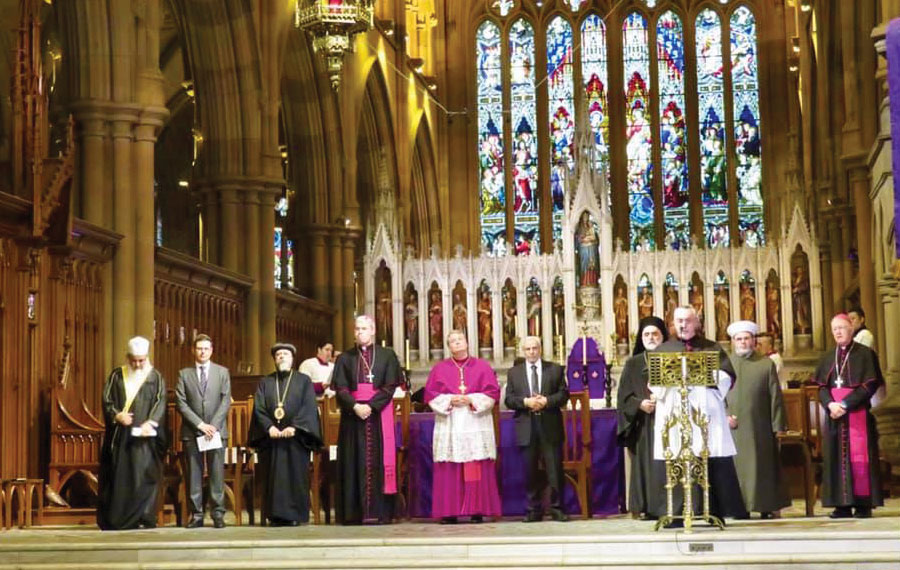
The Interfaith Service of Remembrance held at St. Mary’s Cathedral, Sydney on March 17. Photo by Jeremy Jones
On March 17, a huge interfaith service was held at St. Mary’s Cathedral in Sydney, which Elton attended. “It was an opportunity for us to pay our respects,” he said.
Moving forward, Elton said the lay leadership organization, the NSW Jewish Board of Deputies, is holding an additional prayer service for the victims and their families this week at their weekly meeting, and they’re also raising money to send to the community in Christchurch. “It’s not just words and prayers,” he said. “We’re sending practical assistance.”
The Journal also reached out to Sydney-based Peter Wertheim, the co-executive officer of the Executive Council of Australian Jewry (ECAJ), the peak organization representing Jews in Australia.
Wertheim directed the Journal to two timely pieces: an essay he wrote in August 2018 for the Australian Broadcasting Commission’s Religion & Ethics section, about how law enforcement agencies have a history of being blindsided by far right groups. In his essay, he states: “Miniscule far-right political groups have for decades inhabited the murky fringes of Australian politics. The last ten years have seen a burgeoning of such groups. They represent every conceivable gradation of far-right political opinion, from anti-immigrant and anti-globalist groups who seek to “restore” Australian democracy, to secretive cabals of Hitler-saluting neo-Nazis who are intent on overthrowing it.”
The second piece, Wertheim noted, was “chillingly prescient.” It was a report compiled just last month by ECAJ’s Research Director Julie Nathan, who has been tracking and writing about far-right groups for several years.
The New Zealand shooter wrote in his manifesto about the need for “White Replacement.” In the opening to her paper last month, Nathan wrote, “Little more than a year ago, far-right activists in Australia could reasonably accurately be divided into three ideological groupings: civic patriots, nationalists and racialists. Whatever they might be said to have in common, these groups differed fundamentally in their beliefs about race, religion and citizenship. But now, something far more sinister is going on. There has been a move further to the right by the civic patriots and nationalists, and a general convergence around the racialist myth of “White Replacement.”
Nathan goes on to say: “Such political exploitation of racism and religious bigotry is nothing new. It preys on fears about non-European immigration into Australia, and attempts to revive the old “White Australia” conviction that Australia should be almost wholly, if not fully, composed of those of European ethnicity and Christian culture. Even indigenous Australians are air-brushed out of the picture. Variants of this kind of “nativist” populism are percolating in Australia, and throughout the world.
The ECAJ issued a statement after the attacks that read, in part, “The ideology that drove this particular terrorist, known as the “white genocide” myth, which supposes that Europeans are being exterminated by non-European immigration and multiculturalism, has been invoked to justify the massacre of African-American worshipers at a church in Charleston, South Carolina, in 2015. It was invoked by the terrorist Anders Breivik in 2011 when he murdered 77 innocent people in Norway. And it was invoked again by the terrorist who massacred Jewish worshipers in a synagogue in Pittsburgh just last year.”
The statement also said, “We mourn with our Muslim brothers and sisters for what they have lost. For the desecration of their sanctuary. For the loss of their loved ones. For the deprivation of their sense of peace and security. We extend our deepest sympathies to the communities affected, to the people of Christchurch and to the Islamic community in Australia.”
“Such political exploitation of racism and religious bigotry is nothing new. It preys on fears about non-European immigration into Australia, and attempts to revive the old “White Australia” conviction that Australia should be almost wholly, if not fully, composed of those of European ethnicity and Christian culture.” — Julie Nathan
However, the ECAJ also issued a call to action, stating, “Free and democratic societies urgently need to do two things in response. First, we must examine and improve the way we conduct political debate. As the Nazi Holocaust and the mass crimes in Rwanda and the former Yugoslavia demonstrated all too clearly, genocide does not begin with killing. It begins with words. Political, community, religious and civil society leaders all have a duty to lead by example, by setting the right tone of discourse from the top.
Secondly, our law enforcement agencies must take to heart the fact that the threat of terrorism does not emanate exclusively from one source. The old saying that the price of liberty is eternal vigilance remains as true as ever.”
Purim As a Response to Christchurch Attack
March 18, 2019 / Adar II 11, 5779
Dearest members of the Jewish communities in Auckland and Wellington AHC, WJCC and wider Jewish community,
Purim is about eradicating Amalek from the world, fighting evil. On Friday, evil struck in Christchurch. A terrorist murdered 50 innocent Muslims and injured another 48 people. This is the manifestation of Amalek in our times, here in New Zealand.
On Shabbat we read Parashat Zachor, reminding all of us that Amalek is still a relevant issue that terrorists and evildoers still lurk among our communities seeking to destroy Am Israel and any other communities that they target out of sheer hate and intolerance.
Our hearts go out to the victims, their families and communities in Christchurch and throughout New Zealand. Our hope and prayer is that this monstrous act will never happen again. Yet the question remains: What can we do as a Jewish community in these dark times?
Our synagogues were closed over Shabbat, with each community having “pop-up” and impromptu minyanim at the rabbis’ houses. We mourn with the victims of Christchurch, and did not stop our prayers, especially in these dark times. Because we are in unprecedented times of national terror in New Zealand, this is the time to strengthen our communities. This is the time to come together.
There is a deep insight into the Purim story that speaks to the power of coming together. King Achashverosh invited all residents of the Persian Empire to a party that lasted 180 days, catered to each and every person and culture in the 127 provinces — “Kirtzon Ish Va’Ish” — according to the will of each person and person. The Be’er Emunah explains that there is an extra letter in the second word — the letter “vav” in the word “Va’Ish.” The word “Va’Ish” are the same letters as the Hebrew word (“Ye’ush”) or despair. In other words, Haman and Amalek attack the Jewish people in order to create despair.Mordechai and the Jewish people are the antithesis of Haman and create hope and strength wherever they go. Mordechai fights evil and ultimately defeats Haman.
This Purim, let’s strengthen the Jewish communities in New Zealand and show our solidarity for the residents of this amazing country. We will raise a campaign to strengthen the victims of Christchurch through our Matanot La’Evyonim, our Purim gifts, and make a statement that terror, fear and despair will not prevail, hope and love will.
We encourage all of our members and wider Jewish community to show up for our Purim events in Auckland and Wellington, and will publicize it with the hashtag #ShowupforPurim. Just as Queen Esther ordered Mordechai when Haman’s threat to eradicate the Jewish people was imminent — go and gather all of the Jews. So, too, we will gather in these dark times and strengthen our community. We will have a prayer session for the victims of the attack during Ma’ariv on Purim night in each synagogue, on Wednesday, March 20, and will celebrate the holiday of Purim in a united stance to stand up to Amalek, stay strong and never despair in our faith and right to our religious freedom and any religious freedom in this country.
Should a prime minister debate with a model online? Maybe not. And yet, during election seasons, strange things happen, including a short and fierce debate between Prime Minister Benjamin Netanyahu and Rotem Sela, an Israeli model, TV personality and actress. She said, then he said, then “Wonder Woman” actress Gal Gadot defended Sela, then Netanyahu’s backers piled on Sela. If the right-religious coalition wins the upcoming election, the Sela moment could serve as a guide to the perplexed observer as to why the right-religious coalition rules and why the other side keeps failing.
The exchange, and even more so the aftermath, is based on a misunderstanding. Sela was upset, and rightly so, by the fact that so many politicians regard the Arab vote as semi-illegitimate. “When the hell will someone in this government let the Israeli public know that this is a country for all its citizens and that every person is born equal. And also, that the Arabs are human beings,” the model wrote on Instagram, on which she has close to 1 million followers.
Netanyahu sensed an opportunity. Maybe this would be his 2019 “Garbuz moment.” Four years ago, Yair Garbuz, a well-known Israeli artist, unified the right by being condescending toward traditional right-wing Israelis during a leftist rally just a few days before election day. Living in his silo of secular leftists, Garbuz might not have realized that looking down at “mezuzah kissers” is not a good way to connect with, well, Israelis who like their mezuzahs. Sela, apparently, has a similar problem. She thought she was stating the obvious, when in fact she pushed a red-alert button. What did you just say? A state of all of its citizens?
This is where misunderstanding begins. Of course, Israel is a country in which all citizens have equal rights. And when they don’t, this should be corrected. But — and this is why Netanyahu was quick to zero in on Sela’s comments — in the Israeli context, a “state of all of its citizens” is not a technical description of a desired legal situation. It is a political statement. A “state of all of its citizens” is the code term used by those wanting to eliminate the character of Israel as the nation-state of the Jewish people.
In a response to Sela on Facebook, Netanyahu reaffirmed that all Israeli citizens have equal rights. However, he added this distinction: “According to a basic law we passed, Israel is the nation-state of the Jewish people — and the Jewish people only.” I must admit, when The Washington Post publishes such statement without context, this sounds awful. It sounds as if Israel doesn’t want to treat its Arab citizens equally. But to the trained Israeli ear,what the prime minister wrote is quite obvious. Israelis, by and large, don’t want Israel to become a “state of all of its citizens.” Not in the way most proponents of this slogan mean it. Not in a way that will make Israel nationally-neutral.
That’s the misunderstanding. Sela was trying to be sympathetic to Arab voters — a noble intention — but was tone deaf to the way her words are interpreted by Jewish voters. She thought that she was defending a minority, when in fact, she was attacking the majority.
“Israelis, by and large, don’t want Israel to become a “state of all of its citizens…” Not in a way that will make Israel nationally-neutral. “
Netanyahu wants to make her the poster girl of the left. He wants her to be a Garbuz. He cynically uses her to make the same argument that he famously made in the mid-’90s, as he was whispering in a rabbi’s ear that “the left forgot what it means to be Jewish.” You think Sela had won this short battle when Gadot defended her? You think a supportive story in The Forward or Haaretz proves that the prime minister finally botched it by going against a popular figure? (“Israeli politicians, beware: Don’t mess with Rotem Sela. The woman knows how to look good while discussing public policy and nursing a baby”).
Think again. Arab Israelis support Sela’s views. Jewish Israelis — except for a tiny minority on the far left (4 to 5 percent) — vehemently oppose her views. Not because these Israelis are racist. Not because they don’t want Arabs to have equal rights as citizens. Many of them do. But they also want Israel to remain a Jewish state. They insist that Israel must remain a Jewish state. And they understand that Sela, unintentionally, goodheartedly, naively, was speaking the language of Israel’s most cunning enemies.
Shmuel Rosner is senior political editor. For more analysis of Israeli and international politics, visit Rosner’s Domain at jewishjournal.com/rosnersdomain.