After services the other day, I asked a fellow mourner how much longer he had to say Kaddish. “Wednesday,” he replied, with a smile a mile wide. He then called out to another mourner, asking him the same question and was told “Friday.” The two of them shared a moment of unabashed glee. For each of them, freedom was but a week away. I stood beside them, jealousy running through my veins like a prisoner who has longer to serve, and walked away, my head down.
I am tired, drained. The emotion is no longer present each time I utter the words of the Kaddish. I no longer pause to seek out an image of my father to be omnipresent during the prayer. The prayer has evolved into a monotone expression, a chore rather than what began as a moment of remembrance, replete with memories and love, a symbol of honor and respect. I am in the tail end of a marathon of prayer, a yearlong observance of saying the Kaddish for my father, three times a day, seven days a week. And just as when I ran a marathon I slowed around mile 20, I do the same now, continuing to labor onward toward the finish line, but wondering, at times, what exactly I signed up for.
By my count, I have recited the Kaddish over 1,300 times. Six times a day during the week, minimum; more on Shabbat. I can count the number of minyans I have missed on two hands. Our tradition has come a long way from when saying it once a day satisfied the requirement. (Maybe this is the progress our rabbis speak of when they compare themselves to the Talmudic scholars.) Using the math of the initial tradition, and the 11 months of Kaddish we say ostensibly to help lift our loved ones up to heaven, my father should have joined the angels over 1,000 Kaddishes ago. Yet I continue, at a frenetic, almost manic pace that has caused me undue stress, anxiety and tension.
Is there any other way to define the year of saying Kaddish? Is the year of mourning supposed to be accompanied by levels of stress doctors would characterize as unhealthy and encourage me to discontinue for medical reasons? Of course the Kaddish is not designed for those who do not regularly attend services. If one is a regular attendant at morning and evening minyan — and I continue to be amazed and exasperated at the level of commitment people show, which has to come at the expense of family and marital obligations — the addition of a single prayer is no big burden. But for the many of us for whom Kaddish is a life-changing event, the burden can be overwhelming.
Still, I continue to endure. I go because my faith says so, as childish as that sounds. I go because tradition dictates it, because this is what my father did for his parents, and I presume what my grandfather did for his parents and so on, back through time. I am comfortable with that. Maybe comfortable is not the right word, as it does not reflect my exhaustion. Resigned would be a better choice.
I have said the Kaddish in three different countries, numerous cities. I have been in Orthodox synagogues, Conservative synagogues, Chabad services (which are unique to themselves) and services in people’s homes for shivah or while on vacation when skiing in the mountains of Whistler. I have had the warmest welcome from an ex-federal convict who could not have been more kind in helping me with the Kaddish and received the coldest reaction from a kollel rabbi who refused to cede the pulpit to me despite the fact that I “qualified” — if that is the right word — to lead the service at his evening minyan. I have said the Kaddish alone in a room full of over 100 people and have said it in a chorus of other men who make up almost the entire quorum. By now, the routine is rote; the saying of the Kaddish has largely lost its meaning as time goes on.
Except for the Saturday night service that concludes with Havdalah. When I see the Havdalah candle being lit, I see my father’s face rising above the fire. I recall my mother’s superstition from growing up, her belief that Shabbat was also a day of rest for those in hell, and that prolonging the Shabbat gives them extra peace. I stand in shul, alone in thought, hoping he is at peace. I am not really sure what that means anymore. The Kaddish journey has neither affirmed nor refuted any concept I may have had of an afterlife. If anything, I fear that this is it. That the day I stop saying Kaddish, his memory will dwindle further from people’s minds; that the day I stop declaring this donation or that donation in his memory, his memory will recede even further until a dog-eared, or shall I say digitized, picture of him remains on my screen or in some rarely accessed folder on my children’s computer that one day they will show to their kids or grandkids and say this was their papa. What will they say about him? What can I say?
A few weeks back, while I was at a synagogue for the first time, the rabbi kindly approached me afterward, first to apologize for the way the shul said the Kaddish together in unison at one juncture (I had unknowingly jumped the gun and was immediately shushed by some of the congregants). He then asked me about my father, a question I had not heard in some time, though it is a mainstay of the shivah circuit and for Kaddish novices. I was caught off guard and instantly felt my eyes well up. Because in truth, it had been some time since I had had a conversation about my father where someone wanted to know about him, how he had lived, how he died. And last, how I was doing.
Eight months in, I have no answers to the last question. I wonder whether the Kaddish routine has shielded me from thinking about him. Has it prevented me from truly grieving? Have I become so obsessed with minyan times that I have forgotten why I am in shul in the first place? It is impossible to forget, of course, as I am consumed by making it to the minyan and saying Kaddish. But in that focus, I worry I may have forgotten how to really grieve. I march on, 100 days to go, and yes, I am counting.
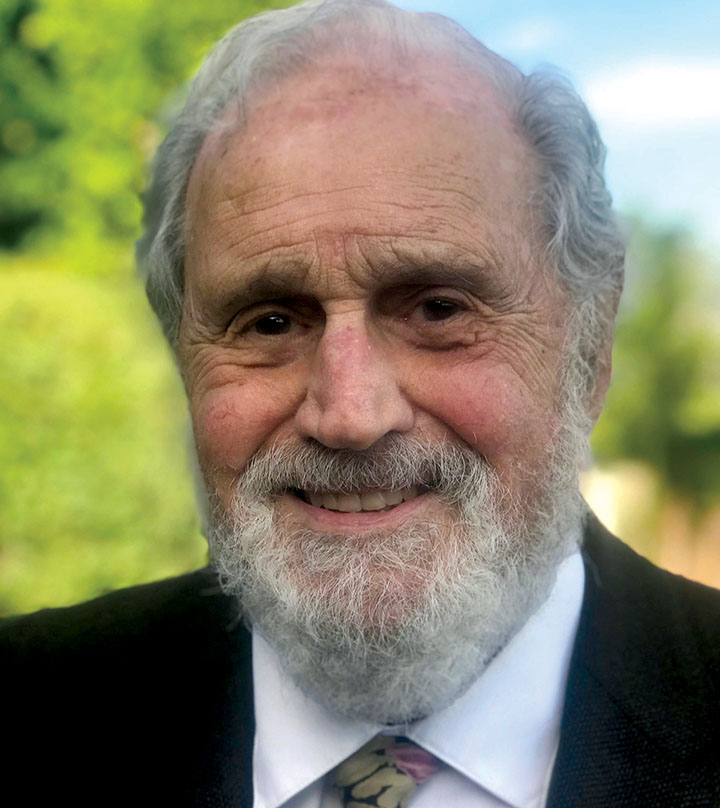
Joshua Metzger works at an online video start-up in Los Angeles. He has also written two plays, the first of which was selected for development at the National Playwrights Conference. He attended Jewish day schools in New York City.