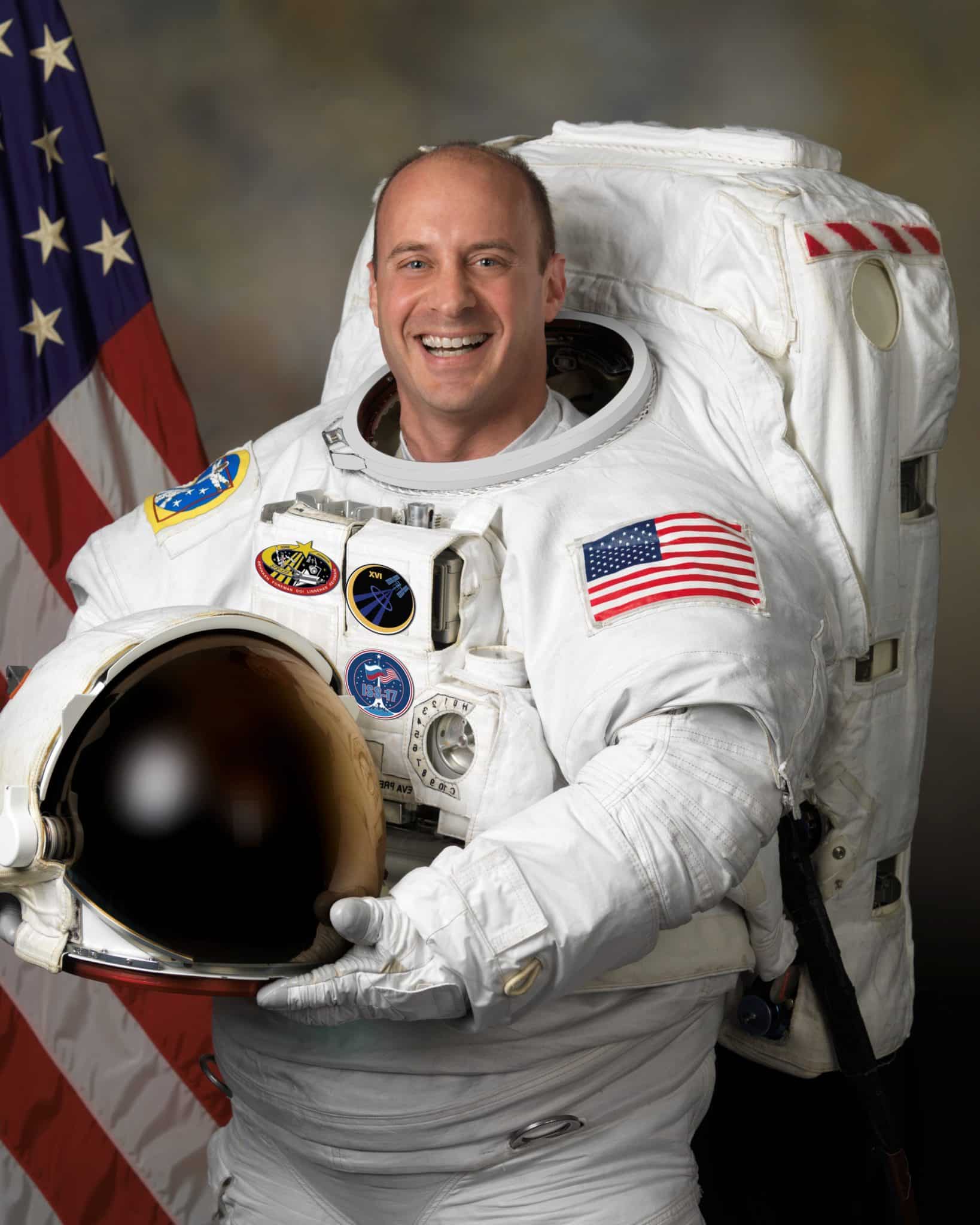
With last month’s Space X launch of the Crew Dragon, there’s a renewed enthusiasm for space travel. While the interest may be new to some, it’s been a longtime passion for Garrett Reisman, who has made two trips to the International Space Station (ISS) — first aboard Space Shuttle Endeavour, and later, on Space Shuttle Atlantis. During his time there, he participated in several spacewalks and operated the ISS robotic arm.
After departing NASA in 2011, he joined Elon Musk’s SpaceX, where Reisman held a variety of positions. He left SpaceX in 2018 and became a professor of astronautical engineering at USC’s Viterbi School. Reisman also is a civilian pilot and a certified flight instructor.
The Journal caught up with Reisman to discuss all things beyond planet Earth.
Jewish Journal: Were you always interested in space travel?
Garrett Reisman: I became fascinated with space travel a long time ago. I thought it was the greatest adventure you could ever have. I was a science-fiction fan, but the real space program absolutely captivated me. Back then, almost all astronauts were test pilots and I had a typical Jewish mom who wasn’t going to let her boy become a test pilot. She was afraid to fly just on a regular plane flight.
JJ: Did you ever get her to change her mind?
GR: Once I became a pilot, I finally got her to fly with me. I was taking my dad and sister and joked, “You don’t want to be the only one left.” So, she decided to join us.
JJ: When did you start thinking seriously about pursuing a career as an astronaut?
GR: As I was nearing the end of my time as an undergrad, I was able to get a hold of some NASA bios. And I saw that they weren’t all test pilots. There were engineers and scientists and doctors. In that moment, everything changed. I thought maybe becoming an astronaut was within the realm of possibility.
JJ: What does it feel like in the space shuttle?
GR: It’s very exciting. You know, intellectually, that it’s not the safest way to spend a Wednesday, but what you’re more afraid of is making a mistake. When you’re on the launchpad, your crewmates are counting on you and you don’t want to mess up. The biggest anxiety is about doing a good job. There’s a lot of shaking, and of course, you feel the G-force, which gets up to three times your body weight.

JJ: You were the first Jewish astronaut on the International Space Station. Does that have any special significance to you?
GR: It was significant to me, and I tried to treat it appropriately. I actually took a mezuzah with me and kept it at my sleep station. Being the only Jewish astronaut on the space station didn’t last long, because the guy who replaced me was Jewish. I would joke with him to remember that he’s number two. I think there’s been around 13 or 14 Jewish astronauts altogether.
“I actually took a mezuzah with me and kept it at my sleep station. Being the only Jewish astronaut on the space station didn’t last long, because the guy who replaced me was Jewish. I would joke with him to remember that he’s number two. I think there’s been around 13 or 14 Jewish astronauts altogether.” — Garrett Reisman
JJ: Does Judaism play any role in your life?
GR: It’s absolutely part of my life, culturally. I observe major holidays. My family in Southern California gets together for a Passover seder every year. I have close ties to the Jewish community. I also go to Israel yearly for the memorial service for [the first Israeli astronaut] Ilan Ramon [who was killed in the Columbia space shuttle disaster in 2003]. I became very close with Ilan’s family after the accident, and helped them after the tragedy.
JJ: How do you like working in academia and teaching?
GR: I enjoy it very much, and really like working with students. That’s the best part. It’s been a lot of fun. I started teaching because I saw gaps in trying to get people to build human spacecraft — things like making a spacesuit, scrubbing the carbon dioxide out of the life-support equipment. I structured my course around all the things I’d want someone to work on. That’s how I designed the curriculum.
JJ: Can you discuss your role with SpaceX?
GR: I have a limited role now, where I do consulting work as needed. It’s infrequent now, but I was with them full-time until 2018. I had different leadership roles. I ran the commercial program efforts, led the proposal team that won two big NASA contracts and went through the whole procurement process. With the operations group, I was responsible for Dragon mission planning and training.
JJ: What do you think of NASA partnering with private companies?
GR: NASA has always contracted with different companies to build NASA vehicles and the space station. But the relationship is different now. Before, it was the government/NASA directly managing the program and making all the important decisions. Now, it’s a private-public partnership. The partner has more leeway to be innovative.
JJ: What do you do in your spare time?
GR: I still fly airplanes. And I love to work on old trucks, keeping them running.
Allison Futterman is a writer based in North Carolina.