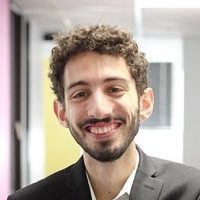
Martin Cruz owes his freedom to the California juvenile justice system.
His childhood essentially ended at age 8, when he saw a friend shot five times and killed. Soon enough, he was part of a gang, and at 16, after years of cycling in and out of the juvenile justice system, a district attorney tried to send him to adult court.
“If I had been sent to adult court, I would be done,” he told an audience at Temple Israel of Hollywood (TIOH) on a recent Tuesday evening. “I would probably still be in prison today.”
Seated in plastic chairs set in semicircles in the Reform synagogue’s meeting hall, shul members and representatives from other faith communities and social justice organizations had gathered to hear about Proposition 57. The measure on the November ballot aims to reduce California’s prison population through a variety of methods, including by ending the practice of allowing prosecutors to send minors to adult court without approval from a judge.
In advance of the election, Prop. 57 made its way into High Holy Days sermons across the city, including that of TIOH’s Rabbi Jocee Hudson, who moderated the Oct. 18 panel.
While critics have raised safety concerns, the proposal sponsored by Gov. Jerry Brown has earned the support of Reform CA, the progressive Jewish organization Bend the Arc, and the California chapter of the National Council of Jewish Women.
The measure would allow nonviolent offenders to earn parole after they serve the sentences for the primary offense that landed them in prison. In addition, it instructs the California Department of Corrections and Rehabilitation to consider educational and rehabilitative achievements when weighing a prisoner’s early release.
But perhaps the most important step Prop. 57 would take, Hudson said, relates to juveniles being sent to adult court. When the synagogue adopted criminal justice reform as one of its initiatives and she began learning more about the prison system in California, she said, “I didn’t realize that juveniles could be sentenced to life — I mean, without parole.”
For every six youths sent to adult court, California’s Legislative Analyst’s Office (LAO) estimates that five of them are there at the sole discretion of a prosecutor, contributing to harsher sentences and longer prison terms.
Things would have gone much differently for Cruz if he had been tried as an adult, according to Elizabeth Calvin, a Human Rights Watch attorney and co-author of Prop. 57.
“Everyone in the courtroom would have operated under the myth that he was an adult,” she said, speaking beside him at the Hollywood congregation. “And he would have faced adult prison time.”
Instead, Cruz said, he got the chance to seek therapy in a juvenile detention facility and learn about himself, eventually reforming his behavior. Today, he’s a father and film student at West Los Angeles College.
But thousands of youths in California are never afforded that opportunity — roughly 44,000 of them, according to the LAO.
“We don’t give them the right to vote, we don’t give them the right to buy cigarettes, we don’t give them the right, under 16, to drive, but we’re willing to put them into the adult system and treat them like adults,” Miriam Aroni Krinsky, a former federal prosecutor and Temple Israel member, said at the event.
She said she became jaded as she watched politicians pass harsher and harsher sentencing laws during her 15 years as a prosecutor.
“I became deeply troubled during those 15 years by the willingness of our justice system to throw away a generation of young people,” she said.
Each panelist encouraged the audience to support Prop. 57, painting it as a crucial social justice issue for religious communities.
“California’s justice system is terribly broken, really from one end to the other,” said Calvin, the Human Rights Watch attorney. “As people of faith, as people who care about repairing the world, we have to wade in and decide that we’re going to fix it piece by piece by piece.”
That, more or less, is the pitch Brown made to Southern California rabbis in April, hoping to earn their support for the measure. At a meeting in Beverly Hills called by Leo Baeck Temple Senior Rabbi Ken Chasen, at Brown’s request, the governor urged about two dozen rabbis to get behind Prop. 57, said Hudson, who was present at the meeting.
He told the rabbis he’s supporting the measure with surplus campaign funds as a way of seeking “prophetic justice” for a mandatory sentencing law he signed during his first term, which contributed to an increasing prison population.
“It was a very profound experience, I thought, for him to say to us, publicly, ‘I put this law into effect in my first term; I never anticipated what the consequences of it would be,’ ” Hudson told the Journal.
Brown has made similar statements in more public venues. In an Oct. 21 op-ed in the Bay Area’s Mercury News, he wrote of his support for mandatory sentencing, “My idea then was to add greater certainty in sentencing, but it turned out just the opposite. The legislature kept changing sentences by passing hundreds and hundreds of new crime laws.”
Opponents of the measure — including a host of California law enforcement officers associations and district attorneys — see it as a public danger that would put violent criminals on the streets. L.A. county’s sheriff and its district attorney have joined the opposition campaign.
The “No on 57” campaign has gone so far as to distribute playing cards with pictures of rapists and murderers under the words, “Meet your new neighbors.”
“The summary says that it applies to nonviolent offenders,” said L.A. County District Attorney Jackie Lacey, speaking at an Oct. 20 news conference alongside a number of city leaders opposed to the measure. “But the truth of the matter is that the way it was written, human traffickers, who we’re trying hard to get off the streets, would actually be eligible to be released earlier.”
In fact, the measure fails to outline its definition of nonviolent crime. Instead, it assumes any crime not listed as violent in the penal code is nonviolent, according to the LAO.
In general, Jewish activism in favor of the reform has focused on social justice and teshuvah — repentance — rather than public safety. But Krinsky, the former federal prosecutor, did address the issue during the TIOH event.
“As a matter of outcomes, we’re not making our community any safer” by trying juveniles as adults, she said. “Kids we put into our adult system are at greater risk of future criminal conduct.”