Thirty-nine years ago, Dov Indig, a young soldier in the Israel Defense Force tank corps, sat on guard duty in the Golan Heights. Joining him was a reserve soldier, many years older than Dov. During their four hours of guard duty, they engaged in a deep conversation about religion. It must have been a fascinating exchange; Dov came from Yeshivat Kerem B’Yavneh, a Hesder yeshiva where students combine Torah study and military service in combat units, and the reservist came from a Hashomer Hatzair kibbutz, the epitome of secular Zionism.
The reservist told Dov of his teenage daughter, Talya, an 11th-grade student in the kibbutz high school. Talya’s class had recently spent one week in a Gesher (Bridge) seminar, where secular Israeli teenagers interact with religious kids and study Judaism from a more traditional perspective. The seminar raised many questions in Talya’s mind about Judaism, and her father felt unable to address her questions. He liked Dov’s approach and asked permission from Dov for Talya to write to him with her questions. Dov happily obliged, and what ensued was a two-year exchange of letters between Dov and Talya.
This thought-provoking and moving exchange of letters between two pre-Facebook teenagers is found in the 2005 book “Michtavim L’Talya” (“Letters to Talya”). I was recently rereading the book, and it dawned on me how deeply this book relates to one of the most powerful lessons of Yom Kippur.
The Mishnah teaches: “For transgressions between man and fellow man, Yom Kippur effects no atonement, until they have pacified each other” (Yoma 8:9). This Mishnah emphasizes the interpersonal angle of Yom Kippur, one that far transcends cantorial performances and eloquent sermons. It teaches us that fasting and prayer do not resolve differences between people. It reminds us that in addition to talking to God with a scripted text, Yom Kippur is also about talking things out with family, friends and those with whom we have different religious and political viewpoints.
So it was with Dov and Talya. They lived in the same country but came from two extremely different places in life.
Dov was a Modern Orthodox religious Zionist yeshiva student. His worldview was rooted in God, Torah, halachah and the uniqueness of the Jewish people.
Talya was the classic secular Zionist. Raised in a secular kibbutz, her worldview was rooted in the modern-day values of Western civilization, of an enlightened Zionist society in Israel and in the Jewish people as agents of universalism.
Egalitarianism was not a part of Dov’s world, and God was not present in Talya’s upbringing and education. Dov frowned upon the abandonment of Torah and saw it as part of the cause for the breakdown of family values in Israeli society. Talya could not accept the separation of boys and girls in social venues such as dancing or holding hands on a date. What these vastly different youngsters had in common was their youth, their curiosity about the other and their willingness to talk with each other.
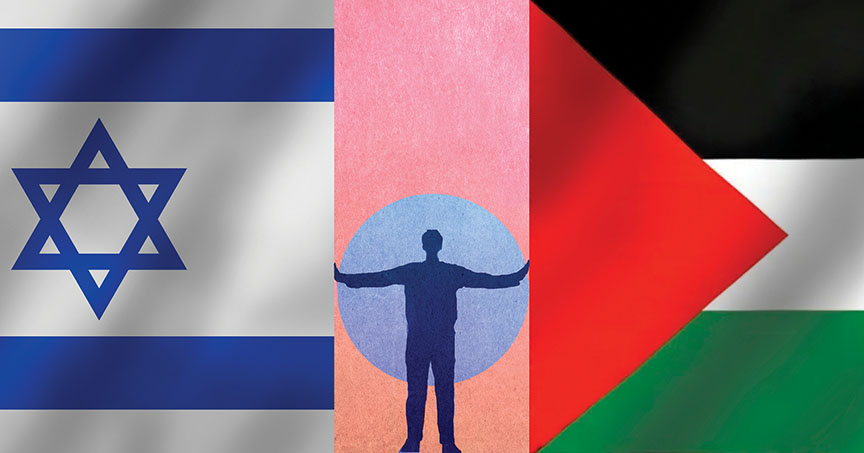
From very different perspectives, Dov and Talya exchanged letters for two years. It sounds scripted, but it’s all true. They spoke about God, Torah, Zionism, values, Jewish history and the political direction of their country vis-à-vis the Arabs. As we enter Yom Kippur, these intellectually brave teenagers remind all of us that the power of dialogue — face to face, Facebook or through written letters — has the power to bridge gaps, resolve differences and bring people closer together.
In fact, here is Talya’s very last letter to Dov (my own translation):
Dear Dov,
I received your letter today, and I am already writing back. Perhaps this is because of your previous letter, where you wrote of the possibility of war with Syria. I am deeply worried; so much so that I have decided that this year, for the very first time in my life, I am fasting and going to the synagogue on Yom Kippur. There I will pray that there will be no war, and that the high alert of our soldiers is a false alarm.
So, what do you think? Would you have ever believed two years ago, when we started writing to each other, that a cynical kibbutz girl, who bothers you with all sorts of annoying questions, is actually going to the synagogue and fasting on Yom Kippur? I hope I can hold up throughout the day!
I have changed so much these past two years, as my world has opened up to ideas that I would have never imagined in my wildest dreams. It’s all thanks to you, Dov, thanks to your fantastic letters, and thanks to our fascinating dialogues and exchanges. It now seems to me that I am living from letter to letter, so please, hurry up and write more, as I await your letters.
I wish you a good and wonderful New Year.
Yours, who thinks about you often,
Talya.
Dov never had a chance to respond. Hewas killed on the second day of the YomKippur war.
On this Yom Kippur, let us commit to continue their dialogue.
Rabbi Daniel Bouskila is director of special projects for the Sephardic Educational Center (secjerusalem.org). He blogs at rabbidanielbouskila.blogspot.com.