Rereading the Talmud’s description of the Roman destruction of the Temple in Jerusalem this year for Tisha B’Av amidst the still-simmering ashes of Hamas’ October 7th devastation, one is struck by the slaughters’ similarities. But perhaps a measure of solace can be found in the rabbinic writers’ striking postscript about the nudgiest of gnats.
As the ancient Jewish sages tell it, Titus, the general and future emperor, millennia before Hamas, raped and pillaged his way through the Jewish homeland, inflicting maximum spiritual damage alongside the murderous mayhem. The sacrilege was the point.
Tractate Gittin unflinchingly sets the brutal scene:
“What did Titus do when he conquered the Temple? He took a prostitute with his hand, and entered the Holy of Holies with her. He then spread out a Torah scroll underneath him and committed a sin, i.e., engaged in sexual intercourse, on it. Afterward he took a sword and cut into the curtain separating between the Sanctuary and the Holy of Holies. And a miracle was performed and blood spurted forth. Seeing the blood, he thought that he had killed God.”
Similar to the attack on Simchat Torah, the festival celebrating the Jewish people’s commitment to the divine covenant, Israel’s enemies sought to sunder Israel’s connection to its God through sex and slaughter.
The Talmud then continues, describing the theft of Jewish treasures:
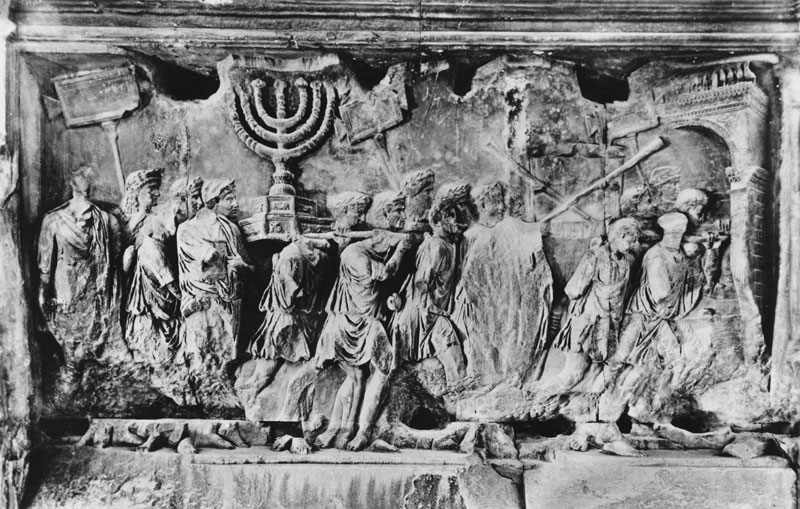
“What else did Titus do? He took the curtain and formed it like a large basket, and brought all of the sacred vessels of the Temple and placed them in it. And he put them on a ship to go and be praised in his city.”
Anyone who has viewed footage of elated Gazans celebrating dead and kidnapped Israelis flung on the backs of pickup trucks entering the Strip can easily imagine the glee the Romans shamelessly exhibited upon catching a glimpse of Israel’s most precious possessions.
Unlike prior attempts by Israel’s enemies thwarted by miraculous sea-splitting or Six Day War-style salvations, the Romans, like Hamas, were devastatingly successful.
Yet then, like now, signs of survival remained.
The Sages’ story continues:
“…and a gnat came, entered his nostril, and picked at his brain for seven years.”
Like a pestering nuisance that refuses to be swatted, like Israel remains to its enemies, Titus couldn’t long enjoy his vicious victory. The idea of Israel still buzzed frustratingly in his brain.
So, utilizing the best means of pressure, the Qataris and ICCs of his day, Titus kept trying to rid himself of his infernal menace.
“… One day he passed by the gate of a blacksmith’s shop. The gnat heard the sound of a hammer and was silent and still. Titus said: I see that there is a remedy for my pain. Every day they would bring a blacksmith who hammered before him. He would give four dinars as payment…”
Alongside his continued destructive inclinations, there was of course, the attempt to garner sympathy for the gall of experiencing repercussions for what he had wrought:
“… To a Jew he would simply say: It is enough for you that you see your enemy in so much pain.”
Alas for Titus, his comeuppance eventually arrived:
“… Since the gnat became accustomed to the hammering, it became accustomed to it, and once again it began to pick away at Titus’ brain. It is taught in a baraita that Rabbi Pinehas ben Arova said: I was at that time among the noblemen of Rome, and when Titus died they split open his head and found that the gnat had grown to the size of a sparrow weighing two sela. It was taught in another baraita: It was like a one-year-old pigeon weighing two litra.”
Allowed time to recover from initial attempts to destroy it, the gnat not only grew, it flourished. The tormenting Titus was eventually felled by the flea.
The story is told that when traveling through Rome, the mid-20th century rabbinic scholar Yosef Shlomo Kahaneman, the Ponevezher Rav, asked his cab driver to pull over at the Arch of Titus, that monumental depiction of our people’s political and spiritual nadir. Stepping out of the car, the rabbi shouted in Yiddish:
“Titus! Evil Titus! Take a good look at what has occurred. You dragged my hapless people out of our land two millennia ago and led them into an exile. You went home to Rome – the most powerful nation on earth – in glory and triumph. But Titus, where are you? What has become of the glory that was Rome? Titus, mir zenen noch do, avu bist du? (We are still here! Where are you?)”
This year, we need no reminder of Tisha B’Av’s timeliness. Yet Israel’s glory continues to grow as it recovers from Hamas’ horrors.
The historian David Blight has noted how “nations rarely commemorate their disasters and tragedies, unless compelled by forces that will not let the politics of memory rest.” This year, we need no reminder of Tisha B’av’s timeliness. Yet Israel’s glory continues to grow as it recovers from Hamas’ horrors. Now, as then, we refuse to silence our incessant fluttering. We are still here, flying, ever-faithful.
Rabbi Dr. Stuart Halpern is Senior Adviser to the Provost of Yeshiva University and Deputy Director of Y.U.’s Straus Center for Torah and Western Thought. His books include “The Promise of Liberty: A Passover Haggada,” which examines the Exodus story’s impact on the United States, “Esther in America,” “Gleanings: Reflections on Ruth” and “Proclaim Liberty Throughout the Land: The Hebrew Bible in the United States.”