fbpx

August 8, 2024

How Kamala Harris Missed a Chance to Make History

By deciding not to pick Pennsylvania Gov. Josh Shapiro as her running mate, Democratic presidential candidate Kamala Harris didn’t just miss a chance to lock up a must-win battleground state. She also missed a chance to make history.

Picking Shapiro would have made a historic statement about the aspirational greatness of both America and any political party. She would have confronted head on the dark and rising antisemitic wing of her own party with a brave and honest message that would have resonated everywhere:

“There is no place in America or in any party for the singling out of Jews for special animosity, as we’ve seen with Josh Shapiro. Josh’s views on Israel– including his support for a two-state solution— are no different than those of the other candidates, and are clearly in the mainstream of our party. And yet, he was singled out for ugly attacks, including calling him “Genocide Josh.” That is blatant antisemitism. We must do better.

“Jews have been at the forefront of building this great nation since our very birth. It’s unconscionable that 80 years after the Holocaust, they should feel a need to hide or downplay their Jewish identity in a free country. Like any minority group, they are entitled to equal and fair treatment. Using Israel and Zionism to assault and blacklist Jews is wrong and destructive. We can protest the war in Gaza and criticize Israeli policies without denigrating the Jewish right to a homeland or bullying Jewish college students. Our State Department has designated Hamas as a terror organization. I share that view. Hamas seeks Israel’s destruction, not peace.

“Today, I am proud to stand with two great Americans and two great Jews– my husband Doug and my choice of running mate, Josh Shapiro.

“Now on to victory!”

Would she have taken serious heat from the left wing of her party? Of course! That’s the whole point. Taking heat would have shown her courage; it would have shown that she’s no one’s puppet; it would have told her party and the world that she puts principle above politics.

This is not a critique of her choice of Tim Walz. He may indeed end up as the best choice. There were strong arguments in favor of all three finalists, including Shapiro.

But Walz was a risk-free choice. Picking Shapiro was anything but safe. For starters, it would have shaken the unity flowing through the party after the many weeks of gloom and divisiveness when the party was forced to replace President Joe Biden.

And yet, in politics as in life, there is value in risk. Risk is electric. It cuts through the fog of predictability. It shows character. It’s creative.

Everything about the Harris campaign right now is risk-free. The team running the campaign is keeping her away from any situation where she might stumble. There haven’t been media interviews or press conferences where she would need to answer tough questions. Just as Biden was insulated as the “basement candidate” in 2020, Harris is being insulated as the “teleprompter candidate” in 2024.

Do they really think they can do this indefinitely? My guess is they’re trying to milk the honeymoon period for as long as possible. So far, with the mainstream media brazenly cooperating, it seems to be working. At least until a debate happens, the Harris campaign is the perfectly coordinated campaign with the perfect optics and the perfect press. Clearly, they want to avoid the kind of verbal blunders from their blunder-prone candidate that will come back to haunt them on social media.

Avoiding blunders, however, is not a sign of greatness. Fearlessness is.

Picking Josh Shapiro would have been a bold and fearless move. Yes, it would have caused a major stir within the party, but Harris could have used that stir to make an epic statement for the history books; a statement not just good for the Jews but good for her party and her country.

How ironic that given how popular Shapiro is in Pennsylvania, he conceivably could have paved her way into the White House by delivering that indispensable state.

And then, maybe even the Jew haters inside her party would have been grateful for the genocide Jew.

How Kamala Harris Missed a Chance to Make History Read More »

I don’t want to write this poem – a poem for Devarim

And we conquered all [Sihon’s] cities at that time, and utterly destroyed every city, the men, women, and the young children; we left over no survivor.
~ Deuteronomy 2:34

… another one inspired by my
ancestors’ zeal for war.

They said God said and
brought the war in.

They took all human life
every age of human

from the wise-eyed
to the able-bodied

to the young who had
never spoken the word war.

They only took the cattle
as even the spoils were detested.

It wasn’t the first time.
It wasn’t the last.

I am in the never war camp.
I’m in the should we have

argued with the instructions camp.
I’m in the when we have to

wage war to survive a
few thousand years later

aren’t they going to look back at this
and say ‘see how they are’ camp.

I want to write about our triumph
over slavery but every time I

turn a page I find we’re
eating another apple.

Where are the chapters where
we’re told to wage peace?

I want to write about waging peace.
War has taken too much space

in my poems.
Just like the moon


Rick Lupert, a poet, songleader and graphic designer, is the author of 28 books including “God Wrestler: A Poem for Every Torah Portion.” Find him online at www.JewishPoetry.net

I don’t want to write this poem – a poem for Devarim Read More »

MAZON Announces New Grants for Long-Term Solutions to Hunger

In July, MAZON: A Jewish Response to Hunger announced nearly $3.5 million in new grants to 52 local anti-hunger partner organizations, expanding its investment in fighting food insecurity. 

Their new grants are for organizations advocating for the people of Puerto Rico, indigenous communities in the U.S. and vulnerable populations in Israel, as well as partners in Arkansas, Georgia, Kansas and Oklahoma.

Inspired by Jewish values and ideals, MAZON is a national advocacy organization working to end hunger among people of all faiths and backgrounds. Since 2018, MAZON has invested over $17 million in 19 states, Puerto Rico, Indian Country and Israel.

Built on nearly four decades of seeding, supporting and strengthening the anti-hunger advocacy movement in communities across the U.S., MAZON’s innovative “Emerging Advocacy Fund” grantmaking model builds foundations for public policy change in communities with particularly high rates of food insecurity. 

“Our grantmaking serves as a key driver of our work nationally and in Israel, building a network of advocates for long-term solutions, advancing local and state policies that can make a difference in the lives of people struggling with hunger and food insecurity,” Mia Hubbard, MAZON’s executive vice president, told the Journal. “Our trusted partners are deeply committed to this work with us, and we are proud to seed them with the tools to advocate forcefully and effectively for change.”

Since its founding, MAZON has been working to address food security and poverty issues in Israel. In the beginning, there was neither a meaningful system of emergency charitable aid to address food insecurity in Israel nor government policies needed to address the roots of hunger. MAZON set out to build both. 

These foundations, strengthened over decades, have been essential to supporting Israelis of all backgrounds in the last year since the Oct. 7 attacks. Amid concerns about ongoing systemic issues in Israel, including the high cost of food, industry workers going without income and food systems being disrupted, MAZON and its partners continue raising awareness and advocating for policy solutions at all levels of government.

MAZON’s grantee partners in Israel include 121 Engine for Social Change, Adva Center, ASSAF – Aid Organization for Refugees, Itach Ma’aki – Women Lawyers for Social Justice, Latet, Solidarity Film Festival and The Israel Forum for Sustainable Nutrition (Tel Aviv); Jerusalem Food Rescuers, Kerem, Rabbis for Human Rights and Sikkuy-Aufoq (Jerusalem); Leket Israel and Nevet (Ra’anana); Negev Coexistence Forum for Civil Equality and Sidreh (Omer) and Pitchon Lev  (Rishon LeZion).

“MAZON’s support is particularly crucial as we address a significant gap in Jerusalem’s municipal policies; the municipality of Jerusalem does not currently have a food policy or recognize food as a field requiring one,” said Daniella Seltzer (co-founder) and Maytal Lochoff (urban food policy coordinator) of the Jerusalem Food Rescuers. “MAZON’s support allows us to create a food council that will place food systems and food security on the agenda. This support is crucial in helping us achieve these milestones.”

Hubbard explained that food insecurity is growing in both the U.S. and Israel, while political leaders engage in increasingly partisan battles, rather than enacting policies to address it. 

Hubbard explained that food insecurity is growing in both the U.S. and Israel, while political leaders engage in increasingly partisan battles, rather than enacting policies to address it. “That’s why it is so critical that programs like MAZON’s Emerging Advocacy Fund invest in our partner’s vital anti-hunger work in some of the most food insecure places in the U.S.,” she said. “Achieving food justice requires time and persistence, and MAZON is proud to commit to long-term partnerships with advocates on the ground through its multi-year grantmaking model to support systemic changes in our food system.” She added, “We are extremely proud of our partners in the U.S. and Israel who work every day to end hunger and address inequity with wisdom, creativity and resilience.”


To learn more, go to MAZON.org. 

MAZON Announces New Grants for Long-Term Solutions to Hunger Read More »

Israel on Campus Coalition Draws 500 Students from 153 Campuses to DC

When Jewish college students return to campus this fall, it will be, “barring a miracle,” the first time since the Israeli War for Independence that American Jewish students go back to school while the Jewish state is actively at war, Jacob Baime, CEO of Israel on Campus Coalition, told JNS.

“Hasn’t happened since 1948,” Baime said, on the sidelines of the group’s annual conference in Washington, D.C., which began on Sunday and runs through Tuesday. “That reality sets the table for this summit.”

The event drew 500 students this year—up from 400 last year and 200 in 2022—from 153 campuses, according to Baime. That’s more than 118 last year, he added.

“There’s so much demand from the students to come together and to stand up for what’s right,” he said. “One of the things we’re really thinking about is how many seats do we need next year? Should it be 750? Should it be a 1,000-student conference? Probably that’s what we’re moving towards, because there’s such demand.”

Matching the opposition

Since the Hamas terrorist attacks on Oct. 7, pro-Israel students have wanted “to get up off the bench,” said Baime.

“That has been inspiring,” he told JNS. “It has been a dramatic increase in interest among pro-Israel students, so even as it’s becoming more challenging to stand up for Israel and to stand up for what’s right, more students want to do it.”

But he cautioned that the Jewish state’s opponents are also organizing, and there is “a very sophisticated, professional, coordinated national network of anti-Israel students and professionals.”

Baime hopes the conference will help student attendees build broad alliances beyond the pro-Israel base; find their online voices as digital activists; and help their peers understand that Israel and the United States have shared values.

He emphasized that “this is not just about Israel.”

Physical safety

Security, including situational awareness and self-defense, was a focus at the conference.

Security, including situational awareness and self-defense, was a focus at the conference.

“One of the top things that we’ve heard from students is that they’re concerned about physical safety,” Baime said, noting that Secure Community Network, Hillel International and Chabad on Campus International partner with the group.

“We’re lucky that the Jewish and pro-Israel communities have taken this really seriously,” he said.

Baime noted being surprised that speakers were able to attend the event from Israel. “We were thinking, are any of our Israel-based speakers going to make it because of the security situation in Israel?” he said. “They were, and they did. They all made it.”

Unlike in prior years, the group brought in an outside security company that provided the sort of security that TSA offers at airports.

“It’s an unfortunate reality that we have to take physical security very, very seriously,” Baime told JNS. “It is a huge change. We hired a big national firm to handle it that has assets around the country.”

He’s already thinking ahead to next year’s event.

“It’s one of those things where we’ll have to take a leap, and we need to sign with a hotel real soon if we’re going to do it,” Baime said. “The challenge isn’t going away. The demand is not going away, and we’re not going anywhere either.”

Israel on Campus Coalition Draws 500 Students from 153 Campuses to DC Read More »

JFLSA Appoints Board Chair, JVS SoCal Scholarship Ceremony, Community Service

Tami Kagan-Abrams was named the incoming board president of Jewish Family Service Los Angeles (JFSLA), making her the youngest serving board chair in the organization’s history.

Kagan-Abrams boasts more than a decade of service as a JFSLA board member and has long been passionate about volunteering and philanthropy, particularly in programs and organizations that benefit women and children.  With an extensive background in the private and philanthropic sectors, she previously served as director of program management at Disney and Yahoo! Currently, Kagan-Abrams works as projects director at Abundant Housing LA.

“Over its 170-year history, JFSLA has successfully adapted to many changes, some of tremendous magnitude,” Kagan-Abrams said. “As board chair, I hope to continue the incredible work of the leaders before me to help strengthen the agency and prepare for the opportunities and challenges that lie ahead, both in the next two years and the next 170.”

JFSLA appointed Kagan-Abrams to board chair during a July 14 installation ceremony. Her term lasts until 2026.


JVS SoCal’s 2024-2025 scholarship recipients. Courtesy of JVS SoCal

JVS SoCal, a leading human services agency focused on workforce development, presented scholarships to more than 200 Jewish students at an award ceremony held at Sinai Temple on July 25. This year the scholarships ranged from $2,000 to $10,000, for a total of $914,000.

“The Scholarship Program was created to provide a bridge of opportunity for Jewish students and their families,” Committee Co-Chair Jonathan Karp said. “This program is successful because of its volunteers and how much they care about their work and the scholars that benefit from it.”

This is the 53rd year the agency has awarded these need-based scholarships as part of its legacy devoted to Jewish continuity. To date, the JVS SoCal Scholarship Program has awarded $14.3 million to more than 6,200 students.

Karp reminded scholars and donors that the cost of attending college and student loan debt have been on the rise. The JVS Scholarship Program helps students alleviate some of that burden and allows them to pursue their dreams.

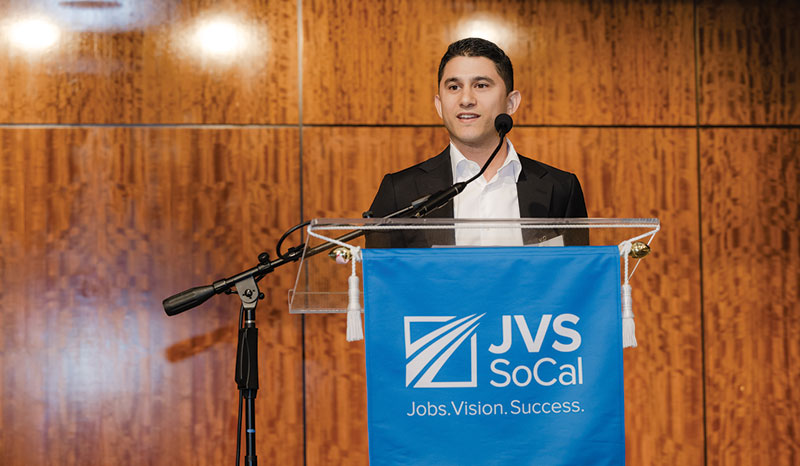
Addee Lerner, keynote speaker at JVS SoCal’s recent awards ceremony. Courtesy of JVS SoCal

Addee Lerner, keynote speaker and a current scholarship recipient, thanked donors and supporters for helping support the medical school studies at the University of California Los Angeles. “The JVS Scholarship is more than a typical scholarship where generosity endorses merit and potential … I’m eternally grateful to our donors for paving the road for me and other scholars.”

JVS SoCal’s Chief Executive Officer Jeff Carr summed up the importance of the JVS Scholarship program. “It’s that ‘generation to generation’ concept that really is our strength as a community,” he said. “I hope you help us carry this tradition for the next hundred years.”


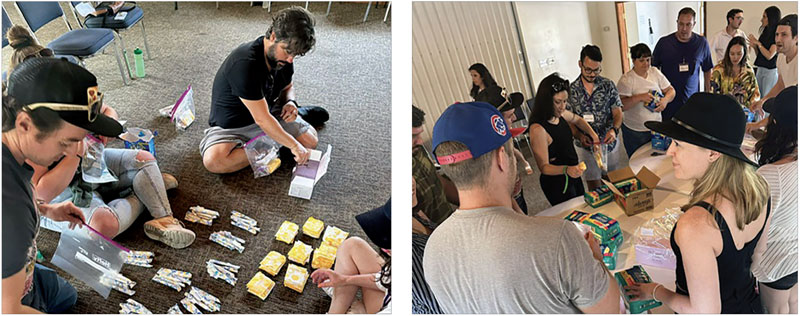
Repair the World L.A. on a recent community service project and Honeymoon Israel partners. Courtesy of Repair the World Los Angeles

Repair the World Los Angeles recently partnered with the local Honeymoon Israel chapter on a community service project. 

Together they produced more than 100 wellness kits for residents at Alexandria House, which provides safe and supportive housing for women and children experiencing homelessness and trauma.

Repair the World L.A. mobilizes young Jewish adults to serve in ways that address the needs of those in Los Angeles. The organization regularly provides community service opportunities in partnership with groups including Jewish Federation Los Angeles. 

Meanwhile, Honeymoon Israel provides young couples — where there is at least one Jewish partner — with immersive trips to Israel.  According to the organization’s website, Honeymoon Israel is “creating communities of couples who are building families with deep and meaningful connection to Jewish life and the Jewish people.”

JFLSA Appoints Board Chair, JVS SoCal Scholarship Ceremony, Community Service Read More »

A Moment in Time: “Israel – the 911 for Jews around the World”

Dear All,

It’s been a tough year for Jews.

I think about our people over the past 2000 years. Whenever and wherever anti-Semitism made things tough for Jews, no one had our back. Israel, our ancestral homeland was in our prayers – but it wasn’t at our fingertips.

Since 1948, with Modern Israel a reality, whether we realize it or not, Jews have a 911 number to call to protect us when things get tough. Israel has stood with us and for us to ensure our safety.

Does the government of Israel always align with each and every value we hold? That’s a legitimate debate.

But the country of Israel stands solidly with our souls.

So we can argue and protest with leadership. But we can’t turn our backs or take for granted that we have a 911 to call whenever we are in danger.

I can’t imagine a secure Judaism without a secure Israel.

As Israel faces attacks from surrounding enemies, we unite with prayer, hope, and resilience. This is our moment in time to stand as one with our people.

And please know this ….. It’s about more than security for Israel. It’s about security for all inhabitants of the land – for all who care about the values we hold deep in our hearts. Our dream is to be free. Our hope is to be at peace.

With love and shalom,

Rabbi Zach Shapiro

A Moment in Time: “Israel – the 911 for Jews around the World” Read More »

A Bisl Torah – Curtailing Joy and Embracing Life

Over the next week, we continue commemorating the nine days, the period leading up to Tisha b’Av. Tisha b’Av is the darkest day in Jewish history in which we remember the destruction of both Temples in Jerusalem along with other catastrophes harming the Jewish people.

The nine days involve a series of stringencies. Many do not eat meat, renovations pause in home building, swimming is discouraged and we refrain from buying or repairing clothing.

But there is one stringency that caught my eye.

According to the Shulchan Arukh, one should not plant flowers or trees for frivolous reasons. However, planting for life purposes is permissible. While during a period in which we commemorate loss and intentionally curtail joy, we do not stop living. Even through our sadness and sorrow, Jewish law asks us to choose life.

During these darkest of days in which the events of Tisha b’Av are understood and felt more than ever, we mourn, cry, remember and take stock of what has been destroyed and brutally taken away. And simultaneously we take heart in knowing, through terror, we embrace life. We choose to live. We plant, we rebuild and find a way forward.

Over and over again.

Shabbat shalom


Rabbi Nicole Guzik is senior rabbi at Sinai Temple. She can be reached at her Facebook page at Rabbi Nicole Guzik or on Instagram @rabbiguzik. For more writings, visit Rabbi Guzik’s blog section from Sinai Temple’s website.

A Bisl Torah – Curtailing Joy and Embracing Life Read More »

Reputations Hobbled by the Book of Lamentations

“The man has not been born yet who
can write about himself the truth.”
So Mark Twain wrote. His words are true
regarding old age, but not youth,
for it’s not hard to tell of facts
that when they long ago occurred
embarrassed us, though clearly acts
that challenged what seems as absurd
now we are older as when they
occurred. Our youthful indiscretions
now give us pride, but we all pray
that only God hears our confessions
concerning what we do when old
enough to know just how we should
behave. These stories can’t be told
by us, though fully understood,
when they’re about ourselves, although
when they’re about our family or friends
we do relate all that we know,
plus what we don’t, if it offends
just them but not ourselves, unless
we feel that what demeans them may
detract from us, when we tell less,
since it’s ourselves whom we portray,
unless like Samuel Pepys we are
either interesting or famous,
and posthumously read, we mar
ourselves with unforgotten words that shame us.
False views, hobgoblins of the mind,
evade corrections:  Their persistence
can cause us to be to undermined,
uncured, incurred through their consistence

as lamentable as our in-
consistencies that ruin reputations,
like Jewish history’s literary hobgoblin,
Jeremiah’s Book of Lamentations.


In “We’re Taught to Hate Hypocrisy We Shouldn’t,” NYT, 8/4/24, by Lydia Polgreen writes:

A manichean devotion to principle brings its own peril. As Ralph Waldo Emerson wrote in his best-known essay, “a foolish consistency is the hobgoblin of little minds.” But it is a less famous line from that essay, “Self-Reliance,” that has always stuck with me. It suggests that finding yourself abandoning a principle may well be a necessary precursor to changing your mind based on something new. It is, Emerson wrote, “a rule of wisdom never to rely on your memory alone, scarcely even in acts of pure memory, but to bring the past for judgment into the thousand-eyed present.”


Gershon Hepner is a poet who has written over 25,000 poems on subjects ranging from music to literature, politics to Torah. He grew up in England and moved to Los Angeles in 1976. Using his varied interests and experiences, he has authored dozens of papers in medical and academic journals, and authored “Legal Friction: Law, Narrative, and Identity Politics in Biblical Israel.” He can be reached at gershonhepner@gmail.com.

Reputations Hobbled by the Book of Lamentations Read More »

Print Issue: The War Nobody Wants | Aug 09, 2024

CLICK HERE FOR FULLSCREEN VERSION

Print Issue: The War Nobody Wants | Aug 09, 2024 Read More »

Patricia Heaton: Philanthropy, Food in Entertainment and Chicken Chilaquiles

Patricia Heaton has created relatable characters on TV over the years (“Everybody Loves Raymond,” “The Middle,” “Carol’s Second Act”). One thing she is also known for is her commitment to philanthropy, as well as a love of food.

One way she showcases the latter is through a series of unity dinners, designed to bring Christians and Jews together in conversation.

“I’m the founder of an organization called  07C, which stands for October 7th Coalition,” Heaton told the Journal. “It came together after October 7th and I didn’t see quite the response from Christian and Catholic churches as I was hoping to … so my co-founder and I decided to start speaking to churches and trying to bring Christians and Jews together.”

Recently, Heaton and O7C partnered with Maman Nonprofit for a Unity Table with The Dream Center Foundation, which brought Jews, Christians and Muslims together.

“There’s not an agenda other than to say, let’s be together in this time of crisis,” she said.

“Sharing a meal together is a sign of peace and of unity … so it’s the perfect way to start helping our communities get to know each other.”

For Heaton, growing up in an Irish Catholic family was a world away from the food she discovered, as a result of working in entertainment.

“My mom was an okay cook, but she had kind of like five standard things and nothing was gourmet,” she said. “There was a lot of ground beef involved – burgers or meatloaf or spaghetti sauce, meat sauce – and then, as a catholic, it was fish on Fridays, which usually meant fish sticks or fish filets.”

There was the occasional pot roast and lots of boiled foods.

“That’s kind of an Irish thing, isn’t it: boil everything,” said Heaton, who was one of five children. “When I started having my family and I have four sons … I really appreciated the fact that my mom worked so hard to try to put something different on the table every night.”

When Heaton moved to New York City, after graduating from the Ohio State University, a whole new world of food opened up to her. A studio musician friend introduced her to sushi. As a hostess at an Argentinian Italian restaurant, she learned all about sweetbreads (though she never got used to them). Plus, a good friend of Heaton’s was a restaurant consultant, so she got to go to all these restaurants and eat for free, as a starving actress.

Heaton, however, got the best food education when she started working with Phil Rosenthal.

“Phil Rosenthal, who created “Everybody Loves Raymond,” he had a mom who wasn’t a great cook,” she said. “Even as a starving actor/writer in New York, he would save up money all year, and then for his birthday, he would take himself out to a very high end restaurant.”

He brought that same sensibility to “Everybody Loves Raymond.”

“So much of the workplace revolved around food; this is before you could get everything everywhere through GoldBelly or whatever,” she said.

At that time, Krispy Kreme donuts were still local to the South, and he would have those FedExed in. He’d have LA’s Pink’s Hotdog truck driven on to the sound stage.

“He also introduced me to the finer things in life, as far as cuisine was concerned,” she said. “It didn’t start out that way, but eventually my adventures in the entertainment industry took me to all these great food places.”

Heaton, whose books include “Your Second Act” and the autobiographical “Motherhood and Hollywood — How to Get A Job Like Mine,” also has a cookbook: “Patricia Heaton’s Food for Family and Friends.” Heaton’s recipe for Chicken Chilaquiles is below.

“For someone who works in an industry where everything is sort of ephemeral – you go in front of cameras, you do stuff, but the editor takes it away,” Heaton said. “You have no idea how it’s going to turn out, you don’t know if anybody’s actually going to watch it.

“It’s great to be able to go into a kitchen, pull some ingredients together, start cooking, chopping, sauteing, whatever you’re baking, whatever you’re doing,” she said. “At the end of it, you have a meal and it actually is nourishing yourself and others; it’s a very tangible thing.”

Learn more about O7C at october7coalition.com and follow @PatriciaHeaton on Instagram.

This is just a taste of Deb’s conversation with Patricia Heaton. More about Heaton’s philanthropy and commitment in support of the Jews coming soon.

For the full conversation, listen to the podcast:


Chicken Chilaquiles

(c) Ed Anderson

Chilaquiles is a traditional Mexican dish, often served at breakfast or brunch. It usually consists of corn tortillas covered in a salsa, mixed with meat, and topped with cheese or sour cream—kind of like nachos made into a whole meal. We make chilaquiles in our household because it’s fast, easy, and delicious. It’s also a great solution to leftover chicken.

Makes 4 servings

2 teaspoons extra virgin olive oil

1 small yellow onion, chopped

1 garlic clove, chopped

1 (28-ounce) can crushed tomatoes

¼ cup pickled jalapeños, chopped

Sea salt

3 cups shredded leftover chicken

Generous handful of fresh cilantro leaves, chopped

4 ounces queso fresco or feta, crumbled

4 ounces corn tortilla chips

1 lime, cut into quarters

  1. Heat the oil in a deep skillet over medium heat. Add the onion and sauté until lightly golden, about 2 minutes. Add the garlic and sauté until just softened but not browned, about 1 minute. Stir in the tomatoes and jalapeños and season with salt. Bring to a boil, then turn the heat to low and simmer for 10 minutes.
  1. Stir in the chicken and most of the cilantro (save a little to garnish) and cook for 10 minutes more, until the chicken is heated through and the sauce has thickened.
  1. Divide the chips among four deep bowls. Ladle the chicken over the chips. Top with cheese, the remaining cilantro, and a squeeze of lime. Serve immediately.

From “Patricia Heaton’s Food for Family and Friends” by Patricia Heaton. Copyright © 2018 by Patricia Heaton. Reprinted by permission of William Morrow, an imprint of HarperCollins Publishers.


Debra Eckerling is a writer for the Jewish Journal and the host of “Taste Buds with Deb.Subscribe on YouTube or your favorite podcast platform. Email Debra: tastebuds@jewishjournal.com.

Patricia Heaton: Philanthropy, Food in Entertainment and Chicken Chilaquiles Read More »