The stars were aligned the night I met Neil. It was February 10th, 1990 and it was at a Moroccan themed party held by the Sephardic Educational Center. My brother’s friend Yvette encouraged me to come and my mother gave me the final nudge.
I really, really didn’t want to go. I brought my cousin Simy with me for support and we promised each other that we would leave early if it was really awful. We made so many friends that night. And we were among the last to leave.
Soon after we started dating, I invited Neil for dinner with my parents. My mother prepared most of the meal. I was in charge of dessert. I painted a thin layer of melted chocolate on the inside of foil cupcake holders, then I let them harden in the refrigerator. After the chocolate hardened, I peeled away the foil. I whipped cream and mixed in raspberries and blueberries and strawberries and piled them into the chocolate cups. I shaved chocolate over the berry cups for a very impressive dessert.
Neil loved them and asked where I bought them. He couldn’t believe that I had made them. I think it made him love me just that little bit more!
We have been married for 34 years and Neil is still impressed and appreciative of my cooking and baking.
Sharon and I had the best time baking this Persian Almond Love Cake. We hope you bake it for this Shabbat Valentine’s Day and save the recipe for Passover!
—Rachel
I met Alan at a singles event at the Beverly Hills Country Club. I was talking to Roger, a very handsome banker in a fine Italian suit with embroidered cuffs and a Rolex watch. He wasn’t Jewish and he was a player. I saw Alan watching me from across the room and all of a sudden, he joined the conversation and Roger was out of the picture.
Months later, Alan told me that he knew Roger and wasn’t about to let him get the prettiest girl in the room. Shameless flattery. Of course, I married him.
The first time I made dessert for Alan was for a picnic at the Hollywood Bowl and it also involved melted chocolate because I made chocolate covered strawberries.
Over the years, Rachel and I have grown to love almond cakes. They feel slightly healthier than cakes made with white flour. They are the perfect foil for any flavor and ingredient we can think of adding—lemon, orange, vanilla, chocolate, dried fruit or nuts. This is our version of a Persian Love Cake, a poetic name for a cake that incorporates so many ingredients prized in the ancient Persian kitchen.
Our recipe includes nuts — almond flour, slivered almonds and pistachios — which symbolize wealth and abundance. There is citrus — orange juice and orange rind in the honey syrup glaze and orange zest in the batter. The cool cardamom in our syrup represents warmth, sensuality and hospitality. The exquisite pale pink baby rosebuds that decorate the cake convey a message of love, beauty and the divine.
Love is precious and this Persian Love Cake is the perfect way to show a little love to your friends and family.
—Sharon
Persian Almond Love Cake
Syrup
1/3 cup honey
Juice of 1 orange
Slice of orange rind
1 tsp ground cardamom or cinnamon
1 tsp rose water, optional
In a small pot, warm the honey, orange juice, orange rind and cardamom to a slow boil over medium heat. Stir with a wooden spoon to ensure ingredients are combined. When the syrup is boiling, remove from the stovetop and set aside.
Cake
4 large eggs, at room temperature
1/2 cup avocado oil
1 tsp vanilla
1/2 tsp salt
1/2 cup sugar
1 tsp baking powder
2 cups almond flour
Zest of 1 orange
1/2 cup toasted slivered almonds
Garnish
1 cup roasted, unsalted pistachios
1/4cup dried baby rosebuds
Preheat oven to 350°F.
Spray a 9 inch round nonstick cake pan, then place a circle cutout of parchment paper on the bottom of the pan.
In a large bowl, beat the eggs, then add the oil and whisk to combine.
Add the vanilla, salt, sugar and baking powder and stir the batter until it is creamy and pale yellow.
Add the almond flour, orange zest and almonds and slowly beat until well combined.
Pour the batter into the prepared pan and bake for about 20 minutes. Insert a toothpick in the center of the cake. If it comes out dry, cake is ready.
Allow the cake to cool, then remove from the pan onto a cake stand. Pour the warm syrup evenly over the cake.
Garnish with pistachios and rosebuds.
Cake can be stored in an airtight container for up to 4 days.
Sharon Gomperts and Rachel Emquies Sheff have been friends since high school. The Sephardic Spice Girls project has grown from their collaboration on events for the Sephardic Educational Center in Jerusalem. Follow them on Instagram @sephardicspicegirls and on Facebook at Sephardic Spice SEC Food. Website sephardicspicegirls.com/full-recipes.
One verse, five voices. Edited by Nina Litvak and Salvador Litvak, the Accidental Talmudist
”You shall not wrong a stranger or oppress him, for you were strangers in the land of Egypt.”
– Ex.22:20
Kira Sirote
Author of “Haftorah Unrolled”
The Jewish Nation was not born in the Land of Israel. The first time we were called a nation was when Pharaoh said: “this nation Israel has gotten to be too numerous.” We became a family in Israel, but we became a nation in Egypt.
God promised Abraham: “your descendants will be strangers in a land not their own.” Well before Pharaoh, well before Moses, even before Joseph, it was the plan all along.
Why? Why couldn’t we be like a normal nation, like the Japanese or the Swiss, who became a nation in their own land?
God didn’t want a normal nation; He wanted “a kingdom of priests and a holy people.” The problem with priests, however, is that they tend to believe that their holiness grants them not only privilege but outright dominance over other people. They’re true humans, and everyone else is a lower being. They’re in and everyone else is out. Strangers are not only distrusted, they are despised.
So God sent us to Egypt, where we would be the strangers in a land not our own. He took us out, chose us and made us holy and told us in no uncertain terms: strangers are not beneath you. Strangers are not the other. Strangers are not prey.
We are commanded to cultivate our memory of being strangers and aim to reach a level of empathy that is well beyond that of Japan or Switzerland, or any other “normal” nation founded in their own homeland.
Rabbi Ari Averbach
Temple Etz Chaim – Thousand Oaks
If the Torah merely commanded that we don’t oppress strangers, we could all agree on its importance in creating a moral society. But the second clause, reminding us that we were gerim (strangers, outsiders, immigrants – multiple definitions, depending on which translation you prefer), is what makes this line remarkable.
We want to think that Judaism is revelation at Mount Sinai. A big, beautiful moment that reminds us of how powerful we are – that we have a personal relationship with the Creator of the World; that we are chosen. But the most repeated idea in Judaism, what we are constantly reminding ourselves, is that we were gerim. We say it in every prayer service. A more optimistic faith would reminisce about Abraham and Sarah’s epiphany or the sea splitting. But instead, we dwell on the fact that we have a history of being oppressed. That we know what it’s like. And now it is our sacred (and seemingly impossible) responsibility to never treat another with that pharaonic brutalization.
To be honest, I don’t know what it’s like to be a stranger (or outsider or immigrant). And I need this reminder that Judaism revolves around how we treat those who are so easy to subjugate. Our sacred call in the Torah and in our liturgy is about how we know what it’s like to be oppressed. This is your mission, if you choose to accept it: remember how bad it was, and never let that happen to anyone else.
Rabbi Rebecca Schatz
Associate Rabbi, Temple Beth Am
You shall not wrong or oppress a stranger. Period. End of sentence. The next verse does not qualify the need to treat the orphan and the widow with respect. So, why do we need to be reminded of the emotional reason to rid ourselves of xenophobia? The human condition is, unfortunately, to be afraid of anything different from us. We are afraid of the unknown and we are afraid of that which seems “strange,” defined as “surprising and making something or someone hard to understand.”
In 2026, we are creating wars and building societies of people afraid of one another. Rabbi Lord Jonathan Sacks z”l famously said: “to be a Jew is to be a stranger … God made you into the world’s archetypal strangers so that you would fight for the rights of strangers – for your own and those of others. Why should I not hate the stranger? Because the stranger is me.” The qualifier in the verse is to recognize that you too will, and have been, oppressed unless you welcome everyone into conversation. As Pirkei Avot teaches, it is not our duty to finish the work, but it is our obligation not to neglect it. We must do better. Love the other as you love yourself. Lean into curiosity rather than fear differences.
Rabbi/Cantor Eva Robbins
Co-Rabbi N’vay Shalom & Faculty AJRCA
Fresh from their experience as slaves in Egypt, G-d wants to reinforce the memory and demand exemplary behavior, ensuring that revenge not be the response to pain and suffering, but empathy and generosity of spirit, preventing retaliation and retribution that so frequently is the response to anguish and adversity; to not enslave others because of the experience. Some feel that this is a perfect reminder in these times, as the media shows us images of undocumented immigrants being oppressed, man-handled and transported away from their homes and families as if they were strangers in this land. Often running away from autocratic regimes turned unsafe and dangerous, they come to this country as strangers but soon find a home with friends, neighbors, schools and even work that gives them new meaning and identities.
In response to what can seem like unlawful and inhumane treatment, citizens are supporting, feeding and even trying to prevent cruelty, then becoming targets themselves, even shot to death. Jew and non-Jew alike commit themselves to this directive ‘to not wrong or oppress the stranger,’ even “treating them as one who is born here … Love him as yourself.” (Lev. 19)
The most historic act of enforced slavery has become an inspirational tale for so many cultures, encouraging rebellions, including our own country, rejecting monarchal leadership for democracy highlighted by an invitation, “Give me your tired, Your poor, Your huddled masses yearning to breathe free …” (Emma Lazarus) With pride, our parsha has become a symbol of hope and opportunity and must become our resounding call NOW.
Dr. Sheila Tuller Keiter
Judaic Studies Faculty, Shalhevet High School
Hillel argued on one foot that the entire Torah could be encapsulated in “Love your fellow as yourself” (Lev 19:18). One could make a solid mono-pedal case for the eminence of this verse. The Torah, mitzvot, and our collective history all demand this moral imperative: Treat all humanity with dignity and respect. Our Jewish mission is to model this for everyone. It took millennia before Western society caught up. Only with the Enlightenment could Thomas Jefferson declare, “all men are created equal” in 1776.
In mid-19th century Germany, Rav Samson Raphael Hirsch considered this verse, perhaps anticipating the rhetoric of Rev. Martin Luther King Jr. a century later: “… personal and civil rights, and personal worth, are not dependent on descent, place of birth or property ownership – indeed … they are independent of any external, incidental factor which bears no relationship to the individual’s true character. These rights are determined solely by the individual’s moral and spiritual qualities.” We must judge others not by nationality or skin color “but by the content of their character.”
But there’s a flipside. Hirsch continues: “All your misfortunes in [Egypt] were caused by the fact that you were foreigners there, and that as such, in the view of the other nations, you had no right to land, honor or existence. … ” Yes, argues Hirsch, we have the moral imperative to treat all people equally, but the only guarantor of Jewish rights is Jewish sovereignty. The Jew must defend the vulnerable, and he must defend himself.
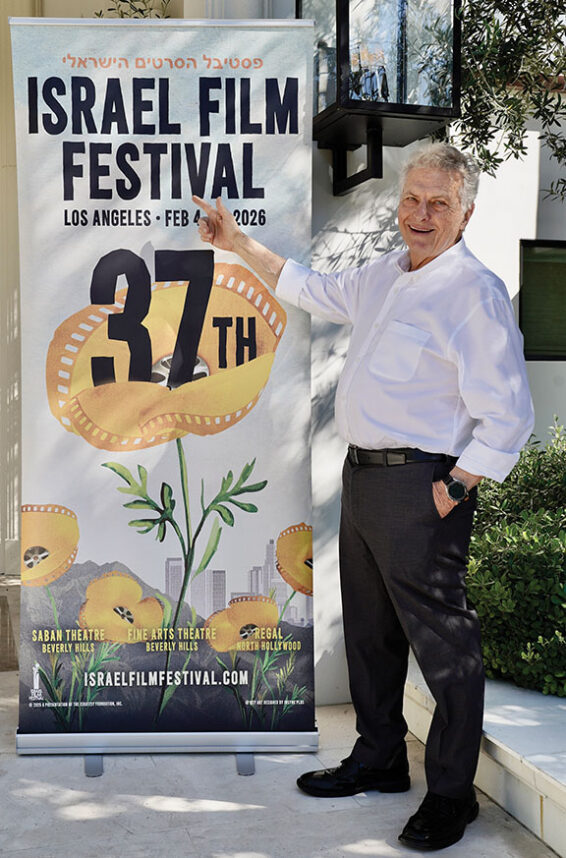
At 75, Meir Fenigstein, the founder and longtime executive director of the Israeli Film Festival, is still orchestrating a cultural feat that would exhaust people half his age. Every year, despite the shrinking number of movie-goers and the lure of streaming at home, he single-handedly brings Israeli cinema to American audiences — curating, fundraising, promoting and presenting films.
Fenigstein has spent decades building a bridge between Israeli filmmakers and American audiences. It’s a role he has played since 1981, when, as a music student at Berklee College of Music in Boston, he made a decision that would change his life. In his second year of music studies, Fenigstein walked away from academia to launch what would become the Israeli Film Festival, long before Israeli cinema was fashionable abroad. This year, he marked the festival’s 37th edition — a one-man operation powered by passion.
Running a film festival is never simple — doing it from thousands of miles away is even harder. Fenigstein oversees the festival from his office in Tel Aviv, but distance never loosened his grip on the project he built. Three to four times a year, he flies to the U.S. to prepare for the next festival, court sponsors and repeatedly make the case for why the Israeli Film Festival still matters — for Israel’s cultural image and for keeping Israeli cinema visible on the American stage.
Photo by Orly Halevy
Each year, the pitch becomes more difficult as funding grows tighter and donors are courted by competing Jewish organizations — especially in the wake of Oct. 7, 2023.
Convincing sponsors to invest in a cultural program rather than immediate humanitarian or political needs remains a constant challenge. Still, Fenigstein — who started the festival when he was 31 — refused to let go. For him, the festival is not just a series of screenings but a mission to ensure Israeli stories, talent and culture reach audiences in the U.S. The festival’s core audience is largely Israelis and American Jews, a loyal base that has sustained the event while gradually bringing new viewers into the fold.
That sense of purpose is most visible when Fenigstein steps onto the stage at the Saban Theatre at the opening night gala. Each time, he chokes up. Sometimes, there are tears in his eyes. Facing the audience, he pauses, steadying himself, visibly moved by the people who showed up — again — to watch Israeli films on a big screen. The emotion is not performative; it takes him by surprise every year.
Sitting with The Journal, Fenigstein admitted that even though it’s getting harder each year, he has no plans of quitting. He simply loves what he does. “I see this as a mission for the State of Israel,” he said. “I’ve screened more than a thousand Israeli films. Without the festival, people wouldn’t really know Israeli cinema.”
I’ve known Fenigstein for many years and consider him a friend, which has given me a front-row seat to the intensity of his passion for the festival. When asked how the comic character Poogy (which was also his nickname) was born, he launches into an animated, highly detailed description that verges on the theatrical, mimicking voices and gestures along the way.
“It was 1970 and I was a young soldier with the Nahal troupe, performing at kibbutzim. One night we came to Kibbutz Mefalsim in the Negev, where a group of young Argentinians had just made Aliyah. They had their own little band, singing and playing in Spanish. Israel Hadar, one of the kibbutz founders, introduced the group” (he slips into a thick Argentinian accent): ‘Amigos, buenas noches! Here with us, la Trio de Mefalsim! And after, la Band of the Nahal!’ I couldn’t stop laughing. On the bus back with the guys, I kept imitating him all throughout my service and whenever I went on stage and performed.”
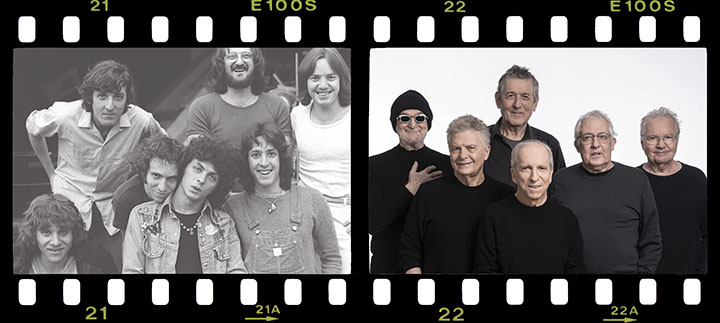
Before he had moved to the U.S., Fenigstein was the drummer in the pop rock band Kaveret, one of the most beloved and influential Israeli bands of the 1970s. The group represented Israel at Eurovision in 1974 and reunited four times after their initial breakup, the last reunion in 2013 — playing to sold-out theaters. Their songs remain part of the national soundtrack.
Fenigstein with his Kaveret bandmates in the 70s (Photo by Monty Abrahmson); The Kaveret band.
When the band broke-up 50 years ago and its members pursued solo careers, Fenigstein wasn’t sure what he wanted to do next. “In the years after Kaveret, I had acted in a few films, but honestly, I didn’t know what I wanted to do: actor? … musician? I felt lost, so I went to Boston to study music. I quickly learned it wasn’t simple to start from scratch at 30, learning piano and arrangements. It was a steep climb,” Fenigstein said.
In his second year in Boston, he had a chance encounter that would change the course of his life. A university professor asked if he could bring Israeli films to campus.
The professor had seen the Israeli cult film “Eskimo Lemon” — the second most commercially successful Israeli movie of all time. Could he find out how to get Israeli films to screen here? Fenigstein said he could try. He reached out to producer Menachem Golan (“Delta Force,” “Death Wish”), who agreed to provide a few films for $1,500.
“That was half a year’s tuition back then,” Fenigstein said. Golan replied, “Take it or leave it.”
Fenigstein left the office to figure out a solution. That’s when producer Shish Koler approached him. “What are you doing here?” he asked. “I said I wanted two films to screen in Boston.”
“Are you going to do a festival?” Koler asked.
“What are you talking about? I just want two films,” Fenigstein replied.
“So you’re doing a festival?”
“No, just two films for the university!”
Then Koler said, “Listen, I’m at Cannes every year. If you want to take 18 films and run a festival, I know distribution and marketing — I can help.”
Even though Fenigstein had been the drummer of one of Israel’s most successful bands, he wasn’t wealthy. Kaveret members had opted for a fixed salary instead of the 50% of profits their manager offered, earning about $30 per show — roughly $205 today.
Still, he decided to take the gamble. With Koler’s guidance, he secured several films for the first festival, betting everything on a vision.
The first Israeli Film Festival kicked off with Avi Nesher’s “The Band” (1978), a musical comedy about an Israeli military ensemble. Fenigstein even had a part in the film as the band’s drummer. It was a hit. “After the screening, a Jewish doctor approached me and asked if I planned to advertise in the Boston Globe. I said I couldn’t afford it — I was just a student. He said, ‘Don’t worry, I’ll take care of it. I want every Jew in Boston to come.’”
The festival was scheduled to run for four days, from Wednesday to Sunday. On Saturday, the ad was placed, and on Sunday, the final day, there were five screenings, all sold out. Over the course of one day, 3,000 people attended the festival.
“It was simply incredible,” Fenigstein said. “I made a lot of money that night. Three weeks later, I notified the school I was leaving, packed my belongings, got in my van and headed to New York, where I was planning to open the next film festival. I thought, if I can make it there, I can make it anywhere.”
In New York, Fenigstein found a small apartment on 28th Street between Second and Third Avenues and rented an office on the 19th floor of the Empire State Building. For the next nine months, he threw himself into the festival, investing everything he had. The opening night was scheduled for February, when temperatures were 20 degrees Fahrenheit.
“Opening day was freezing — everything iced over, there were no taxis, the streets completely blocked. I believe the subway trains weren’t running, because I remember walking in a tuxedo, from my apartment to the theater on 59th Street, about 30 blocks. I was convinced no one would show up — who would brave this cold? On 42nd Street, a semi-trailer blocked both lanes; it looked terrible.”
When he finally arrived at the Manhattan One theater, it was already packed, all 300 seats were full. A representative of Mayor Ed Koch was there to say a few words, lending the event an official stamp of recognition.
A reporter from WPIX-TV also arrived to cover the first Israeli Film Festival in the U.S. “It was the first and last time I appeared on Channel 11 news,” he laughed.
The second Israeli Film Festival was a success, and the following year Fenigstein founded IsraFest, a foundation to promote American productions in Israel and encourage co-productions. It was then at he met a fundraising expert who worked for the Anti-Defamation League (ADL). The man immediately offered him a crash course in fundraising.
“I make money for a living. Come to my office, I need to teach you how to do it,” he told him.
Fenigstein didn’t wait long. A week later, he arrived at the man’s office. The man sat behind a desk on a lofty chair atop a raised platform, with two lower seats for guests across from him. He was on the phone and gestured for Fenigstein to wait.
“He was talking for maybe half an hour; I looked around at the countless photos on the walls. One was with the Israeli prime minister, another with the U.S. president, and one with Gila Golan, Israel’s runner-up in the 1960 beauty pageant. She had written him a warm dedication. I remembered someone telling me I needed to reach out to her for help — she had moved to the U.S. and married a very wealthy Jewish millionaire who invented the electric blanket.”
Once the call ended, the meeting began — and quickly became Fenigstein’s first crash course in persuasion.
“He looked at me and said, ‘Listen, young man, never ask me for two things at once, only one, because then I get confused and don’t know how to help. Second, when you ask me for something, you must touch my heart. And third, you have to be sure I can deliver.’ While he said this, I thought fast about what to ask, it had to be the right thing. I smiled, leaned over his desk, and said, ‘I want to meet Gila Golan.”
His request hit the mark. The man immediately punched his chest and said, “You’ve touched my heart.”
Without another word, he picked up the phone and called Golan in Miami. The former beauty queen and actress was married three times, her second husband being Matthew Bernard Rosenhaus, a Jewish American industrialist in the pharmaceutical sector, a pro-Israel philanthropist and the largest shareholder of Columbia Studios.
At first, Golan didn’t sound enthusiastic on the phone. Her husband had passed away a couple of years ago, leaving her with millions of dollars and countless charity requests. “She said she only supported orphans, since she had been an orphan herself. She was born in Poland in 1940 to Jewish parents who were murdered by the Nazis,” Fenigstein said. “But the ADL guy didn’t give up. He told her, ‘He doesn’t want money, he just wants to talk to you. He has a very interesting idea, you should hear him out.’ She was finally convinced — or maybe she just wanted to end the call. ‘Okay,’ she said. ‘I’ll come to New York in two weeks and meet him at my apartment.’”
Two weeks later Fenigstein went to meet Golan. He took the elevator up in the luxury apartment building and was greeted by a stunning woman in her early 40s, wearing an elegant leopard-print dress and a hat.
He told her about the Israeli Film Festival and his plan for a gala at the Waldorf Astoria with a formal dinner, selling tables at $2,500 each. Golan asked him to wait and returned with a check for $25,000 — equivalent to about $86,000 today.
“Honestly, I was terrified. I didn’t want to take the money. It meant I had to actually pull off this event, and I wasn’t sure I could,” said Fenigstein. “Besides, I had promised I wasn’t asking for money, and suddenly here I was taking this huge check. But she insisted, ‘If you don’t take it, there won’t be an event. Please take it.”
That’s how the first festival gala happened with a list of celebrities which included Paul Sorvino, Howard Cosell, Brooke Shields, Israeli director/actor Assi Dayan and, of course, Gila Golan.
Brooke Shields and Meir Fenigstein at the second Israeli Film Festival in NY; Michael Douglas and Danny DeVito with Fenigstein; Fenigstein with his wife and
After establishing the festival in New York, Fenigstein began expanding its reach across the United States. In 1986, he opened the festival in Los Angeles, transforming it into a bicoastal cultural event and planting the seeds for what would become its long-term home base. Nearly two decades later, in 2005, he pushed the concept even further, launching editions in Chicago and Miami as well. At one point, he was running four festivals back-to-back — an exhausting logistical marathon that required coordinating venues, guests, film shipments, sponsors and press in multiple cities almost simultaneously. For Fenigstein, however, the expansion wasn’t about scale for its own sake; it was about making Israeli cinema visible wherever there was an audience willing to discover it.
Throughout the years the festival went on to host some of Hollywood’s biggest names, including Danny DeVito, Michael Douglas, Sacha Baron Cohen, Natalie Portman, Sharon Stone and Helen Mirren. It was a different era — a time when celebrities weren’t hesitant to be publicly associated with Israel, before it became “unpopular” to show support out of fear of retaliation.
Over the years, the festival has become far more than a screening platform. Each edition brings filmmakers, actors and industry professionals from Israel to meet American audiences, often staying after screenings for lively Q&A sessions that turn the events into cultural conversations rather than simple movie nights. According to Fenigstein, the exposure has helped open doors for Israeli creators in the U.S. and expand their international networks, giving them an opportunity to create connections.
Fenigstein was born in Israel to Polish Holocaust survivors. “Very few people survived Majdanek — I don’t know how my father made it out,” he said. Unlike many survivors who struggled to speak about their experiences, his father, Shimon, shared stories from that darkest period of his life. “During the Warsaw Ghetto Uprising, he fired at the Germans with a machine gun from a high floor of a building. When he saw the tanks approaching, he ran downstairs, and just as he got out, the entire building collapsed. Another time, they caught him stealing a potato and put him naked in the middle of the night into a large water tank. He survived that too.”
Shimon lost his first wife and two daughters, ages five and 10, during the Holocaust. He later met Fenigstein’s mother, Mania, at an SS munitions factory. The couple married and made Aliyah in 1949. A year later, Meir was born.
Growing up with the weight of his parents’ experiences and the importance of remembering history, Fenigstein developed a deep sense that stories, of survival, courage, and resilience, must be told and shared. That conviction is evident every year at the festival.
To open the festival this year, Fenigstein chose “A Letter to David,” the film about brothers Ariel and David Cunio, who were held hostage by Hamas. The film moves him to tears every time he watches it. “When I see David speaking, I can’t believe he was in captivity for two years and two months. What did they do to him? What did he eat? It’s hard to believe what he had to endure,” he said.
Films like “A Letter to David” offer audiences a glimpse into experiences most people abroad rarely see — the realities Israelis have faced, often absent from local media or mainstream films. But the festival is about more than war or conflict; it showcases the full spectrum of Israeli life through dramas, comedies and documentaries, each providing a window into the people behind the headlines.
In many ways, Fenigstein’s life reads like a movie. A documentary is currently in the works that will follow his journey — from his years as a band member to building the festival, and even a surprising chapter from his personal life.
In 1997, Fenigstein received news from his brother in Israel that a letter addressed to him had arrived from a woman named Susan, informing him that he had a 19-year-old daughter by the name of Rachel. She had been conceived during a brief encounter while Fenigstein was touring the U.S. with his band.
“They got my address from my school in Boston. I was living in LA at the time, Susan called me with Rachel on the line and said: ‘Hi, this is Susan; I’m Rachel’s mom, and you are the dad!’ — it sounded like it was an accusation,” Fenigstein laughed.
He was 47 at the time, a lifelong bachelor with no children. He arranged to meet Rachel in New York and took a DNA test which confirmed what was already hard to miss — the resemblance was striking. Rachel strongly reminded him of his late mother. From that moment on, Fenigstein became an active presence in her life. He attended her graduation from Harvard and later from Yale, where she earned her medical doctorate.
At 50, Fenigstein married Jessica (“Jessi”), who was 22 and a half. The couple moved back to Israel in 2013 with their two sons and welcomed a third son after relocating. Today, their youngest is 10 and a half — the same age as Fenigstein’s grandson, Ezra, the son of his daughter Rachel, who has made him a grandfather of two. “In May we are going to fly to Boston to celebrate Noah’s, my oldest grandson, bar mitzvah,” Fenigstein said.
These days, the festival takes place solely in Los Angeles. Running it in multiple cities proved too exhausting — there is no other foreign film festival, especially from a country as small as Israel, that once held four editions across the U.S. There were a few occasions when the relentless founder had to postpone the festival, like during COVID, when it was only online, and after the war, when fewer films were being made in Israel.
Director Eran Riklis, whose “Reading Lolita in Tehran” had its Los Angeles premiere at this year’s festival, participated in the festival for the first time in 1991, with “Cup Final,” then two years later, with “Zohar.” Both films were huge successes.
“Meir was and remains the heart of the festival in every sense — faith, vision, and hard work have driven him from the very beginning,” said Riklis. “After all these years, his passion seems even stronger, perhaps because it has never gotten easier. At a time when Israeli cinema faces challenges on the international stage, this festival remains a vital ‘window to the Middle East,’ and I am confident it will continue to be so.”
Actor Mike Burstyn, a lifelong friend, has supported the festival for the past 44 years. He served as master of ceremonies for many of the festival galas, starting with the first one in New York, where he was performing on Broadway in “Barnum” at the time. Over the years, he has continued to lend a hand, often conducting Q&A sessions with filmmakers after their screenings.
“I’m happy to do it,” he said. “Meir needs help — it’s not easy to organize such a festival year after year. We’ve known each other for so many years, back in Israel. His parents used to bring him to see me and my parents perform at the Yiddish theater.”
During the interview, Fenigstein was constantly interrupted by phone calls, urgent issues and fires to put out. He’s perpetually tired, sleeps little and feels the pressure of filling theaters and securing new sponsors. It’s a nonstop battle. And yet, he shows no signs of slowing down.
Beyond running the festival, he dreams of making his own feature film, based on a script he wrote 40 years ago but never had the chance to produce — a story about Poogy’s Dream, a nod to his nickname from the Kaveret years. “I really want to do it,” he said. “This is my life’s project.”
Then, as he often does, he launches into a long, animated description of the plot, frame by frame, eyes lighting up with excitement, and there’s no stopping him.
Close to 60% of Jewish Israelis place themselves, in one way or another, in the “right wing” camp. We see this in almost every measurement we take. Whether we divide the public into two camps (right and left); three camps (right, center, left); five camps (adding “moderate right” and “moderate left”); seven groups; or even nine. We haven’t tried more than nine, but we shouldn’t expect a different result in such a scenario.
Every new scale yields a slightly different result, but the reality is stark: Between 50-to-60% of Jewish Israelis prefer the brand “right” as part of their political identity. They prefer “right-center” over “center.” They prefer “moderate right” over anything that isn’t right. And then there are those who choose “deep right.” For them, the standard “right” is a bit too moderate. They know exactly where they stand — at the rightmost edge of the spectrum. In a recent survey, 12% of Jews selected this “deep right” category.
Because the right is so dominant — comprising the clear majority of the Jewish population — and because it is so diverse, stretching from the deep right to the center-right, there is value in examining the differences within the camp. In fact, these internal differences are more important than the differences between the right and the smaller camps of the center and left.
The left is tiny, hovering around 5%. The center-left adds another 15%. Together, they are dwarfed by the sheer size of the right. Therefore, if one half of the right thinks differently from the other half, that disagreement is numerically more significant than the traditional friction between right and left.
It must be said: the right is diverse not just in self-definition, but in substance. When “Moshe” calls himself right and “Hannah” calls herself center-right, they aren’t just choosing different labels; they are expressing different ideologies and sentiments. These differences are currently the most significant variable in the Israeli public arena because they will likely determine where voters migrate in the next election, and perhaps where the next government will steer the country.
So, what are the glaring differences inside the right?
To make life easier, we will do two things. First, we will skip the complicated division into four or five right-wing sub-groups and look at the right as two main blocs: the “right” and the “center-right.” Second, we will look at just three core issues. We chose these three because we have polled them repeatedly, allowing us to ensure the analysis is robust.
We will examine the gap between the right and the center-right regarding the Israeli-Palestinian conflict, judicial reform, and the draft of Yeshiva students (Haredim). These are three issues at the center of the agenda.
1. On the Palestinian conflict we presented three options: First, strengthening control, expanding settlements and considering annexation in Judea and Samaria. Second, maximum separation from Palestinians while maintaining security control. Third, striving for a peace agreement.
Let’s look at the first option – deepening control. In the “right” group, 70% choose this option. A clear majority. In the “center-right” group, only 35% choose this option. The majority of the center-right prefers separation. The Gap: 35%.
2. The Haredi Draft question had just two options. One: support of the coalition’s exemption law. Two: mandating the draft of young Haredim and deepening economic sanctions on draft dodgers.
In the right, 55% support the exemption law. In the center-right, only 25% support the exemption law. Again, a distinct gap in preferences: 30%.
3. The question on judicial reform also had three options: Oppose any reform; support reform only with broad consensus; or support reform even without consensus.
In the right, there is a small majority (52%) in favor of reform even without consensus. (with a high percentage of “don’t knows”). In the center-right, only 18% support unilateral reform. They may want changes to the legal system, but they reject the aggresive approach. The gap: 34%.
These gaps are already visible in the shadow campaign for the next election. The battle is for the soul — and the vote — of the center-right.
PM Netanyahu and the Likud are emphasizing judicial reform. There are center-right voters who care about this issue, but perhaps less than Netanyahu thinks. Challengers like Naftali Bennett and Gadi Eisenkot are talking about the Haredi draft. This is an excellent wedge issue because even within the right there isn’t much enthusiasm about the exemption law, and the center-right actively opposes it. The only problem? For many voters, the draft is important, but not the most crucial factor for their vote.
And what about the conflict? The right will promise settlements and perhaps annexation. Avigdor Lieberman, Eisenkot, and Bennett will maneuver carefully, emphasizing “security.”
One thing is certain: The elections of 2026 will not be “right vs. center-left.” They will be “right vs. right.” Because there is one right, and there is another right. And as the numbers show, it is quite easy to spot the difference.
Something I wrote in Hebrew
Another week, another Trump-Netanyahu meeting, another pre-meeting competition of guessing games:
As Netanyahu sits down for his umpteenth meeting with President Trump (there have been so many that counting seems pointless) the challenge isn’t explaining why a U.S. nuclear deal with Iran endangers Israel and global stability. The hard part is convincing Trump that a more aggressive path serves his own interests, both politically and personally.
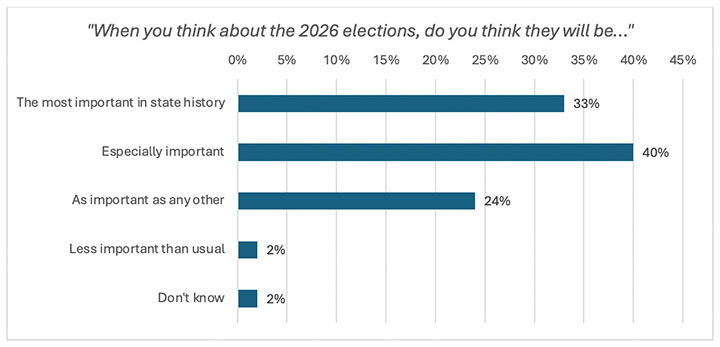
A week’s numbers
The center-left think it’s the most important ever, the right tends to say “as important as any other.”
A reader’s response
Toby writes (following last week’s article): “Israel isn’t western, it’s a theocracy of Jews.” My response: No, it’s not. A country doesn’t have to be as strict as the US in separating church and state to be considered “western” (a poorly defined term anyway).
Shmuel Rosner is senior political editor. For more analysis of Israeli and international politics, visit Rosner’s Domain at jewishjournal.com/rosnersdomain.
It’s like a broken record: another breathless email telling us how bad things are for the Jews.
The latest is from head honcho Ted Deutch of AJC letting us know “we’ve never seen numbers quite like this.” Referring to a new AJC survey, Deutch says “the findings are chilling and paint a picture of a reality American Jews face that is flatly unacceptable.”
AJC is hardly the only player in this Bad News Industrial Complex. Countless other Jewish groups have made it a habit to tickle our fear gene with a continuous drip of bad news for the Jews.
I’m not here to contest the bad news. I’m sure it’s accurate. I’m more interested in this question: Why is it that despite the enormous resources and money we spend fighting antisemitism, it just keeps getting worse?
AJC, for example, says they use the data to “help shape policies, mobilize leaders, and combat antisemitism across American society.” Every organization that fights antisemitism has its own list of action items.
The question remains: With all these groups fighting the same problem, why is the problem getting alarmingly worse?
It’s too easy to counter that things might be even worse without those efforts. Even if that were true, it’d be like saying that very bad is better than very very bad. Lame consolation.
Maybe that’s why Bret Stephens struck a nerve with his much-discussed “State of World Jewry” address, when he called the fight against antisemitism a “well-meaning but mostly wasted effort.”
We can argue that this was an exaggeration (as I have), but we can’t deny that Stephens put his finger on the most uncomfortable question in philanthropy: Is my money making a difference?
To put it more delicately, if we assume that we all want the same thing– reduce antisemitism while building a thriving Jewish future—what is the best way to allocate resources?
That’s not just an honest question; it’s a decisive one.
If our community can respond constructively rather than defensively, I would say this would be very good news for the Jews.
The first step, as I see it, is to get a better handle on what works and what doesn’t. The “fight against antisemitism” is multi-faceted; it comprises a whole array of different tactics and approaches.
We ought to take some of the money we spend on surveys and commission a comprehensive study so we can better understand the parts of the fight that work best—and why.
We all have our opinions. Some of us think that making a lot of noise about Jew-hatred conveys fear and weakness and can backfire. Others believe that the more noise we make, the more likely we’ll get more people on our side. Some think we should fight in the courts rather than the streets, while others say the real war is in social media. Still others believe we should Americanize the fight or make it about fighting antizionism. Some even think we should run ads on the Super Bowl.
The point is: There are a million ways to fight antisemitism. Which ones work better and what’s the best way to measure that?
Until we get some actionable answers, we should expect the calls for a more positive approach—like strengthening Jewish identity– to continue, if not accelerate. After all, an investment in something positive like Jewish education or summer camps is usually seen as a sure bet.
In his speech, Stephens reminded us that, ultimately, “The goal of Jewish life is Jewish thriving…a community in which Jewish learning, Jewish culture, Jewish ritual, Jewish concerns, Jewish aspiration and Jewish identification… are central to every member’s sense of him or herself.” He called on Jews to “lean into our Jewishness as far as each of us can.”
He was basically arguing that we’re investing too many resources going after bad guys (Jew haters) and not enough creating good guys (proud Jews).
No one is saying we should do only one or the other. Of course we need both, and of course we must protect Jews. But if we’re going to make our limited resources go further, we should figure out ways to fight antisemitism that gets us better results.
Just as today’s reality for Jews is “flatly unacceptable,” the reality that antisemitism just keeps getting worse despite our herculean efforts should also be unacceptable.
Stephens is daring us to do the Jewish thing and aim higher.
Calls to invest in Jewish education and pride-building are not misguided. Identity matters. Confidence matters. Knowledge matters. Bret Stephens is right to argue that a Jewish community grounded in pride will always be stronger than one defined solely by fear. But before we rush to expand Jewish schools, camps, and programs as the answer to rising antisemitism, we need to confront a more uncomfortable question: what kind of Jewish education are we actually producing—and to what end?
Education is only a defense when it is done right. Much of mainstream American Jewish education today is not.
Put plainly, the system is inadequate—putting it mildly. Not for lack of effort, but for lack of substance where it matters most. Some Jewish schools invest heavily in Mishnah and Gemara, yet graduate students with only the faintest grasp of Jewish or Israeli history. Others reduce Jewish life almost entirely to tikkun olam, tzedakah, and the occasional hamotzi. In both cases, students emerge earnest but unanchored.
They can analyze a passage of Talmud or recite values slogans, yet struggle to place the Israelites alongside the ancient Greeks in a serious historical framework. Where are the middle-school history classes that teach Jewish civilization with the same rigor, continuity, and legitimacy as Greece or Rome? They are rare—if they exist at all.
This imbalance has consequences. Jewish history becomes fragmented or sentimentalized. Zionism is hedged as “complex” rather than taught as a historical necessity born of exile, statelessness, and repeated failure of minority existence. Jewish peoplehood is softened into culture; sovereignty becomes morally suspect. Education that is uneasy about Jewish history cannot produce Jewish pride.
This detachment has surfaced repeatedly over the past year. At multiple conferences and professional gatherings of Jewish educators, a consistent sentiment has emerged: discomfort with the word Zionism itself; calls to stop “defending Israel” in favor of “holding space”; warnings that clarity is polarizing and certainty dangerous. Everything is framed as nuanced and complicated—as though avoiding moral and historical judgment will somehow lower the temperature.
At one such gathering, a prominent rabbi remarked that he would gladly give up Hebron if it meant no more Jewish soldiers would die. The significance of the statement lies not in Hebron itself, but in what it reveals. Hebron is rarely taught not because it is marginal, but because teaching it would require educators to confront Jewish historical continuity and Jewish claims to nationhood without apology. Instead, students are often offered a sanitized version of Jewish attachment, where the Kotel becomes the singular symbol of meaning, stripped of broader historical context. This is not nuance. It is avoidance.
Which brings us to a question Jewish institutions have avoided for too long: why do leaders of anti-Israel activism so often emerge from within the Jewish educational institutions those movements now challenge? Public reporting shows that this pattern is not isolated. Simone Zimmerman, a founder of IfNotNow, attended Jewish day schools and describes those experiences as formative. Rae Abileh, an early Code Pink leader, is a graduate of BBYO and the Diller Teen Fellows program. Sydney Levy, longtime advocacy director of Jewish Voice for Peace, is a graduate of Jewish school and earned both his BA and MA in Jewish history while living in Jerusalem – a background he has publicly discussed as shaping his politics. JVP has a list These figures did not come from the margins of Jewish life; they passed through its core institutions—day schools, camps, youth movements, and leadership programs. They frequently invoke Jewish texts, values, and prayer in protests and teach-ins, deploying the tools of Jewish education to legitimize opposition to the Jewish collective itself. By any serious educational standard, this is a failing outcome. And yet it remains completely unexamined, swept under a rug and expected not to be discussed in polite company.
So when we call for “more Jewish education,” we must be honest. More of what? Expanding institutions without re-examining who staffs them and what worldview they transmit guarantees repetition of the same failures. Producing more education that is historically thin and ideologically timid will not yield stronger Jews—it will simply scale weakness.
I don’t mean to toot my own horn, but I’ve been warning about this for years: education without training doesn’t make Jews stronger – it leaves them exposed. Teaching identity without teaching how to defend it is not neutral. It is negligent. It is educational malpractice. What everyone is seeing for the past 2+ years didn’t come out of nowhere. It is the result of wishing reality away for far too long.
And yet, there is an alternative model—one that has existed quietly and consistently for more than a decade. It is a single, integrated approach to Jewish education that refuses to separate identity from history, or pride from agency. In this model, advocacy is not an extracurricular activity but a core educational outcome, built into the curriculum from the start on the assumption that knowing who you are is meaningless if you are not prepared to defend it publicly, intelligently, and under pressure. What distinguishes this approach is clarity. It teaches Jewish and Israeli history without euphemism. It draws moral lines where history demands them. And it trains students to engage—to argue, to challenge falsehoods, and to withstand social and intellectual pressure. The goal is not to manufacture activists, but to produce Jews who are neither confused by antizionism nor intimidated by it.
This matters because the supposed choice between education and confronting antisemitism is a false one. Education done right is not an alternative to fighting Jew-hatred; it is what makes that fight possible.
Stephens argues that fighting antisemitism has become a mostly wasted effort. The frustration is understandable. Antisemitism is ancient, adaptive, and relentless. It will not be defeated. But the belief that it can be safely deprioritized—or wished away through inward focus—is a dangerous misreading of history.
Antizionism did not become normalized because it was persuasive. It became normalized because it went insufficiently challenged—especially by Jews who lacked historical clarity themselves. Ignorance created the opening; silence allowed the lie to harden. What followed was inevitable: an industry built on weaponizing Jewish confusion into moral indictment—against Israel, and ultimately against Jews.
Fighting antisemitism is not inspiring work. It is exhausting, repetitive, and often thankless. History doesn’t show that confronting antisemitism makes it disappear. What it does show—over and over again—is that when it’s left unanswered, it moves from being unacceptable to being tolerated, and from being tolerated to being justified, normalized and even celebrated.
Choosing not to fight Jew-hatred vigorously and consistently is not realism—it is surrender.
The choice, then, is not between identity and defense. It is identity with defense. Education must include history, moral clarity, and the skills to confront lies in real time. Pride without truth collapses. Education without conviction misleads. And defense without identity cannot endure.
If we want a different future, we must be willing to examine what already exists, what has failed, and what is quietly working.
Masha Merkulova is the Chief Zionist Officer of Club Z, an unapologetically proud Jewish Zionist space for teens to connect to each other, Jewish history, and Zionism.
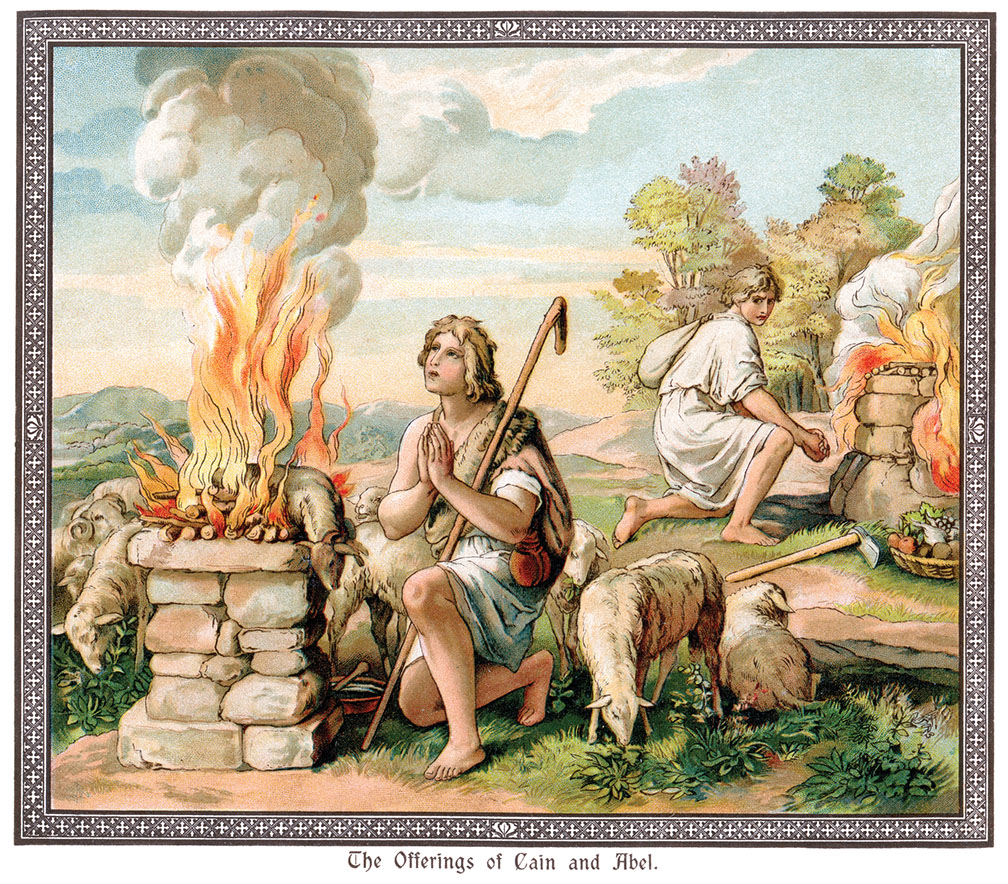
In Genesis (chapter 4), Cain and Abel offer sacrifices to God. Abel’s is accepted and Cain’s is not. Cain is angry. God explains to him that Cain has a choice: “Surely, if you do right, there is uplift. But if you do not do right, sin crouches at the door, its urge is toward you, but you can be its master.” Immediately following that encounter, Cain kills his brother.
The Biblical text is rich with great symbolic meaning, carrying a fundamental moral lesson. It takes place at the beginning of time and carries a universal message: Cain and Abel were not Jewish. The first Jew was Abraham who came generations later. Hence, the message is for all humankind and all eras.
Something went wrong with Cain’s offering. There is no explicit reason given but the text does state that Cain’s offering was from “the fruit of the soil” whereas Abel brought “the choicest of the firstlings of his flock.” The implication is that Abel’s offering was the object of painstaking effort, an offering from his best, a heartfelt gift, whereas Cain’s was perfunctory and insincere.
In any event, the life lesson is that God does not rebuke Cain or take offense. Rather, He explains to Cain that if he can create a relationship with the Divine (“if you do right”), then he can benefit spiritually (“uplift”). The choice is left to Cain. He can choose his own path. It is a moral test.
For reasons unexplained, Cain impulsively chooses to murder his brother and, worse, when confronted by God, he utters the outlandish response, “Am I my brother’s keeper?” God does not respond to his question but does condemn Cain for his action. The first murder in history was a conscious choice. There was a clear, moral and humane alternative. God does not even dignify Cain’s response with an answer but leaves the answer to us, the readers: Yes, Cain, you were your brother’s keeper, as we are all our brothers’ keepers in God’s eyes.
The alternative to the spiritual uplift that was offered to Cain was “sin crouching at the door.” That phrase is unique. It appears nowhere else in the Bible. What crouches at the door? Something ominous, threatening, dangerous. Almost like an animal of some type, or a monster. These are the characteristics of sin and immorality, of which murder is just one example. Why at the door? Because the door is the entry point of one’s home, a symbol of one’s intimate, private space. If you choose to sin, you are internalizing something evil and making it part of your way of life.
Its “urge is toward you” means that immorality in the form of hatred is a strong and commanding force. Yet the final words are positive and hopeful: “But you can be its master.” God states explicitly that He has endowed humankind with the power and the will to rule over their emotions and to establish the good, to love and respect the Other. Free choice, yes, but with the clear idea of human agency for good.
The story appears in the Bible before the birth of Judaism and its “children,” Christianity and Islam, because it is a statement about universal truth and morality that applies to every religion and every person. Murder is the most egregious of immoral acts and is condemned forcefully and unequivocably.
In his magisterial book “Not in God’s Name” – the subtitle is “Confronting Religious Violence” – Rabbi Jonathan Sacks explains how all Jewish, Christian and Islamic antagonism throughout the ages is the result of sibling rivalry – from Cain and Abel, Isaac and Ishmael, Jacob and Esau and Joseph and his brothers. This adversarial relationship is based on the idea that if one wins, the other loses, resulting in hatred and even death.
He demonstrates how the Torah is not a zero-sum game. Isaac and Jacob may well be the bearers of the divine covenant, but Ishmael and Esau are blessed and respected, not rejected. In this interpretation of the text, all are included and none are excluded.
All who embrace Abraham “must aspire to live like Abraham … jihad, barbarism, terror, murder are pagan ideas and have no place in monotheism.” Isaac’s and Ishmael’s descendants became enemies because they did not understand that all were descended from the same family and were meant to live in peace with one another fully blessed by God.
That is why there are two covenants – one given to all humankind asserting our common humanity and one given to the Jewish people in our specific identity. Both are essential.
Cain was not rejected by God before he chose violence, and neither were any of the major figures in these stories in the Torah, most importantly Ishmael and Esau. God may choose but he does not reject.
The lesson that God may choose but does not reject is critically important. No, it is essential: there will be hatred and violence now, and in the future, as it was in the past, as long as we refuse to recognize the face of God in the Other, as long as we do not acknowledge that all humans are due respect and dignity. Violently imposing religion on others never succeeds in the long term because it perverts religion and is sacrilegious.
Feeling blessed instead of rejected allows one to see the face of God in the Other. Understanding that everyone is part of the human family reverses the horror of Cain’s jealousy, rage and inhumanity.
The story of Cain and Abel is the archetype of sibling rivalry and all the grief that flows from it.It constitutes a critical and fundamental lesson – we are all children of the covenant with the opportunity to serve each other and to serve God. We are, indeed, each other’s keeper. The path to peace and harmony is clear. May it not be forever the path not taken.
Dr. Paul Socken is Distinguished Professor Emeritus and founder of the Jewish Studies program at the University of Waterloo
Life, Liberty and the Pursuit ofHappiness was not meant to describe comfort, affirmation or emotional safety. It named a moral aspiration: the conditions under which human life can flourish. Yet, in an age increasingly organized around identity and belonging, we have lost sight of a more demanding requirement of flourishing: mattering.
In “The Mattering Instinct: How Our Deepest Longing Drives Us and Divides Us,” Harvard philosopher Rebecca Newberger Goldstein argues that human flourishing rests on two distinct “cornerstones of our humanness”: connectedness and the longing to matter. Connectedness — what we often call belonging — is “the feeling that there are particular others who are prepared to pay us special attention, whether we deserve it or not.” It is unconditional, relational and necessary. But it is not sufficient.
Mattering is different. It is the drive to justify one’s existence. “We long to demonstrate that the reason we subjectively feel that we matter is that we objectively do.” Where belonging answers the question, “Who will have me?” mattering asks, “Is my life worth living?”
“We don’t want to live if we become convinced that we don’t, can’t, will never truly matter,” Goldstein notes. “The paradigmatic words of the suicidally depressed are, ‘I don’t matter.’” It’s no accident, she says, “that the URL for the U.S. Hotline for Suicide Prevention is: youmatter.suicidepreventionlifeline.org.”
Goldstein, from a philosophical perspective, understands flourishing as bigger than happiness. Flourishing is a resistance to entropy — the psychological and moral forces that pull lives toward disorder and dissolution.
The late social psychologist Mihaly Csikszentmihalyi, author of flow theory (and my mentor in graduate school), contrasted psychic entropy — the distractions, anxieties and drift toward mental disorganization and disorder — with the “optimal experience” of the “flow state,” which involves intense concentration, focus and effort.
Csikszentmihalyi found that the highest quality of life is achieved when a person stretches himself to accomplish something difficult and worthwhile over time. Belonging can support such projects, but it cannot replace them.
This distinction is even found in childhood. A recent paper from Harvard’s Center on the Developing Child emphasizes that children, too, need more than to feel like they belong. They need to feel that they matter — that their presence has value and their contributions make a difference.
Children as young as 18 months show a motivation to help others. And when adults acknowledge those efforts, children develop resilience, empathy and well-being. Connectedness tells a child, “You belong with us.” Mattering tells them, “What you do counts.”
Belonging is a fundamental human need. But on its own, it does not teach judgment. It does not teach responsibility. And it does not teach the link between action and self-worth that flourishing requires. When that developmental pathway is disrupted, when people grow up receiving affirmation without standards, the longing to matter can be directed toward destructive ends.
“Subjective meaningfulness is but a feeling,” Goldstein says, one that “can accommodate the worst of which we’re capable.” Even hatred and killing can become a mattering project — a fact that helps explain the appeal of extremist groups, cults and violent protest movements. They offer feelings of belonging and promise significance without the burden of truth.
Contemporary extremist networks and even recent college encampments, function in a similar way, supplying belonging, identity and a sense of righteousness, while encouraging a belief in wild conspiracy theories. These movements don’t merely reject liberal democratic norms. They reject the idea that flourishing is constrained by reality.
Research indicates that when individual identity collapses into group identity, people become willing to engage in extreme, self-destructive and even violent behavior endorsed by the group. Studies of radicalization find that a sense of belonging draws people in and a distorted sense of mattering keeps them there.
“The quest for personal significance,” say researchers at the National Consortium for the Study of Terrorism and Responses to Terrorism, “constitutes a major motivational force that may push individuals toward violent extremism.” And eventually, they can come to believe that engaging in violence — even terrorism — is, as psychologist and terrorism specialist John Horgan says, “not inherently immoral.”
What is lost in these movements is not just the reverence for life, but liberty in its democratic sense: the freedom to judge, to doubt, to revise one’s commitments in light of evidence, to dissent without fear. Flourishing requires that freedom.
Goldstein insists that mattering must answer to standards outside the self and outside the group. We are, she writes, “staunch realists” about mattering. In a pluralistic liberal democracy, we know, however uncomfortably, when meaning has been purchased at the expense of truth.
A society that maximizes belonging while severing it from standards produces conformity, not freedom. A society that encourages mattering divorced from truth produces fanaticism, not dignity. Life and liberty depend on holding the two together.
The hopeful implication is that individual agency still matters. You cannot choose to discard the needs to belong and to matter. But you can choose how you pursue them. A particular group might make you feel seen, but does it invite you to see more clearly? It might expect compassion toward its members, but does it extend the same toward those who don’t belong? It might provide a sense of being “on the right side of history,” but does it treat truth as a necessary constraint?
Belonging protects us from loneliness. Mattering, rightly pursued, protects us from self-deception. As I teach in the Habits of a Free Mind program, the mantra for the habit of compassion is “You belong here.” The mantra for the habit of calling is “You matter.” Communities that provide not just belonging but mattering require both compassion and a sense of calling.
They also require reality-based justification if they are to sustain a culture of civil liberties. They teach children (and remind adults) about the importance of both individual contribution and objective truth. And they underscore the understanding that democratic norms are not obstacles, but guardrails.
Flourishing, Goldstein posits, requires both belonging and mattering — grounded in truth, sustained by liberty and oriented toward constructing a life worth living.
A social psychologist with a clinical background, Dr. Paresky serves as Senior Advisor to the Open Therapy Institute, Advisor to the Mindful Education Lab at New York University, Senior Fellow at the Network Contagion Research Institute, and Associate at Harvard University. She writes the Habits of a Free Mind newsletter on Substack. Follow her on Twitter at @PamelaParesky
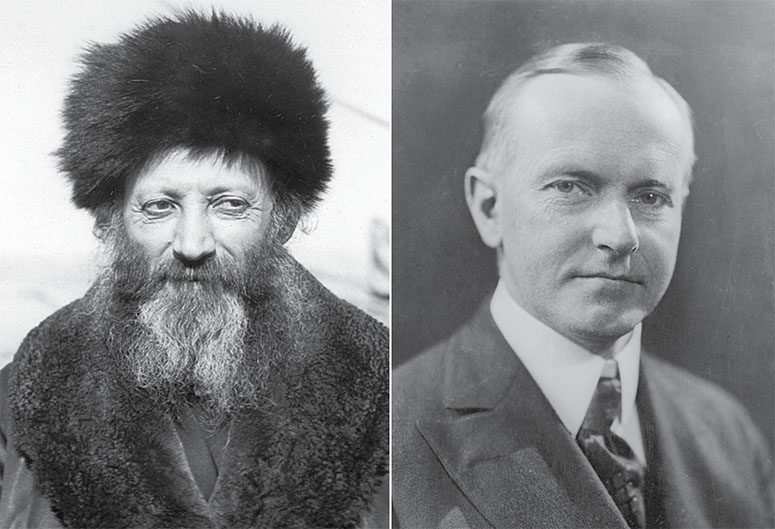
April 15, 1924 was a typical day for President Calvin Coolidge. He dedicated the Arizona State stone in the Washington Monument, met with his cabinet and held a press conference in which he discussed matters both domestic (“The Secretary of Labor reported that there was very little unemployment”) and foreign (“I don’t expect to designate a commission to assist me in the arbitration of the controversy between Peru and Chile”). He threw out the first pitch at the Washington Senators’ season opener at Griffith Stadium in Washington, D.C. (the home team, led by future Hall of Famer Walter Johnson, won 4-0). But it was a brief meeting that afternoon that’s worth recalling amidst the current efforts by hate-spewing pundits to weaken the bond between the United States and the historic Jewishhomeland.
Rabbi Kook, the Ashkenazi Chief Rabbi of British-mandate Palestine, headed a delegation of rabbis to the United States that had arrived the previous month to raise funds for yeshivot in Europe and Eretz Yisrael. As The New York Times described, “Rabbi Kook said that it was his first visit to America. He has a long, white, patriarchal beard and wore a black cassock and round, fur-trimmed hat.” He was joined by Rabbi Moshe Mordechai Epstein, head of the Slabodka yeshiva in Lithuania, and Rabbi Avraham Dov Baer Kahana Shapiro, the Rabbi of Kovno and president of the Rabbinical Association of Lithuania. The trip was sponsored by the Central Committee for the Relief of Jews Suffering through the War, known as the Central Relief Committee (CRC), established a decade earlier to help those affected by WWI.
According to a 1991 article by Joshua Hoffman in the journal Orot, “the rabbis had originally planned to stay in America for about three months. However, because their fund-raising efforts were not as successful as had been hoped, they remained for eight months. In the end, they raised a little over $300,000, far short of the one million dollar goal which the CRC had set.”
Contemporary records recount that at the meeting, Rabbi Kook thanked the President for his government’s support of the Balfour Declaration, which set in motion the establishment of a “national home for the Jewish people” in Palestine. He told President Coolidge that the return of the Jews to the Holy Land will benefit not only the Jews, but nations throughout the world. After all, the Bible mandates that the Jewish people aspire to serve as a source of blessing for all the nations of the earth. Rabbi Kook also expressed his gratitude to the American government for aiding in relief work during the war. He added that America has always stood as a model of liberty and freedom, as reflected on the Liberty Bell’s inscription, taken from Leviticus 25:10: “Proclaim Liberty Throughout All the Land Unto All the Inhabitants thereof.” Rabbi Kook concluded his remarks, delivered in English by Rabbi Aaron Teitelbaum, executive secretary of the CRC, by expressing his wish that the U.S. would continue to uphold its foundational values and render its assistance whenever possible.
The Jewish Telegraphic Agency reported that Rabbi Kook apologized for being unable to speak English and made a point of saying “Amen” after Rabbi Teitelbaum had finished, showing his affirmation of the letter Kook had written for the occasion. The President warmly stated that he felt highly honored by the visit of Palestine’s Chief Rabbi, and assured Rabbi Kook that the United States government would assist, in every way possible, the establishment of a Jewish homeland in Palestine. The President added his wishes for the trip’s success.
In a subsequent speech during the same trip, on June 22 at Independence Hall in Philadelphia, Rabbi Kook noted that the liberty the Bell’s inscription proclaimed was achieved after 49 years of work leading up to the 50-year celebration. Freedom is so important, he argued, that one must work 49 years to achieve it. This is true for individuals, to whom the verse is addressed, and even more so for a nation. Rabbi Kook then placed a wreath of flowers on the Bell and said that freedom can be a crown of thorns or a crown of flowers, depending upon how it is used. In America, freedom is used properly, and therefore, it is a crown of flowers.
President Coolidge undoubtedly agreed that America was forged from the biblical conception of freedom. The year after meeting Rabbi Kook, on May 3, 1925, he delivered an address at the laying of the cornerstone of the Jewish Community Center in Washington, D.C. In this remarkable speech, Coolidge expressed his belief that “Hebraic mortar cemented the foundations of American democracy.” The American Revolutionaries “found the Bible a chief source of illumination for their arguments in support of the patriot cause. They knew the Book. They were profoundly familiar with it, and eminently capable in the exposition of all its justifications for rebellion. To them, the record of the exodus from Egypt was indeed an inspired precedent. They knew what arguments from holy writ would most powerfully influence their people. It required no great stretch of logical processes to demonstrate that the children of Israel, making bricks without straw in Egypt, had their modern counterpart in the people of the colonies, enduring the imposition of taxation without representation. And the Jews themselves, of whom a considerable number were already scattered throughout the colonies, were true to the teachings of their own prophets. The Jewish faith is predominantly the faith of liberty.”
Fittingly, Coolidge expressed his admiration for the American Jewish community, which has demonstrated its ability to “thrive under the influence of liberty, to take their full part as citizens in building and sustaining the nation and to bear their part in its defense, in order to make contribution to the national life fully worthy of the traditions they had inherited.” He concluded that “if American democracy is to remain the greatest hope of humanity it must continue abundantly in the faith of the Bible.”
Both the Chief Rabbi and America’s Commander in Chief understood that America and Israel were bonded by the Bible, allies in a faith guided by God’s ancient promise of freedom centuries ago.
Rabbi Dr. Stuart Halpern is Senior Adviser to the Provost of Yeshiva University and Deputy Director of Y.U.’s Straus Center for Torah and Western Thought. His books include the newly released “Jewish Roots of American Liberty,” “The Promise of Liberty: A Passover Haggada,” “Esther in America,” “Gleanings: Reflections on Ruth” and “Proclaim Liberty Throughout the Land: The Hebrew Bible in the United States.”
One doesn’t need complex econometric models or a crystal ball to foresee Israel’s economic and social future. Just look at today’s Jerusalem, and reality will hit you straight in the eye. Jerusalem is a demographic-economic portent for the State of Israel as a whole, and unless there is a dramatic change in government policy, this is what Israel will look like in three decades.
Thirty years ago, Israel’s capital was an average Israeli city, with the added charm of deep history and meaning. Certainly, it was marked by complexities and tensions then, but the demographic and socioeconomic picture was different.
Israel’s Central Bureau of Statistics (CBS) uses a 1-10 socioeconomic cluster scale (10 is the highest score) to characterize the country’s population centers. Three decades ago, Jerusalem was designated a cluster 5 – a middle-class city of government civil servants, academia and commerce. Today, Jerusalem is languishing at the bottom, in clusters 1-2, alongside the poorest localities in Israel’s social periphery.
Poverty in Jerusalem is not just a statistic in dry CBS reports. Its crumbling infrastructure is painfully evident in the streets of the Haredi and East Jerusalem neighborhoods.
This collapse is the direct result of demography and unsound government policy. The trends shaping the city over recent decades are a frightening looking glass for what is happening in Israel today. In the 1980s, the ultra-Orthodox (Haredim) constituted 16% of Jerusalem’s population, similar to the Haredi share in Israel’s population today. In the 1990s, they represented 20% of all Jerusalemites and 28% of the city’s Jews; by 2011, they were 27% of all Jerusalemites and 30% of its Jews. And today, roughly 30% of Jerusalem residents are Haredi, making up more than 50% of the city’s Jewish population, a result of the sector’s high fertility rates and migration into the city.
When we examine the education system – the most accurate predictor of the future – the figures are even starker. An overwhelming majority (67%) of Jerusalem’s Jewish first-graders study in Haredi schools; just 17% are enrolled in secular institutions.
Jerusalem has suffered from decades of “negative migration,” primarily of the Zionist, productive and liberal population. According to CBS data, thousands of young people and secular families leave the city every year for the Tel Aviv metropolitan area or the coastal plain, leaving behind a city whose engines of economic growth sputter and groan. Today, the share of secular residents in Jerusalem is only 20%. The share of the Arab population, incidentally, rose only very moderately over these years (by about 4%), so that is not what has changed the city’s circumstances.
The economic equation is simple and brutal: labor productivity in the Haredi sector is far below the national average, and the employment rate of Haredi men is still dramatically low (around 52%) compared with the general public (over 85%). The result is a shrinking tax base alongside expanding welfare needs.
The poverty rate in Jerusalem is alarming: 39% of families and 51% of children live below the poverty line. That is why a significant share of Jerusalem households are eligible for substantial municipal property tax (arnona) discounts with an annual value amounting to more than a quarter of the city’s potential revenue. This means that the residents who generate income and pay full taxes carry the city’s burden on their backs and pay the highest arnona rates in Israel.
So how is it that Jerusalem does not go bankrupt? The answer is “artificial respiration.” Jerusalem survives thanks to an annual infusion of billions of shekels from the state budget – through capital grants, balancing grants and earmarked budgets. Some of this is intended to fund the complexities of being the capital city. But a considerable portion finances the deficit created by Jerusalem’s demography. Put simply: high-tech workers in Tel Aviv, industrial workers in Haifa and service workers in Rishon LeZion are financing the entrenched deficit of Israel’s capital.
Jerusalem’s data profile from 1980s is eerily similar that of Israel in 2026 with respect to Haredi demography, the departure of an established and educated population, poverty, tax burden, the education system and more. Looking at Jerusalem today is looking at Israel in a few more decades. And herein lies the existential danger. According to demographic forecasts by the National Economic Council and the Central Bureau of Statistics, if current trends continue, in about three decades the share of Haredim in the general population will jump to around 30% – similar to the situation in Jerusalem today. Israel as a whole will become “Greater Jerusalem.”
By then the difference will be critical and irreversible: from whom will the “State of Jerusalem” receive its balancing grant? When the entire State of Israel presents a Third World socio-economic profile, there will be no “external purse” to rescue us. Tel Aviv, no matter how thriving, will simply be unable to subsidize an entire country of dependents.
And the implications go far beyond living standards. This is a matter of national security. You cannot maintain a modern army, procure squadrons of F-35 fighter jets, develop laser defense systems and sustain intelligence, cyber and technological superiority with a per-capita GDP that resembles Angola’s. The IDF – the people’s army – will not be able to maintain its qualitative military edge when half the eligible draft cohort evades service, and those who do enlist lack basic skills in mathematics and English. Economic collapse is an existential threat to Israeli sovereignty no less severe and no less immediate than the Iranian threat.
We are sailing, eyes wide open, into an iceberg. The Israeli public may look at Jerusalem with nostalgic longing, but it misses the glaring warning sign the city is raising. The current Jerusalem model is not sustainable at the national level. If there is no drastic policy change – full military service, full mandatory core curriculum studies, full integration into the labor market and active participation in Israeli life – Jerusalem’s fate will be the fate of us all.
Dr. Shuki Friedman is Director-General of JPPI – the Jewish People Policy Institute – and a senior lecturer in law at the Peres Academic Center.