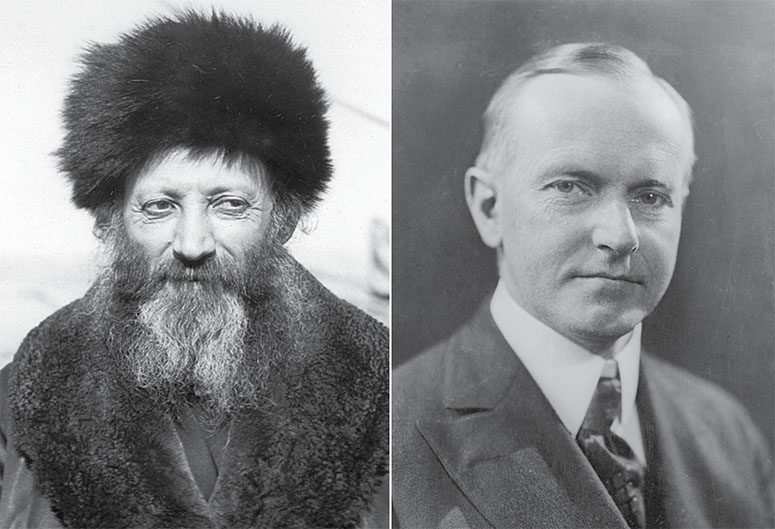
April 15, 1924 was a typical day for President Calvin Coolidge. He dedicated the Arizona State stone in the Washington Monument, met with his cabinet and held a press conference in which he discussed matters both domestic (“The Secretary of Labor reported that there was very little unemployment”) and foreign (“I don’t expect to designate a commission to assist me in the arbitration of the controversy between Peru and Chile”). He threw out the first pitch at the Washington Senators’ season opener at Griffith Stadium in Washington, D.C. (the home team, led by future Hall of Famer Walter Johnson, won 4-0). But it was a brief meeting that afternoon that’s worth recalling amidst the current efforts by hate-spewing pundits to weaken the bond between the United States and the historic Jewish homeland.
Rabbi Kook, the Ashkenazi Chief Rabbi of British-mandate Palestine, headed a delegation of rabbis to the United States that had arrived the previous month to raise funds for yeshivot in Europe and Eretz Yisrael. As The New York Times described, “Rabbi Kook said that it was his first visit to America. He has a long, white, patriarchal beard and wore a black cassock and round, fur-trimmed hat.” He was joined by Rabbi Moshe Mordechai Epstein, head of the Slabodka yeshiva in Lithuania, and Rabbi Avraham Dov Baer Kahana Shapiro, the Rabbi of Kovno and president of the Rabbinical Association of Lithuania. The trip was sponsored by the Central Committee for the Relief of Jews Suffering through the War, known as the Central Relief Committee (CRC), established a decade earlier to help those affected by WWI.
According to a 1991 article by Joshua Hoffman in the journal Orot, “the rabbis had originally planned to stay in America for about three months. However, because their fund-raising efforts were not as successful as had been hoped, they remained for eight months. In the end, they raised a little over $300,000, far short of the one million dollar goal which the CRC had set.”
Contemporary records recount that at the meeting, Rabbi Kook thanked the President for his government’s support of the Balfour Declaration, which set in motion the establishment of a “national home for the Jewish people” in Palestine. He told President Coolidge that the return of the Jews to the Holy Land will benefit not only the Jews, but nations throughout the world. After all, the Bible mandates that the Jewish people aspire to serve as a source of blessing for all the nations of the earth. Rabbi Kook also expressed his gratitude to the American government for aiding in relief work during the war. He added that America has always stood as a model of liberty and freedom, as reflected on the Liberty Bell’s inscription, taken from Leviticus 25:10: “Proclaim Liberty Throughout All the Land Unto All the Inhabitants thereof.” Rabbi Kook concluded his remarks, delivered in English by Rabbi Aaron Teitelbaum, executive secretary of the CRC, by expressing his wish that the U.S. would continue to uphold its foundational values and render its assistance whenever possible.
The Jewish Telegraphic Agency reported that Rabbi Kook apologized for being unable to speak English and made a point of saying “Amen” after Rabbi Teitelbaum had finished, showing his affirmation of the letter Kook had written for the occasion. The President warmly stated that he felt highly honored by the visit of Palestine’s Chief Rabbi, and assured Rabbi Kook that the United States government would assist, in every way possible, the establishment of a Jewish homeland in Palestine. The President added his wishes for the trip’s success.
In a subsequent speech during the same trip, on June 22 at Independence Hall in Philadelphia, Rabbi Kook noted that the liberty the Bell’s inscription proclaimed was achieved after 49 years of work leading up to the 50-year celebration. Freedom is so important, he argued, that one must work 49 years to achieve it. This is true for individuals, to whom the verse is addressed, and even more so for a nation. Rabbi Kook then placed a wreath of flowers on the Bell and said that freedom can be a crown of thorns or a crown of flowers, depending upon how it is used. In America, freedom is used properly, and therefore, it is a crown of flowers.
President Coolidge undoubtedly agreed that America was forged from the biblical conception of freedom. The year after meeting Rabbi Kook, on May 3, 1925, he delivered an address at the laying of the cornerstone of the Jewish Community Center in Washington, D.C. In this remarkable speech, Coolidge expressed his belief that “Hebraic mortar cemented the foundations of American democracy.” The American Revolutionaries “found the Bible a chief source of illumination for their arguments in support of the patriot cause. They knew the Book. They were profoundly familiar with it, and eminently capable in the exposition of all its justifications for rebellion. To them, the record of the exodus from Egypt was indeed an inspired precedent. They knew what arguments from holy writ would most powerfully influence their people. It required no great stretch of logical processes to demonstrate that the children of Israel, making bricks without straw in Egypt, had their modern counterpart in the people of the colonies, enduring the imposition of taxation without representation. And the Jews themselves, of whom a considerable number were already scattered throughout the colonies, were true to the teachings of their own prophets. The Jewish faith is predominantly the faith of liberty.”
Fittingly, Coolidge expressed his admiration for the American Jewish community, which has demonstrated its ability to “thrive under the influence of liberty, to take their full part as citizens in building and sustaining the nation and to bear their part in its defense, in order to make contribution to the national life fully worthy of the traditions they had inherited.” He concluded that “if American democracy is to remain the greatest hope of humanity it must continue abundantly in the faith of the Bible.”
Both the Chief Rabbi and America’s Commander in Chief understood that America and Israel were bonded by the Bible, allies in a faith guided by God’s ancient promise of freedom centuries ago.
Rabbi Dr. Stuart Halpern is Senior Adviser to the Provost of Yeshiva University and Deputy Director of Y.U.’s Straus Center for Torah and Western Thought. His books include the newly released “Jewish Roots of American Liberty,” “The Promise of Liberty: A Passover Haggada,” “Esther in America,” “Gleanings: Reflections on Ruth” and “Proclaim Liberty Throughout the Land: The Hebrew Bible in the United States.”