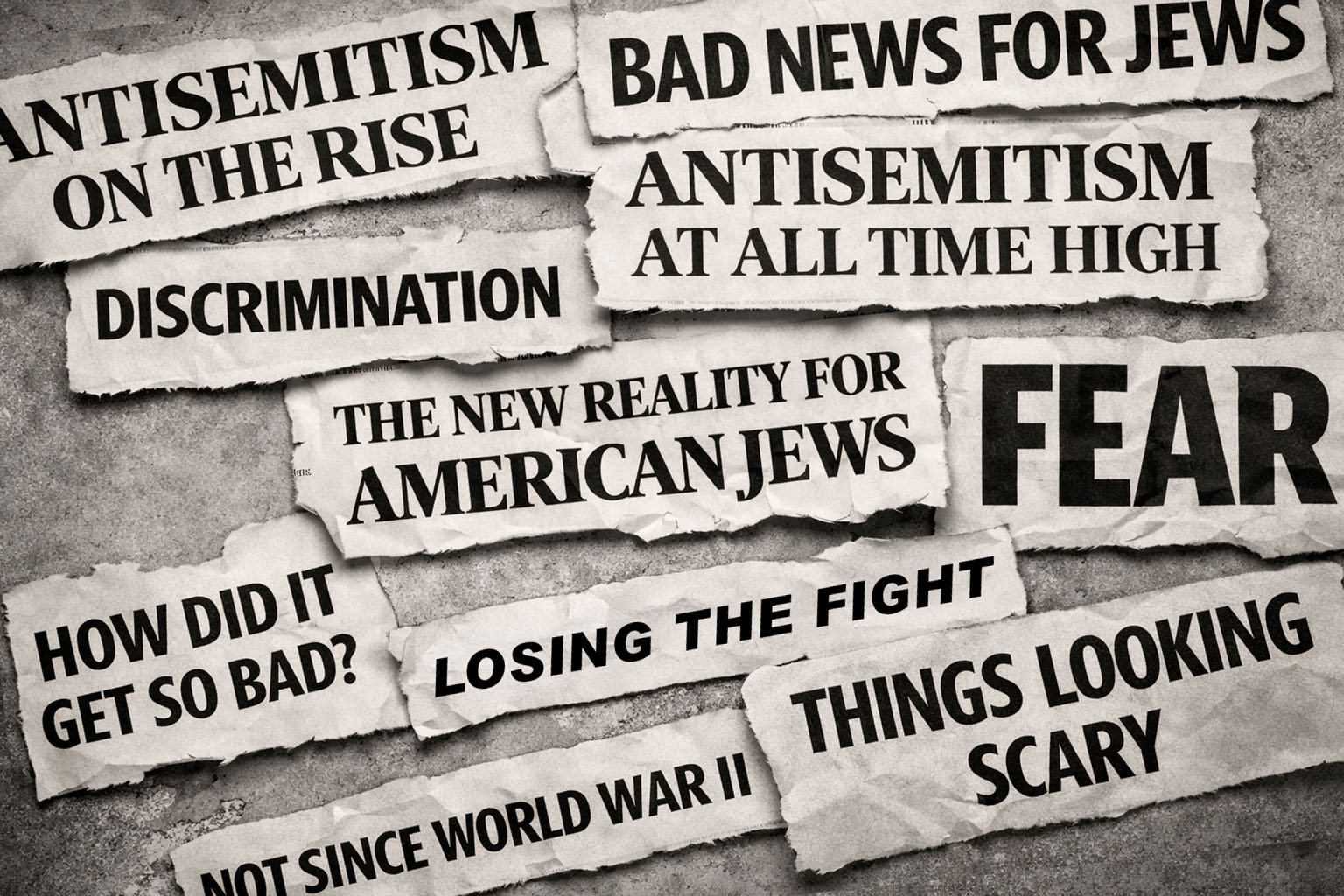
It’s like a broken record: another breathless email telling us how bad things are for the Jews.
The latest is from head honcho Ted Deutch of AJC letting us know “we’ve never seen numbers quite like this.” Referring to a new AJC survey, Deutch says “the findings are chilling and paint a picture of a reality American Jews face that is flatly unacceptable.”
AJC is hardly the only player in this Bad News Industrial Complex. Countless other Jewish groups have made it a habit to tickle our fear gene with a continuous drip of bad news for the Jews.
I’m not here to contest the bad news. I’m sure it’s accurate. I’m more interested in this question: Why is it that despite the enormous resources and money we spend fighting antisemitism, it just keeps getting worse?
AJC, for example, says they use the data to “help shape policies, mobilize leaders, and combat antisemitism across American society.” Every organization that fights antisemitism has its own list of action items.
The question remains: With all these groups fighting the same problem, why is the problem getting alarmingly worse?
It’s too easy to counter that things might be even worse without those efforts. Even if that were true, it’d be like saying that very bad is better than very very bad. Lame consolation.
Maybe that’s why Bret Stephens struck a nerve with his much-discussed “State of World Jewry” address, when he called the fight against antisemitism a “well-meaning but mostly wasted effort.”
We can argue that this was an exaggeration (as I have), but we can’t deny that Stephens put his finger on the most uncomfortable question in philanthropy: Is my money making a difference?
To put it more delicately, if we assume that we all want the same thing– reduce antisemitism while building a thriving Jewish future—what is the best way to allocate resources?
That’s not just an honest question; it’s a decisive one.
If our community can respond constructively rather than defensively, I would say this would be very good news for the Jews.
The first step, as I see it, is to get a better handle on what works and what doesn’t. The “fight against antisemitism” is multi-faceted; it comprises a whole array of different tactics and approaches.
We ought to take some of the money we spend on surveys and commission a comprehensive study so we can better understand the parts of the fight that work best—and why.
We all have our opinions. Some of us think that making a lot of noise about Jew-hatred conveys fear and weakness and can backfire. Others believe that the more noise we make, the more likely we’ll get more people on our side. Some think we should fight in the courts rather than the streets, while others say the real war is in social media. Still others believe we should Americanize the fight or make it about fighting antizionism. Some even think we should run ads on the Super Bowl.
The point is: There are a million ways to fight antisemitism. Which ones work better and what’s the best way to measure that?
Until we get some actionable answers, we should expect the calls for a more positive approach—like strengthening Jewish identity– to continue, if not accelerate. After all, an investment in something positive like Jewish education or summer camps is usually seen as a sure bet.
In his speech, Stephens reminded us that, ultimately, “The goal of Jewish life is Jewish thriving…a community in which Jewish learning, Jewish culture, Jewish ritual, Jewish concerns, Jewish aspiration and Jewish identification… are central to every member’s sense of him or herself.” He called on Jews to “lean into our Jewishness as far as each of us can.”
He was basically arguing that we’re investing too many resources going after bad guys (Jew haters) and not enough creating good guys (proud Jews).
No one is saying we should do only one or the other. Of course we need both, and of course we must protect Jews. But if we’re going to make our limited resources go further, we should figure out ways to fight antisemitism that gets us better results.
Just as today’s reality for Jews is “flatly unacceptable,” the reality that antisemitism just keeps getting worse despite our herculean efforts should also be unacceptable.
Stephens is daring us to do the Jewish thing and aim higher.