fbpx

July 24, 2025

Tisha b’Av: Holiday of Wake-Up Calls

Events and moments have legacies. The Jewish calendar is filled with them. Times that are suffused with emotion, contemplation and perspective. Pick any holiday and there is a historical and foundational message that it trumpets. With Tisha b’Av around the corner and in the midst of the “three-weeks” period of national introspection, it behooves us, the Jewish people, to look in the mirror and remind ourselves of our noble and timeless mission to be a reflection.  

It is not random that both Temples in Jerusalem were destroyed on Tisha b’Av.  What is more tragic, however, is that we continue to break a glass at a Jewish wedding.  This profound and universal custom is not designed to merely remind us of past tragedies. It’s to direct our attention to the ongoing fragmentation of humanity as a whole and of the Jewish people in particular.  So how is this year going to be different than last year or the year before or the centuries before?   

You see, Jewish history is filled with wake-up calls. Every generation since Pharaoh conceived of the dual allegiance canard has experienced existential threats and mind-numbing suffering. And each was followed by bursts of clarity and purpose coupled with a fierce determination to rebuild, rethink and repurpose our lives.  More than Startup Nation we are the consummate Start Again nation. Oct. 7 was the latest in a very long line of such events and the ripple effect of that horrific event is still unfolding. But here’s the thing: if one’s renewed awareness, pride and activism is merely a response to antisemitism and is not rooted in a deeper affinity for the depth, power and aspirations of Jewish peoplehood and missionhood, then the rekindled flame will be a flickering one.    

If one’s renewed awareness, pride and activism is merely a response to antisemitism and is not rooted in a deeper affinity for the depth, power and aspirations of Jewish peoplehood and missionhood, then the rekindled flame will be a flickering one. 

A couple of weeks ago I spoke to a group of fathers and their high school and college-aged children. Prior to the class as each father introduced me to their children, I jokingly asked each of them how much they were paid to show up!  To my great joy, and without exception, they each chuckled but stated emphatically that they wanted to be at the class and conversation, that they needed to be there. And then, as I was moderating a group-wide conversation, these young adults seized the opportunity to express both the challenges and the victories that they have been experiencing.  Their findings in high school and especially on the college campus, dovetailed with what we’re seeing in the Jewish world: both a revelational awakening of Jewish pride and activism, along with a corresponding alienation of many Jews toward Israel and their Jewish identity.  

It was deeply gratifying and reassuring to be in a room of young Jewish students eagerly sharing their renewed pride and dedication to their Jewish identity.  But their first-hand, from-the-trenches ruminations springboarded to two larger conversations:  What about Jews whose wake-up call has awoken within them a further alienation from their Jewishness and where do we go from here?  I capitalized on the opportunity to share two essential Tisha b’Av-related lessons and aspirations.  First, that Jewish pride and Jewish identity should not be formed as a response to hatred and darkness but rather as a march toward light and harmony.  That for Jewish consciousness to stay awake it needs to flow and be guided by a deep reverence for and dedication to Jewish learning, practice and mission.  

Secondly, that despite seemingly intractable disagreements with other Jews we should never abandon the aspiration of Jewish unity nor underestimate the power of engagement.  It’s important to remember that it’s not enough to build bridges.  We need to cross them as well.  Waking up is the first step.  Staying awake is the next step.  Awakening the world is the final step.  May we all derive the deepest soul satisfaction from our aspirations and may our efforts transform Tisha b’Av from a day of tragedy to a day of joy and shared humanity.  Am Yisroel Chai.


Rabbi Shlomo Seidenfeld is a lifecycle rabbi, teacher, speaker and residential real estate agent.  

Tisha b’Av: Holiday of Wake-Up Calls Read More »

Tisha b’Av: Birthday of Grief and Truth

Shortly we will be honoring our next Holy Day, Tisha b’Av, the Ninth of Av. This date is dedicated to remembering one of our most dreadful calamities in Jewish history. Just over 2,000 years ago, in the year 70 C.E., the Second Holy Temple was destroyed, Jerusalem was set ablaze while blood filled the streets. The Jews were either slaughtered, taken captive or exiled, once again, this time to wherever our souls could rest. From the earliest moments in the land, G-d promised to our people, we have had to disperse, run away, and travel the world trying to find a home, a place of safety. Not until 1948 when Israel became our homeland, once again, had Jews discovered an inner sense of confidence and place, “Makom,” one of the names for G-d. From 70 to 1948 it has been a constant wandering, finding new environments in which to settle, engage, and create generational stories, a mixture of pain and suffering and some beautiful moments where our traditions could mature and flourish. Held together by common ceremonies, rituals and, most importantly Torah, somehow, we are still a People with a covenant with HaShem, One, despite cultural variations. 

The description of the trauma and horrors witnessed and experienced by our people these centuries ago are reflected in the main text we read on this mournful day. Along with fasting, sitting together as if at a Shiva (ritual mourning, low to the floor, by candlelight, and chanting somber melodies and prayers, it is an opportunity to be grief-stricken and despairing, to feel “Ki Ilu,” “as if,” we walked the dark streets of Jerusalem, all aflame, hearing the inconsolable wailing and weeping of our brethren. Anyone touched by the Holocaust or the events of Oct. 7 has had their hearts broken apart. Tisha b’Av is but another opportunity to allow the tears of our inner Mikveh (Divine spiritual bath) to flow once again, releasing all that fills our souls.

Grief is an emotion we all know. Our lives are filled with loss, whether it be a loved one, a dream, a home, a job, strength and vitality due to illness, a belief such as truth or justice, a sign of aging and disability or even the false sense of security many Jews once had in this country. So many are grieving as American values feel torn apart. It is part of the human condition and the rabbis of old understood that along with joy, celebration, study and prayer, the emotions that are part of our ongoing life cycle need to be expressed and find safe keeping with others, whether in large community or even in small groups on Zoom.

Tisha b’Av is also a truth telling. The liturgy and text the rabbis created, often a weaving of Torah’s wisdom and creative commentary, was not only to support and lament, but also to teach and remind each one of us that we had a hand in the Temple’s downfall. We played a role in her demise, as she became vulnerable because of our behavior often seen as petty, inconsiderate, and even hateful. The prophets, throughout our texts, constantly reminded the people that their “sinful lives” would only bring destruction and G-d’s punishment. For many of our sages the Romans were just tools, used by G-d, to destroy the life the Jews once knew because their behavior deteriorated and ran amok. Sinat Chinam is baseless hatred, the overriding explanation that is at the root of our demise. And yet how many, in their deep hatred think it’s baseless? At a time when divisions are deep and judgment of others is so easy, destructive emotions surface so easily.

At best, what are the lessons for today to be learned? Don’t history and human failings need a way to carve out a different pathway, one that prevents such horrors? The feelings that so many account as legitimate only create more disharmony. Shouldn’t we work on softening our hearts and expanding our perceptions to avoid “baseless hatred”? Shouldn’t our grief teach us how to move forward with more compassion, empathy, righteousness and lovingkindness? After the pain, grief and the tears, lets expand and elevate our hearts with more openness towards others.


Eva Robbins is a rabbi, cantor, artist and the author of “Spiritual Surgery: A Journey of Healing Mind, Body and Spirit.”

Tisha b’Av: Birthday of Grief and Truth Read More »

Jews Join Compton Day of Service, Book Talk, Hadassah Honors Gal Gadot

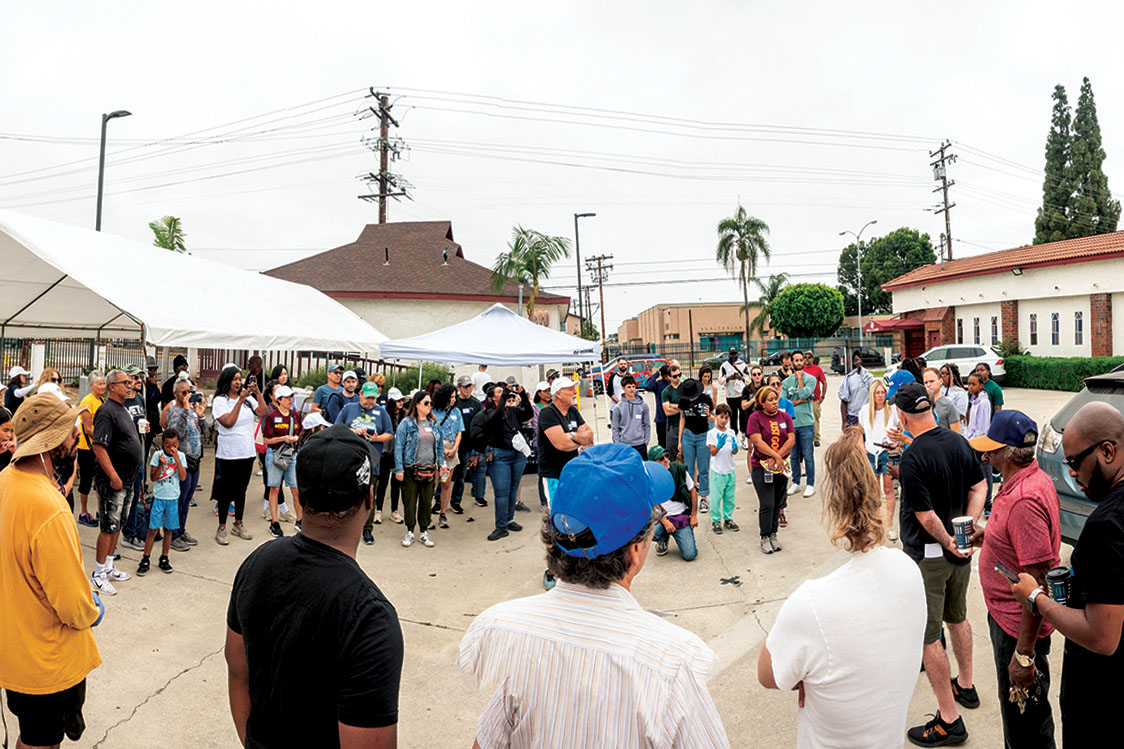
On July 19, members of the Black and Jewish communities came together to help paint a Compton high school as part of a day of service dubbed “Shared Hoped Tour.”

Throughout the day, volunteers helped paint, clean and plant trees at Compton Academy of Technology and Innovation, a new high school overseen by Compton Unified School District. Among those who turned out were Pastor Michael Fisher of Greater Zion Church Family; Rabbi Yoshi Zweiback of Stephen Wise Temple; Amanda Berman, founder and CEO of Zioness; and Congregation Or Ami Rabbis Paul Kipnes and Elana Rabishaw.

“It feels good to do good, and that’s what Or Ami is all about,” Or Ami board member Susie Gruber told The Journal.

The event followed up on a Passover seder earlier this year that drew members of the Black and Jewish communities. This past Saturday, participating groups included Zioness, Repair the World and Exodus Leadership Forum. 

“We’re grateful to be a part of this coalition of Black and multi-ethnic Jewish leaders committed to building our sacred communal partnership, and what better way to honor that partnership than serving side-by-side with our Compton neighbors,” Repair the World Los Angeles City Director Michael Auerbach said.

When I arrived around 1 p.m., the volunteers were lining up for a barbecue lunch, which consisted of chicken, beans, veggies and fruit. Afterwards, we went back to work, and I helped with removing old paint off the walls. Around this time, I caught up with Lakeisha White, principal of Compton Academy of Technology and Innovation. She told me she was grateful to all those who came out to paint the new school’s colors — orange and green — on its walls. 

Volunteers gather in the parking lot at Greater Zion Church Family on Saturday. Courtesy of Repair the World LA

I also spoke with Dani Shear, an educator in the religious school at Temple Israel of Hollywood and a former Zioness fellow. Shear said she was proud to be out there representing Zioness, a movement that works to empower Zionists on the progressive left, especially at a time when the State of Israel is facing demonization on several political fronts.

“We’re undaunted and we wear our ‘Zioness’ shirt, and we stand proud with the State of Israel,” Shear, taking a brief break from painting, said.


Dr. Laura Gabayan leads a book talk at Barnes and Noble in Santa Monica. Courtesy of Laura Gabayan

Former ER physician, scientist, researcher and ”Common Wisdom” author Dr. Laura Gabayan was the featured speaker at an in-store book talk at Barnes and Noble Santa Monica on July 12. In a packed room, Gabayan provided compelling background on how her personal health struggles inspired her groundbreaking study of wisdom, ultimately leading to her acclaimed book and innovative Wisdom IQ Test.

After experiencing a challenging misdiagnosis with an autoimmune disease, Gabayan found herself questioning conventional medical approaches. Drawing from her Jewish heritage’s emphasis on seeking wisdom through questioning and learning — a tradition rooted in Talmudic scholarship — she embarked on a mission to understand what truly makes someone wise. She explained that she was receiving cookie-cutter answers with labels from doctors that weren’t helping, prompting her to explore how ”the wise” think outside the box to find meaningful solutions.

At Barnes and Noble, many attendees expressed appreciation for meeting a physician who thought differently. Some shared frustrations with the medical system and welcomed hearing a fresh perspective from a healthcare professional. One guest mentioned purchasing ”Common Wisdom” as a gift for a friend recently diagnosed with cancer, hoping to provide hope during a difficult time.

When asked about her goals for the book, Gabayan replied, ”My goal is to change lives and bring people more meaning. I loved helping people as an ER doctor, and now that I can no longer practice medicine, my book and test give me new ways to make a difference.”


Courtesy of Tamir Hayun for Hadassah.

Hadassah National President Carol Ann Schwartz gives ”Wonder Woman” Gal Gadot Hadassah’s Power of Dreams Award for her courageous advocacy on behalf of Israel in the wake of Oct. 7. The award was presented during the 42nd annual Jerusalem Film Festival, which kicked off in Israel on July 17 and continues through July 26.

Jews Join Compton Day of Service, Book Talk, Hadassah Honors Gal Gadot Read More »

Let My City Be a Refuge – A poem for Parsha Matot-Masei

…you must designate cities for yourselves that will be cities of refuge for you: a murderer who killed a person unintentionally must flee there. ~ Numbers 35:11

Let my city be a refuge
for the innocent at heart.

Let their apology for
unintended actions be enough.

Let us take into consideration
the circumstances.

Let us defend the people
who’ve sought refuge

from the people who
wear masks and carry guns.

Let us return the coldness of ice
with the coldness of ice.

Let us freeze it into immobility.
Let crossing rivers not be a crime.

Let children and their parents not be
criminal for existing without papers.

Let walls only exist to
keep out the floods.

Let them always have
doors and windows.

Let them be unlocked. Let my city
be a refuge for anyone

who needs space and breath and air.
I designate this for every soul.


Rick Lupert, a poet, songleader and graphic designer, is the author of 29 books including “God Wrestler: A Poem for Every Torah Portion.” Visit him at www.JewishPoetry.net

Let My City Be a Refuge – A poem for Parsha Matot-Masei Read More »

The Duty of Care: Reclaiming True Viewpoint Diversity and Academic Freedom

The future of American education is at a crossroads: The ideals of “viewpoint diversity” and “academic freedom” increasingly conflict with rising antisemitism and the institutionalization of Diversity, Equity, and Inclusion initiatives.

As the Trump administration purports to promote ideological diversity among faculty, critics passionately defend academic freedom. Rather than harmonizing, these principles are weaponized in political battles where they are not mutually exclusive but inherently aligned.

At this week’s Congressional hearing of the Education and Workforce Committee, titled “Antisemitism in Higher Education: Examining the Role of Faculty, Funding, and Ideology,” Representatives questioned the presidents of Georgetown University, UC Berkeley, and the City University of New York. Rep. Glenn Grothman raised concerns about ideological imbalance among university faculty, asking whether their departments reflect the ideological diversity of the broader American public. He specifically challenged the witnesses on whether it was problematic that up to 95% of faculty lean toward the progressive left, which animates contemporary antisemitism. The university presidents appeared largely untroubled by this ideological skew, so long as open debate was permitted on campus.

Secretary of Education Linda McMahon’s testimony before the House Education Committee last month underscored the confusion, too. California Representative Mark Takano (D-CA) asked whether refusing to hire a Holocaust denier at Harvard constituted an ideological litmus test. McMahon dodged the question, citing Harvard’s termination of its Middle East Studies leadership.

These exchanges highlighted a deeper dilemma: a lack of a clear definition of viewpoint diversity and the limits of academic freedom.

Both concepts should be anchored in a shared, apolitical standard: The duty of care. This principle demands that professionals act with prudence to avoid harm. Any breach can form the basis for claims of negligence. The duty of care should be practiced by professors but ultimately enforced by administrators. After all, both students and faculty enter into contractual obligations with the university—through codes of conduct agreed upon at the time of enrollment and hiring.

The duty of care should be practiced by professors but ultimately enforced by administrators.

Abandoning duty of care has proven dangerous. Professors aligned with Faculty and Staff for Justice in Palestine are falsely accusing Israel of genocide and promoting narratives that depict Israelis as violent settler-colonial aggressors. These claims fuel demonstrations that often cross into antisemitic abuse—complete with Holocaust inversion, swastika-laced flags, and signs explicitly excluding Zionists, some 80% of Jews.

When politically charged teachings are masked as scholarship and left unchecked by administrators, a sanctioned atmosphere of hostility emerges. This hostility has extended beyond campuses and impacted our streets, as seen in the recent attacks in Boulder, Colorado and Washington, D.C.

Legitimizing the “Free Palestine” movement alongside Holocaust denial or revisionism reflects a serious breach of the duty of care. Neglecting it means allowing ideology to override academic integrity. Professors must provide accurate information, foster critical inquiry, and avoid foreseeable harm—responsibilities that administrators must enforce to maintain a safe learning environment.

Appointing a Holocaust denier to teach history at Harvard, or permitting the likes of Columbia University Professor Joseph Massad, an outspoken Hamas sympathizer, to lecture on Zionism amounts to a blatant dereliction of that obligation. So too does the appointment of Ussama Makdisi—who wrote, “I could have been one of those who broke through the siege on October 7”—as the inaugural chair of a new endowed program on Palestinian and Arab Studies at UC Berkeley. That his colleagues made this decision based solely on his “academic standards,” as Berkeley Chancellor Rich Lyons stated, while disregarding his apparent sympathy for terror, is a stark example of how ideologically skewed the department has become, and how normalized such sympathies now are within it.

Invoking “viewpoint diversity” to suggest there are two sides to the Holocaust is not intellectual pluralism; it’s a clear distortion of historical fact. So is the misuse of academic freedom to advance fabrications like the baseless accusation of genocide leveled at Israel. Twisting facts to fit political ideology falls within the Federal Office of Research Integrity’s definition of research misconduct: “a significant, intentional, or reckless departure from accepted practices.”

Academic freedom, though vital to intellectual inquiry, is not without limits. It is not a shield for indoctrination, intimidation or discrimination. The American Association of University Professors holds that faculty must foster diverse perspectives and independent thought. They cannot indoctrinate through censorship, impose conclusions and dogma, or promote falsehoods as fact. Speech crossing into harassment or disrupting a student’s educational experience is not academic freedom.

The nostalgic appeal to an era of politically neutral universities under the banner of academic freedom ignores reality. Such neutrality never existed. Even before Oct. 7, academic freedom was selectively applied.

At George Washington University, a professor who fostered hostility toward Israeli students was shielded by academic freedom. Meanwhile, another professor was disciplined for quoting a statement by a Black author to prompt a class discussion. The result: a perverse inversion whereby incitement is protected, and genuine academic engagement is punished.

Faculty are not free to recklessly distort facts or harass students. As in the sciences, academic conclusions must be grounded in evidence and adhere to legal definitions. Fact is not subjective, and legal standards cannot be exempted as racial or political critique.

A duty of care framework that integrates viewpoint diversity and academic freedom enables educators to explore false ideas, such as conspiracy theories or historical revisionism, without endorsing them. Teaching about dangerous ideologies is imperative. Teaching from them is professional malpractice.

For educational reform to succeed, policymakers must affirm that viewpoint diversity demands fidelity in truth and intellectual honesty. Universities, in turn, must recognize that academic freedom is not a shield for dogma, but a privilege contingent on scholarly integrity and accountability. When subsumed under a duty of care, these values no longer clash. They complete each other.


Sabrina Soffer presently works with the Institute for the Study of Global Antisemitism and Policy (ISGAP) and is a recent graduate of the George Washington University.

The Duty of Care: Reclaiming True Viewpoint Diversity and Academic Freedom Read More »

Homelessness Numbers Dropped in 2025. But the Crisis is Far From Over.

Every year, more than 2,000 people die unhoused on the streets of Los Angeles. Today, over 72,000 people across the county live without stable shelter. According to a recent UCLA study, one in six people experiencing homelessness are victims of physical violence. And yet, despite the urgent crisis unfolding in our own backyards, it often feels like my fellow Angelenos have time to rally around every cause but this one.

Want to protest illegal ICE raids or mass deportations? Thousands show up within hours. Want to counter a presidential military parade with a “No Kings” march? People will drop everything to make signs and chant slogans. Think the Israeli government has made mistakes in its military response to a terror group that murdered civilians at a music festival? Protestors will block highways and drape provocative banners from overpasses.

I’m not opposed to activism—far from it. I share concerns about the cruelty of ICE tactics. I fear authoritarian overreach by our government. And while I take issue, as a Jew, with how pro-Palestinian rallies too often veer into anti-Zionist and antisemitic rhetoric, I understand how chaotic images from a war zone could spark global outrage. Still, I can’t help but notice what’s missing. Where are the marches for our unhoused neighbors? Where is the sense of moral urgency for those living in tents, cars, and under freeways?

While homelessness in Los Angeles remains out of control, a recent point-in-time count showed a four percent decrease in the county’s homeless population—a second consecutive year of decline. That progress deserves recognition. But even with this modest drop, more people remain unhoused today than in 2022 and 2020 (no count was conducted in 2021 due to COVID). We cannot let slightly improved numbers justify growing desensitization. There was a time when this level of suffering would have moved people to organize protests or sit-ins. Now, the crisis is “managed” through talking points and spreadsheets, as though it were a PR challenge instead of a humanitarian emergency.

This issue isn’t abstract to me. I’ve seen it up close. Through Brentwood School, where I will be a junior this Fall, I volunteer with Feed The Streets, a nonprofit serving unhoused people on Skid Row. While I distribute meals and pass out clothes, the most important thing I do is listen. I’ve spoken with women whose lives were upended by trauma, abuse, and eviction. Most aren’t homeless because of “bad decisions.” They’re homeless because they ran out of options.

Yes, some people become homeless due to addiction, mental illness, or poor choices. But that shouldn’t determine whether they’re worthy of help. The reasons people end up on the street may vary. Our obligation to care for them does not. Everyone deserves safety, dignity, and compassion.

As a Fellow with the Jewish Center for Justice, I’ve learned how to turn empathy into action. JCJ’s mission to build a just society grounded in Jewish values reminds me that caring for the vulnerable isn’t just a mitzvah; it’s a mandate. In our tradition, we are called to feed the hungry, clothe the poor, and love the stranger. That’s not politics. That’s Torah.

In our tradition, we are called to feed the hungry, clothe the poor, and love the stranger. That’s not politics. That’s Torah.

What frustrates me most is seeing so many of my peers singularly focused on what’s happening 7,000 miles away while remaining silent about the suffering right in front of us. The war in Gaza understandably sparks emotion, debate, and disagreement. Homelessness, by contrast, is a problem we can actually solve.

We can protest. We can donate. We can volunteer. We can pressure our elected officials. But too many of us choose not to.

So here’s my plea: If you can march for climate justice, immigrant rights, or peace in the Middle East, bring that same passion to the streets of Los Angeles. Let’s build on the progress reflected in recent numbers and push for real, sustained solutions—not merely statistics that suggest we’re doing just enough.

We need more permanent supportive housing. We need wraparound mental services. We need safe emergency shelters for women and families. We need rent stabilization, tenant protections, and transitional programs that actually work.

But most of all, we need to remember that rampant homelessness is not normal. It is not inevitable. It is a crisis. And it deserves just as much outrage, organizing, and moral clarity as anything else we fight for.


Jack Sampson is a Jewish Center for Justice Fellow and a rising junior at Brentwood School in Los Angeles.

Homelessness Numbers Dropped in 2025. But the Crisis is Far From Over. Read More »

Why Moses Wrote the Book of Deuteronomy

Escaping into solitude,
avoiding hunters’ need to roam,
I long so for the latitude
to find my longitude, my home,

where with the goddess who presides
as my poetic editor
of rhymes she frequently derides,
corrections spousal creditor.

She follows the famed female path
Zelophehad’s daughters once selected,
without the radical inspired wrath
these five femmes fatales too objected,

when fatherless, sans brothers, they
hoped to claim their father’s land,
for which they found a legal way —
inheritance to females banned

till they suggested rules be changed,
which God told Moses he should do.
From his two sons somewhat estranged,
Moses felt unable to

appoint one son or both as leaders
who might become meta-Mosaic.
God’s answer learned by Bible’s readers
is less — than one God gave five girls — prosaic.

Not only Joshua, Deuteronomy may be
to Moses’ problem the solution,
the Bible’s fifth book like a baby
echoing Genesis’s evolution,

the first four Torah books’ great sequel,
Moses’ bequest to  Israelites,
literally, comparably equal
to land for which five daughters all had rights,

Deuteronomy’s name, Devarim, an allusion
links Zelophehad’s land bequest
to the Torah’s Devarim conclusion,
to which the words ken dovrot attest.


Num. 27:7 states:
כֵּ֗ן בְּנ֣וֹת צְלׇפְחָד֮ דֹּבְרֹת֒ נָתֹ֨ן תִּתֵּ֤ן לָהֶם֙ אֲחֻזַּ֣ת נַחֲלָ֔ה בְּת֖וֹךְ אֲחֵ֣י אֲבִיהֶ֑ם וְהַֽעֲבַרְתָּ֛ אֶת־נַחֲלַ֥ת אֲבִיהֶ֖ן לָהֶֽן׃

Zelophehad’s daughters’ ken dovrot, speak justly: You should give them a hereditary holding among their father’s kinsmen; transfer their father’s share to them.

Deut. 1:2 states: 
אֵ֣לֶּה הַדְּבָרִ֗ים אֲשֶׁ֨ר דִּבֶּ֤ר מֹשֶׁה֙ אֶל־כׇּל־יִשְׂרָאֵ֔ל בְּעֵ֖בֶר הַיַּרְדֵּ֑ן בַּמִּדְבָּ֡ר בָּֽעֲרָבָה֩ מ֨וֹל ס֜וּף בֵּֽין־פָּארָ֧ן וּבֵֽין־תֹּ֛פֶל וְלָבָ֥ן וַחֲצֵרֹ֖ת וְדִ֥י זָהָֽב׃
These are הַדְּבָרִ֗ים, hadevarim,  the words, that Moses addressed to all Israel on the other side of the Jordan.—Through the wilderness, in the Arabah near Suph, between Paran and Tophel, Laban, Hazeroth, and Di-zahab.

Zelophehad’s five daughters inherit his land, and while Moses’ sons don’t inherit his leadership, he bequeaths the Book of Deuteronomy to all of the nation of Israel, a bequest which makes Deuteronomy, as the final book of the five books of the Torah, the literal analogue of the land Zelophehad bequeathed to his five daughters, the words in Num. 27:7,  כֵּ֗ן בְּנ֣וֹת צְלׇפְחָד֮ דֹּבְרֹת֒, Zelophehad’s daughters’ ken dovrot, speak justly, anticipating he Book of Deuteronomy, which is called הַדְּבָרִ֗ים; hadevarim,  the words, in Deut. 1:2.


Gershon Hepner is a poet who has written over 25,000 poems on subjects ranging from music to literature, politics to Torah. He grew up in England and moved to Los Angeles in 1976. Using his varied interests and experiences, he has authored dozens of papers in medical and academic journals, and authored “Legal Friction: Law, Narrative, and Identity Politics in Biblical Israel.” He can be reached at gershonhepner@gmail.com.

Why Moses Wrote the Book of Deuteronomy Read More »

A Bisl Torah — Detours

Often, we remark that life is about the journey. Upon reflection, this seems incorrect. Life is about the detours.

The Yiddish phrase is, “Man plans, and God laughs.” But I can’t imagine a God laughing when someone doesn’t get into their dream college. No God of mine chuckles over a diagnosis or prolonged illness. No Lord finds amusement in untimely deaths.

Perhaps God laughs at the idea we might even think we know life’s itinerary. But more comforting, as the detours develop, I imagine God grimacing, cringing, commiserating, and reminding us, “Detours always offer another route.” Meaning, God joins us on the curvy path, no matter how many times we are thrown off what we deem the determined track.

Early on, we are asked to create goals, think about future professions, and manifest the trajectory of our lives. Our dreaming should continue and inspire our decisions. Additionally, we should teach ourselves to expect and embrace the detours: The closed exits, rejection letters, disappointments, and devastations. As we meet each curve in the road, God’s gentle guidance will lead us to where we are meant to go.

Shabbat Shalom


Rabbi Nicole Guzik is senior rabbi at Sinai Temple. She can be reached at her Facebook page at Rabbi Nicole Guzik or on Instagram @rabbiguzik. For more writings, visit Rabbi Guzik’s blog section from Sinai Temple’s website.

A Bisl Torah — Detours Read More »

A Moment in Time: “On the Flip-Side…”

Dear all,

Maya was curious to look at me up-side-down this week. While it was all part of imaginative play, I realized how important it is to always consider how things appear from another angle – to always look at the flip-side.

Rabbi Hillel once taught, “Do not judge another until you have been in that person’s place.”

So often we are quick to form opinions based on how we typically view the world. So we need to step outside our comfort zone, and we need to gain perspective.

It isn’t easy. It can take some mental and emotional acrobatics. And it may make us a little nervous.

Ultimately, however, it will deepen our empathy, expand our wisdom, and give focus to our balance.

With love and Shalom,

Rabbi Zach Shapiro

A Moment in Time: “On the Flip-Side…” Read More »

Why China Must Drop Iran and Embrace Israel

The echoes of Nanking and October 7 demand that China reexamine its alliances and stand with Israel against barbarism.

The other night, my wife Debbie and I were guests of our dear friends Sir Clive and Lady Anya Gillinson at Carnegie Hall. Clive—who is like a brother to me—is the most accomplished head of a cultural institution anywhere on earth. Over more than two decades, he has transformed Carnegie Hall, already world-famous, into an unparalleled global supernova of live music who’s prestige is unchallenged, even in the greatest cultural Meccas of Paris, Rome, Vienna, and Milan.

The occasion was an unforgettable and inspiring concert by the National Youth Orchestra, created by Clive and Carnegie Hall, which is about to tour Asia—most notably China. In the “Presidential” box with us, as Clive’s personal guest, was the newly appointed Consul General of China in New York.

Last year, we had attended China’s own National Youth Orchestra’s performance at Carnegie Hall, which was indeed outstanding—although as an American, I will confess it was perhaps not quite as electrifying as our own. (I trust the Chinese people can forgive my patriotic bias.)

In our warm and brief conversation, I told the Consul General how deeply moved I am, as a Jew, an American, and a student of history, by the story of the Rape of Nanking in 1937. The atrocities that befell China in those months echo, almost uncannily, the horrors that the Jewish people—and especially Israeli women—endured on October 7 in the barbaric Hamas attack on the communities surrounding Gaza.

I write today not merely as a man of faith, but as a voice for those silenced by rape, terror, and ideological apathy. I call upon China’s leadership—and the conscience of every Chinese citizen—to recognize our shared past trauma, born of two of history’s most harrowing chapters: the Rape of Nanking and the October 7 massacre in Israel.

These twin horrors should unite our peoples—not only in mourning but in moral purpose.

Two Catastrophes, One Moral Imperative

Each event tore at the fabric of human dignity. Relative to the size of each nation’s population, the massacres in Nanking and southern Israel are chillingly comparable.

In Nanking, between December 1937 and March 1938, the Japanese Imperial Army unleashed an orgy of terror in China’s capital. Civilians were systematically hunted, executed, burned alive. And women—mothers, daughters, grandmothers—were violated on a scale that defies comprehension.

“They raped my sister and my mother in front of me. When my father protested, they shot him.” —Nanking survivor

Most camel victims were forced to “service” four to six Japanese soldiers daily; some who were particularly “attractive” endured 10 to 20 assaults per day. Japanese soldiers reportedly shoved poles into women’s vaginas “to see how far they would go” and stuffed burning cotton into their private parts, igniting them from within. Babies were bayoneted. Pregnant women were disemboweled. Conservative estimates place the death toll above 200,000; rape victims numbered anywhere from 20,000 to 80,000.

Now consider October 7, 2023. On that horrific morning, Hamas terrorists stormed southern Israel—attacking music festivals, kibbutzim, and family homes. Nearly 1,200 men, women, and children were massacred. More than 250 were taken hostage. And like Nanking, sexual violence was not incidental but strategic and systemic.

A UN investigation found “clear and convincing” evidence of systemic sexual violence by Hamas—rape, gang rape, genital mutilation, and forced nudity at multiple sites. Women were raped in front of their children. Some had their breasts sliced off; Hamas terrorists reportedly tossed the severed remains back and forth like grotesque toys. Others were raped and then shot in the vagina.

“They tied my neighbor’s teenage daughter naked to a pole and made her watch as they slaughtered her family.” —October 7 survivor

Men were castrated. Children were forced to witness their parents’ torture and murder.

The parallels are too stark to ignore: entire communities annihilated, women’s bodies weaponized to humiliate nations, and atrocities proudly recorded. The Japanese filmed Nanking. Hamas used GoPros. Both celebrated their crimes, rather than concealing them.

China’s Strategic and Moral Crossroads

Why should the People’s Republic of China—a nation of ancient wisdom and emerging global power—heed Israel’s cries? Because China knows too well the corrosive legacy of victimization and denial.

China’s current alignment—embracing Iran while sidelining Israel—is shortsighted and problematically immoral. Iran funds and arms Hamas, whose barbarity is a stain on the great world religion of Islam. Iran’s proxies—Hezbollah in Lebanon, militias in Syria and Yemen—share the same genocidal ideology that engineered October 7.

By contrast, Israel prosecutes perpetrators and cares for survivors. It has transformed grief into resilience and serves as a global leader in documenting wartime sexual violence, notably through the Dinah Project.

China prides itself on “the people’s welfare” as a cornerstone of governance. That welfare must include women, who disproportionately suffer in wartime atrocities. Aligning with Israel over Iran would send a powerful moral message: victims of sexual violence and genocide deserve accountability—not ideological excuses.

Lessons From History, A Path for the Future

In Nanking and Israel, sexual violence was a weapon of genocide, aimed at annihilating identity and pride.

After Nanking, Japan denied or minimized its crimes for decades. Only recently has full acknowledgment begun. Similarly, Hamas denies its rapes, even as video, forensic reports, and survivor testimonies stack into a Mount Everest of evidence.

“Both atrocities were not hidden—they were celebrated.”

China, which has itself wrestled with historical denial—from the Cultural Revolution to WWII—should understand the necessity of truth for healing.

Together, China and Israel could co-sponsor a new international treaty against sexual violence in war. They could lead the United Nations in atrocity prevention, drawing from their hard-earned moral authority and suffering.

A Strategic Pivot With Global Benefits

China’s dependency on Iranian oil may seem pragmatic. But this friendship is a reputational liability. Iran is a state sponsor of terror, allied to Assad’s genocidal Syria, and now a cheerleader for Hamas’s atrocities.

A pivot toward Israel offers China not only moral high ground but tangible benefits: access to Israeli innovations in clean technology, famine relief, counterterrorism, and diplomacy.

A Chinese-Israeli joint memorial, or an annual remembrance for victims of sexual violence in Nanking and October 7, would send an unambiguous message: the sanctity of life and dignity is not Western—it is universal.

China could even leverage its Belt and Road Initiative to create “rapid forensic response units” modeled on Israel’s Dinah Project—helping nations document and prosecute wartime sexual violence. This would position China as a growing leader in global humanitarian norms that specifically retain to outlawing rape as a weapon of war.

The Call of History

China’s leadership now stands at a crossroads: support regimes that perpetrate terror, or pivot toward ethical clarity and partnership with a nation that has turned tragedy into resilience.

“Drop the murderers in Tehran. Condemn the monsters in Gaza. Embrace your Jewish brothers—and especially your Jewish sisters.”

Remember Nanking: a city of blood and shame, and—eventually—reckoning. Remember Israel: a people gazing at the ashes of October 7 and refusing to yield.

It is time for China and Israel, two ancient civilizations, to build bridges—not only of shared sorrow but of shared resolve. To say: never again. Never to rape as terror. Never to genocide. Never to denial.

China: Israel calls you to join the side of survivors, justice, and rebuilding. History awaits your answer.

Drop the murderers in Tehran. Condemn the monsters in Gaza. And embrace your Jewish brothers—and especially your Jewish sisters.


Rabbi Shmuley Boteach is the author of “Kosher Hate” and “Judaism for Everyone.” Follow him on Instagram and X @RabbiShmuley.

Why China Must Drop Iran and Embrace Israel Read More »