
Print Issue: Bringing Back the Young Zionists | July 25, 2025
Print Issue: Bringing Back the Young Zionists | July 25, 2025 Read More »


Stop and smell the rosemary.
“Little moments of joy make all the difference,” Jewish romance author Jean Meltzer (“The Matzah Ball,” “Kissing Kosher”) told the Journal.
Last week, Meltzer, the founder of Jewish Joy LLC — which includes the Jewish Joy Book Club and the Jewish Joy Box — announced the inaugural Jewish Joy Con. The three-day cultural convention, set for March 13 to 15, 2026, in Fort Lauderdale, Florida, will celebrate Jewish pop culture, storytelling and creativity through the lens of joy.
“This is a time right now where we need joy, especially Jewish joy,” she said. “I just thought, ‘Let’s get together and throw ComicCon meets Jewish summer camp.”
A romance author by trade, Meltzer has long been an advocate of joy. She said romance authors only have one rule in their books: “Your story must have a happy ending.”
While a lot of Jewish stories are focused on trauma — and rightly so — Meltzer tries to focus her stories on joy. She has been chronically ill since age 18, so holding onto joy has helped her get through the most challenging moments.
When asked for her definition of Jewish Joy, Meltzer said it’s different for each person.
“For me, I love wrapping my hair as a married woman on Fridays before Shabbat, making Shabbat dinner,” she said. “I love writing Jewish books and planning Jewish Joy Con.”
In her Jewish Joy Book Club group, she said, some women connect to their Jewish joy by making a Hanukkah wreath, others by using a product that is from Israel; some do so through reading a Jewish romance. All of those are good.
“We don’t have to know all the Halakha, the Jewish law; we don’t have to be the person who does everything,” she said. “Whenever you connect to your Judaism through joy, you are connecting to a bigger power.”
Food also falls into the “joy” category.
“Baking and romance go hand in hand; that’s a big trope seller in romance,” Meltzer said. “So if you’re ever thinking about writing a Jewish baking romance [there’s] definitely an audience for it.”
One of Meltzer’s earliest food memories involves the love her grandmother put into the meals she cooked. She would make fruit kugel, and other traditional Jewish foods, especially around the holidays.
“You can see the points of your life [through food],” she said. “It kind of travels with you like a history.”
While Meltzer hasn’t made a fruit kugel in years, due to her health issues, she holds onto the beautiful memories.
She calls her particular cooking style, “easy gourmet.”
“I can make all these recipes that seem and look really fancy, but take like 15 minutes,” she said. “I have a whole repertoire, and I always pull it out when I’m visiting family or they’re coming to visit us, and especially for the holidays.”
One of her favorites is lamb kofta.
“What I love about this is it’s delicious – there’s never a bit left, it’s super healthy, it’s gluten-free,” she said. “It takes literally. 10 to 15 minutes to make; 20 minutes, 30 minutes to cook and you are good to go.” The recipe is below.
Her other easy recipes include a black bean salmon and rack of lamb (“I use a black bean sauce with extra ginger, throw some scallions on the top and bake it,” she said.) and za’atar potatoes (“It’s really just smashed potatoes that I nuked in the microwave and then baked, but I dumped za’atar on it,” she said.)
Just because you’re busy does not mean you can’t eat fancy things.
“I cut corners – I use the steamed potatoes, I buy the salmon ready to go — and it tastes great,” she said. “They’re foolproof recipes.”
To bring more joy into your life, Meltzer suggested taking a few seconds every day to be present doing something you enjoy; recognize the beautiful moments. It could be playing with your children, walking your dog or seeing someone you love laughing.
“And if it can be Jewish, even better, but it doesn’t have to be because joy is what will connect you to your universe,” she said.
The same thing is true for food. Treat whatever it is you’re eating like a gift.
“Enjoy that ice cream, enjoy that meal, enjoy the sensation of going to a grocery store and smelling the rosemary fresh,” Meltzer said. “These little moments of joy make all the difference.”
Follow @JeanMeltzer on Instagram and Threads and JeanMeltzerAuthor on Facebook. Check out JeanMeltzer.com, Jewish-Joy.com and TheJewishJoyCon.com
For the full conversation, listen to the podcast:
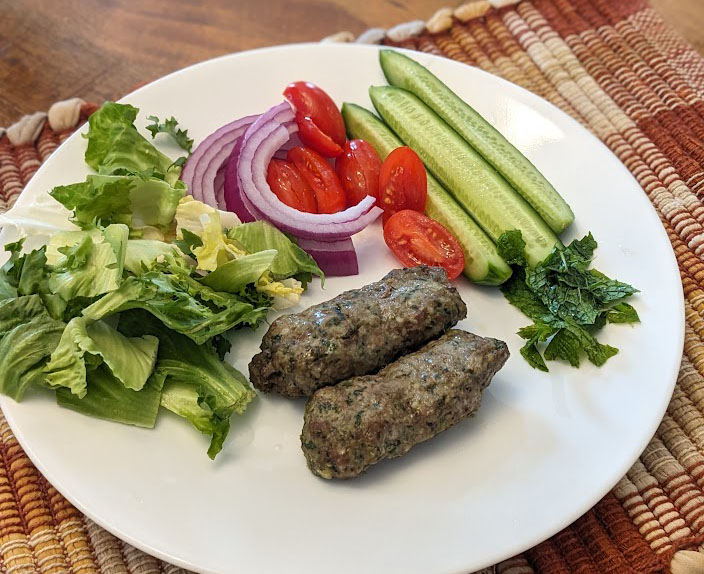
I’m the queen of quick and easy food that tastes amazing, feels gourmet, but takes almost no effort to prepare. One of my favorite recipes — for both special occasions and Shabbat — are these super flavorful lamb koftas. As a chronically-ill person, I also like that they can be eaten by those on a variety of health diets. I serve them with sliced cucumbers and tomatoes from the farmers market, and some Israeli couscous.
Ingredients
1 pound ground lamb
1 entire cluster cilantro
½ white or yellow onion, chopped
2 cloves garlic
1 Tbsp cumin
1 Tbsp paprika
1 Tbsp onion powder
1 tsp salt
Instructions
Debra Eckerling is a writer for the Jewish Journal and the host of “Taste Buds with Deb.” Subscribe on YouTube or your favorite podcast platform. Email Debra: tastebuds@jewishjournal.com.
Jean Meltzer: Jewish Joy Con, Easy Gourmet and Lamb Koftas Read More »

“I’m not a new world girl,” said artist Lea Shabat, sitting in her home studio in Montreal. “What can I get you?” she asked. “A coffee? Some tea?” She laughed and lamented that she could not offer me something to drink, given that I was in her home only by way of a computer screen. Perhaps there is always something mildly inauthentic about encounters that transpire by way of technology, but for me, getting to know Shabat and see some of her private work was a delight, even if we were nearly 4,000 miles apart.

Shabat is a rare jewel in the world of art and painting — certainly not undiscovered but also not as commonly known as one would expect when looking at her paintings. When I discovered her work last year, I wondered how it was possible I hadn’t come across it before. Perhaps it’s because Shabat, who says she is from “the old generation,” sees her art not as a commodity but as an extension of herself. “I don’t want to part [with my paintings],” she said. “It’s hard to let go of your children. I like to show my work, but I don’t want to think about the moment I have to part with it.”
Shabat was born in Casablanca in 1945 and left to France with her family for two years when she was young. From France, the family went to Israel aboard an immigration ship in 1950. In Israel, she and her family lived for a time in tents in one of the many ma’abarot (transition camps). I suspect her intense love for nature was nourished in this way, as she lived virtually as one with nature, without the confines (or conveniences) of building and structure.
“In Israel, I did my primary school, and we lived in tents,” she said, “and it was a beautiful life of nature … I was a little girl, and the Jewish community was very embracing. I also learned about different cultures like Yemenite and Russian.”
Shabat’s early exposure to transnational travel and to people from different cultures was a touchstone to the artistic journey on which she would one day embark. “But then I grew up,” she said, “and I went to secondary school, which was an agricultural school, so I had the experience of riding on a platform, you know, a pulled tractor with horses and sometimes camels … I love nature.”

She started painting at the age of five, and by the time she was an adult she longed to attend art school, but it was not part of her path. Instead, she had an arranged marriage to a man from Haifa. When she was in her mid-20s she moved with him to Montreal, “for love,” she said. They arrived alone in Montreal in the dead of winter, and she has resided there ever since. It’s a city that has been good to Shabat, who gave birth to two children there in addition to setting up her home art studio. “I’m not a party-goer,” she said. “If you see my backyard, it’s only trees, and I live with big windows and the sun shines on my face in the morning and at night, and I have no curtains. At night, I have the moon that comes and I’m really connected to nature. You can be one with nature, even in your home.”
But Shabat has always had an internal drive to be and feel free and unfettered. The idea of liberation is one she has explored not only in her work but also in her life. She has traveled all over the world and has lived in places like Cambodia and Indonesia and even Jordan, where she rented a little cabin in which to paint, for extended periods.
In Jordan, “I met the animals that I love,” she said. One of the first things I noticed about some of Shabat’s work is the prevalence of birds and other animals. In many cases they are, unsurprisingly once you know Shabat, moving and migrating; they are always in motion. In one piece — a triptych called “Mother Earth” — we see Shabat’s concern not just for animals but also for the world that sustains and nourishes them. In the top third of the triptych we see a woman’s body shaded in red with her arms raised above her with hands meeting above her head. From her breasts grow vines that work their way up to the surface of the mountainous ground, but it becomes heavier underneath.
“The turtle, the fish, the sea and the animals” are there, “and she’s feeding everyone from her belly … and the sea level is going down. We are losing a lot of nature … she’s feeding every form of animal,” Shabat said, looking at her painting. But “although the sea level is going down and we are losing a lot of nature, there is still hope.” She gestured to the top of the painting. “You see at the top, there are some sperm … [but] the earth is burning because the heat is on.” But though the sea is rising and the earth is burning, “she’s feeding everyone and everything, and she’s being depleted because she is not being nourished.”
I couldn’t help but wonder if Shabat sees some of herself in that figure, if she finds the endless job of women — to nurture and nourish others while pushing our own needs and desires from the forefront — as part of what drives her to paint in this way.
In “Out of the Rubble,” the figure of a person breaks out of a pile of colored bricks; white birds fly behind her as the person looks off into the distance. I asked Shabat about the birds and she was surprised by the question. “I don’t see birds,” she said. “I see liberation, being liberated from the traditional way.”
I couldn’t help but ask Shabat: What do you want to be free from? “Myself,” she said. “All I wanted to do is paint and read books and work in nature. And I raised my children on these principles. And I had a very nice partner who was a good man, but I wanted to go, you see?”
 Shabat may long to be free, but in that longing for freedom she also finds a deep and intense love for children. It’s impossible to miss the shapes and forms of children throughout her work, usually appearing faceless. “They are present all the time,” she said, “the children in my paintings.” It seems like a bit of a paradox at first, to paint persistently of liberation, but then focus simultaneously on the presence of children. It isn’t that she paints them to point out that they are a burden; it’s the opposite. “It’s love,” she said, “and they are very intriguing. Children have their own mind, and that’s how I live.”
When Shabat traveled to Cambodia, a friend told her there was a hospital for children. “I jumped on it,” said Shabat, “I said, give me a room there, and I will teach.” There were 50 children there, all struggling with their health, and Shabat did art with them and taught them to paint. “The kids and my life are entangled,” she reflected. She has also worked with children with special needs, and so it’s not surprising that children appear in her work, even if sometimes only faintly, again and again.
Shabat’s personal and artistic emphasis on nature and love for children is the same ethos that guided her when raising her own children. Her daughter Stephanie is a prominent figure in the art world who credits her upbringing as the reason she decided to enter the profession. In honor of Shabat’s recent 80th birthday, Stephanie created an Instagram page to showcase her work. Shabat’s son, Eric, works in human rights and environmental peacebuilding. One might say that her children embody Shabat’s most treasured ideals, and that their work is an extension of hers. Perhaps this too is the hope Shabat imagines in her triptych “Mother Earth.”
Shabat has many memories of her own childhood, and some of these stories inform her work. When she was a child, she would walk three to five times a week with her father to the water where they would eat sandwiches and catch fish together. But one day, he had his bike and his fishing rod and Shabat knew he was leaving without her and was distressed.
 “’Today, you’re not coming with me,’ he said. And I said, ‘Why?’ He said, ‘Because I will meet my friends there and my neighbors.’ He didn’t want me to be in company of adults. And I started to cry. So he went with his bike, and I was walking behind him and crying, ‘Take me! Take me!’ I remember this because I keep telling the story.” As Shabat got closer to her father on the bike, the hook from the fishing rod cut her neck, but her father did not realize. “I was crying. And he was looking away because he was on his bike, and he said, ‘Go home.’ But I kept running after him. Then the hook cut my leg, and he didn’t understand. I yelled, ‘Papa, look what happened to me.’ I went home and I took it out by myself. The fishing hook, you know, is for the fish not to run away.”
The irony of being caught — with a fish hook — by someone who is trying to escape you is not lost on Shabat, who chuckles as she tells the story. But I can tell that it is a deeply significant story for her. And I wonder if, in all the faceless children scattered throughout her work, one of them is her, longing to catch up with her father, to not be left behind even as the adult version of Lea Shabat runs the opposite direction, forever chasing liberation.
At the end of our talk, I asked her if being Jewish influences her art in any way. “Not at all,” she said. But I couldn’t help but smile because it’s easy to see the theme of tikkun olam in her work. Pushing a bit, I asked, “Did you grow up religious at all?” Her answer may be one of the best lines I’ve ever taken from an interview: “Religious, no. Shabbat, yes.”
Monica Osborne is a former professor of literature, critical theory, and Jewish studies. She is Editor at Large at The Jewish Journal and is author of “The Midrashic Impulse.” X @DrMonicaOsborne
Lea Shabat and the Art of Chasing Liberation Read More »
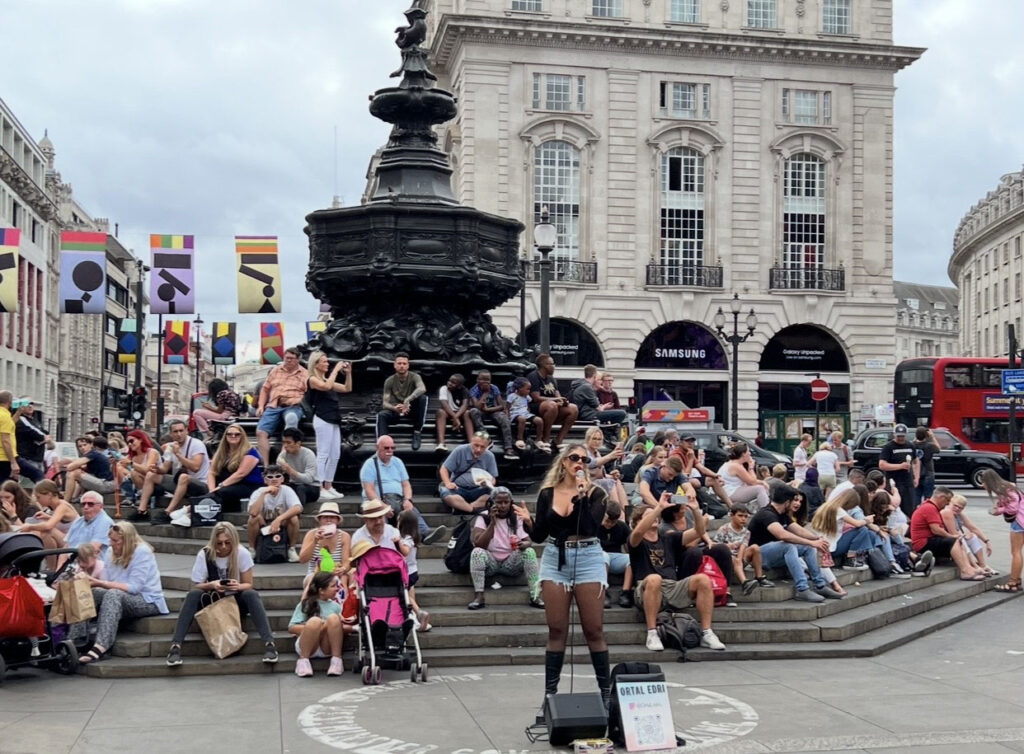
Ortal Edri stood in front of the Chinese Theater on Hollywood Boulevard and sang her heart out, performing “I’ll Stand by You” by The Pretenders. Beside her, among her audience was a man held holding a large cardboard sign that read: “Even $1.00 helps,” and in big, bold capital letters, “FOOD, WATER.”
Unlike many performers who appear on the Hollywood Walk of Fame, Edri doesn’t do it for money. She does it for those who often go unseen — or rather, ignored: the transients who sit on the sidewalk and beg.
A man wearing a hat with a cardboard sign was clearly moved. He joined her as she sang, “I’ll stand by you, I’ll stand by you, won’t let nobody hurt you, I’ll stand by you.”
 Edri has been singing for the homeless since she arrived in Los Angeles a couple of years ago. In Israel, she participated in a singing competition called “A Star is Born,” and in 2023 she auditioned for “America’s Got Talent.”
“I sang a Demi Lovato song, and “the audition gave me so much confidence that I said, ‘Come on, let’s go sing on the Hollywood Walk of Fame,’” Edri said.
Edri has a powerful voice that’s hard to ignore as when on the street she belts out songs by Celine Dion and Whitney Houston on the street. It feels like she’s been singing her whole life, but in an interview with The Journal, Edri revealed she only started singing at 18 — and had no idea she had such any talent. In fact, she hadn’t spoken at all since she was nine years old.
“My father committed suicide when I was nine, and I stopped talking,” she said. “I suffered such trauma that I didn’t speak at home or at school. They tried everything, including sending me to a psychologist, but I didn’t utter a word. When I was 17, I started talking a little with my mom — just simple things like, ‘Hi,’ ‘Good morning.’”
When she received her recruitment order for the IDF, her mom was happy. “She said, ‘Finally, you’ll have some friends,’ because I didn’t have any friends — I couldn’t talk.” So she enlisted, and while standing in military formation, she began humming a tune. The sergeant major approached her, and she was sure she was about to be disciplined. Instead, he said, “I want you to sing for us at basic training graduation.”
The 18-year-old soldier was shocked but decided to go for it. During the ceremony, she sang “Shir HaMa’alot” (“Song of Ascents”), a popular and uplifting psalm expressing spiritual yearning, gratitude, and hope for redemption.
Her performance earned enthusiastic applause and appreciation — and it made her commander realize her talent. With his support, she enrolled at Thelma Yellin High School of the Arts in Tel Aviv and began taking vocal training.
“I was able to combine my studies with my service,” Edri she said. “I used to travel in uniform to Thelma Yellin. It was the first time I had seen Tel Aviv. I didn’t understand why people were so impressed with me, and I thought to myself, it’s because I’m from the periphery.”
This was the first time in Edri’s life that she attended an extracurricular activity. Bit by bit, the shy girl gained confidence and new friends.
“We were very poor, so my mother couldn’t afford to send me to any classes as a child. We hardly had enough money for food. That’s why I’ve always had a soft spot for those less fortunate and wanted to do something for the homeless.”
Another first time Edri sang on the street was in London’s Piccadilly Square. She uploaded the video clips to her social media accounts and it immediately went viral, receiving millions of views. Her TikTok account now has 1.2 million followers, and her Instagram boasts 384,000 followers.
One video of her singing Beyoncé’s “Halo” to a man in a wheelchair earned 1.5 million views, while another clip of her performing Whitney Houston’s “I Have Nothing” garnered 7.9 million views. These videos caught the attention of several music industry professionals, including songwriter and producer Rickhard Nowels (who has worked with Dua Lipa, Stevie Nicks and Lana Del Rey) and acclaimed songwriter Diane Warren, who invited her to record with them.
Currently, Edri and her soon-to-be husband, Shamir Fink — a music producer — are working on her first album, “Insanity,” which will feature original songs. The two met 11 years ago and run a recording studio in Herzliya, Israel, which they plan to bring to the U.S. when they settle down.
Her mother, she said, is one of her biggest fans and supporters. “When I first told her I was going to audition for “A Star is Born,” she was skeptical and said, ‘I hope you’re not going to embarrass us on TV.’ But when she saw my first audition, she couldn’t believe it, she was so excited. Sometimes I can’t believe it myself — I have to pinch myself to see if it’s all real.”
Follow Edri on Instagram @ Ortal_edri
View this post on Instagram
From Silence to Song: Ortal Edri’s Journey from Trauma to Viral Street Performer Read More »
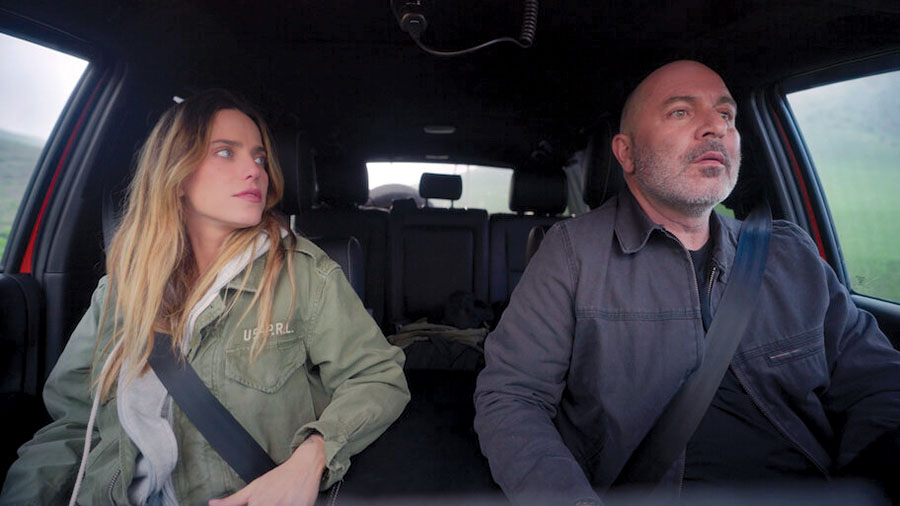
What happens when a tough- as-nails action star and a glamorous actress/TV host hit the road together in Central Asia? In “Off Road,” Lior Raz (“Fauda,” “Gladiator II”) and Rotem Sela (“The Baker and the Beauty”) trade the safety of scripted series for the unpredictable — rough roads, leaking tents, raw emotions and sheep-related sports you didn’t know existed. It’s part soul-searching, part therapy session and part voyage through the unbelievably stunning landscapes of Kazakhstan and Kyrgyzstan.
The two actors, who previously collaborated on the feature film “Soda” and the TV drama “A Body That Works,” have been close friends for the past three years. So when Raz approached Sela with the idea for “Off Road,” she immediately said yes — even though off-roading in a Jeep through remote terrain was never exactly her dream.
They presented the concept to Netflix and were given a green light. “Off Road” is the first unscripted Israeli series produced by the streaming giant.
The decision to explore Central Asia came from their shared desire to visit somewhere they’d never been before. Over six episodes and 25 days of filming, viewers are treated to sweeping landscapes, wild horses galloping across endless green hills and intimate conversations — some of them with a psychologist. They also encounter kok boru, a traditional Central Asian sport often described as “dead goat polo,” in which teams on horseback compete to toss a goat carcass into a goal. Sela found the game so upsetting that she opted to return to the Jeep, while Raz stayed behind, politely watching as men kicked around a freshly slaughtered goat.
Another shared challenge: the food. In a country where much of the cuisine is meat-based, both actors struggled. Sela has been a vegetarian for years, and Raz had recently become one. On the first day, they politely declined their host’s offering of horse meat.
But for Raz, the biggest challenge wasn’t the food — it was being exposed to the camera 24/7.
“Being filmed nonstop and feeling so exposed was the hardest part,” he said in a Zoom interview with The Journal. “I hardly give interviews. I’m usually very measured in what I say — and this wasn’t like that. I had to let go of something inside me. But once I did, it became easier. I learned that I can loosen up and let go of the parts in me that I tend to hold tightly.”
Despite both actors being well-known — Rotem primarily in Israel and Raz internationally — most of the people they encountered had no idea who they were. This led to some amusing moments as they explained their celebrity status to clueless strangers.
Spending that kind of intense, uninterrupted time with a friend — especially under pressure — can often test the friendship. And while the two are seen arguing in nearly every episode, they also laugh a lot and genuinely support one another. “It was an intense journey. We were in very close quarters,” Sela said. “There were lots of difficult moments, which you can see on the show, but our friendship ultimately stood the test — we’re still very close. In a way, it even made us stronger, because most of the time, we really enjoyed each other’s company. It’s true that once we got back home, we needed a little break from one another,” she laughed, “but in the long run, it was amazing for our friendship.”
“Off Road” isn’t your typical National Geographic-style travelogue. At times, it becomes a deeply personal journey of reflection and self-discovery. “I think it was a triple journey,” Raz said. “An outer journey, an inner journey and a journey of our friendship. What I learned about Rotem is that she’s incredibly brave, a great friend and a sharp, intelligent woman. I already knew that—but under extreme conditions, those qualities really sharpened.”
Raz is best known as the co-creator and star of “Fauda,” where he plays Doron Kavillio, a commander in an elite undercover unit pursuing terrorists in the West Bank. But “Off Road” reveals a much softer, more vulnerable side of him. He opens up about his father, who left the family when Raz was 11, and about his first girlfriend, who was murdered in a terror attack while they were both serving in the army.
“I never planned to open up like that — honestly, it scared me,” Raz admitted. “You never see me that exposed. Even as an actor, I’ve never shown that level of vulnerability. But I learned to let go. There’s something about Rotem — our friendship — that helped me do that. It gave me the freedom to release.”
Sela also revealed a traumatic event in her life which she refrained to talk about in the past. “It happened many years ago, when I was 14 or 15, my grandfather committed suicide. I wasn’t there when it happened, but my grandmother called me and screamed on the phone — it was around 7:30 — to tell me, ‘Grandpa is dead.’ Like a crazy person.”
Sela and Raz had played lovers in previous projects, which naturally raised the question — weren’t their spouses a bit concerned about the two going on a road trip together?
Rotem is married to Ariel Roter, a real estate professional, and is a mother of three. Raz is married to actress Meital Berdah and is a father of four.
Their trip reignited an age-old question: Can a man and a woman truly be platonic friends?
In a conversation before their journey, Sela shared what her mother had told her before she embarked on her trip — that her father was a bit worried. “Why is he concerned?” Sela asked.
“You know … going on a month-long trip with a man,” her mother replied.
“But Mom, this is Lior! We’ve been friends for three years — we’ve traveled abroad together countless times.” She then turned to Raz and said, “People just don’t know that I’m not attracted to you.”
“Not at all?” Raz asked and the two burst out laughing.
“If we were going to fall in love, it would’ve happened long ago,” Raz said.
Since returning to Israel, a few things have changed. Raz is no longer a vegetarian.
“I stopped eating meat after I was in LA and ate steaks and didn’t feel good afterward in my body and soul, so I decided to take a break from meat, but after returning to Israel, I started training hard and needed meat,” he explained.
Sela, on the other hand, fell in love with off-roading and even bought a Jeep Bronco — the same one Raz owns. A longtime Jeep enthusiast, Raz also drives a Toyota Land Cruiser and often goes off-roading.
If the series gets a second season, Raz already has some destinations in mind.
“I’d love to go to Argentina and Brazil … maybe India and Myanmar. There are so many places I’d like to visit,” he said.
There’s no doubt he’d want Sela to join him again. After they returned from Kazakhstan, Raz received numerous messages from friends asking why he hadn’t invited them along. “I still get texts from people saying, ‘It would’ve been more fun if you took us instead!’”
Both countries they visited are predominantly Muslim, but being Israeli didn’t cause any friction.
“We met amazing people who were incredibly hospitable,” Raz shared. “Us being Israeli wasn’t an issue. At one point, we asked a family we met about it, and they said, ‘We don’t pay attention to that stuff. To us, you’re just human.’”
Off Road, On Camera: Lior Raz and Rotem Sela’s Wild, Emotional Ride Through Central Asia Read More »
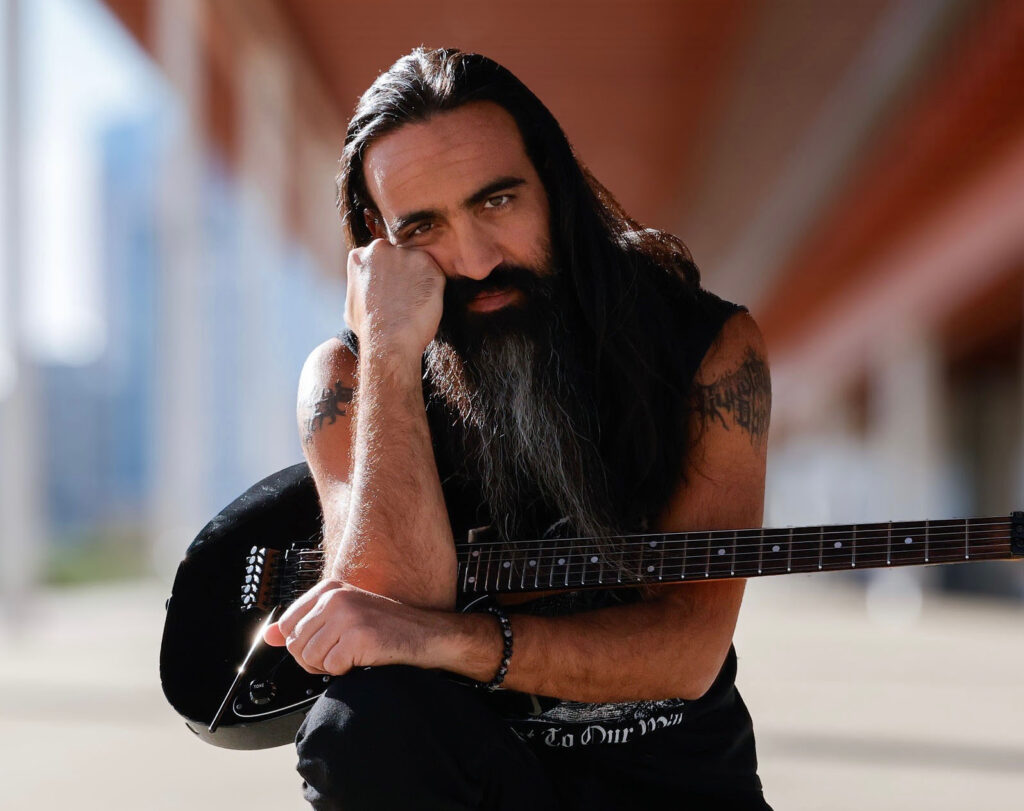
Israeli guitarist Aviv Hadari wondered why there wasn’t a CrossFit program for guitarists in LA. No songs, no solos — just seasoned guitarists stretching their hands, doing drills up and down the fretboard and remembering why they love it. So he created one himself in June and called it the Shred Factory. It’s a twice-weekly, nine-session group guitar workout held inside a rehearsal space in Koreatown.
Students take their seats quietly while Glendale’s System of a Down can be heard on the PA. Hadari is the only guitarist plugged into an amplifier; everyone else is either playing their electric guitars completely unplugged, or has headphones plugged into a mini amp so only they can hear themselves.
Hadari welcomes each guitarist with a smile and questions about what they’ve been up to. Before any playing, Hadari reiterates Shred Factory’s purpose. “This is not a lesson, this is not a class, this is a workout,” Hadari told his students. “This is purely for mechanics. This is not for making music. It’s not for performing. It’s not even for writing music. This is just muscle memory. This is just programming. This is rewiring the brain.”
After hand stretches, Hadari explains the first workout — playing a chord on every fret up and down the fretboard. Each workout is a chromatic pattern, a diagonal stretch or a spider drill, done to a locked metronome. Throughout, Hadari reminds the players to “breathe, focus on your left hand, and visualize it going right.” He pushes them to jump back in if they stumble. Hadari speaks not so much with a CrossFit intensity, but with a meditative encouragement.
“We’re not worried about playing fast, this is not a jam, this is not a hang, this is not a circle of shredders showing off, it’s not about how cool it sounds or if you nailed it perfectly,” Hadari said. “It’s about reps. If you’re doing this every week, your hands are going to feel different when you play. Today you’re laying down railroad tracks in your nervous system.”
Born in Herzliya, in the 1990s, Hadari began by studying jazz guitar. He credits his deep dive into hard rock to his last teacher before moving to the U.S., Guy Be’er, a veteran session guitarist from the band HaYehudim, (“The Jews”). “He broke me down completely and built me up just like a true mentor should,” Hadari said. “He told me, ‘You can shred, but if I put ‘Happy Birthday’ in front of you, you wouldn’t be able to read it.’ So he made me learn to read music.”
Hadari also studied with musicians who specialized in maqams — Middle Eastern scales and quarter tones rarely heard in Western music. “When I play that stuff here, people stop and ask where I’m from,” he said. “I tell them I’m Israeli. And yeah, we use a lot of Arab scales.” He describes that music as the “notes between the notes” we hear in Western music. Those scales stuck with him even after he moved to Los Angeles and trained with top-tier international teachers. “If I bust out a maqam, it’s like using sumac in cooking. It’s not salt or pepper. It’s a very specific flavor. But when you use it in the right context, it elevates everything.”
Hadari prides himself on teaching people to go “from ‘Yankee Doodle’ to Eddie Van Halen,” he said. “I’ve been calling myself the Shred Factory for years because that’s what I do. I take people from playing ‘Happy Birthday’ and cowboy chords to playing ‘Painkiller’ by Judas Priest. I make shredders.” He wanted to strip away the chaos and distraction that usually surrounds learning an instrument. The class is capped at about 15 students, many of whom have been playing for years. Several students also tune in remotely via Zoom.
In 2024 Hadari was performing at a Shabbat dinner at Valley Beth Shalom (VBS) in Encino. He was plugged in, but had the distortion and volume turned down to match the Shabbat dinner vibe. Among the songs he played on his black Ibanez guitar was “Earth Angel” by The Penguins. Then, with a confident smile, he effortlessly segued into the intro of Chuck Berry’s “Johnny B. Goode,” as if he was ”ringing a bell.”
He doesn’t perform at VBS any more. After his mother passed away in May 2024, Hadari decided not to work on Shabbat anymore. “I decided not to play guitar on Friday night or Saturday during the day, and I kept it,” Hadari he said. “I still don’t play on Shabbat. It’s not a thing that’s going to happen. I wanted to bless my mother and myself by giving a certain level of sanctity to my craft.”
He’s also kosher and keeps a morning ritual of prayer, meditation and journaling. “To me, being able to do that every day is already success.” For Hadari, Shred Factory embodies so much that he’s learned, lost, and chosen to believe in. There’s a lot of alone time when learning an instrument. Shred Factory is a place where Hadari gets people to break that up a few times per week. “When we’re all doing an exercise together, even unplugged, I can still hear the collective sound,” he said. “It feels good. The energy of the group is way more powerful.”
He sees much value in ritual, whether it’s guitar or Judaism. “Shred Factory is like a minyan, you can pray alone, but it’s not the same. Doing something together is more powerful. Practicing guitar together is no different.”
“Shred Factory is like a minyan, you can pray alone, but it’s not the same. Doing something together is more powerful. Practicing guitar together is no different.” – Aviv Hadari
What sets Shred Factory apart isn’t just the drills — it’s the language. Hadari, who also leads live musical meditations and guided sound baths, laces his instructions with mindfulness. “Focus on yourself and your breathing,” he’ll say. “Think about someone in your life who sees you as the greatest guitarist they know. Play for them.” It is reminiscent of Hadari’s monthly guided music meditation he leads. His instruction style isn’t like a drill sergeant nor metal singer; he uses a soothing, encouraging approach. “When you think about how awesome you are while you’re playing — you physically play better. You actually miss fewer notes.”
That message is intentional. “I’m aware of what guitarists are thinking while they practice. All the self-doubt: ‘I’m not fast enough, not good enough, that guy’s better than me.’ I know those voices because I’ve had them. And I try to say things that give people a different voice in their head.”
On Hadari’s right forearm is a tattoo in bold letters, “Never Give Up.” He got the tattoo while in Israel for his mother’s Yahrzeit. “If someone wants to do something and they’re willing to speak it, it must come true,” he said. “It’s the law of God’s universe. We are divine creatures. We can create our lives. If you want to shred — seek it out, find it, and never give up. Anyone can do this.”
Hadari’s positive mindset runs through every session at Shred Factory. And if your hands tingle a little on the drive home? That’s proof it’s working.
Israeli Guitarist Aviv Hadari’s Shred Factory Read More »
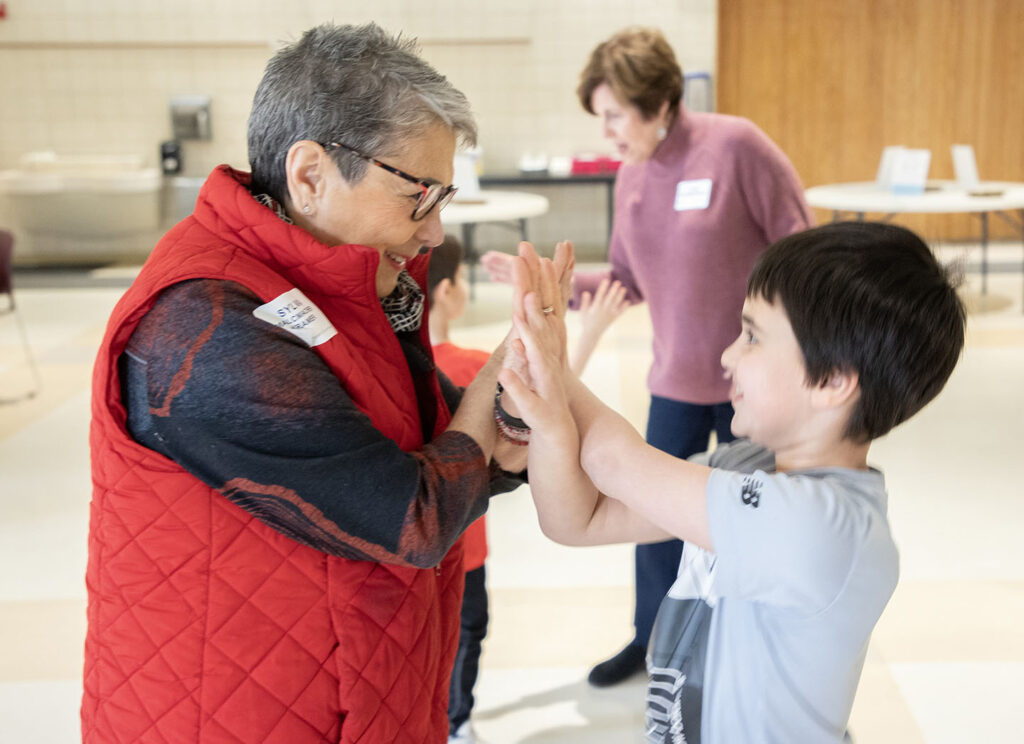
On Monday, June 9, Debra S. Weinberg — known to everyone as Debs — was heading home to Baltimore from Washington. She and her husband had celebrated his birthday at a restaurant with their family. It was a joyous event, and Debs had made sure not to drink, knowing she would be the one driving.
But just a minute before they reached home, the accident happened.
“I fell asleep at the wheel. I hadn’t been drinking — I was wide awake when I got in the car — but it had been a long drive,” Weinberg said in a phone interview with The Journal.
The car crashed into a wall, the airbags deployed, and miraculously, the couple walked away unharmed.
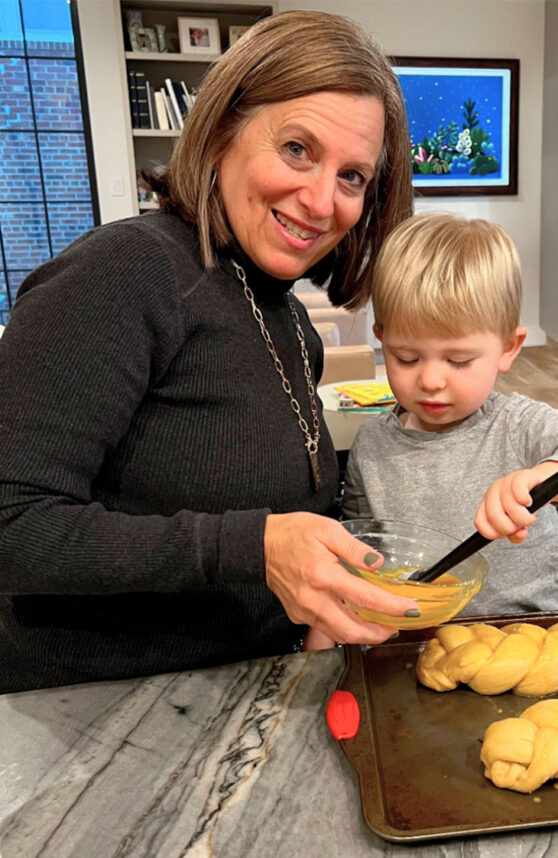
“Physically I was fine, but the next day I kept wondering: What is my purpose? Why did God allow me to live?” she recalled. “I kept thinking about what was missing in my life, and I realized how much I missed the sacred work of serving the Jewish community and helping others. I felt this was a calling — a sign — that I’m meant to help people who truly want to play an essential role in the lives of their grandchildren.”
The Jewish Grandparents Network (JGN) has announced that Debra S. Weinberg will serve as Executive Director beginning Sept. 1, and Richard N. Bernstein will take on the role of co-president. With these leadership additions and a growing base of supporters, JGN is well positioned for long-term sustainability as it continues to engage more families in meaningful and accessible Jewish experiences and content.
Weinberg learned about the organization’s impactful outreach from her next-door neighbor. “I didn’t know her very well, but we went for a walk, and I asked how her grandchildren were doing,” Weinberg recalled. “She said, ‘I wish I knew. I’m very estranged from my children and grandchildren.’” The neighbor then shared how much support she had received from the Jewish Grandparents Network. “She thought she was alone,” Weinberg said, “but she discovered that others are struggling with the same challenge.”
This is just one example of the many vital services JGN offers Jewish grandparents — from helping them reconnect with estranged children and grandchildren, to facilitating meaningful conversations about topics like the war in Israel and antisemitism, to enriching their Jewish lives through shared games, storytelling and multigenerational dialogue.

“I was on the board for about a year, and I became interested in taking on a bigger role because I have four grandchildren and play a very active social role in our family life and Jewish traditions,” said Weinberg. “The conversations I’ve had over the past few years with friends about the role we play in our grandchildren’s lives inspired me to get involved in the network.”
Research has shown that grandparents play a significant and integral role in family life. As such, they have a major influence in strengthening their grandchildren’s Jewish identity. A visit to the organization’s website reveals a wide array of activities, events and suggestions to help grandparents build strong, meaningful connections with their grandchildren — connections rooted in Jewish values.
These offerings include lectures on how to connect with teen grandchildren in the age of social media, how to prepare your home and heart for the Jewish New Year, recreating Shabbat dinners, sharing family stories and tips from a globe-trotting grandfather on how to turn time with your grandkids into a shared adventure.
“One of my initiatives is an online Grandparent Jewish Learning Fest that we are hoping to hold this winter, that will help us build a community that is much broader across the world,” said Weinberg. “We will hear from experts and presenters nationwide and abroad.”
Thanks to the website, Jewish grandparents from all over the world can learn the best ways to interact and play with their young grandchildren and have more serious talks about death, something that grandparents often struggle to bring up with their grandchildren.
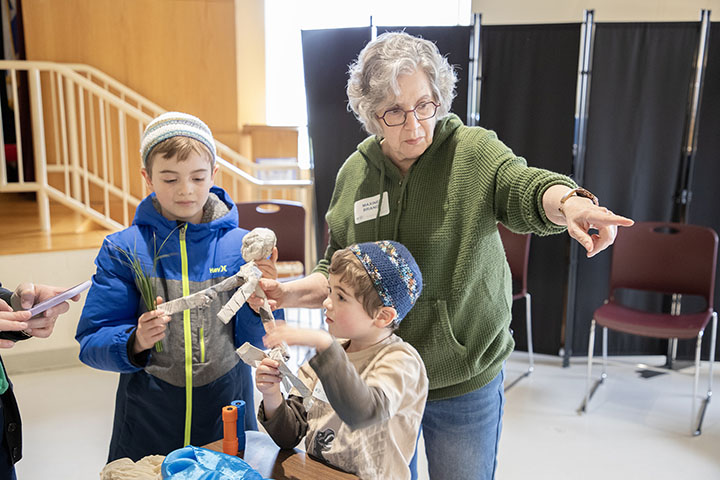
Despite the name: — Jewish Grandparents — there are also non-Jewish grandparents who have Jewish grandchildren. They joined the community with the hopes of learning more about Judaism so they can connect better to their grandchildren. “One of the things we hope to address is the growing number of grandparents who are starting a new chapter in their 60s and 70s by relocating to be closer to their grandchildren,” said Weinberg.
Indeed, many grandparents are uprooting their lives — moving from the West Coast to the East Coast or vice versa — in order to be near children and grandchildren who have moved away.
Weinberg’s long-term vision for the organization is to expand its reach and bring its programs to more families. “We also want to build a network for professionals who can join us, and to inspire more people to celebrate and engage meaningfully in Jewish family life. There’s so much potential to support grandparents in doing their best to help raise the next generation of Jews,” she said.
More than anything, Weinberg said, she wants grandparents to experience and share the joy of Judaism with their grandchildren.
To learn more, visit: https://jewishgrandparentsnetwork.org
Strengthening Jewish Identity Through the Power of Grandparenting Read More »
At the henna party before our wedding, Neil and I were dressed in the traditional Moroccan costume — embroidered caftans. Neil wore a red fez and I wore an elaborate bejeweled crown and neckpiece. A special moment of the celebration was when Neil’s mother Becky and her friends broke a rosca over my head. This rosca was shaped like a hand with a dough “ring” on one finger and it is a Sephardic custom meant to ward off the evil eye and bless the bride.
This is a tradition with deep roots. On the island of Rhodes, the ceremony was called Bañu de Novia — the bride’s bath. The bride would immerse in the mikvah and after she emerged purified and glowing, her female relatives would sing traditional songs, celebrating her transition. Then they would break a rosca over her head to shower her with blessings and protection.
Whether it’s a Rhodesli-style rosca or a ka’ak from the Syrian Jewish community, the symbolism is the same — invoking protection and good fortune with a bread lovingly shaped by hand.
In Ladino, the Judeo-Spanish spoken by the descendants of Jews exiled from Spain, the word roska means “round.” This festive bread is circular, sweet and just made to be shared.
In Sephardic homes, roscas are a staple of the Shabbat desayuno (breakfast). They are also served at tea time alongside feta cheese, homemade jams, black olives and hot black coffee. The braided loaves can also be shaped into smaller rolls known as roskitas or panizikos, which are especially comforting when served warm with fruit preserves.
Neil, who grew up in the Rhodesli community of Los Angeles, remembers that a rosca was always served at lunches and teas. He also told me that during Sukkot, families would hang the loaves inside their sukkah as edible decorations.
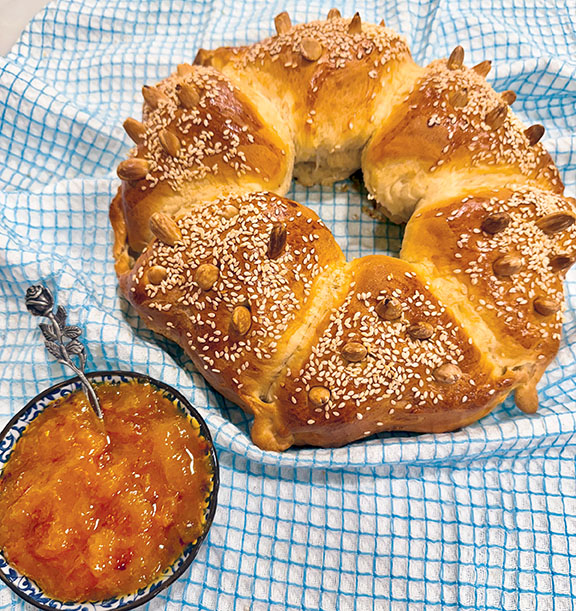
Most commonly, rosca are topped with sesame seeds. For special occasions, whole blanched almonds are pressed into the dough before baking, a decorative tradition that is as beautiful as it is delicious.
When our children were growing up, my mother-in-law Becky often made roscas for us and my kids used to fight over the almonds on top, plucking them off one by one before the bread was even sliced. When I began baking my own, I covered the top of the rosca with lots of almonds, so that there would be no need to compete!
I rarely bake rosca because I like to keep them special. I will bring one out for a family brunch, a dairy Shabbat lunch or a High Holy Day meal. Whenever I set one out, I can feel the anticipation — everyone is excited to see the rosca on the table.
Rosca have a texture that is similar to challah, but the flavor is unique. The traditional rosca includes orange blossom which imparts a sweet perfume scent (my mother-in-law baked hers with vanilla). Since Neil and my kids aren’t fans of orange blossom water, I use fresh orange zest instead. It imparts a fragrant citrus lift without an overpowering sweetness.
When baked right, the roscas are light, fluffy, and utterly heavenly. The secret is in the second rise — once the dough is shaped into rings or rolls, allow the dough to rest again. That extra patience makes all the difference.
For me, roscas are more than just bread. They carry the imprint of generations, the warmth of my mother-in-law’s kitchen and the joy of family coming together. Each loaf is a reminder that the most meaningful blessings are often shaped by hand and passed from one table to the next.
—Rachel
Yields 3 large rings, or 12–15 rolls
2 Tbsp active dry yeast
2½ cups warm water
1 cup sugar
3 large eggs
½ cup avocado oil or other neutral oil
1 tablespoon orange rind or orange blossom water.
8–10 cups all-purpose flour
1 egg, for egg wash
Sesame seeds, for topping
Blanched whole almonds, for decoration
Preheat the oven to 350°F. In a small bowl, dissolve the yeast in warm water and let it sit for about 10 minutes, until frothy.
In a large mixing bowl (or stand mixer fitted with a dough hook), add 8 cups of flour. Make a well in the center and add the eggs, sugar, oil, orange rind and the activated yeast mixture. Mix until a soft, medium dough forms, adding additional flour a little at a time as needed. Knead for about 8 to 10 minutes, until the dough is smooth and elastic.
Lightly grease a large bowl with oil. Place the dough inside, turning to coat lightly. Cover with a clean towel. Let rise in a warm place until doubled in size, about 1½ hours.
Punch down the dough and divide it into 6 pieces. Knead each piece lightly.
Cut and shape into small rolls, roskitas, or braid and form into rings. Place on a parchment-lined baking tray, spacing rolls ½“ apart (if forming a ring, or evenly spaced as individual rolls). Cover with a towel and let rise again for about 30 – 40 minutes, until puffed and nearly doubled in size.
Beat the remaining egg and brush over the tops of the dough. Sprinkle generously with sesame seeds.
Using the tip of a sharp knife, make small slits on the top and gently press a blanched almond halfway into each slit. Repeat as desired.
Bake for 20 – 25 minutes, until golden brown. Let cool on a wire rack.
Baked roscas freeze beautifully. Store in airtight containers or zip-top bags once fully cooled.
As a young girl, I took it for granted that my grandfather and father would shop for food. I remember my grandfather would stock their garage with huge sacks of rice and large mesh sacks filled with onions and boxes of tomatoes.
My father took great pleasure in buying boxes of fruit from the wholesale produce market. Summer was the most exciting season with all its abundance. Bright red, juicy watermelon. Dark ruby, sweet fleshy cherries. The mangoes — Australian mangoes have a sweet, creamy flesh with a deep intoxicating aroma.
He especially loved apricots. As their short season was coming to an end, he would ask my mother to prepare the “mishmish” into a jam.
There is nothing quite as satisfying as eating a homemade jam (my Aba loved his with a chunk of cheese and a fresh bread roll).
—Sharon
2 pounds fresh apricots
1 cup granulated sugar
¼ cup freshly squeezed lemon juice (about 1 medium lemon)
½ cup water
Wash the apricots thoroughly. Cut them in half, remove the pits, and place the fruit in a wide, heavy-bottomed pot.
Add the water and bring to a gentle simmer over medium heat. Cook for about 10 minutes, stirring frequently, until the apricots begin to break down and become soft and pulpy.
Stir in the sugar and lemon juice. Lower the heat and continue to simmer for 40 to 45 minutes, stirring often, until the jam thickens and the apricots are completely broken down. Keep cooking until it reaches a smooth, jammy consistency.
Carefully ladle the hot jam into clean, glass jars. Allow to cool completely before storing in refrigerator.
Sharon Gomperts and Rachel Emquies Sheff have been friends since high school. The Sephardic Spice Girls project has grown from their collaboration on events for the Sephardic Educational Center in Jerusalem. Follow them
on Instagram @sephardicspicegirls and on Facebook at Sephardic Spice SEC Food. Website sephardicspicegirls.com/full-recipes.
Blessings of Bread – A Sweet Rosca Read More »
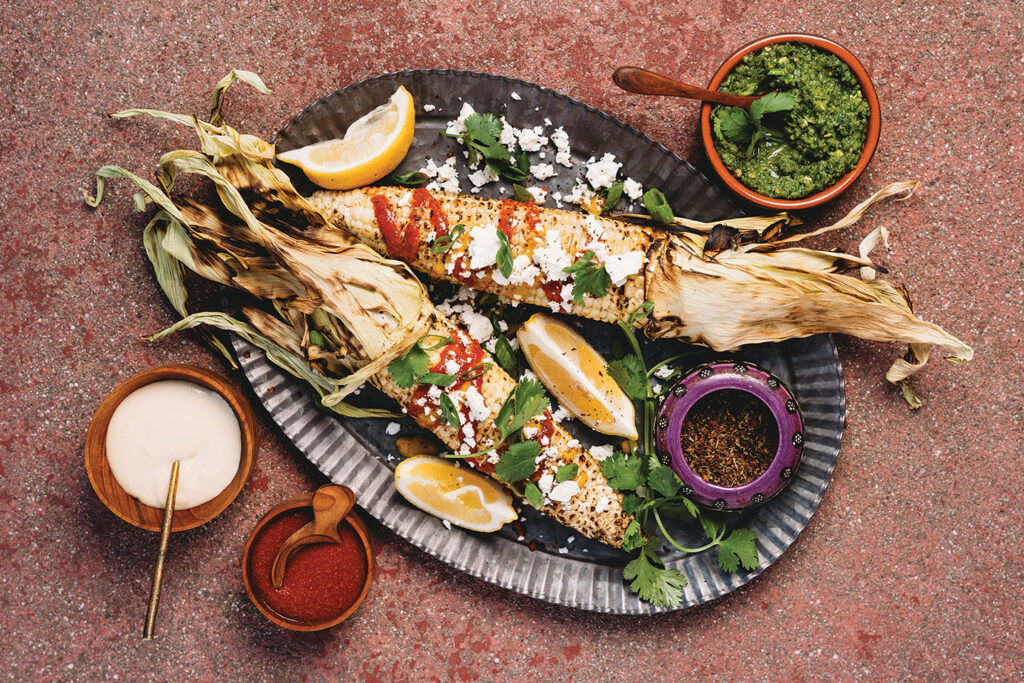
July is National Corn Month! It’s designed to celebrate the versatility and importance of corn.
While there are plenty of ways to enjoy corn — from corn bread to corn salad — nothing says summer like corn on the cob!
“I think grilled corn is one of the best foods for a summer cookout,” Faith Kramer, author of “52 Shabbats: Friday Night Dinners Inspired by a Global Jewish Kitchen” told The Journal. “It’s tasty, fun to eat and grilling it on the cob gives corn a real flavor punch.”
Kramer’s family favorite from “52 Shabbats” has a Middle Eastern twist. It makes a fun appetizer, starter or side dish. Her recipe is full of texture and flavor with toppings that are spicy, creamy, and tart.
“Try the toppings suggested here or improvise your own,” Kramer said. “To make it vegan or parve, choose non-dairy toppings.”
Serves 4 to 8
For the Spice Mix
1/2 tsp salt
1/2 tsp ground black pepper
1/2 tsp paprika
1/2 tsp dried mint
1/2 tsp ground sumac or 1 tsp finely grated and minced lemon zest
In a small bowl, mix together the salt, black pepper, paprika, mint and sumac and set aside.
For the Drizzles
(Choose 1 or 2 creamy and 1 tart, plus 1 hot sauce, if desired)
Creamy:
1 to 3 Tbsp garlic sauce (see below)
1 to 3 Tbsp tahini sauce (see below) or tahini
1 to 3 Tbsp plain yogurt
Tart:
1 to 3 Tbsp purchased amba or yellow curry sauce (see below)
1 to 3 Tbsp pomegranate molasses
1 to 3 Tbsp silan (date syrup)
Hot Sauce:
1 tsp zhoug
1 tsp harissa
1 tsp bottled hot sauce
Notes: Amba (fermented mango sauce), silan (date syrup or date honey), pomegranate molasses, zhoug (Yemeni hot sauce) and harissa (North African hot sauce) are available in many kosher, Middle Eastern, international and other specialty markets and online.
For Serving
1/2 cup crumbled feta cheese, optional
1/4 cup chopped fresh cilantro or mint
1/4 cup chopped green onion
Garlic Sauce
Makes about 1 cup
1/4 cup peeled garlic cloves
1/3 cup fresh lemon juice
1/2 cup extra-virgin olive oil
1/4 tsp salt
In a blender, combine the garlic, lemon juice, olive oil and salt and purée on high speed until smooth. The sauce can be stored in an airtight container in the refrigerator for up to 5 days. Bring to room temperature before using. (This makes a very thin sauce perfect for drizzling. Use 1/3 cup garlic and reduce oil to 1/3 cup for a thicker, zestier sauce.)
Tahini Sauce
Makes about 1 cup
1 tsp minced garlic
1½ Tbsp fresh lemon juice, plus more if desired
1/4 cup plus 2 Tbsp very cold water, plus more if desired
3/4 cup tahini
1/4 tsp salt, optional
In a medium bowl, stir together the garlic, lemon juice and water. Stir in the tahini paste with a fork. The mixture may thicken and seize, but keep stirring, until smooth and thick but still pourable. Add cold water 1 teaspoon at a time to reach the desired consistency. Taste and add salt and/or lemon juice, if desired. Store in an airtight container in the refrigerator for up to 3 days.
Yellow Curry Sauce
Makes about 3/4 cup
1/2 cup plain Greek yogurt
1 tsp minced lemon zest
1 Tbsp fresh lemon juice
1 tsp curry powder
1/2 tsp ground turmeric
1/8 tsp sugar
2 Tbsp milk plus more if needed
In a bowl, mix together the yogurt, lemon zest, lemon juice, curry powder, turmeric and sugar until smooth. Slowly stir in the milk, adding more, if needed, until the sauce can be drizzled. Store in an airtight container in the refrigerator for up to 3 days.
To Make the Corn
4 large ears fresh corn on the cob with husks
1 Tbsp extra-virgin olive oil
Spice mix
Sauces and toppings
Remove the silk from the corn, but leave the outer husks and stem on. Soak the corn in cold water for 20 minutes.
Heat a grill to medium-hot. With the husks closed over the corn cobs, grill the corn on all sides until the kernels can be easily pierced and are charred in places. (If a grill is not available, husk the corn and cook as desired.)
Pull down or remove the husks. Leave the stems on if desired. For smaller portions cut each corn cob in half. Brush each corn cob all over with olive oil. Rub the corn all over with the spice mix and place on a plate. Drizzle the toppings with your choice of sauces and spoon or shake on the hot sauce. Sprinkle with feta (if using), cilantro and green onions.
Serve immediately with lots of napkins.
Chef Micah Siva loves sweet corn season. Her Mexican street corn — with nutty tahini for a Jewish twist — is a delicious cultural hybrid.
“After a fabulous week in Oaxaca, Mexico, I was reminded that elote, or Mexican street corn, is one of the best ways to enjoy the season,” Siva, founder of Nosh with Micah and author of “Nosh: Plant-Forward Recipes Celebrating Modern Jewish Cuisine,” told The Journal.
“Perfect for backyard barbecues, picnics and any gathering that calls for a show-stopping treat, this fusion creation is sure to … earn a spot as your new favorite summer side dish,” she said.
Serves: 4

4 cobs of corn, husks removed
1 Tbsp extra virgin olive oil
¼ cup tahini
¼ cup water
2 Tbsp sour cream or crema
¼ tsp lemon zest
2 Tbsp lemon juice
1 tsp za’atar
¼ tsp kosher salt
¼ cup feta cheese, crumbled
¼ cup fresh parsley, chopped
½ tsp Aleppo chili flakes
Preheat a grill or grill pan to medium-high heat. Brush the corn with olive oil and sprinkle it with salt. Grill the corn for 10-15 minutes, turning occasionally until fully cooked.
While the corn is cooking, make the sauce: In a medium bowl or jar with a tight fitting lid, combine the tahini, water, sour cream, lemon zest, lemon juice, za’atar and sea salt, shaking or whisking to combine. The sauce will thicken, so add 1 to 2 tablespoons additional water, as needed.
When ready to serve, drizzle the corn with the tahini sauce, and top with feta cheese, parsley and Aleppo chili flakes. Enjoy!
Fusion Grilled Corn Recipes for National Corn Month Read More »

What is the value proposition for young Zionists today — or for those the Jewish community is trying to persuade to become vocal, unapologetic Zionist voices in their schools, friend circles and digital spaces? The answer is about as clear as the Ganges River. For older generations — Boomers, Gen Xers, and even the Silent Generation — Zionism was a relatively straightforward affair. The story of Israel was clearer. The threats were more external than internal. The state was young and idealistic. And Jewish unity, however imperfect, felt more achievable. The media landscape was centralized and relatively easy to navigate. Zionism then was something you could defend with pride — and with minimal social penalty.
Today’s Millennial, Gen Z and Gen Alpha Jews — the MZAs — are playing a different game on a very different field. The frameworks their elders used to understand and advocate for Israel might be compelling to them — but to younger Jews, they carry all the relevance of the 1903 World Series or a Hoplitodromos foot race. In other words: ancient history, wholly detached from the world they’re living in.
The dynamics facing MZAs — when it comes to telling Israel’s story, justifying their own emotional and political connection to the state and deciding whether to advocate for it publicly — are fundamentally different from anything their parents or grandparents ever encountered. The battlefield has changed. The weapons are social, digital, and cultural. The costs are personal and immediate.
And yet, what is the older generation of Zionist “builders” doing to help MZAs define a Zionism that resonates in 2025? What are they doing to make the case — to really make the case — that taking a stand for Israel is worth the backlash, the sacrifice, the social fallout? That answer, unfortunately, is also unclear.
From tone-deaf messaging out of the Israeli government, to an unwillingness to confront the extremism festering within its own ranks, to the absence of compelling visions for peace and pluralism, the current Israeli political and civic landscape offers little for young diasporic Jews to rally around. Add to that the litmus tests in Jewish communal spaces — where any deviation from the party line can make you suspect — and what you get is a suffocating environment that does the opposite of cultivating future Zionists.
In past generations, even during moments of war, there was relative clarity about who was on the right side of history. There was a basic level of trust in the leaders making life-and-death decisions. There was an assumption of statesmanship and diplomatic decorum. That moral scaffolding has largely collapsed. What’s left is a vacuum — and young people are being asked to step into it without armor or guidance.
Let’s be brutally honest: when a 19-year-old is still in the process of forming their worldviews, taking a public pro-Israel stance — especially one wrapped in outdated slogans and simplified narratives — feels less like defending the truth and more like self-sabotage. Why would anyone trade their social standing, romantic prospects or ability to make friends for a cause that offers little clarity and even less cool?
And this isn’t because they’re weak or apathetic — it’s because they’re human. At 19, most people are looking to explore the world, fall in love, make friends and have a good time. If being a Zionist means sacrificing any of that, then of course they’ll walk away. That’s not ideological failure. That’s basic social calculus.
This is the reality: speaking up for Israel today can mean being labeled a bigot, a colonizer or worse. It can mean social media pile-ons, campus isolation or professional consequences. And we’re asking young Jews to bear that burden with outdated frameworks and little emotional support.
The current Israeli government, for its part, seems unconcerned with the global Jewish diaspora — let alone the existential questions younger Jews are asking. That disconnect is corrosive. It not only erodes trust — it undermines any claim to shared destiny.
So what’s the path forward?
First, we need to stop trying to revive the Zionism of yesteryear and start building a Zionism for tomorrow. That means radical reinvention. A new generation of MZA Zionist thinkers, artists, influencers, educators, and organizers must be empowered — not just to carry the torch, but to completely redesign it.
That starts with honesty. Honesty about Palestinian suffering. Honesty about the moral complexity of the current war. Honesty about the deep concerns many of us have with Israeli leadership. Honesty about what makes us proud and what makes us sick to our stomachs. If young Jews don’t see that kind of moral seriousness reflected in our institutions, they’ll look elsewhere — or nowhere at all.
We must also build new spaces — intellectually rigorous, emotionally safe and socially relevant — where Zionism isn’t reduced to a test of tribal loyalty, but expanded into a real-time exploration of values, identity, history, justice and future-building.
And yes, we need to make Zionism cool again. Not in a superficial, marketing sense, but by embedding it in stories and communities that speak to young people’s highest aspirations — not just their inherited affiliations.
That means new messengers. New mediums. New language. It means embracing TikTok creators as much as Times columnists. It means putting trust in those who actually know what it’s like to be 21 and defending Israel in a college seminar. It means understanding that leadership doesn’t always come in a suit and tie — it sometimes comes in memes and DMs.
Right now, the thought leadership space is dominated by older voices who — well-meaning as they may be — simply don’t understand the world MZAs are navigating. They don’t understand the cost. They don’t speak the language. And so they don’t connect.
The time has come for young Zionists to stop waiting to be invited to the table — and build their own. To write in Jewish journals and mainstream op-eds. To create reels and curate Twitch streams. To show up with complexity, with confidence, and with moral clarity.
The end goal isn’t just to make Zionism defensible — it’s to make it compelling. To make it something young people want to own, not inherit. And that means answering the question that has haunted this entire conversation: What is the value proposition?
Because if we can’t answer that — not with spin, but with substance — we will lose an entire generation. And we’ll only have ourselves to blame.
Coby Schoffman is a Los Angeles–based serial social entrepreneur and the founder of The Nation Foundation (TNF), which operates project zones across East Africa. Schoffman holds an MSc in Transnational Security from New York University and a BA in Counterterrorism and Conflict Resolution from Reichman University. The views expressed are his own and do not reflect those of any affiliated organization.
The Value Proposition for Young Zionists Read More »
