The Fourth of July not only is this nation’s Independence Day, but mine as well. Years ago, on this date in Washington, D.C., I left my job in my family’s business, my marriage, my friends and, worst of all, my parents. I packed a few suitcases and a few pieces of art into my tiny car and drove to New York City. I had no job, very little money and no furniture, not even a bed. I remember climbing the drab stairway of my third-floor walk-up in the West Village after midnight, those long, fluorescent bulbs buzzing all the way up to the apartment I had rented from the friend of a friend’s sister.
Entering the small unit, I noticed the black-and-white checkered floors glowing in the moonlight streaming through the curtainless windows. When my eyes adjusted, I spotted a dirty toilet brush sitting in the middle of what was to become my living room. That was it — no light bulbs in the light fixtures, nothing but that toilet brush and some dust bunnies rolling around on the floor like tumbleweeds in an old Western.
I unlatched one of the large windows, stepped out onto the fire escape into the the muggy New York night and proceeded to sit there until the sun came up — chain smoking and trying to figure out how I’d neglected to buy a mattress.
It was frightening. It was sobering. But most of all, it was sweet, glorious freedom — filling my entire being with hope. During the first months, perhaps to gather myself and give me courage, I frequented New York haunts that had been around for decades and had stories and photographs of their history etched into their grimy walls. And nothing spells comfort food to a Jew more than carbs in the form of bagels with fatty, salty, smoked fish.
Every time I had a chance, I’d pick out a new spot, the older and more storied the better. These places were my salvation — with the shouting and bickering emanating from their kitchens; their horrible acoustics and dripping air conditioners; their awful bottomless coffee poured into thick, chipped, white-porcelain mugs practically engraved with old lipstick stains. I’d go during the busy hours, want ads in hand, and take in the scene around me: the grizzled waitresses; the upscale families with squirming kids shooting spitballs through straws at one another; and the lonely elderly folks with lifetimes of memories etched on their faces, pulling tea bags from their pockets and purses to steep the mugs of hot water and lemon they’d ordered.
Barney’s was considered the exemplar of Jewish food and the first to introduce the delicacy of sturgeon and smoked fish to the Jewish community.
These places provided me with both company and cautionary tales in those first months of my new life.
One day, I felt ready to venture out all the way to the Upper West Side, to the circa-1908 Barney Greengrass deli and its promise of serving “the best breakfast in New York.” I could get lost on my own street, so trying to figure out how to get to a place where I had to change trains twice was a daunting adventure.
I had read that there were two kinds of deli patrons on the Upper West Side: those who loved the Zabar’s chain of stores and those who frequented Barney’s, the more expensive and exclusive store that confined itself to one location. Barney’s was considered the exemplar of Jewish food and the first to introduce the delicacy of sturgeon and smoked fish to the Jewish community.
The store has been open since 1908 when the original owner, Barney Greengrass, opened it in its first location in Harlem. In 1929, the store moved to its present Upper West Side location at Amsterdam Avenue and 87th Street, into the area where almost a million Eastern European Jews had immigrated. The owner was famous for having shipped an order of smoked fish to President Franklin Roosevelt, whose head speechwriter gave him the moniker “King of Sturgeon.”
As with most New York City institutions, Barney Greengrass’ décor was not a reason to visit, but its food most decidedly was. Even if cheap Formica tables and mismatched chairs with a backdrop of a drab, green-and-yellow mural depicting Victorian-era New Orleans were not your thing, the tender piles of firm sturgeon, fatty, delicate sable and perfectly sliced Nova salmon certainly would be. So would the house-made blintzes, the H & H bagels and the lox, caramelized onion, egg scramble and the ethereally fluffy chopped liver.
The best thing about Barney Greengrass and the few remaining purveyors of nostalgia left in Manhattan today is that they don’t change much. That’s what makes them comforting.
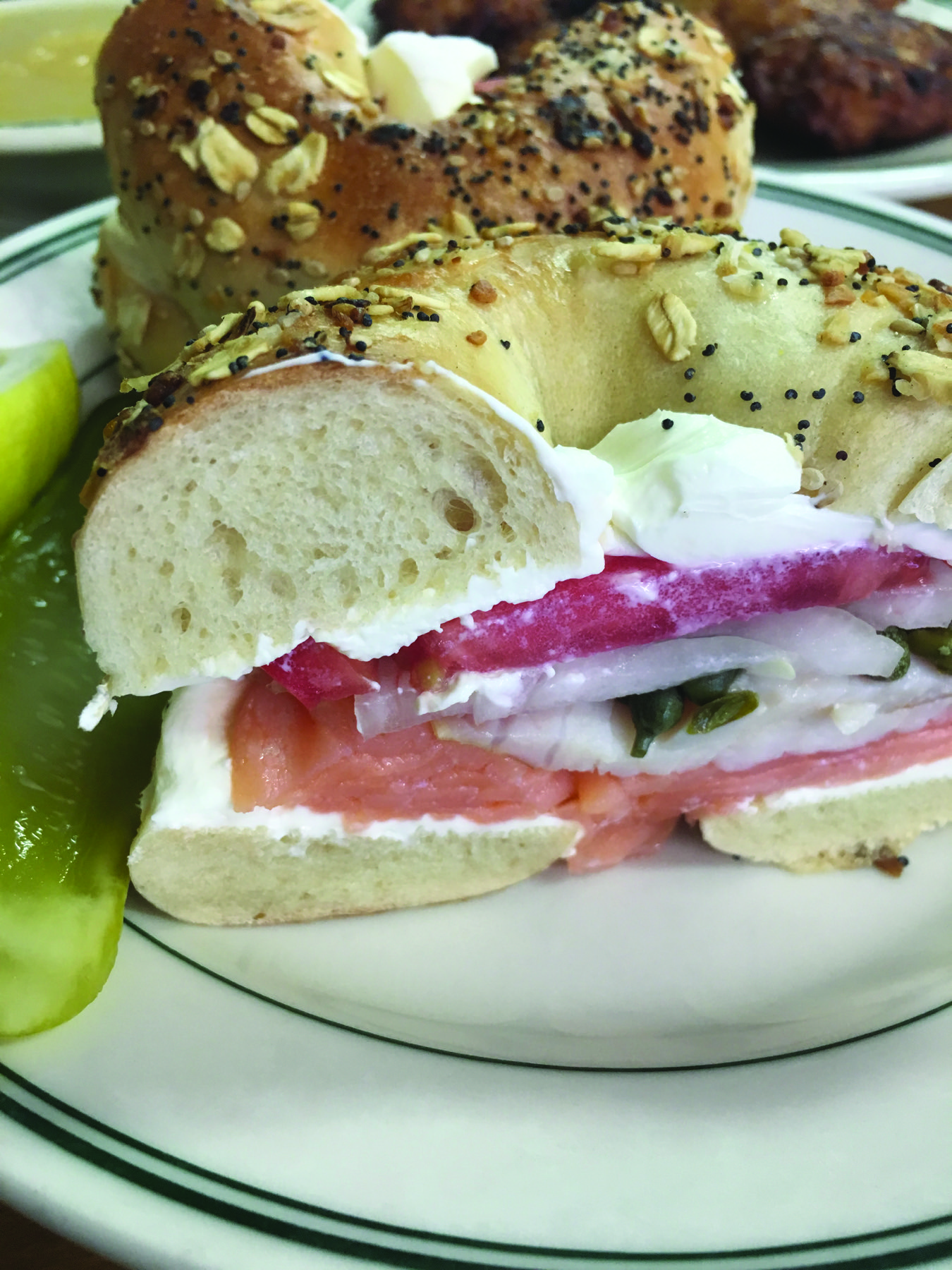
Recently, after having made the nearly 24-hour journey from my current home in Uganda to New York, I went to Barney’s bleary-eyed and jet-lagged. I sat at my usual table and ordered my favorite sandwich: smoked salmon, sturgeon, cream cheese, onion, tomato and capers on an untoasted everything bagel. Of course, I had coffee “regular” from the same chipped, green-striped mugs. The waiter said he remembered me, told me a joke and refilled my mug practically every time I took a sip.
I reflected on how everything had changed for me since I discovered this place, how the world had changed irrevocably for everyone, how the only thing we can count on is that the world will continue to change and so will we. And how, at times, the world feels like it could end at any moment — and then it goes on.
Yamit Behar Wood, an Israeli-American food and travel writer, is the executive chef at the U.S. Embassy in Kampala, Uganda, and founder of the New York Kitchen Catering Co.