fbpx

July 4, 2018

Ocasio-Cortez: Come With Me to Israel

Dear Alexandria,
Congratulations on your recent inspiring and well-earned victory in New York’s 14th Congressional District. Your win shows that a positive message, great organizing and engagement with the disconnected can transform politics and help put America back on track.

I write to you as a progressive and a Zionist. There is often much rancor toward Israel among progressives. Too many see the conflict in strictly black-and-white terms. The few public statements you have made about Israel and Palestine, most recently in the wake the recent violence and tragic deaths at the Gaza border, indicate to me a less than nuanced perspective. 

Did you know that many of the early founders of Zionism were 19th-century socialist Jews from Eastern and Central Europe who believed that human dignity was to be found in just and equal access to work, health care and education? Many of Israel’s early builders were committed to a vision of Zionism that was predicated on the shared destiny of Jews and Palestinians living together in the land.

And though Israel’s government is right wing, many people on both sides are fighting for justice for all. As a leader, I have been devoted to the notion of an independent Israel living in peace and coexistence with an independent Palestine. The two-state solution is the only hope for peace.

I have held this position when Israel and the United States were led by presidents in favor of or opposed this view. During times of extremist terror, racist reprisals and periods of hope and reconciliation, I’ve never wavered in my view that the Jewish and Palestinian people have just claims to their shared homeland. A full recognition of each other’s claim is the only path forward for peace.

There is often much rancor toward Israel among progressives. Too many see the conflict in strictly black-and-white terms. 

This conflict too often degenerates into competing claims, zero-sum solutions and hateful, violence-inducing rhetoric that results in the spilling of innocent blood. As a student of history, I’m often disturbed by the ways historical reality gets distorted by hatred. Jewish people have had a 3,000-year connection to the land. One can walk around Jerusalem’s ancient settlements that were inhabited by Jews from the era of King David to the prophet Isaiah; from Alexander the Great to King Herod and Jesus; through the pain of Roman exile and a thriving Diaspora; and finally to the modern era’s 19th-century Zionist movement, which revitalized the Hebrew language, established a state (through U.N. acclamation) and won independence in 1948.

But as a Jew, I am also commanded to encounter “the other,” Arab and Palestinian people who also claim the land as their own. As a Jew, I am obligated to listen, to understand and to remain committed to the idea that knowledge and inquiry and education remain essential if both peoples are to be truly free.

I’m in Israel each year, visiting friends and leading groups to help them understand their unique historical connection to the land and the importance of engaging Israelis and Palestinians who are working tirelessly to forge a lasting peace. We visit the Hand in Hand schools, Israel’s only bilingual public school system, dedicated to coexistence for its thousands of Israeli and Palestinian students; we visit projects at the Gaza border, helping connect Palestinians and Israelis seeking an alleviation of the terrible conditions within Gaza; and we help strengthen organizations dedicated to fair and equal treatment before the law with organizations like the Association for Civil Rights in Israel.

Through all these visits and more, we learn that the most promising path forward is engagement, dialogue, and productive relationships that are the foundation for peace between Jews, Muslims and Christians in Israel and Palestine.

I’d encourage you to consider a short trip to Israel and Palestine. I’ll take you and there introduce you to leaders across racial, ethnic, religious, class and generational spectrums who are working each day in a positive and constructive way to build the two-state solution and the chance for peace for Israelis and Palestinians.

In the meantime, congratulations on your impressive victory. And if you want to visit Israel and Palestine, give me a call. I promise a thrilling adventure that will be anything but black and white.


Rabbi Andy Bachman is executive director of the Jewish Community Project of Lower Manhattan.  

Ocasio-Cortez: Come With Me to Israel Read More »

Mister Rogers’ Lessons for a Broken World

“Won’t You Be My Neighbor?” the documentary about Fred Rogers, host of the long-running children’s TV show “Mister Rogers’ Neighborhood,” could not be more timely.

I grew up watching “Mister Rogers’ Neighborhood,” and as I watched this film about Rogers’ life and values, it became clear to me that he is exactly the kind of person we need to heal today’s broken world.

There are many lessons and teachings to learn from Rogers, but two overarching ideas drive them all. One comes from his motivation and the other from his core belief.

Rogers, an ordained Presbyterian minister, practiced and preached true tikkun olam. A year after the 9/11 attacks, he recorded a short message for parents of young children, reminding them that we are called upon “to be tikkun olam” — fixers of the world.

Tikkun olam guided everything Rogers did in his professional life. He was trying to heal the world. 

“I went into television because I hated it so,” Rogers explains in a clip shown in the documentary. “I thought there was some way of using this fabulous instrument to be of nurture to those who would watch and listen.”

Rogers said he thought a show like “Mister Rogers’ Neighborhood” was needed because most of the children’s programming in the late 1960s — when the show first aired on PBS — was full of slapstick and violence. It was all “pies in the face” and adults making fools of themselves. To Rogers, such programs were a degradation of people’s humanity. He disagreed with adults who thought that children would be entertained only by silliness and klutziness. He took children seriously. “Anyone making children’s programming should respect children the way I do,” he said.

That is why he always made a point of telling children that they were special and loved. That is why he talked about feelings and how to talk about feelings. That is why he tackled important issues like war, race, death, divorce, fear and friends. He treated children like real people. He listened without judgment. He talked but did not patronize. He loved unconditionally. He put his heart and soul into his work because he wanted to heal the world.

Good Judaism takes children seriously, too. Meaningful Judaism does not “dumb down” our traditions and rituals. There is a trend of infantilizing Judaism for preschoolers and then never allowing that Judaism to mature. This hurts us twice. It hurts the children because their Judaism becomes child’s play instead of something thoughtful and worthy of seriousness. It hurts Jewish adults because the only Judaism left for them is the infantile version that they find meaningless. 

Serious programming for children does not need to be boring, sad and dusty. “Mister Rogers’ Neighborhood” was none of those things. Serious Judaism does not need to be boring, sad and dusty, either.

I watched “Won’t You Be My Neighbor?” and my mind processed these ideas while I was sitting on a cushioned seat in the comfort of an air-conditioned multiplex theater. In that moment, I could not help but think of the brokenness of our world, where children are being separated from their parents on our border and being housed in converted Walmarts — with no cushioned seats and no air conditioning.

It occurred to me that this policy does not take children seriously. It does not value children the way Rogers valued children. It sees children as pawns, as trade bait, as collateral in a political and sociological power play. It does not tell children that they are loved and that they are special just the way they are right now. It tells me that the timing of this documentary is perfect because we need more reminders of the values Rogers taught us.

According to Rogers, “Those who make you feel less than who you are is the worst evil.” That should be our guiding light.

Our Judaism should be aspirational and invite children to feel loved and respected for who they are. It should not be watered down beyond recognition. Our politics should be aspirational, too. We should treat all children and adults in a way that makes them feel loved and respected for who they are — not degraded and manipulated for political points.

Perhaps a better approach to our immigration conundrum would be to echo Mister Rogers and softly sing: “Won’t you be my neighbor?”


Eli Fink is a rabbi, writer and managing supervisor at the Jewish Journal.

Mister Rogers’ Lessons for a Broken World Read More »

Serious Learning for the Spiritual Seeker

Beyond her Shabbat and holiday services and eclectic events, many people are drawn to Rabbi Lori Shapiro’s Open Temple because of the variety of classes on offer. Among them are:

David Dassa hosts Israeli dancing before Shabbat services every third Friday. The dancing resumes in October.

Rabbi Daniel Bouskila’s Talmud classes. The next series begins after the High Holy Days. 

Other rabbis and chaplains offering classes include Tamar Frankiel, Rabbi Avivah Winocur Erlick, Rabbi Janet Madden, Chaplain Muriel Dance and Rabbi Lori Shapiro, who teach Soul Journey/Introduction to Judaism.

This fall, the Open Temple House will host a “transdenominational approach to Introduction to Judaism.” Said Shapiro, “I felt inspired to create an intro class that is taught by women (most in Los Angeles are run by men).  I also wanted to spotlight the incredible offerings of AJRCA graduates.”

Debra Schmidt, a chaplain, lawyer and spiritual director, teaches “Breakfast Club,” a weekly spiritual direction group of contemplative Jewish learning, meditation, holy listening, text and spiritually directed journaling.

Barbara Olinger formerly ran the famed parenting center at the Santa Monica YWCA until it closed two years ago. She joined Open Temple and helped create a parenting center serving new mothers parenting kids through teen years. Classes include a dad’s group, a new mom group, welcoming your second child group, as well as classes on parenting, non-defensive communication and other trending parenting topics.

Cin Kats and Jen Regan, a candle maker and an astrologer, respectively, run the New Moon Women’s Group, a monthly group in which members weave rituals of fire and the constellations into the Jewish calendar year.

Open Temple’s Shabbat dinner series covers hot topics including crypto currencies, plant medicine, issues surrounding the “Minecraft” and “Fortnite” video games, and others with local professionals on each of these topics.

Rabbi Shapiro hosts ‘Mood,” a learner’s minyan that runs during the winter for the newcomer to davening. It’s “Mood” as in Limmud and is a Shabbat morning offering with meditation, prayer and Torah.

Family Shabbat Fast Pass is a series of 10 experiences throughout the year for families with young children, including collaborations with PJ Library, recording artist Jennifer Paskow, and includes Havdalah dance parties, Pajama Tot Shabbat, sound baths, yoga, mindful parenting and other experiences. Tripsitter will be providing a number of educational workshops on psychedelic drugs like kratom and toad venom.

Lex Lightning and Sharon Kopp host Sound Journey Sound Bath, a series of five “sound baths” throughout the year weaving prayer, scent, family experiences and other elements into a traditional sound bath.

Arts 36/Creative Torah Academy is the Hebrew School of the Arts, taught by arts professionals and rabbi/cantors. The bar and bat mitzvah program, aka b. mitzvah, is a personalized program that works with each family to create an impactful and meaningful bar or bat mitzvah.

Serious Learning for the Spiritual Seeker Read More »

Opening Hearts, Minds and a Temple

It’s Friday night and people are gathering outside the Electric Lodge, an intimate theater space near Abbot Kinney Boulevard in Venice before Open Temple’s monthly “Shabbat Take Me Higher” service.

The scene is decidedly “Venice,” with its on-site electric vehicle charging station, Bird scooters available for rent, and a woman wearing a hat that reads, “Mystical Mama.” A boy named Henry, whose bar mitzvah is the following morning, is wearing a fedora and a slim-fitting button-down shirt.  He looks as though he’s getting ready to perform at a club instead of reading from the Torah.

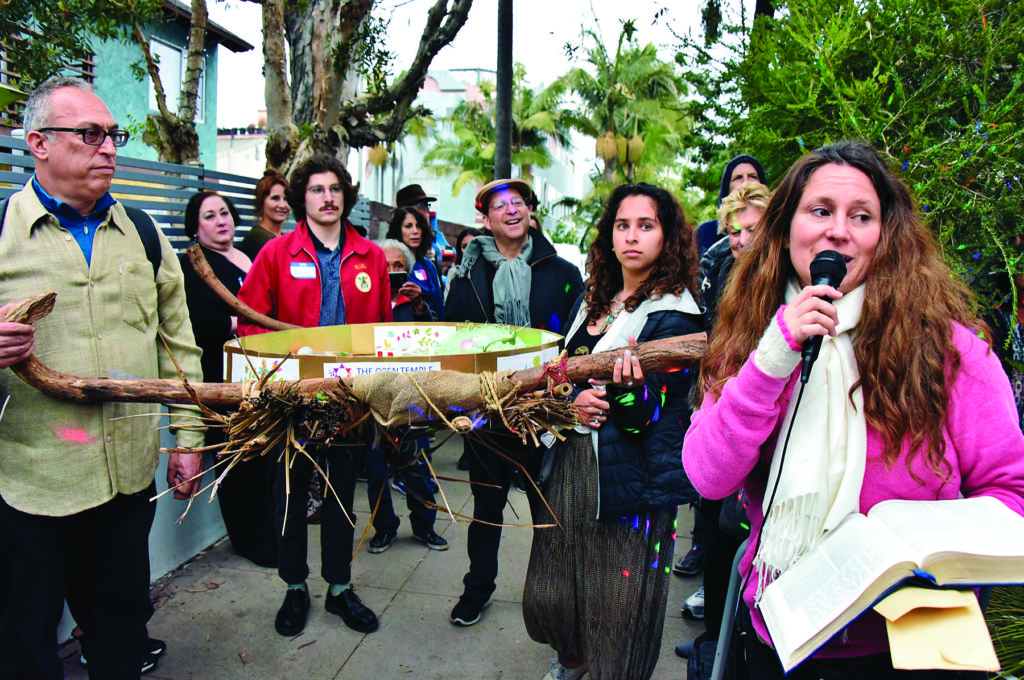
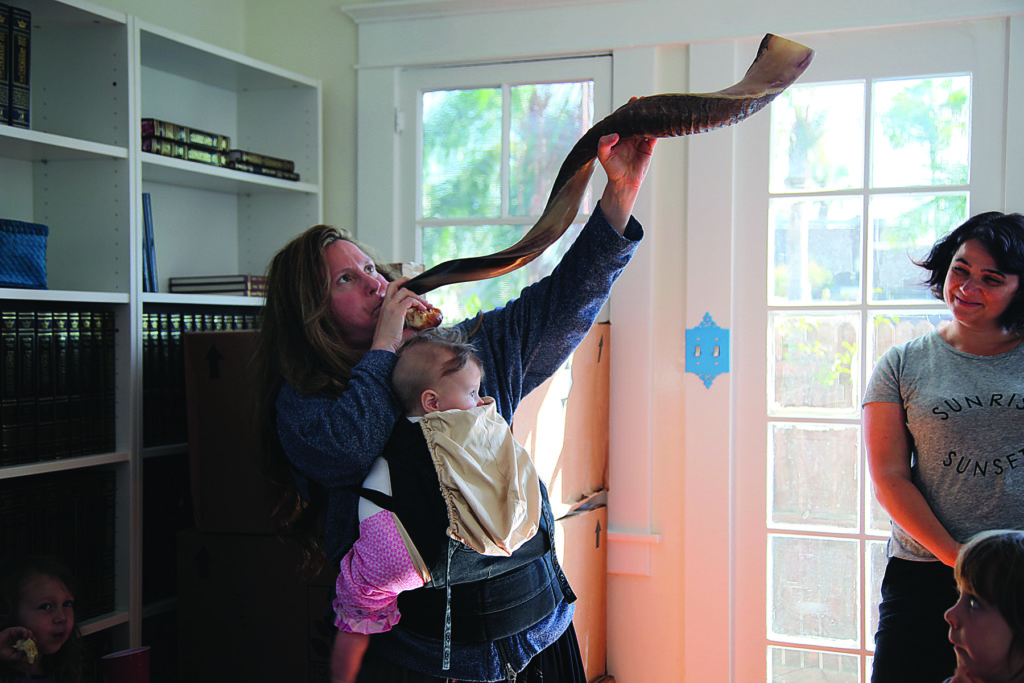
But this is par for the course for Open Temple. Founded by Rabbi Lori Shapiro in 2016, it seeks to engage the unaffiliated, intermarried and Jewishly curious. 

Shapiro, 46, was born and raised in New York and grew up with little to no Judaism. 

“I grew up outside of ritual,” she said. “Imagine growing up and not having Passover. You know when Rosh Hashanah is because you’re off from school, but there was no going to shul.”

After studying English at Barnard College in New York, Shapiro moved to Israel for three years. She said it was there, in the kabbalistic city of Tzfat in the northern region of the country, that she found her Jewish identity. That led to enrolling in rabbinical school at the Conservative American Jewish University (AJU) in Los Angeles. While there, she discovered Reconstructionist Judaism and began to question whether she wanted to commit to a single denomination. She left AJU and joined the staff at Kehillat Israel, a Reconstructionist synagogue in Pacific Palisades. For more than four years, she helped build the congregation’s youth department. 

“Open Temple is not a show. My husband says this is performance art Judaism, but it is participatory. We are transforming ourselves from an eclectic constellation of strangers into what the rabbis call a ‘kehillah kedoshah,’ a holy community.” — Rabbi Lori Shapiro 

“AJU ended as I was very young and my mind was growing,” Shapiro said. “I needed to keep growing before committing to a denominational agenda.”

Working up the courage to leave Los Angeles, she eventually enrolled at the Reconstructionist Rabbinical College (RRC) in Pennsylvania, where she connected with the teachings of the movement’s founder, Rabbi Mordecai Kaplan. During that time, she observed rabbinical students at the trans-denominational Academy for Jewish Religion, California (AJRCA) landing jobs at some of the most active synagogues in Los Angeles. Longing for the same, Shapiro returned to L.A. and enrolled in AJRCA, where she received ordination in 2010.

During her final year at AJRCA, Shapiro began working at USC as the director of Jewish life and the senior consultant for interfaith relations and outreach. It was during this period she met and married Joel Shapiro in 2011 and moved to Venice. Two years later, they had Harel, the first of their two daughters, and Shapiro said she was disappointed there was no Jewish community in Venice that felt right for her daughter.

That same year, the 2013 outdoor Abbot Kinney street fair happened to coincide with Sukkot. Shapiro set up a sukkah at the festival and asked passersby a series of questions, including what they thought of the prospect of a Jewish community in Venice for unaffiliated and intermarried Jews. She received 125 responses.

“What I didn’t know then is those 125 names were the seeds of Open Temple,” she said.

Shapiro’s ambition was to “create a space for people to explore their Judaism through the arts,” something she had also expressed on her rabbinical school application. She began laying the groundwork for Open Temple, holding events tied to holidays and forming a group for Venice moms.

“The duties of a rabbi are sacred and professional development is important. For me, this work is the holy work of leadership.” — Rabbi Lori Shapiro

Open Temple finally transitioned from an idea on paper to an operational community in 2016, after Shapiro acquired the Open Temple House, a two-level home neighboring the Electric Lodge, which serves as a hub for Open Temple programming.

Tonight, almost two years later, 60 people have turned out for the synagogue’s (or spiritual startup, as Shapiro likes to call it) Shabbat services, which are held on the third Friday of every month. Shapiro incorporates music, multimedia presentations, prayer and storytelling into the experience in a way only a Venice-based rabbi — in this once-bohemian enclave that’s now one of the coolest places to live in L.A. — can. 

Services begin with the Open Temple Band, led by “Divine Rhymer” Zach Puchtel, performing the song “Uprising” by hard rockers Muse. Throughout the evening, people rise from their pews, grooving to the beats and shaking tambourines.

There are no prayer books here. Instead, Shapiro directs attendees to images, text and lyrics projected onto the wall. But, she says, “This is not a show. My husband says this is performance art Judaism, but it is participatory. We are transforming ourselves from an eclectic constellation of strangers into what the rabbis call a ‘kehillah kedoshah,’ a holy community.” 

Shapiro bills Open Temple as “traditional yet contemporary,” a community helping its members (or co-creators, as she calls them) understand the world in which they are living today.

Multimedia in the service is appropriate, she said, because Judaism, after all, is a form of technology. If that sounds a little heady, Shapiro said it’s appropriate for a shul that draws in people who work in Silicon Beach.

Venice is also known for its liberal views, and many Open Temple members are advocates of marijuana use. Jeff Chen, founder and director of the UCLA Cannabis Research Initiative, has spoken at Open Temple Shabbat dinners.

“We take topical things and go deep and create community around it through Shabbat,” Shapiro said.

Congregant Brad Pomerance is among those who were drawn to Shapiro’s concept for Open Temple.  The senior vice president of news and programming at Jewish Life Television, he is also Open Temple’s incoming board president. He was introduced to Open Temple when he attended his daughter’s friend’s bat mitzvah.

“I was blown away by what I saw,” Pomerance said, recalling how the bat mitzvah girl and her audience were equally engaged in the experience, something he had never seen before.

“Lori is doing a great job in attracting people who would never be exposed to the depth of Judaism if not for this new modeling. She is also very engaging, very social and very friendly to people so that it also draws them in.” — AJRCA President Mel Gottlieb

Pomerance credits Shapiro for creating “a very unique welcoming and accessible environment for both the bat mitzvah girl’s family and the audience,” he said.

Moishe House CEO David Cygielman concurred. Cygielman has come to know Shapiro through her selection for the 2018 cohort of Open Dor Project, an initiative of Moishe House that seeks to empower clergy who are building emergent spiritual communities. Open Temple has a received a three-year, $225,000 grant from Open Dor. 

Shapiro acknowledged that Open Dor and similar leadership fellowships have played a significant role in her evolution as a spiritual leader. The duties of a rabbi are sacred, she said, and professional development is important. “For me,” she added, “this work is the holy work of leadership.” 

But Shapiro is not just a rabbi. She is also Open Temple’s artistic director and executive director.

Photo by @FishMakesPhotos

On a recent afternoon, Shapiro was counseling a young couple in the Open Temple House while an acting class was taking place in the neighboring Electric Lodge, which her husband rents out to various organizations.

The Open Temple House serves many purposes. Millennials hang out, schmooze and eat and drink there after services. The house also has a garage and courtyard for the community’s religious school called Arts 36, which serves children between the ages of 7 and 11. An additional space is outfitted with music production equipment. The Open Temple Band records its music there and Shapiro said she plans to use the space for podcasts.

“It’s right now at a point where we need strong leadership,” Shapiro said of her community. “At Open Temple, I feel my greatest asset has been the lay leadership that has come forward. However, they don’t fulfill the role of the nonprofit professional. Whereas our lay leaders are very involved, no one is saying, ‘I am going to be your executive director. I am going to build this with you.’ ”

Shapiro said she aspires to be like IKAR, a local independent congregation with humble beginnings that is one of the most influential Jewish communities in the country. However, she added that much of IKAR’s success can be attributed to Senior Rabbi Sharon Brous receiving support from her executive director, Melissa Balaban.

Mel Gottlieb, president of AJRCA, told the Journal Shapiro’s strength is that for all of her innovations, she does not sacrifice Jewish substance.

“She is doing a great job in attracting people who would never be exposed to the depth of Judaism if not for this new modeling,” said Gottlieb, who officiated at Shapiro’s wedding. “She is also very engaging, very social and very friendly to people so that it also draws them in. She is very accepting and has a great passion for tikkun olam.”

Shapiro’s reach also is reflected in her impressive social media efforts. The Open Temple mailing list has close to 3,000 subscribers and there are more than 1,000 followers on Open Temple’s Facebook and Instagram pages. 

Currently, Open Temple has 48 co-creators — individuals who have contributed more than $900 and families that have given more than $1,800. More than 2,800 people have supported the community with donations under $900.

Cygielman said he is confident Shapiro will continue to grow her unique community.

“She has really good momentum already. She has people come who feel fulfilled by the experiences she put on,” he said. “There is room for growth. We think [Open Temple] could be much larger than it is right now with the right kind of resources.”

Shapiro continues to embrace her role at Open Temple and fulfill the responsibilities that come with leading an emergent community.

“The people who were at services, most of them would never go to services,” she said.  “And they go [now] because they found something that speaks to them. I think we’re doing something very special.”

Opening Hearts, Minds and a Temple Read More »

Syrian Dilemmas

Simple facts and complicated dilemmas are typical characteristics of the Syrian civil war. 

Simple facts: Many thousands of Syrians are seeking refuge near the Israeli border as they flee the Syrian army’s advance. Syrian President Bashir Assad and his military are making a final push to retake the province of Daraa in southern Syria. Syrian forces are advancing toward the Jordanian and Israeli borders.

Complicated dilemmas: How to deal with the desperate refugees; how to keep Israel from interfering in the Syrian civil war when Assad’s forces post victories; how to keep the Syrian military away from the border and out of the buffer zone; how to do all these things without getting in trouble with Russia; how to rearrange Israeli-Syrian relations when Assad is back where he was more than half a decade ago. 

Earlier this week, Israel deployed a reinforcement of tanks and artillery near the Syria border. In diplomatic lingo, this is called “communicating.” The message, as the Israel Defense Forces (IDF) stated, was as follows: “The IDF sees great importance in maintaining the armistice agreement between Israel and Syria from 1974.” That is to say: The Syrians cannot violate Israeli territory, they cannot violate the terms of the 44-year armistice agreement — an agreement that kept the Golan Heights border quiet for so long. 

Earlier this week, Israel rushed wounded Syrians to hospitals in the north, some of whom were children. The children’s families had been killed in bombardments. This is a routine that we are all familiar with, and barely think about: Since the beginning of the Syrian war, Israel has treated many wounded civilians. Syrian civilians. Enemy civilians. Last week, Israel also sent a few hundred tents, more than 20 tons of food, including 15 tons of baby food, clothing, footwear and medicine to several locations in southern Syria. 

Denying entrance when refugees knock on the door is not easy.

Israel feels obligated to offer humanitarian assistance to the suffering civilians. The stories of these civilians are heartbreaking. The drawings that their children hand the soldiers —  Syrian children drawing Israel’s flag using crayons — are heartbreaking. But make no mistake, Israel is not ready to absorb any of the refugees. When Defense Minister Avigdor Lieberman was asked about this on July 3, his response was almost sarcastic: There are so many Sunni states around us, let them offer refuge to their Syrian brethren. 

In fact, this has been Israel’s tactic all along: Define Israel’s interests narrowly but leave no room for mistakes and misunderstandings. Rule No. 1: Israel takes no side in the Syrian war. Rule No. 2: Israel would not tolerate the presence of Iranian forces in Syria. Rule No. 3: Israel would not accept any change to the military status quo ante because of the war. Rule No. 4: Israel would not agree to any violation of its territory, either by the Syrian military or by refuges seeking a shelter. 

Each of these rules represents a tough choice: 

There were people — including Israelis — who believed that Israel must not remain unengaged when hundreds of thousands of people are being butchered on its doorstep — they wanted Israel to intervene. These people have a strong moral argument. Ignoring it was Israel’s choice, but it was not always the obvious choice.

Drawing a red line on Iran was a risky move. It forces Israel to back words with action. It puts it in danger — war could break out. Israel defined its security interest narrowly, but for Israel and Iran, the fight over Syria is no less about prestige and clout than about missiles and tactical maneuvers.

Keeping the status quo is a matter for the future. When Assad puts an end to the war, he will be a changed leader; his reputation will be completely altered, his calculations and obligations different. His plans for the future — well, he did not have much time for planning when he was fighting for survival, so who knows what he plans for Syria’s future? Insisting that he sticks to the status quo is a gamble. What if he doesn’t? What if he says that circumstances have changed and hence a change of the status quo is essential? 

Rule No. 4 is the most difficult, emotionally speaking. Israel cannot be a refuge for people from other countries. It is too small, it has too much to worry about — and it wants to keep its cultural coherence. Still, denying entrance when refugees knock on the door is not easy, one of many acts of maneuvering that a country must commit in a world of simple facts and complicated dilemmas.

Syrian Dilemmas Read More »

NYC Deli’s Slice of Life

The Fourth of July not only is this nation’s Independence Day, but mine as well. Years ago, on this date in Washington, D.C., I left my job in my family’s business, my marriage, my friends and, worst of all, my parents. I packed a few suitcases and a few pieces of art into my tiny car and drove to New York City. I had no job, very little money and no furniture, not even a bed. I remember climbing the drab stairway of my third-floor walk-up in the West Village after midnight, those long, fluorescent bulbs buzzing all the way up to the apartment I had rented from the friend of a friend’s sister. 

Entering the small unit, I noticed the black-and-white checkered floors glowing in the moonlight streaming through the curtainless windows. When my eyes adjusted, I spotted a dirty toilet brush sitting in the middle of what was to become my living room. That was it — no light bulbs in the light fixtures, nothing but that toilet brush and some dust bunnies rolling around on the floor like tumbleweeds in an old Western.

I unlatched one of the large windows, stepped out onto the fire escape into the the muggy New York night and proceeded to sit there until the sun came up — chain smoking and trying to figure out how I’d neglected to buy a mattress.

It was frightening. It was sobering. But most of all, it was sweet, glorious freedom — filling my entire being with hope. During the first months, perhaps to gather myself and give me courage, I frequented New York haunts that had been around for decades and had stories and photographs of their history etched into their grimy walls. And nothing spells comfort food to a Jew more than carbs in the form of bagels with fatty, salty, smoked fish. 

Every time I had a chance, I’d pick out a new spot, the older and more storied the better. These places were my salvation — with the shouting and bickering emanating from their kitchens; their horrible acoustics and dripping air conditioners; their awful bottomless coffee poured into thick, chipped, white-porcelain mugs practically engraved with old lipstick stains. I’d go during the busy hours, want ads in hand, and take in the scene around me: the grizzled waitresses; the upscale families with squirming kids shooting spitballs through straws at one another; and the lonely elderly folks with lifetimes of memories etched on their faces, pulling tea bags from their pockets and purses to steep the mugs of hot water and lemon they’d ordered.

Barney’s was considered the exemplar of Jewish food and the first to introduce the delicacy of sturgeon and smoked fish to the Jewish community.

These places provided me with both company and cautionary tales in those first months of my new life.

One day, I felt ready to venture out all the way to the Upper West Side, to the circa-1908 Barney Greengrass deli and its promise of serving “the best breakfast in New York.” I could get lost on my own street, so trying to figure out how to get to a place where I had to change trains twice was a daunting adventure.  

I had read that there were two kinds of deli patrons on the Upper West Side: those who loved the Zabar’s chain of stores and those who frequented Barney’s, the more expensive and exclusive store that confined itself to one location. Barney’s was considered the exemplar of Jewish food and the first to introduce the delicacy of sturgeon and smoked fish to the Jewish community.

The store has been open since 1908 when the original owner, Barney Greengrass, opened it in its first location in Harlem. In 1929, the store moved to its present Upper West Side location at Amsterdam Avenue and 87th Street, into the area where almost a million Eastern European Jews had immigrated. The owner was famous for having shipped an order of smoked fish to President Franklin Roosevelt, whose head speechwriter gave him the moniker “King of Sturgeon.”

As with most New York City institutions, Barney Greengrass’ décor was not a reason to visit, but its food most decidedly was. Even if cheap Formica tables and mismatched chairs with a backdrop of a drab, green-and-yellow mural depicting Victorian-era New Orleans were not your thing, the tender piles of firm sturgeon, fatty, delicate sable and perfectly sliced Nova salmon certainly would be. So would the house-made blintzes, the H & H bagels and the lox, caramelized onion, egg scramble and the ethereally fluffy chopped liver.

The best thing about Barney Greengrass and the few remaining purveyors of nostalgia left in Manhattan today is that they don’t change much. That’s what makes them comforting.

Recently, after having made the nearly 24-hour journey from my current home in Uganda to New York, I went to Barney’s bleary-eyed and jet-lagged. I sat at my usual table and ordered my favorite sandwich: smoked salmon, sturgeon, cream cheese, onion, tomato and capers on an untoasted everything bagel. Of course, I had coffee “regular” from the same chipped, green-striped mugs. The waiter said he remembered me, told me a joke and refilled my mug practically every time I took a sip. 

I reflected on how everything had changed for me since I discovered this place, how the world had changed irrevocably for everyone, how the only thing we can count on is that the world will continue to change and so will we. And how, at times, the world feels like it could end at any moment — and then it goes on.


Yamit Behar Wood, an Israeli-American food and travel writer, is the executive chef at the U.S. Embassy in Kampala, Uganda, and founder of the New York Kitchen Catering Co. 

NYC Deli’s Slice of Life Read More »

Law of Physics

Do you remember when we were young?
Already we thought ahead to the time
When we would be our middle-aged selves,
Writing these exact odes to the past
Like a strung-out actor
Wondering if it’s time to quit.
The astrophysicists say there is no such thing
As free will; everything we do
Was set in motion at the big bang.
O to break free of this talent show
Where we display our cruelty
Over and over. O to believe
That kindness can be learned,
Pharaoh’s heart melted,
Nineveh chastened.
In my four-year-old’s bedroom,
Small planets made of glass
Hang from the ceiling.
I wanted to teach him
About living in our solar system.
Where is the sun? he asks,
And I tell him, It’s up to each of us
To be the sun.


Alicia Jo Rabins is a writer, musician and Torah teacher based in Portland, Ore. Her second poetry book, “Fruit Geode,” will be published by Augury Books in October. 

Law of Physics Read More »

A Dangerous Disconnect: Making Millennials Proud of Israel

It seems as though we wake up every other morning to the news of a new “crisis” that is breaking down the relationship between Israel and the American-Jewish community. Coalition politics and religious observance continue to mix in unnatural ways, sparking the ire of American Jewish leaders and Israeli decision-makers who simply cannot find common ground, though they no doubt value the same things.

The underlying issue, and the reason why this relationship continually cycles back to discord and discontent, is that the two sides do not view their alliance through the same prism. In fact, they never have.

While Israelis see themselves as the custodians of the Jewish homeland and seek unquestioned support from their brothers and sisters in the United States, those in the American Jewish community simply cannot see beyond their decades-old role as benefactors of the Zionist dream. And who can blame them?

For seven decades, American Jewry has been investing in a state that they believed would showcase the very best of Jewish values. Thus far, however, it is a haphazard work-in-progress that irks and confuses them at every turn. While cultural differences no doubt contribute to the contention, the fact remains that Israel is far from the paragon of virtue that its American investors had hoped for, and they are growing weary. What’s more, our Jewish millennials cannot and do not want to connect to an entity that does not represent their values.

The fact remains that Israel is far from the paragon of virtue that its American investors had hoped for.

But we cannot allow Israel to be seen as a disappointment, nor a charity case. After all, it is the only country we can truly call our own, and we know in our hearts that we can do better, that so much more is possible. As such, the onus is on Israel to give American Jews, especially millennials in search of their identities, new reasons to want to connect with the land of our shared heritage, starting with profound pride in our ability to focus our renowned innovative abilities on societal advancement.

As I see it, the change we seek begins with a paradigm shift, from the intense fear upon which Israel was built and continues to run, to one of diversity and acceptance.

Although years have passed since the Holocaust and our bittersweet victory in the War of Independence, we are still plagued by thoughts of bloodshed and loss, and we continue to construct walls to keep out those who swore to kill us and drive us into the sea. In the process, we have constructed invisible barriers — within ourselves and throughout our national infrastructure — to keep our neighbors, our fellow citizens, at arm’s length.

We live as one people divided, never truly acknowledging our shared nationality because of a preoccupation with divisive labels — Ashkenazi and Sephardic, secular and religious, Jews and Arabs — and Israel’s growth has stalled. What’s more, Israel stands on the brink of financial and ideological bankruptcy because of this pervasive culture of exclusion that infects almost every aspect of Israeli life, as well as an educational system that is inaccessible to the country’s minorities.

So, we must start there, with educational opportunities for all that will solidify our economic health and change the face of our shared society.

We have no need for another ivory tower, nor can we accept more empty promises about multicultural programming from our government officials. Rather, we must establish educational frameworks that empower populations that are otherwise underrepresented in Israeli higher education, including men and women from ultra-Orthodox, Ethiopian and Arab backgrounds and individuals with disabilities, to develop a voice all their own, make a seamless transition into the workforce, and become productive citizens of the new Israel.

Our universities must teach applied studies that are economically relevant to all who wish to learn. We must insist on excellence and creativity, and employ the best and most diverse faculty and staff that Israel has to offer. And above all, we must harness the power of education to promote diversity and inclusion and produce leadership that mends social gaps.

What I have outlined above describes the educational programming at Ono Academic College, the “social startup” that I launched more than 22 years ago, which now boasts more than 14,500 students from across Israel’s religious, cultural and ethnic spectrum, and satellite campuses in major cities and development towns around the country. But although we have seen seeds of success on our own campuses, having helped thousands of students from all sectors of Israeli society achieve personal fulfillment and professional success, I understand that we are still a startup, that this is just the beginning of something much bigger.

The real success will come when institutions like Ono are no longer the exception but the rule, when multiculturalism becomes part and parcel of Israeli life, and when we as a nation actively strive to identify and eliminate the barriers that prevent the full participation of minorities at school, at work and in our communities.

When equity guides our decisions about social reform and Israel becomes a place where conflicting visions and ideologies are welcome, we not only will become the bastion of Jewish values that American Jewry had always dreamed of, but we will capture the attention — and the imagination — of the entire world. By reshaping higher education in Israel into a training ground for inclusion and multicultural understanding, we will create new points of connection for Jewish millennials around the world, and we even will find new reasons to believe in ourselves.


Ranan Hartman is founder and CEO of Ono Academic College, a model of multicultural graduate and undergraduate programming and education-based social reform, as well as the fastest-growing institute of higher education in Israel.

A Dangerous Disconnect: Making Millennials Proud of Israel Read More »

Who Killed Raphael’s Son?

Editor’s note: This is the first of a five-part excerpt from the novel “The Luminous Heart of Jonah S.” by Gina Nahai published by Akashic Books. 


Raphael’s Son died alone in his car, sitting upright behind the wheel with his safety belt on and his throat slashed from right to left — a clean, some would say artful, cut of almost surgical precision. His body was discovered at 4:45 a.m. on Monday, June 24, 2013, by Neda Raiis, his wife of seventeen years who, according to her statement to the police, had found him cold and unresponsive in his gray, two-door Aston Martin with the personalized license plate — I WYNN—as it sat idling against the wrought-iron gates of their house on Mapleton Drive in Holmby Hills. Nearly one hour before that, Neda had been awakened by the sound of what she imagined was a car accident—metal crashing against metal — on the street. She had spent the next fifty minutes drifting into and out of sleep. Then, finally, she had decided to investigate the source of the earlier disturbance, risen from bed, and walked the length of the yard to the front of the estate. The sound she had heard was that of the Aston Martin crashing head-on into the gate.

The driver’s window was lowered all the way. Through it, Neda could see a trail of blood that had spilled out of the wound in Raphael’s Son’s neck down along his chest and stomach, onto his short, portly thighs, and gathered in a pool on the Italian leather of the car seat. Raphael’s Son’s eyes were open and his mouth was slack, and he looked as gray and hollow as an inflatable toy animal with the air let out—like he had finally lost those extra thirty pounds he had carried so imperfectly for so long around the middle and that made everything he wore—those $2,800 Zegna suits from Saks Fifth Avenue and $700 jeans from Barney’s and, on Sundays at the Sports Club in West LA, those black Nike shirts that he had to buy in extralarge, so they fit around the waist but hung too low over his knees — appear as if it belonged to an older, much taller brother.

To find out if her husband was alive, Neda had reached through the window and shaken him gently by the left shoulder. When he didn’t move, she left him in the car and went back into the house to call the police.

* * *

This, at any rate, was the story that circulated within the Iranian Jewish community of the United States in the first two or three hours following the alleged discovery of the body. By nine o’clock Monday morning, word had spread to Canada and Israel. By noon, the closed circuit, Persian-language satellite radio stations broadcasting from LA to Iran and elsewhere in the Middle East were receiving calls from Tehran asking to confirm the rumor.

Raphael’s Son was not the first Iranian Jew to be murdered in America, but he was by far the most high profile, hated, and, according to his enemies, deserving of a painful and untimely death. So the story, which would have been sensational in any case, circulated with even greater speed and urgency, the details becoming more bloody and brutal with each telling until the single wound at the throat had morphed into multiple stabbings, then a beheading, then a complete dismemberment. Accounts varied as to the immediate motive for the killing and whether he had been robbed of his wallet, the five-karat diamond pinkie ring he wore instead of a wedding band, and the $30,000 gold Rolex Daytona he had bought a few years earlier at the Aramaic brothers’ jewelry store on Pico and Sepulveda. The watch, Raphael’s Son had announced to the Aramaic brothers, would serve as a memento of his incontrovertible triumph in the fifty-two-year, scorched earth, take-no-prisoners, only-one-of-us-is-walking-out-of-here-alive, legal and psychological battle he had waged against his wife’s family, the Soleymans of Tehran who, he was proud to claim, had suffered endlessly at his hand.

Meanwhile, a continual string of celebrity murder trials and incessant reruns of CSI on cable having turned the entire population of LA’s West Side into prosecuting attorneys and forensic crime–solvers at once, every bit of information that seeped into the ether was analyzed and employed to draw conclusions about the killer’s identity, motive, and modus operandi.

It wouldn’t take a detective, of course, to figure out that Raphael’s Son could have been murdered by any number of bitter enemies he had toiled so restlessly during his entire adult life to create—from former “enemies of the revolution” in Iran that he had handed over to the ayatollahs only so he could secure their release in exchange for a “service fee,” to every business partner he had defrauded then sued for fraud, to the thousands of Iranian Jews and a few American ones he had most recently swindled out of half a billion dollars. And those were just his adversaries; his allies were even more likely to want him dead.

For years, Raphael’s Son had run what proved, during the great financial meltdown of 2008, to have been an especially smart variation on a Ponzi scheme that targeted mostly Iranian Jews. Because of him, entire families had slipped into poverty or suffered irreversible financial setbacks. When pressed about how he had managed to “lose” all the investors’ money, he blamed the worldwide economic meltdown and reminded people that, with Greece and Iceland also bankrupt, he was, indeed, in good company. When asked if he felt he should be held accountable for any of the pain that had been caused, he sighed and said he wished he were held accountable — just as accountable as Hank Paulson, Ben Bernanke, Timothy Geithner, and all those Wall Street CEOs who either got reappointed to their cabinet posts or received huge bonuses for presiding over a global financial fiasco.

Like those CEOs, Raphael’s Son had emerged from the collapse of the Ponzi game richer and more self-righteous than ever. Five years after he was officially broke, he still lived in a $52 million house — 2.6 acres in one of the city’s most vaunted neighborhoods, just across Sunset Boulevard from the Playboy Mansion with its peacocks and swans and naked twins running loose, a stone’s throw from Aaron and Candy Spelling’s fifty-six-thousand-square-foot, $150 million pad with the leaky roof (recently sold to a twenty-two-year-old Russian “heiress” for half that amount), down the street from the forty-fivethousand-square-foot, $125 million “Little Versailles” of that nice Jewish couple who spent five years building the house and divorced the minute it was completed.

Raphael’s Son’s house had eight bedrooms, a six-thousand-square-foot guesthouse, an outdoor basketball court, indoor bowling alley, outdoor tennis court, indoor lap pool, outdoor pool and cabana, three kitchens (one, the size of the Taj Mahal, where no cooking was done; a smaller, restaurant-caliber, for household use; and a third, catering-style kitchen for large parties), three regular bars, a dry bar, two dining rooms, a thousand-square-foot breakfast “nook,” plus the obligatory library, dome-roofed greenhouse, and thirty-two-seat projection room.

Substantial as that may seem to any reasonable person, Raphael’s Son had the gall to deem the house a “disappointment.” It was big, yes, by most people’s standards, but in Los Angeles, it was not what one would call jaw-dropping—not when Little Versailles boasted a three-and-a-half-mile jogging track, the Spelling house came with a stable of thoroughbred horses, and the Playboy Mansion had Hugh Hefner and a few sets of twin bunnies.

It wouldn’t take a detective, of course, to figure out that Raphael’s Son could have been murdered by any number of bitter enemies he had toiled so restlessly during his entire adult life to create.

Raphael’s Son had said this to the Aramaic brothers the day he went to buy the Rolex. Hoping to remind him that he was too rich to ask for a discount, they had inquired, ever so discreetly, if he enjoyed living in Holmby Hills.

“Oh yeah!” Raphael’s Son had responded ironically. “We have no cell phone reception because AT&T is a rip-off, and the lights go out every time there’s wind or rain because the power lines are old and decrepit, and our neighbors are all useless derelicts.”

The people at the Playboy Mansion threw parties seven nights a week. They blasted the music loud enough to create an earthquake, let their guests park their cars in the middle of the street, and didn’t bother to answer the phone or open the door whenever Raphael’s Son went over to complain. And you’re naive if you think the police were any help; they actually looked forward to being called to Hefner’s door. They got to stand around in the foyer and watch the naked bunnies, throw back a couple of apple martinis, and leave with a nice tip from one of the mansion’s many good-looking gay gatekeepers.

The old woman next door, heir to some cigarette fortune, had built a lake in the middle of her lawn, and she insisted on filling it right up to its sandy banks, never mind the rest of the city was facing a water shortage. Her daughter, married twenty years and a mother of three, lived with her and made a point of sleeping with every plumber, handyman, and eighteen-year-old delivery boy who showed up with a pizza. Across the street an Indian pharmaceutical mogul kept building the same ugly mustard-yellow house with 1,700 little windows, tearing it down just as it was nearly complete, and starting over; and a Russian mobster who, after attending one too many Landmark Forum seminars, confessed to his wife that he had cheated on her exactly 1,112 times. A few weeks later, his body was found, sliced in half, on a beach in Cancún.

Raphael’s Son had sued the cigarette lady for using too much water,  Hugh Hefner for creating a noise disturbance, and AT&T for providing generally awful service, and he planned to sue the Department of Water and Power as well, for its crumbling infrastructure and high rates.

“I feel like I’m living in a third-world country,” he told the Aramaic brothers. “One person hordes all the water, the cops are on the take, and I have to buy my own generator or sit in the dark at night.”

None of this helped explain why Raphael’s Son had been able to maintain ownership of the house and God only knows what else, while some of his former “investors,” having lost their life savings, were reduced to living in their cars or neighbors’ garages. What seemed evident was that, in the ten years leading up to the bankruptcy, he had slowly ferreted half a billion dollars into the savings accounts of a ragtag army of his maternal cousins, their spouses, and their children.

Forever impecunious until they fell into Raphael’s Son’s orbit, the gang known as the Riffraff Brigade had lived in near poverty in various provinces in Iran, then in cinder-block homes in Israel’s “occupied territories,” and finally in three-hundred-square-foot apartments in North Hills and Agoura in Los Angeles. Then all at once, starting in 2003, they began to buy ten-thousand-square-foot houses in Brentwood and Beverly Hills. Their wives’ minuscule diamonds suddenly grew to ten carats, their children enrolled in expensive Jewish day schools, and if you asked them where all this came from, they said with a straight face that it was “old money” from Iran because, didn’t you know, their fathers were all millionaires? That they owned land and horses and enough jewels and antiques to fill a museum?

The creditors believed the Riffraff were helping Raphael’s Son hide the stolen money — that they would hold on to it for a few years, then quietly return it piecemeal, minus their own commission, in creative configurations. It was easy, transparent, and, much to everyone’s amazement, extremely effective. The “investors” who had lost everything could hardly afford a lawsuit against Raphael’s Son or his cousins; the ones who had been robbed of a few million but had more to spare had all been promised, in secret, that they would get their money back if they didn’t go to the authorities or sue. The district attorney, who believed that all “Eye-ray-nians” were rich and entitled, had no interest in pursuing a criminal case in which some of them had  stolen from the rest. The bankruptcy trustee was having a blast billing for time—four years, so far—he spent “looking into” the case, and the news media had their hands full covering celebrities who got drunk and crashed their cars, or killed their wives or themselves.

Raphael’s Son’s only punishment for the damage he had wrought was to become a pariah everywhere on the West Side, but that wasn’t as big a deal as it might seem because he had never been held in very high regard anyway. He was called “The Bandit of Holmby Hills” and “The Thief Who Came for Dinner” in a blog post or two, which he doubted that anyone of consequence actually read. His wife and daughters hated him, but that was neither new nor relevant. His Riffraff cousins prayed daily for his demise so they could keep all the money they held in trust for him, but they were too terrified of him to withhold so much as a dollar when the time came.

In the end, it was safe to say the only person who might have harbored any affection for Raphael’s Son was his mother, but she was dead and buried in Israel—and besides, she had been no Queen of Congeniality herself. He did not relish being universally despised, but he did enjoy having all that money — tax-free — in his offshore accounts.

More than that, he reveled in the harm he had inflicted upon everyone else, the fact that he had gotten away with it so easily, and the certainty that, once the dust had settled and his creditors had tired of crying over their lost money, memories would fade and his commercial credibility would be restored merely by virtue of his hundreds of millions. He was already making backroom deals and buying up foreclosed properties using the Riffraff as a front, paying all cash and hiding the assets in unregistered corporations and having a grand time of it all—let the creditors eat stale bread, there’s money to be made in a recession — when he encountered, in 2011, a glitch in his plan.

Two of Raphael’s Son’s “investors” managed to convince the DA that he could make a strong case for wire fraud and money laundering.

The amount involved was small—$30 million — but the investors were American, which meant they had asked Raphael’s Son for more than a handshake to verify and track their deposits. Thus nudged out of complacency, the DA pressed charges, and almost simultaneously offered a plea: if convicted, Raphael’s Son could get up to twenty years in a federal prison, and have to return the money; if he agreed to settle, he would do six years and return the money.

Raphael’s Son’s attorneys urged him to accept the deal; he fired them summarily for being cowardly and incompetent, then hired a cheaper set. He told them that if the heads of Goldman Sachs and Bank of America were sleeping in their own beds, his case should be a cakewalk. He told his second team of attorneys that he would never be convicted by a court because he was an observant Jew who served on many boards. Then he fired them too and hired a third team.

A trial date was set for Monday, July 8, 2013. As the pressure intensified and the lawyers swore to him that he was no Lloyd Blankfein and that even he — Blankfein — wouldn’t escape conviction and imprisonment if the government wanted it, Raphael’s Son began to contemplate parting with some of other people’s hard-earned money.

He instructed his lawyers to go back to the DA with a plea deal that involved his returning the money but not serving time. He said he would have to “borrow” the money from his cousins, the Riffraff. A meeting was set at the DA’s office for Monday, June 24, at ten a.m. He died approximately five hours before that.

His enemies barely had time to process this information when, at 12:15 p.m. the day of the murder, they were struck by a second, much more disturbing, news bulletin.

In response to Neda’s call to 911, the ambulance had arrived quickly.

It was greeted at the top of Mapleton by a hysterical Latina in a floor-length silk robe with lace trimmings, a pair of gold slippers with three-inch heels, and half a dozen rings in each ear. In between hacking sobs and mutterings of “Oh Mister, poor Mister,” she introduced herself as Esperanza Guadalupe di Chiara Valencia, “the children’s governess,” and led the paramedics to the scene.

Neda Raiis, 5’1”, small-boned, and meek as a canned sardine, was shivering quietly in a bloody bathrobe as she stood next to the car.

A pair of teenage girls — Neda and Raphael’s Son’s daughters — stood barefoot and barely dressed next to the pedestrian gate. The Aston Martin was in park, the engine still running.

The paramedics saw a great deal of blood on the driver’s seat and on the floor mat beneath the steering wheel. They saw Raphael’s Son’s jacket draped carefully on the passenger seat. They did not see a Rolex or a pinkie ring but that was hardly an issue because what they also did not see — dead or alive, injured or whole — was Raphael’s Son. 

He had been there, Neda explained to them plainly from between chattering teeth. He had been in the car and his throat was cut, it was definitely him and he was definitely dead when she left him and went into the house to call the cops. When she came back, he was gone.

To be continued.

Who Killed Raphael’s Son? Read More »

Writing Our Own Rituals for a Modern World

The nature of brachot (blessings) in the Jewish tradition is to elevate the mundane, to make everyday life moments holy by pausing to appreciate them and identify them as special within the myriad moments of a given day. But sometimes a life moment demands more than an uttered blessing: It calls for a ritual.

While the word ritual may, for many, connote something that’s been done repeatedly over decades or centuries (starting the cycle of Torah reading over again every year), or several times over the course of a year (blessing the new moon), in its strictest definition, a ritual is “a religious or solemn ceremony consisting of a series of actions performed according to a prescribed order.” A blessing can be part of a ritual, but technically, a ritual needs more than a blessing to be a ritual.

We have many secular rituals. We wake up, check our phones, visit the bathroom to do what we do there before making coffee; for some, it’s coffee first and then everything else. If we’ve got kids, we wake and dress them, make lunches and take them to school; then we report to work, take a lunch break, go home, make dinner, watch TV, go to sleep. These are a series of actions, but don’t fit the strictest interpretation of being a “religious or solemn ceremony,” all due respect to our morning coffee.  

There are lots of Jewish rituals: throwing bread into a body of water to symbolize the casting off of sins; twirling a chicken overhead while promising to donate it to charity; covering mirrors in a house of mourning; dipping completely beneath the water of the mikveh, the (here it comes, it’s even in the name of the thing) ritual bath, three times until a witness proclaims your immersion “kosher.” These are “official” rituals, validated by rabbis, implemented through decades of communal practice. “Fiddler on the Roof” teaches us that there is a blessing for everything, even the czar, but there isn’t a ritual for everything. Or at least, there isn’t a rabbinically crafted, communally ratified ritual for everything.

“Fiddler on the Roof” teaches us that there is a blessing for everything but there isn’t a ritual for everything.

As participants at the recent (RE)VISION conference hosted by the Jewish Emergent Network earlier this month discovered, meaningful ritual can be crafted by committee or by individuals, not just by rabbinic communal leaders. In two workshops called Ritual 360, Naomi Less, associate director and founding ritual leader of New York’s Lab/Shul, and actress and rabbi Jessica Kate Meyer charged participants to create new Jewish rituals to commemorate occasions that aren’t already Judaically ritualized.

Two groups focused on rituals around moving into or out of a house: While the ritual included mezuzahs, they were not central, making way for things like collecting one last item from each room, inspired by the search for chametz the night before Passover, and reciting quotes from Jewish liturgy and/or popular culture that center on the theme of “home.” One group created a Jewish memorial service for a beloved pet, which included sharing favorite memories, and some Hebrew readings about God’s role in creating all creatures, big and small. And the final group did a dramatic improvisation of two parents marking their teenager’s receipt of his driver’s license, including the traveler’s prayer, to remind the teen of God’s role in making sure we reach our destinations. In the future, this ritual definitely should be called a “car mitzvah.”

As a non-rabbi with lots of ritual experience from a lifetime of living Jewishly, the ideas about how to mark transitional moments meaningfully came to me fluidly. I drew on my day school education, my knowledge of the liturgy, Camp Ramah, my literary experience of symbolism, my love of finding just the right words, and my knowledge of popular culture to help craft a ritual that was meaningful, personalizable and accessible. But in the back of my mind lurked a rogue snippet of educational code that cried out in panic: that ritual is for rabbis and religious leaders to create, and for the community to repeat.

This workshop presented the idea that ritual is at its best when it’s crafted with personal meaning. It can include a rabbi, but it doesn’t require one. We are required only to listen to ourselves, to think deeply about the moment we are trying to mark with ceremony, to identify the way in which this moment will transform us, and find the symbolic objects that will play a role in elevating that occasion as holy.

Writing Our Own Rituals for a Modern World Read More »