At Culinary Kids Academy, classes are anything but typical. Sure, the young students hone their cooking chops, picking up some basic skills. But depending on the class and the school, they might also learn about the gold rush, pollination or the characteristics of the Maccabees.
According to founder Danny Corsun, 51, food is “simply a vehicle” for learning.
“Seeing, touching and feeling, tactically, kinesthetically, is a way that students and people in general learn better,” he said. “The level of engagement you get with experiential learning far exceeds if you say, ‘Open to Page 32 and read a paragraph.’ ”
Last year, Culinary Kids Academy taught 400 individual classes — both during the school day and in after-school enrichment — throughout Los Angeles County. These include classes at Valley Beth Shalom, Pressman Academy of Temple Beth Am, Temple Israel of Hollywood, Sinai Akiba Academy, Lanai Road Elementary School in Encino and Lincoln Elementary School in Redondo Beach.
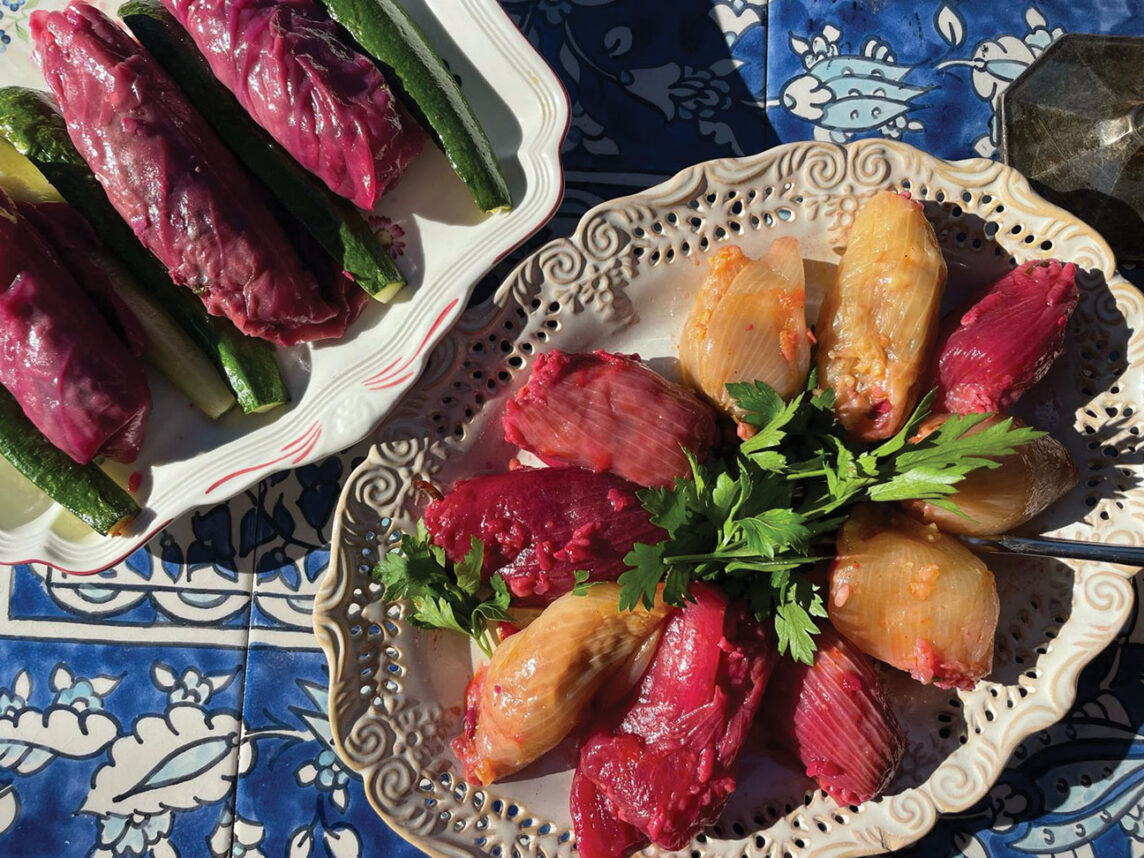
For a lesson on the gold rush, students might make 49er stew or gold rush biscuits. For one on Spanish exploration, they may whip up a fresh fruit trifle or carrot cake. Both contain vanilla, which Corsun uses to tell the story of Spaniard Hernan Cortes, who conquered the Aztecs and took their vanilla beans back to Spain.
The kids learn while they are cooking, with Corsun sharing history, asking questions, and trying to get students to consider the modern-day implications of historic events. But no matter the topic, every lesson ends the same way: eating.
“It provides closure to the lesson that cements the learning process,” he said. “If they don’t eat, then it’s open-ended and they don’t have the same experience.”
Like so many others, Corsun, a New York native, moved to Los Angeles for the entertainment industry. He had no small amount of success, working in production and as a writer. But in 2000, he realized he needed a steady job and took a substitute teaching gig at Franklin Elementary School in Santa Monica.
Within days, the school principal asked him if he would consider temporarily teaching a mixed-grade special education class until a permanent replacement could be found. Corsun ended up teaching the class for five years, pursuing his certification concurrently. Perhaps the highlight — for Corsun and the students — was the weekly cooking lessons he introduced.
In 2005, when the Encino resident decided it was time for another career change, these classes were what inspired him to start Culinary Kids Academy. He began to teach cooking classes that incorporated the Common Core curriculum at local public and private schools.
Although Corsun has taken a few cooking classes over the years, he said he is “90 percent self-taught,” adding that cooking is “an innate gene that runs in my family.” He considers his grandmother and mother excellent cooks and spent many hours with them in the kitchen growing up. Their recipes are part of his repertoire.
In 2009, the married father of two approached Rabbi Ed Feinstein at his congregation, Valley Beth Shalom, about bringing the program there but replacing the math, science and history he usually integrates into his lessons with Judaic studies. Soon he started teaching in the preschool there, then the religious school. Since adding a Judaic studies component, Culinary Kids Academy has provided instruction at more than a dozen Jewish institutions, including the Westside Jewish Community Center, the Pico Union Project, Adat Ari El and de Toledo High School.
Some recipes are obvious selections, depending on the season, such as making hamantashen for Purim; others are less so.
“We can get as abstract as doing a parsha about the golden calf and doing golden honey cornbread,” Corsun said.
But the lessons derived from each dish can be surprisingly deep. When discussing Passover and the Exodus — perhaps while making charoset — Corsun likes to share the story of Nachshon, the Israelite who, according to midrash, was the first during the Exodus to enter the Red Sea, which parted only after he acted. Corsun provides what he calls “thinking questions” to the students: How does this impact how I go about my life? How do I help the world?
“[The late] Rabbi [Harold] Schulweis from Valley Beth Shalom had a great impact on me and a lot of the lessons we do,” Corsun said. “He taught that instead of praying for miracles, we need to make the miracles ourselves. Instead of Nachshon saying, ‘I am going to wait for the water to split,’ he took it on himself to walk forward.”
Corsun teaches the bulk of Culinary Kids Academy’s one- to two-hour classes, though he does work with a handful of freelance educators and recently hired his first full-time employee.
Corsun also has been teaching at Camp Ramah in California in Ojai each summer for the past four years. The camp already had a traditional and outdoor cooking program taught by camp staff, but executive director Rabbi Joe Menashe said the decision to supplement this with Culinary Kids Academy “reflects our understanding that food is central to Jewish identity and an effective means of teaching Jewish values. … Danny brings another voice to this really effective way of connecting to kids.”
Three years ago, one of the counselors at Ramah, an ambassador for Hillel from Syracuse University, which just happens to be Corsun’s alma mater, asked him if he would bring Culinary Kids Academy there — except geared for college kids. He’s been teaching it for three years now.
“The only thing that changes is the level of critical thinking,” he said.
This year promises to be an even bigger year for the company. That’s because Culinary Kids Academy received a $30,000 grant from The Jewish Federation of Greater Los Angeles for the current school year that will partially subsidize the program for organizations that may not be able to otherwise afford it.
“His work in terms of engaging children in a process that really helps them to get a deeper understanding of who they are as Jews and their Jewish connection and to do it really creatively is very much aligned with what we do and the kinds of work we want to make more accessible in the community,” said Shira Rosenblatt, senior vice president of Jewish education and engagement at Federation. “You see [the students] completely get absorbed and excited. … It’s almost like the kids don’t even know what they are walking out with. It’s the best kind of learning, where kids don’t feel like it’s school.”
Corsun said the idea is to reach kids who may fall between the cracks.
“They want me to increase not only the number of students but the amount of exposures those students receive,” Corsun said.
His philosophy is that Judaism needs to become personal for young people to embrace it. And food is personal.
But it’s not the final taste test that Corsun is worried about passing. The best part of his classes is something quite different.
“My favorite part of class is when I say, ‘What did you learn?’ and the floodgates open up,” he said. “I had a student from Pressman [Academy], who said, ‘What you’re saying, Chef Danny, is the Torah is not as much a history book as a rule book on how to live your life.’ I’m like, bingo. Talk about a kvelling moment for me.”