The friendship between two men in London’s Jewish East End forms the heart of “The Bespoke Overcoat,” now playing at the Pacific Resident Theater in Venice. The 1953 play was written by Wolf Mankowitz, a prolific British novelist and playwright of Russian-Jewish descent. It was also made into a film that won a 1957 Academy Award in the “Best Short Subject” category. Mankowitz’s most successful works included the novels ”A Kid for Two Farthings” and ”Make Me an Offer,” which also replicated the culture of the post-war, working-class East End where he was born in 1924.
Mankowitz borrowed the theme of the play from Nikolai Gogol’s short story “The Overcoat,” here focusing on the friendship between the tailor Morry and his friend Fender, who has worked as a shipping clerk in a clothing manufacturing company for more than 40 years. Fender’s boss is cold-hearted, abusive and miserly, more caricature than character. Appropriately, his name is Ranting.
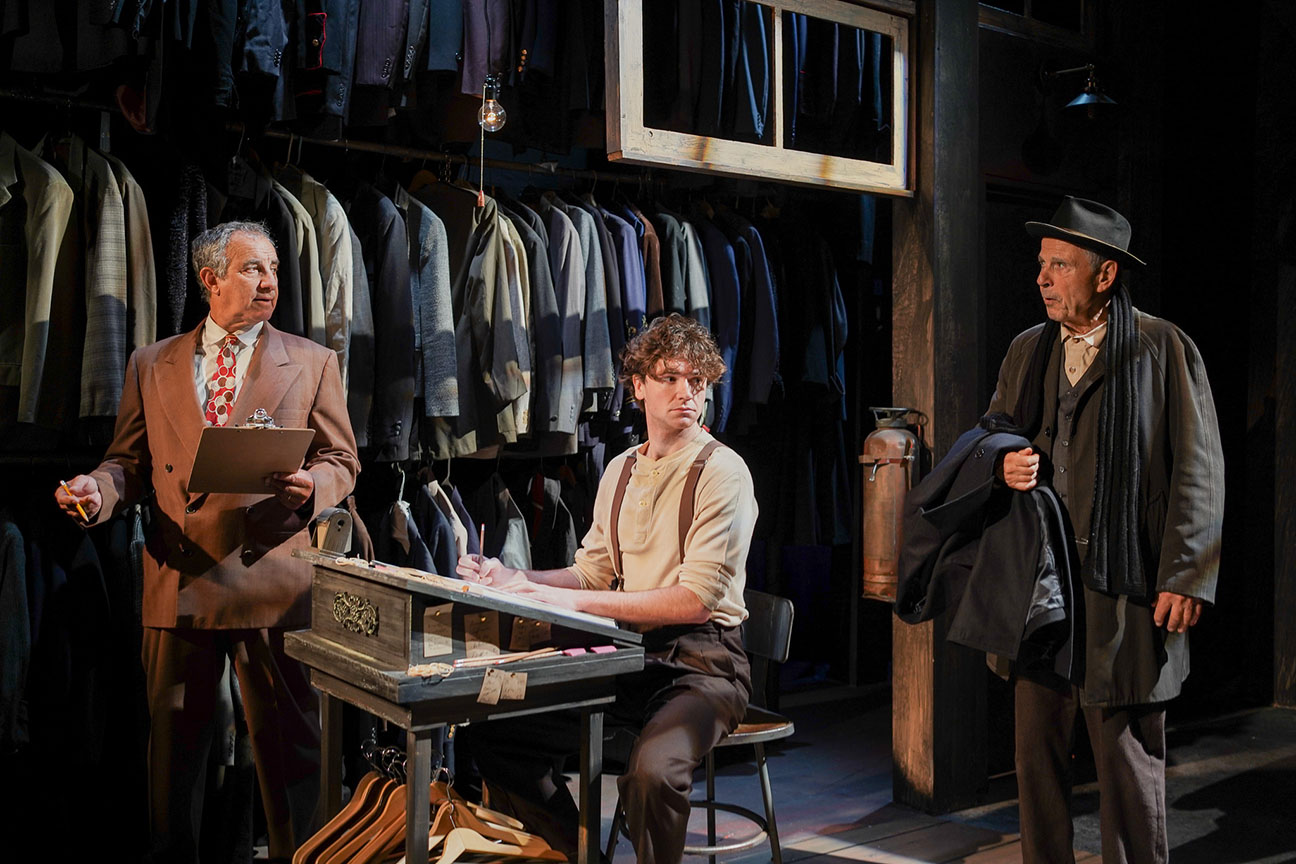
When the play begins, Fender enters Morry’s shop in an overcoat literally falling apart at the seams. He asks Morry, who had originally made him the coat 20 years earlier, how much it would cost to repair it. Morry regretfully tells his friend the coat is impossible to mend, but offers to make him a new, bespoke overcoat for the bargain price of ten pounds — a seeming fortune for shipping clerk.
The drama centers on Fender’s need for a coat for physical warmth, as well as his need for friendship and dignity.
Without giving away spoilers, the drama centers on Fender’s need for a coat for physical warmth, as well as his need for friendship and dignity. Morry can offer friendship, but Fender’s employer’s abuse and poverty wages deny him dignity. When Fender is suddenly fired, he asks Ranting for a new coat from the overflowing inventory, as a token of appreciation for his decades of service. Ranting, a character out of Dickens, simply laughs at him.
While the outlines of the story are sad, the play is often humorous and even inspiring. “It’s the story of a man who loves his friend and shares his burdens and his joys,” said co-director Marilyn Fox. “It shows us the power of kindness and conscience in a poetic, comic, and touching form.”
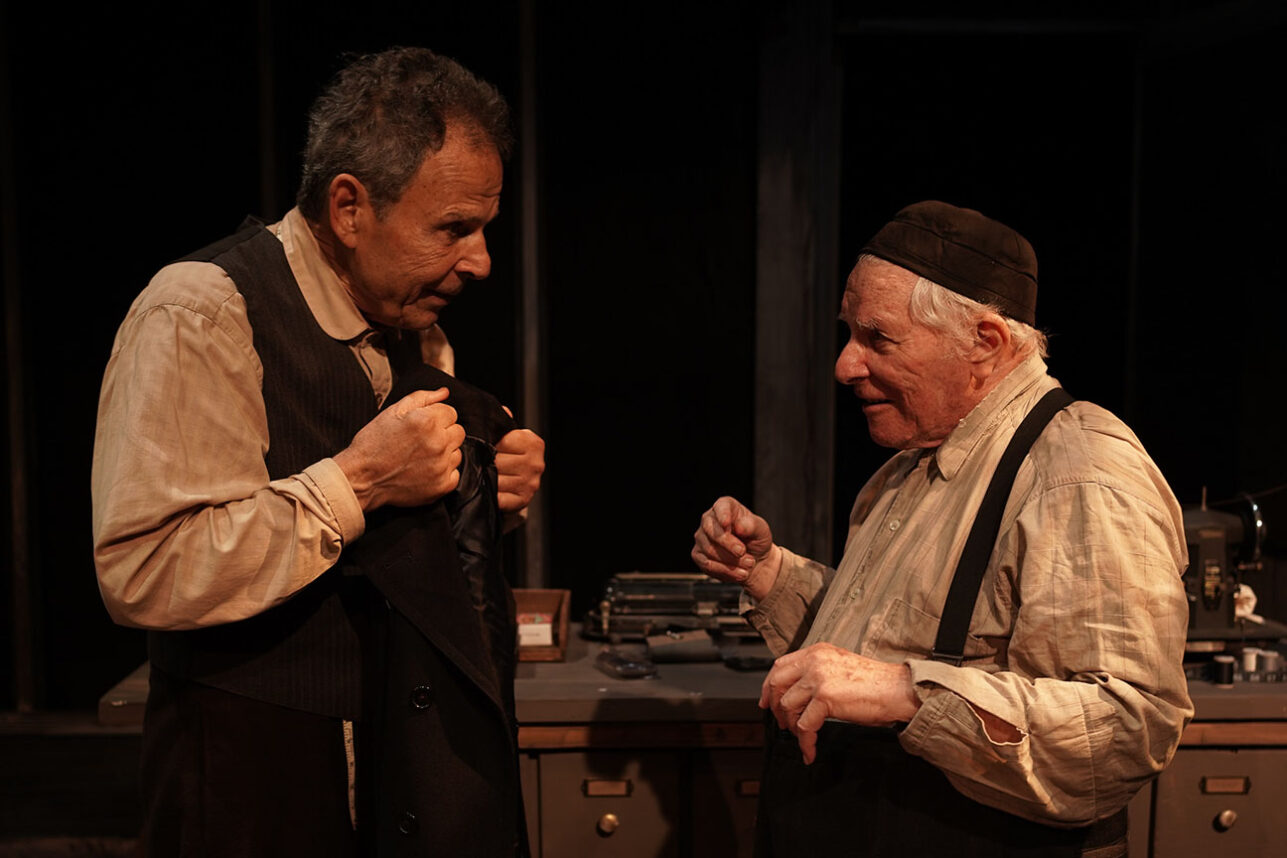
Robert Lesser as Morry and Harry Herman as Fender are both outstanding, with a natural chemistry that suffuses their performances and makes their friendship come alive. Bruce Nozick is nearly over-the-top in heartlessness as Ranting, but Mankowitz hammers home the theme of individuals oppressed by a capitalist system he viewed as corrupt and petty. Tobias Echeverria plays the young clerk hired to replace Fender. While captive to the same verbal abuse as his predecessor, the young clerk already has a plan to build himself into the kind of man who will one day stand up for himself in a way that poor Fender could not.
The set design in this intimate theater by Rich Rose makes you feel you are almost right inside Morry’s tailor shop. His attention to detail includes having the Hebrew word for tailor (“shreiber”) painted outside the shop. The racks of coats in the warehouse where Fender works reinforce the theme of warmth and plenty that are denied to this hardworking, lonely old man.
Co-directors Marilyn Fox and Dana Jackson have been pleasantly surprised that on most nights, the audience stays to enjoy the klezmer music that plays after the lights come up, hanging about to chat with one another. Their hope is that “people will hold onto the message of compassion and forgiveness that is at the center of the friendship between Morry and Fender, and how something as simple as a coat can be the difference between life and death,” Jackson said. “We also hope that discovering Wolf Mankowitz’s writing and his unique blend of comedy and pathos will be a new and fulfilling adventure for our audiences.”
Running time for “The Bespoke Overcoat” is 80 minutes, and tickets are available through PacificResidentTheater.org. Located at 703 Venice Blvd in Venice, the theater is collecting clean, gently worn or new coats during the run, in cooperation with the non-profit One Warm Coat. Donations will be distributed locally and will be thanked by a complimentary cup of coffee and treat during the show. The play is expected to run through May.
Judy Gruen is the author of “Bylines and Blessings,” “The Skeptic and the Rabbi,” and several other books. She is also a book editor and writing coach.