fbpx

April 25, 2024

Steve Garvey Holds Press Conference Calling for Action Against Pro-Palestinian Campus Protests

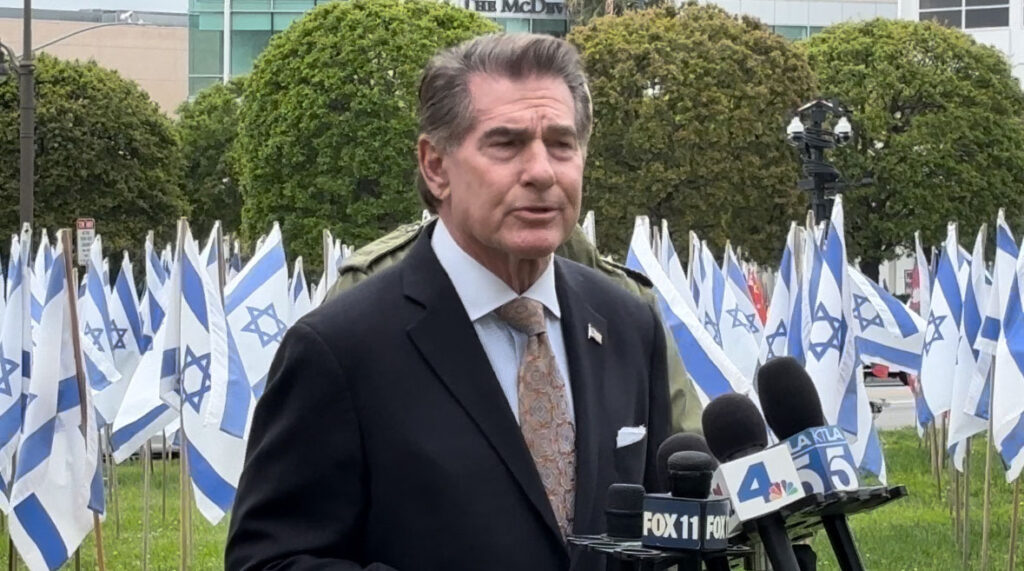
California Republican Senate Candidate Steve Garvey held a press conference at the Beverly Gardens Park on April 25 calling for action to be taken against the pro-Palestinian encampments on college campuses.

The former Los Angeles Dodgers All-Star referred to the protests as “terrorism … disguised as free speech … How do you do this? You go to the soft underbellies of our society,” he said. “Now it’s the campuses, great institutions who all of a sudden are lacking leadership, who all of a sudden saying that one group under the disguise of free speech can attack another. It’s time for us to stand up.”

He added that while he supports free speech, “demonstrations that allow people to build encampments that obstruct the pathway to classes and the opportunity to learn is terrorism.” He emphasized that  “these institutions have to be able to be supported… by our good men and women in local enforcement, in state and federal enforcement … It has to be enforced so that the will of the people is observed.”

Garvey stressed the importance of local leaders standing with law enforcement. “(T)hey’re the ones … who are standing on the front lines. They’re being abused, rocks are thrown at them, bottles are thrown at them. And what are they doing? They’re standing up to protect this country.”

Garvey outlined a series of actions that he believes need to be taken against the protests, urging “the leaders of Washington to bring forward the leaders of these institutions and ask them why they have forsaken their mission statement of providing an education for the future and protecting those students. How can you forget about a whole class of students you’re supposed to represent?”

He also called for “taking away federal aid” from “administrators and leaders” that “aren’t listening” as well as taking “away tenure from professors who are enjoining these encampments, enjoining these terrorists.” Additionally, Garvey advocated for District Attorney George Gascon “to apply the full letter of the law to these terrorists.”

“I stand for Israel yesterday, today and tomorrow,” Garvey later added. “As allies, there [is] no greater ally than Israel. We stand with them in technology, innovation and materials. We can’t back away. For those that support a pro-Hamas demonstration, an attack on Israel, I say: Not on my leadership.”

We can’t back away. For those that support a pro-Hamas demonstration, an attack on Israel, I say: Not on my leadership.”

He also challenged the media to “find out who are supporting these pro-terrorist groups. I’ll stand with you. I’ll support your free speech.”

Asked if he would support terrorism charges being brought against the students who are part of the encampments, Garvey replied: “They’re obstructing the natural flow of life on campus, and what they’re saying is they’re pro-Hamas. They’re pro-terrorist.” Upon further questioning, Garvey said “if it’s determined by the DAs, absolutely” regarding bringing terror charges against the students in the encampments.

“Let’s make a statement. Let’s be leaders,” Garvey declared. “This is Los Angeles. This is California. Everyone looks to California for leadership; where is it?”

Garvey was also asked about the decision by USC to not have any commencement speakers following controversy over this year’s valedictorian. “That’s leadership,” he replied. “They’re determining what they need to do. And I think the most important thing is to put the safety and security of the students, of the community, in front.”

The Journal spoke with Garvey following the press conference, and asked him if he would support the use of the National Guard being deployed against the encampments. “I think leaders will determine that. I think law enforcement will determine that,” replied Garvey. “Because their role is to protect the citizens of this country … I support law enforcement and their decisions.”

The Journal also pointed out that some of the pro-Palestinian protesters in these encampments were arrested and subsequently released; Garvey said that it “absolutely” is a problem. “That’s why I ask DA Gascon to step up, to prosecute these people to the full extent of the law,” he said. “Let’s not let them go out the back door and then be on a college campus 10 hours later. That’s what leadership is: Leadership is being the DA of Los Angeles and having your people feel safe and secure. State legislature, federal government … from California, you wield a lot of power, and it needs to be used at this time. So that’s why I’m imploring everybody that’s out there to step up now and not pander to ideology or party.”

Does Garvey plan to go to the campuses of UCLA, USC or elsewhere to stand with Jewish students? “Absolutely,” he replied. “I’ve been to other synagogues throughout California and listen to them speak. I have so many friends who are Jewish and have done a number of bar mitzvahs and bat mitzvahs … we’re talking about the roots and foundation of religion in Los Angeles and this country because it’s God’s chosen people. Like I said, I will support them yesterday, today and tomorrow.”

His message to Jewish students on campus right now: “Continue to have their faith, as I know they will. There are so many people who are supporting them, have them in the prayers, to be in safe … and again, just know that there are people who care about them.”

Also speaking at the press conference was Israeli Special Forces Veteran and Counterterrorism Analyst Aaron Cohen and Rabbi Chaim Mentz of Chabad of Bel Air. Cohen warned that the “incitement and rhetoric” at the encampments could lead to violence and “mass casualty-style incidents across university campuses.” Mentz said that “in Judaism we have a teaching: You let one little crime go, it grows and grows and grows.” “We have a thing in America — you want to go march in the streets? It’s not my religion, but maybe it’s the way of the new America,” Mentz said. “You can go in the streets and smash windows and get away with it. Today people are running through the streets screaming at Jewish people here at Hancock Park, over there in Pico, what’s going on is ridiculous.”

As a “Jew of history, he said, “I know where this turns.” But Mentz told the Jewish community to not worry and “hold strong. This too shall pass. We will be here tomorrow.”

Steve Garvey Holds Press Conference Calling for Action Against Pro-Palestinian Campus Protests Read More »

West Hollywood’s MASH Gallery Exhibition to Feature Female Jewish Art

In the shadow of the La Cienega incline to Sunset Boulevard is a contemporary art gallery that has become one of the hottest spots for art showings in Los Angeles — The MASH Gallery.  On April 25, the MASH Gallery is holding a group exhibition of female Jewish artists as a fundraiser to for female survivors of trauma and sexual violence in Israel.

Although Haleh Mashian opened the MASH Gallery in 2018, its roots date back to the pre-Islamic Revolution days in Iran. Born in Tehran, Iran, her first taste of the arts was playing the organ in her family’s home. But one day at age 11, Mashian’s father, an architect, came home from work and brought painting into her life.

“My earliest art memory is when my father came home one day and said, ‘I’m going to take you to a painting class,’” Mashian told the Journal. “It was out of the blue. I had never painted anything in my life. I was more musical. He took me to this Persian Jewish art teacher. I still remember the first painting that I did. It was a painting of a couple of trees intersecting. There was one pink and one was green. And then I did a portrait, a little portrait of this guy. It was small, and I was showing it to everybody.”

That class set Mashian on a journey that would become intertwined with her family’s experiences during the 1979 Islamic Revolution.

That year, her father, then 47 years old, was abducted by the Islamic government, never to be seen again. As life in Iran only got worse, Mashian and her younger brother fled Iran in 1986. They left behind their mother, who held out hope she may see her husband once again.

“We escaped with fake names … Every stop, the Islamic Jihadists would come with their guns in our faces,” Mashian said. They fled across the border to Turkey and across Europe before finally reaching the United States in 1987. They settled in Irvine, where art took a back seat as Mashian pursued her education in finance and real estate at USC.

As the years went on, she built a family. She married Bryan Mashian, a lawyer, in 1991. They had son in 1996 and a daughter in 1999. During this time, Mashian’s enthusiasm for art never waned. The pivotal moment came in the last decade when she was at a meditation retreat.

“I saw this image of myself sitting in my studio painting all day alone,” Mashian said. “It felt very alone and lonely and not in a good way. Being alone is not bad, but it had this very lonely quality to it. I knew that I don’t want to do that, I want to open a gallery, I want to show my work. I want to show everybody else’s work. I want to be with like-minded people, have an exchange of energy, commingle my life with what is out there. This world is all about people. It’s not about sitting in your cocoon.”

So in 2018, Mashian opened the first location of the MASH Gallery in the Downtown Los Angeles Arts District. After the pandemic put the kibosh on museum and gallery-going, the MASH Gallery adapted into doing outdoor events. In 2022, the gallery moved in a new location on La Cienega in the West Hollywood design district. The MASH Gallery has become a popular space for art showings, with over 400 shows to date.

“Every exhibition brings a whole new array of people,” Mashian said. “Some locals will come back, some new people, but everybody has a smile on their face no matter what exhibition. To me, this is my contribution to my community — to be able to bring people to share, to express, to welcome.”

Multiple times in the interview, Mashian reiterated how much she enjoys providing a platform for other artists who have triumphed over hardship over their years.

“I take this opportunity at the gallery very seriously because being born in Iran, being a woman, being a Jewish person, you really didn’t have much, you didn’t have the freedom of expression,” Mashian said. “As a woman, as a Jewish person, as an artist, I feel that pursuing my creativity has been such a healing aspect of my life. I really take that as a big blessing because not only it gave me a voice to share joy and creativity with the world, I also gave a platform to other people of all kinds, women, different ethnicity, whatever people, everybody. And to celebrate art and not to think as art, as just a commodity, but as a form of expression that can bring the community together. I really feel very proud about it.”

“As a woman, as a Jewish person, as an artist, I feel that pursuing my creativity has been such a healing aspect of my life.” – Haleh Mashian

Mashian believes in the power of creativity as a healing force and a way to navigate the unpredictable challenges life throws at us.

“To me, art is a big factor in achieving a state of wonder and expansiveness, and to live fearlessly,” she said. All these years later, music still has a big part in Mashian’s life — she still composes music to this day.

“Every art series that I have has music composed for it,” Mashian said. “Creativity is not limited to one act. If you’re creative, which everybody’s creative in some way or form, it’s just a matter of bringing that quality to it.”

Music has rubbed off on her children, now in their 20s. Her son plays guitar and her daughter has dabbled in painting. And just recently, Mashian’s mother finally relocated to the United States to join her children and grandchildren in California.

“It’s very sad, my mom actually stayed behind [in Iran] because when they kidnapped my dad, they didn’t do it legally,” Mashian said. “It’s not like they came and said, ‘oh, you did such and such thing, we’re going to take you to jail.’ They just kidnapped him. And the ransom was a bunch of money. We don’t know what happened though. Then a couple of months later, my mom got the hint that they may have put him in jail. But they never officially said that he’s in jail. So she never saw him again. We never found out what really happened. But we know he went to jail. But they must have killed him there because now he would be like 90. So my mom stayed behind for a long time. She just moved to the United States a few months ago. She’s 80.”

Still, there’s a sadness that pervades Mashian’s family that permeates much of the art she creates.

Tears of Joy, with Haleh Mashian

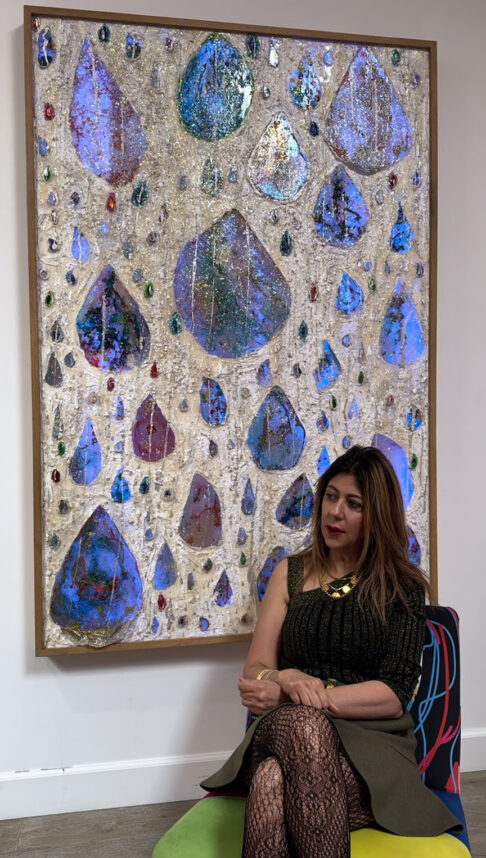
Our interview took place in front of a four foot by six foot painting made of resin, glitter and gel, titled “Tears of Joy,” There are alternating red, royal blue, and green lights behind the tear drops. The tears series is important for her, as it comes from a crying meditation she did, where participants were encouraged to cry for an hour. The whole idea is that your tears are your most precious belonging, because they make you feel better. In this painting, the tears are depicted to look like jewelry. Mashian said it’s to “symbolize that through crying meditation and the emptiness that follows is really a form of healing and ecstasy.”

While describing “Tears of Joy” with the lights alternating behind it, Mashian spoke more about her mother.

“She’s a very strong woman, what she had to go through,” Mashian said. “My dad was not a political figure. He was an architect minding his own business. But some people don’t understand that, I guess. I’m so triggered when I see these idiots come on the screen and they’re for Hamas. Do you have any idea who supports this? People, do you have any idea that the Islamic Revolutionary Guard, the Islamic regime, is behind this? If they come here to the United States, you have no rights whatsoever. I’m getting very triggered throughout this.”

In the wake of the Oct. 7 attacks, Mashian put together the gallery’s latest exhibition in conjunction with the Iranian Jewish Women’s Organization. On April 25, the gallery will open a charity art exhibition of female Jewish artists, “Women of Valor: In The Land of Milk and Honey.” Proceeds from the ticket sales to the event will benefit women victims of trauma and sexual violence in Israel.

The Journal asked Mashian a few more questions about her art and creative philosophy. The conversation has been edited for length and clarity.

JEWISH JOURNAL: You connected with someone recently who knew your father in high school. What did he say about your father?

HALEH MASHIAN: He said ‘your dad was the most positive person. He was so intelligent. And he would say he always had a smile on his face,’ which I see that same smile on my son’s face. It was very interesting. But just how highly he spoke of it was just such a sweet connection that somebody knew my dad like that. So many people that knew my dad, when they see me, I hear nothing but good words about him. And to me that’s an honor. And in a way, when I honor that 90-year-old artist, in a way it was honoring my relationship with my father and honoring him because that he was a connection. It was just full circle.

JJ: You talk about ‘going into the unknown’ a lot with your art. Can you elaborate on that?

HM: You’ll never lose by going into the unknown because you always grow. And that’s the whole purpose. If you’re here to grow, if you don’t grow, because a lot of people think that if they can stay the same, nobody stays the same. You either go forward or you go backward. So in order to go forward, you always have to go into the unknown.

JJ: How has your art evolved over the last 37 years in California?

HM: When I look at my original paintings, I think they were tighter and they weren’t as expressionistic. And most of the time, I had a model or something to work from. But I have moved more towards imagination and more conceptual. I feel more freedom. And I use a lot more materials in my work. I became more of an expressionist painter by using mixed media. I didn’t used to use so much mixed media, but to me, the materiality and the texture and the three dimensionality of an artwork has become a lot more part of my art. I use some [electronic] lighting not only in [“Tears of Joy” and some of the other artwork] so I’m experimenting. I love to experiment with materials and convey a certain message or a certain thematic work, but it’s moving more towards a sculptural feeling as opposed to just flat.

JJ: Tell me more about how music ties into your paintings.

HM:  Oftentimes, I’m very inspired by the resemblance between color theory and music theory, because they do cross. When you see all these harmonic chord progressions, it’s kind of like color theory. They make sense. There is a law that governs all of them. And then if you know it, then you can break it and you create interesting music because you know the color, the music theory, and you can create dissonance. You can put all these amazing chords together and create new sounds, same with colors.”

JJ: You seem like the kind of parent who threw amazing art and painting parties for your kids’ birthdays.

HM: Yes, for my kids, of course. We used to, all four of us, my husband and both of my kids on Saturdays, we’d go to Brentwood Art Center. We all take classes together. It was like a family outing. It was a big part of our life. I would tell them that this is the best gift you can give to yourself. Only you and your happiness, do not rely on anybody else. It’s a private time with you. We can learn how to enjoy ourselves. We can be more of a blessing to other people when we are with them. Because if you learn how to be with yourself, then the rest is icing on the cake.

The “Women of Valor” charity art show is on Thursday, April 25th at 5:00 p.m. at the MASH Gallery. For more information about upcoming exhibitions at the MASH Gallery, visit the website: https://www.mashgallery.com/

West Hollywood’s MASH Gallery Exhibition to Feature Female Jewish Art Read More »

Echad Mi Yodea? Who Knows One?

Who knows thirteen?
I know thirteen

Thirteen could have been the tribes if they let
Jacob’s daughter Dinah have one.
How would this night have been different
if women ran the show?

Who knows twelve?
I know twelve.

Twelve is the age of boys and girls
a year before they come to Torah.
Still unsure if they’re wise or wicked or simple.
Too bold to know what they don’t know.
Do any of us ever know? I’m still waiting
to find out.

Who knows eleven?
I know eleven.

Eleven are the stars that Joseph saw.
Only saw. You can’t touch a star and
they see everything you do.

Who knows ten?
I know ten.

Ten are the commandments.
The famous ones, anyway.
There are six hundred and three more.
Most of them we don’t bother with
any more.

Who knows nine?
I know nine.

Nine is the number of months
it takes for your life to change forever.
For most people, that’s a good thing.

Who knows eight?
I know eight.

I know eight. Eight shows up all the time.
Nights of Passover. Nights of Chanukah.
Days of Sukkot (depending on where you live.)
Days between when your life changes forever
and when you hand the source of your change
over to the mohel and hope for the best.

Who knows seven?
I know seven.

Seven are the lamps in Israel’s Menorah.
When we see it, it’s like putting a sweater on our hearts.
When others see it, they imagine it at the bottom of the sea
forever invisible to human eyes.

Who knows six?
I know six.

Six is the number of days it took to make the world.
So what do we do on the seventh day of the week?
Nothing. Absolutely nothing.

Who knows five?
I know five.

Five are the books in the Torah.
(Back when books were scrolls.
They hadn’t invented the concept
of the page-turner yet.)
I keep reading them so you don’t have to.
That’s not true.
You have to.

Who knows four?
I know four.

Four are my grandparents.
Each of whom had four grandparents.
All the way back to the first four mothers.
I never met any of them. But this chain
is why I write these words.

Who knows three?
I know three.

Three are their husbands.
The numbers don’t work out with
our modern sensibility.
But they all spoke with the One.
Everyone wants their autographs.

Who knows two?
I know two.

Two are the tablets.
Two are the homes of those of us who live
outside the promised land.
Two are the eyes we use in our
forever search for the One.

Who knows one?
I know one.

One is the one who sent us to the place
I don’t know if They considered what would happen
once we got there.


Rick Lupert, a poet, songleader and graphic designer, is the author of 27 books including “God Wrestler: A Poem for Every Torah Portion.” Find him online at www.JewishPoetry.net

Echad Mi Yodea? Who Knows One? Read More »

The First Alphabet and the Third Plague

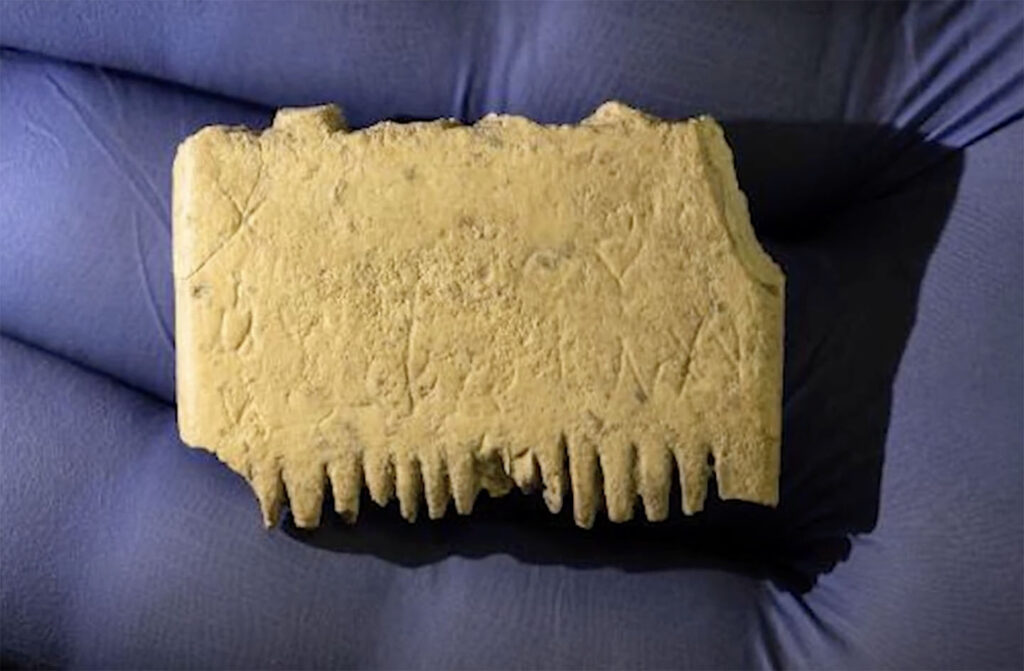
On ivory an alphabet

was used to write, upon a comb,

by Canaanites, a tête-à-tête,

composing words found in no tome

that’s published yet, a prohibition

of lice, the third plague God inflicted.

The text is like the first edition

of this third plague, since when God sicked it

upon Egyptians, He created

a problem for which a solution

was found by Canaanites and stated

for pediculosis pollution.


Jews hint to this plague while they’re dipping

in wine their fingers, to this plague

alluding, quoting while they’re quipping

a mnemonic that is vague,

by means of an acrostic word

recalling ten plagues with ten letters,

lice being of the ten the third,

infecting all who put in fetters

the Israelites enslaved by Pharaoh.


This word for lice is on a comb

once owned by Canaanites whose hair o-

vershadows, (right?) this fun poem,

inscribed by hairy Canaanites

in maybe the first alphabet

that men used once they’d learned to write

what, if they don’t, they might forget.


Philologos (Hillel Halkin) discusses the inscription of the comb mentioned in this poem in “Was the Language Abraham Spoke Engraved on an Ancient Lice Comb?” mosaic.com, 1/4/22:


Lice, and even delousing shampoos (the oldest formula for one has been found on an Egyptian papyrus from 1,500 BCE), have been with us immemorially, and special lice combs are among the most ancient surviving artifacts of civilization. Made of wood, bone, or ivory, and sometimes intricately decorated, known examples of them date back to pre-Pharaonic Egypt. Their basic form has not changed much over time. Squarish in shape, they have traditionally had two facing sets of teeth, thicker and fewer at one end of the comb for first unknotting and straightening the hair, and finer and more numerous at the other end for removing the lice and their eggs.


In itself, therefore, there was nothing earthshaking about the discovery in 2016, in an excavation at the site of Lachish in southern Israel, of a little ivory lice comb, 3.66 by 2.51 centimeters, dated by the experts to roughly 1700 BCE—that is, to about the time that the biblical Abraham was wandering up and down Canaan. What made the Lachish comb a news item upon publication last November of an article about it in the Jerusalem Journal of Archeology was that in 2021, five years after its discovery, an investigator examining it with special optical equipment noticed the presence on it of writing. When deciphered by paleographers, this turned out to be an inscription consisting of seventeen letters (two partly illegible that had to be guessed at) in the alphabet of ancient Canaanite, the language that was the precursor of biblical Hebrew just as the Middle English of Chaucer’s time was that of the English we speak today.


Run together rather than separated into discrete words, these letters represent an extremely early example of Canaanite writing—and since it was apparently the Canaanites, influenced by Egyptian hieroglyphics, who first hit on the idea of representing each of the sounds of their language by a distinct written character, thus leading to the world’s first alphabet, from which most of the alphabets in use today are descended, our little louse comb advances knowledge of the development of one of the most important inventions in human history.


In the conclusion of the book of Malachi, Malachi 3:23-24 predicts that Elijah will come before an ‘awesome, fearful day’. He follows this with a comment that Elijah will nevertheless, just in time, unite and reconcile the generations, whose inter-enmity has presumably helped to bring about the dire situation, but he concludes his prophesy by repeating his warning, this time, however, tempered happily by his promise of reconciliation.  This construct is imitated at the seder, when we too end on a happy note.

Malachi 3:23-24 states:

הִנֵּ֤ה אָנֹכִי֙ שֹׁלֵ֣חַ לָכֶ֔ם אֵ֖ת אֵלִיָּ֣ה הַנָּבִ֑יא לִפְנֵ֗י בּ֚וֹא י֣וֹם יְהֹוָ֔ה הַגָּד֖וֹל וְהַנּוֹרָֽא׃

Lo, I will send the prophet Elijah to you before the coming of the awesome, fearful day of GOD. 

וְהֵשִׁ֤יב לֵב־אָבוֹת֙ עַל־בָּנִ֔ים וְלֵ֥ב בָּנִ֖ים עַל־אֲבוֹתָ֑ם פֶּן־אָב֕וֹא וְהִכֵּיתִ֥י אֶת־הָאָ֖רֶץ חֵֽרֶם׃

He shall reconcile parents with children and children with their parents, lest, when I come, I  strike the whole land with utter destruction.

הִנֵּ֤ה אָנֹכִי֙ שֹׁלֵ֣חַ לָכֶ֔ם אֵ֖ת אֵלִיָּ֣ה הַנָּבִ֑יא לִפְנֵ֗י בּ֚וֹא י֣וֹם יְהֹוָ֔ה הַגָּד֖וֹל וְהַנּוֹרָֽא׃

Lo, I will send the prophet Elijah to you before the coming of the awesome, fearful day of GOD.


Gershon Hepner is a poet who has written over 25,000 poems on subjects ranging from music to literature, politics to Torah. He grew up in England and moved to Los Angeles in 1976. Using his varied interests and experiences, he has authored dozens of papers in medical and academic journals, and authored “Legal Friction: Law, Narrative, and Identity Politics in Biblical Israel.” He can be reached at gershonhepner@gmail.com.

The First Alphabet and the Third Plague Read More »

A Bisl Torah – The Fifth Child

Many of us are familiar with the four children in the Haggadah. The wise, rebellious, innocent and voiceless children sit at the table. Adults are tasked to teach the story of our people according to each child’s learning style and ability.

Rabbi Joseph Isaac Schneersohn analogizes the passage of the four children as four different generations of Jews within America. Rabbi Shlomo Riskin further expounds this interpretation.

Paraphrased: “The wise child represents the European roots…those with a love for learning and profound knowledge of Jewish tradition. The wicked child, brought up within the American ‘melting pot’ rejected his parents’ customs and ways of thought. The third generation, the Simple Child, is confused. He watched his grandfather making Kiddush on Friday night and his father standing silently, perhaps resentfully, impatient to prepare for business Saturday morning. The fourth generation, the Child Who Does Not Know How to Ask…He was born after his great-grandparents had died. We are now being challenged to open our great heritage to this generation which lost it without ever knowing what it had possessed.”

But perhaps, since October 7th, a fifth generation has surfaced. Young Jews determining how (not if) Jewish tradition and beliefs will play a role in their own identity and the future identities of their children. This year, very few people asked how the story of Passover relates to their lives. Quite the opposite. Jews spoke about Israel with an anxiousness for return, knowing that their generation will play a significant role in Israel’s physical and spiritual rebuilding.

This generation will determine the trajectory for the Jewish people. While it may feel unclear what the coming days will bring, one thing is certain: this generation is vocal, loud, strong and unwilling to succumb to the slavery experienced by our ancestors.

And who knows? Maybe next year we will read about a fifth child. The one who knows it is upon him to continue telling and living our story.

Chag Sameach and Shabbat Shalom


Rabbi Nicole Guzik is senior rabbi at Sinai Temple. She can be reached at her Facebook page at Rabbi Nicole Guzik or on Instagram @rabbiguzik. For more writings, visit Rabbi Guzik’s blog section from Sinai Temple’s website.

A Bisl Torah – The Fifth Child Read More »

A Moment in Time: “A Week without Bread: Do we Really Kneed It?”

Dear all,

Full disclosure. I LOVE bread. Passover, therefore, is a VERY long week.

Why abstain from bread and eat Matzah? Sure, Torah teaches us that the Israelites left Egypt in such a hurry that they didn’t have enough time for their dough to rise. And our Haggadah underscores that Matzah is the bread of affliction. And so – we honor our ancestors while we acknowledge continued world afflictions.

But I find an additional spiritual reason that helps sustain me through the week.

You see – we are supposed to avoid the stuff that makes bread rise or ferment. And there is a fine line between fermenting and spoiling.

In other words, we get rid of the stuff that spoils in our souls.

Abstaining from bread (and bread products) may help focus us on the stuff we really want to get rid of:

Rancor.

Impatience.

Inability to listen.

Tunnel-vision.

Self-doubt.

etc.

Passover is our moment in time to deflate our egos and be at one with our people. Do we kneed bread? No.

But I can’t wait until next week when I can have pizza once again!

With love and shalom.

Rabbi Zach Shapiro

A Moment in Time: “A Week without Bread: Do we Really Kneed It?” Read More »

Passover Amid Pain: Families of Hostages Mark 200 Days Since Abductions

To read more articles from The Media Line, click here.

According to the rabbi, many Jews worldwide plan to acknowledge the hostages and the war in Gaza with special holiday activities this year.

Passover 2024 began after sunset on Monday, April 22, and ends on Tuesday evening, April 30. This year, the holiday, which commemorates Jews’ freedom from slavery, will take on a deeper, more emotional significance for Jews in Israel and worldwide. The third day of the holiday, April 24, will mark 200 days since the hostages were abducted in southern Israel by Hamas during the Oct. 7 terror attack.

The Media Line spoke to family members of some of the hostages. They shared their emotions regarding how difficult the upcoming Passover holiday — in Hebrew, Pesach — will be because of the prolonged absence of their loved ones.

Aviram Meir, the uncle of Almog Meir Jan, 21, who was taken captive from the Nova desert party and is now believed to be a hostage of Hamas, told The Media Line: “Our feelings are hard before the holiday. We are facing the 200th day since Almog’s kidnapping. We do not see the end; the feeling is that there is no air to breathe. Pesach will be different this year.”

Yotam Cohen, the twin brother of Nimrod Cohen, 19, who was taken hostage from Kibbutz Nahal Oz, spoke to The Media Line from a protest calling for the release of the hostages. He said that “celebrating a holiday about freedom is the last thing on our minds. We will continue fighting every day. We hope we’ll be able to celebrate Pesach with my brother at home, but we know it is unlikely it will happen.”

Cohen added: “If my brother isn’t back home, we’ll just continue fighting.”

Ayala Harel, the niece of Michel Nisenbaum, 59, who was kidnapped near Sderot and still is being held captive in Gaza, told The Media Line that she “didn’t want to celebrate Pesach because Michel is not free, but I will do it because of my kids. I must celebrate Pesach for them, but it is with a heavy heart.”

Udi Goren, cousin of Tal Haimi, who was murdered in Hamas captivity at age 41, shared with The Media Line that “we have a big family, and it is a chance for everyone to see each other. We’re always looking forward to it. Pesach is more than just the holiday of freedom. It has always been a huge, joyful evening for us, but this year, it will not be this type of occasion. This year, we’ll miss my cousin, so it won’t feel like a holiday or a festivity, and there is no freedom in the air. It’s a sad Pesach,” he said.

Given the difficult times that Israelis — and Jews worldwide — are currently living through, it can be challenging to navigate the holidays, said Rabbi Rafi Ostroff.

“Pesach this year has a feeling of just having left Egypt and the Jewish people’s hope for redemption, a miracle, something positive to hold on to during one of the hardest periods of our lives,” he told The Media Line.

“Another name for Pesach is ‘Chag HaHerut,’ meaning the Festival of Freedom. This year, when talking about freedom, we must acknowledge we’re talking about real people. These individuals with names and families had their freedom interrupted, and we need to rescue them from captivity, so it is a year that the message of Pesach is very literal and not just something spiritual,” Rabbi Ostroff added.

“In every single generation, when the Jews in the Diaspora were threatened, they thought of returning to the land of Israel to prevent these threats from ever happening again. One of the reasons why Israel was created was to prevent pogroms like October 7, like the uncountable other traumas throughout Jewish history worldwide,” Rabbi Ostroff continued. “That commitment of Israel and Diaspora Jews to prevent such violence was put on an endurance test since that terrible day and eroded our sense of security — in the South, with the war in Gaza, in the North with the threats from Lebanon and Syria, and everywhere antisemitism can reach,” he said.

“For me, this year, Pesach’s central question is what it means to be a free Jew in a world with a free State of Israel amidst such hard times. Also, if you are a Jew in the Diaspora, to reflect that, despite the war in Gaza and the threats in northern Israel, many Jewish communities around the world are at greater risk in their current countries than the vast majority of Jews in Israel. This is happening in front of our eyes in America and most of Europe with this recent hike in antisemitism,” Rabbi Ostroff said.

According to the rabbi, many Jews worldwide plan to acknowledge the hostages and the war in Gaza with special holiday activities this year.

His plans include taking his children to “Kikar HaChatufim,” Hostages Square. In addition, during the Passover seder, many additions can be made to memorialize the political situation.

“For example, adding an empty chair to the dinner table to represent the hostages being held in Gaza. This is something many people did in the 80s to honor the Jews trying to escape the Soviet Union. This year, I also suggest adding this extra chair, putting a picture of a hostage of their choice, and trying to learn and share that person’s story. Where did they come from, what was their life like, and what had happened to them? All this can be done by adding a fifth cup of wine to the seder,” Rabbi Ostroff suggested.

Given the despair many Israelis and Jews feel, especially the families of the hostages, the question has arisen whether to celebrate Passover at all this year. According to Jamie Geller, a bestselling cookbook author and the CMO of Aish, an international Jewish organization that promotes education and Jewish identity, “Many families of hostages might not celebrate Pesach this year because their hearts feel so heavy, but many will celebrate because Pesach is so special. People look forward to this holiday, and not having a seder would make them even sadder. Think about it: Pesach is more celebrated and observed than any other holiday,” she told The Media Line.

Given that there are so many children, siblings, mothers, fathers, spouses, and grandparents of the 130 captives still in Gaza, naturally, there are mixed feelings about celebrating freedom right now, asserts Geller. “In these hard times, we need to use it to speak about what it means to be free as individuals, as communities, as a nation around the world, and as a Jewish family. Because we have members who are not free right now,” she added.

“Adding an extra empty seat at the seder table is part of my plans to memorialize the hostages. I also plan to make a table as big as I can, invite those in need closer to me, and fill the table with food that symbolizes our togetherness as a Jewish family. Many people in Israel are struggling economically, with so many people serving in the army right now and the war impacting many sectors of the economy. We already have indicators that Israel added a significant amount of ‘new poor’ to the already existing fraction of its population that is impoverished,” Geller continued.

When cooking for the seder, many foods can also help represent the sense of Jewish family and unity, said Geller, who suggested cooking something from a Jewish background different than your own. “I plan to include a chicken tagine, a staple from Northern Africa, and a tabbouleh, symbolizing Syrian and Lebanese Jews,” she said, explaining that her family origins are of Ashkenazi descent from Transylvania.

Passover Amid Pain: Families of Hostages Mark 200 Days Since Abductions Read More »

Robin Finn Helps Women Find Their Voice on the Page

It started as an eight-week writing course, “Heart. Soul. Pen.,” with writer Robin Finn. Women from all walks of life, ages and backgrounds found the joy of writing. It helped them gain confidence, understand themselves better and contend with what they were going through. Some even claimed it was therapeutic. 

Seeing the great impact of her writing workshops on women, Finn thought about a way to reach a larger audience. That’s when she decided to write a book, “Heart. Soul. Pen: Find Your Voice on the Page and In Your Life.” The book serves as a tangible extension of her workshops, offering guidance and encouragement to a broader audience.

“I tell all my students that writing is healing, and I joke with them that it’s cheaper than therapy.”

“I tell all my students that writing is healing, and I joke with them that it’s cheaper than therapy,” Finn told the Journal. “It doesn’t require you to get on a plane and go somewhere. There are no barriers in terms of finance or even time. It’s enough if you write for five minutes a couple of times a week. And it’s accessible; you just need a pen and a paper, and you can start writing.”

Finn has been a writer for many years. She wrote for The New York Times and Los Angeles Times, she’s published a book and been teaching at the UCLA Extension Writer’s Program. In her writing courses, she taught hundreds of women how to tell their story pass on her motto, “Don’t think. Just write.”

“Too many women think their stories are not important or their voice doesn’t matter, which could not be further from the truth,” she said. “We’re writing from the heart and soul. We get out of our heads and we just allow ourselves to be unleashed on the page. When people read what they wrote, they are like: ‘Oh my God, I didn’t even know that was inside of me.’ When you stop telling yourself you’re not good enough, you’re not smart enough, you’re too old, you’re too whatever, you find that your writing is so meaningful.”

Finn’s debut novel, “Restless in L.A.”’ tells the story of a woman on her 40th birthday who reconnects with her former love from college on Facebook – which sends her on a midlife crisis. It’s a book about infidelity, intimacy and motherhood, and received acclaim from critics and readers alike. Finn’s workshops attract a diverse array of women, united by their desire to connect with themselves and tell their stories. From new mothers grappling with parenthood to retirees reflecting on their life’s journey, Finn’s workshops offer a transformative experience.

“On many occasions those are women in transition – [maybe] they just had a baby and are trying to figure out how to be a mom and how to keep their identity,” said Finn. “There are empty nesters; their children left the home, and they are in midlife. I talk a lot about midlife because I think there is a point in a woman’s life when she suddenly wants to connect more deeply with her own identity and a lot of time women don’t know when and where to start. Writing is such an easy and powerful way to connect to yourself.”

Some participants who are taking Finn’s course are professional writers. Others had never written before and some are what she calls journal writers, but they all share a common desire – to reclaim their voice and assert the worthiness of their words.

Finn’s workshops serve as a powerful catalyst for writers to tap into their creative potential. Initially, many participants doubt their abilities, thinking, “I’m not a writer.” Yet, as she aptly puts it, “The fact that they think they are not writers is not true.

“I see women get a total creative jumpstart where they come away thinking, ‘I can write,'” Finn said. “They come away with increased confidence, knowing they have everything they need to write, whether it’s a personal project or something else.”

Finn offers writing retreats and a variety of workshops — some online — that attract participants from across the United States and beyond. Through platforms like Zoom, she continues to cultivate a supportive community where women can explore their creativity and share their stories with one another.

Another popular workshop is “Hot Writing,” a specialized program that delves into topics like midlife, menopause and life transitions, with candor and compassion. Through “Hot Writing,” women confront the challenges and transformations of this stage of life, finding solace and strength in their shared experiences.

“When you give yourself permission to delve into these issues, you tap into a wellspring of courage and confidence,” Finn said. “Writing becomes a courageous act, and sharing your writing becomes even more courageous.”

Through her guidance, participants discover the strength of their voices and the boundless reservoir of creativity within them. Finn’s greatest reward is witnessing this transformation firsthand. “Everyone has a voice, and when you stop judging it and allow it to emerge, you’re really delighted by your own creativity,” she said.

Participants emerge from her workshops with newfound confidence, realizing they possess all they need to embark on writing endeavors, be it a personal project or a long-cherished book idea. Finn’s approach fosters a total creative kickstart, empowering women to embrace their writing aspirations and believe in the power of their own words.


A book signing event and book discussion with Robin Finn will take place on May 2 at Book Soup in Los Angeles.

Robin Finn Helps Women Find Their Voice on the Page Read More »

Courtesy of MAZON

MAZON Holds Its 15th Annual Hunger Seder

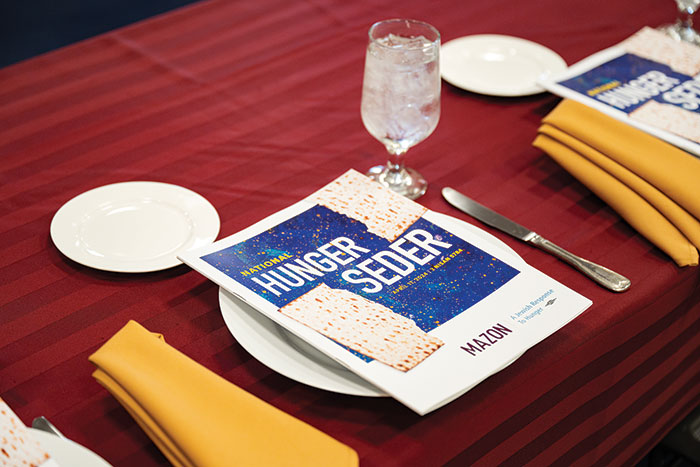
On April 11, MAZON: A Jewish Response to Hunger held its 15th annual National Hunger Seder on Capitol Hill. Members of congress, government officials and anti-hunger advocates gathered to participate in Passover traditions and call attention to food insecurity. This year’s National Hunger Seder was held in conjunction with the House Hunger Caucus. 

“This truly is one of the most unique events that takes place on Capitol Hill,” Liza Lieberman, MAZON’s vice president of public affairs, told the Journal. “It offers an opportunity to take a step back and reflect on the key themes that guide our anti-hunger advocacy, such as freedom, redemption and justice.”

Inspired by Jewish values and ideals, MAZON is a national advocacy organization working to end hunger among people of all faiths and backgrounds in the United States and Israel.

“It was eye-opening to everyone in the room to understand that together, we can reverse the course of hunger in this country.”  – Liza Lieberman

“It’s not every day that you see advocates and government officials come together to partake in ancient traditions that foster discussions about how we can work together and advance policies that reflect our shared values,” Lieberman said. “It was eye-opening to everyone in the room to understand that together, we can reverse the course of hunger in this country.”  

Participants read from MAZON’s 2024 Hunger Seder Haggadah, which frames the Passover rituals around hunger issues. Also, each year, MAZON, along with the traditional Four Questions of Passover, creates and distributes a Fifth Question to bring a new reflection about hunger to the seder table. 

This year’s question, “How will we find our way to freedom and justice?” highlights the fact that 44 million Americans are “bound by the burden of hunger.” MAZON said policymakers must learn from the effectiveness of pandemic-era protections, flexibilities and benefit boosts for programs like SNAP. 

“This is my first Seder experience, but the message and the overall intent is not new to me,” Congresswoman Jahana Hayes (D-Conn.) told the Journal. Hayes is the ranking member of the House Agriculture Subcommittee on Nutrition, Foreign Agriculture and Horticulture. “It has become my clarion call in Congress: Hunger is something incredibly basic that speaks to all of humanity.”

Hayes was one of eight members of Congress in attendance, along with .U.S. representatives Tracey Mann (R-Kan.), Jim McGovern (D-Mass.), Becca Balint (D-Vt.), Suzanne Bonamici (D-Ore.), Jan Schakowsky (D-Ill.), Debbie Wasserman Schultz (D-Fla.) and Mary Gay Scanlon (D-Pa.).

“Shame on us; it’s shameful that we need to fight to ensure millions of people have enough money for food,” Schakowsky told the Journal. “We must demand that every person in this country, whoever they are and wherever they come from, has enough to eat.” 

She added, “We can do this.”

Abby J. Leibman, MAZON’s president & CEO, called this National Hunger Seder the best one yet. “This annual event allows us to create a unique space for community, which is one of the core themes of Passover,” Leibman said. “The Passover story illustrates how [the] community created bonds and purpose, so that our ancestors could move toward the promised land — together. “It was the strength and courage of community in action that allowed our ancestors to find freedom,” she said. “Today, it is the strength and courage of our community in action that can bring an end to the pain and indignity of hunger.” 

Although U.S. Rep. Jim Clyburn (D-S.C.), House minority whip and chair of the Democratic Faith Working Group, was unable to attend the Seder, he offered a quote of support. 

“During this Passover season, as we reflect on shared traditions and find strength in the story of the Israelites’ escape from hunger and hardship, let us not forget those in our own communities who face challenges such as food insecurity,” Clyburn told the Journal. “My Democratic colleagues and I stand for policies that ensure sufficient sustenance reaches every American. Wishing all who celebrate a meaningful holiday of liberation!”


For Passover materials from MAZON, including additional information on the Fifth Question, go to Mazon.org/passover.

MAZON Holds Its 15th Annual Hunger Seder Read More »

“Symphony of the Holocaust,” MDA Paramedic, Birthright Israel Excel Summit

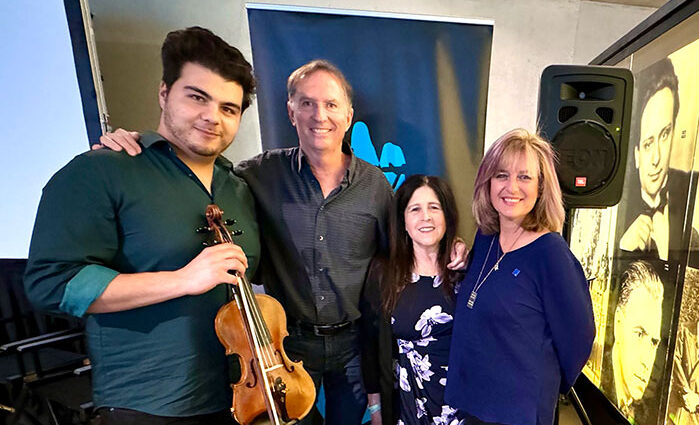
A special screening of the new documentary “Symphony of the Holocaust” was held on April 18 at Holocaust Museum LA, along with a live musical performance and a Q & A.The film features the story and music of child violin prodigy and late Holocaust survivor, Shony Alex Braun, who survived four concentration camps and wrote a symphony about it. In a packed room, many children of Holocaust survivors were moved by the hope, triumphs and prayer in the film.

After the 71-minute film, Holocaust Museum LA Chief Program Manager Jen Maxcy introduced Armenian violinist Erik Ghukasyan. At the museum, Ghukasyan performed parts of Braun’s “Symphony of the Holocaust” along with Armenian music.

Afterwards, there was a Q & A with the documentary’s award-winning director, Greg DeHart; Braun’s daughter, Dinah Braun Griffin; Los Angeles Jewish Symphony Founding Artistic Director and Conductor Noreen Green; and Ghukasyan.

In the documentary, Ghukasyan, the violinist, travels with Braun’s family to Auschwitz to fulfill the late survivor’s final wish to have his “Symphony of the Holocaust” played at the infamous Auschwitz-Birkenau, where his mother and younger sister were murdered. Braun died in 2002, and his wife, Shari, passed in 2017. It was their dream to make this happen.

“Seeing his dream come true, it’s just a miracle,” Griffin said during the Q & A. “It’s just incredible. I’m so proud of him and his music…I hope this music brings healing to other people as well.”

Ghukasyan, the violinist, added, “[I] was so grateful to be invited to help make Shony’s dream come true and be in this film.”

When asked where people can now see this documentary, DeHart explained that anyone can watch the “Symphony of the Holocaust” by visiting the SunnStream.com streaming platform website.

“One of the things I hope the film does,” the director said, “is it brings life to ‘The Symphony of the Holocaust’ and obviously to Shony and what he did—and how he used the power of music to survive… The heart of this is a love story.”


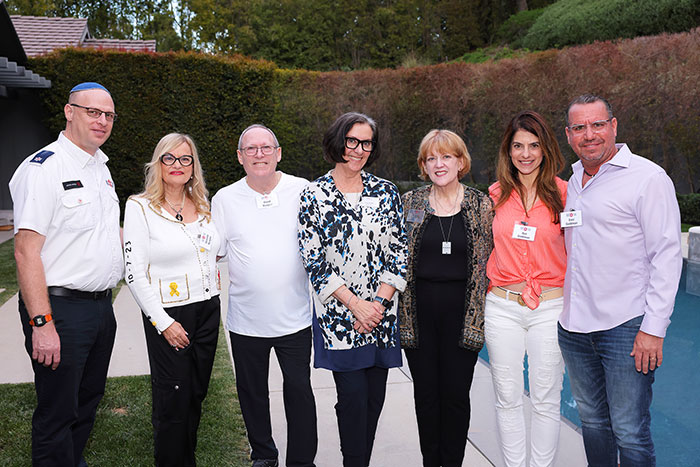
From left: MDA Senior Paramedic and Liaison Aryeh Myers; event hosts Melanie and David Ryngler; AFMDA Regional Director Janet Morgan; AFMDA CEO Catherine Reed; and Aya and Erez Goldman, Israel Bonds executive director-southwest region. Courtesy of American Friends of Magen David Adom

Magen David Adom (MDA) senior paramedic Aryeh Myers appeared at a private residence to discuss the lifesaving work of MDA in the aftermath of Oct. 7. 

Addressing an intimate crowd of about 50 people, Myers, visiting from Israel, spoke about the ways Hamas intentionally targeted MDA ambulances. He highlighted the emergency services organization’s effort to reach Israeli civilians during the unprecedented attack on the country’s south. 

“The reason we do it is because it needs to be done,” Myers said.

He also underlined the vital role of MDA’s Marcus National Blood Services Center and the need for additional MDA ambulances as Israel’s north continues to face threats from Hezbollah in Lebanon and while the future of Israel’s conflict with Iran remains uncertain.

Originally from London, Myers served as a senior paramedic and trainer with MDA— Israel’s official emergency medical organization—for more than a decade before moving to the organization’s international relations department in 2022. On Oct. 7, he was on call in Ashkelon, a coastal city in Israel’s south, treating a range of injuries, including shrapnel wounds and smoke inhalation resulting from rocket attacks.

American Friends of Magen David Adom, which raises funds and awareness for MDA, organized the April 17 event, held at the home of Melanie and David Ryngler.


From left: Yaniv Sadka, Josh Khalili and Bryan Gerber. The three Birthright Israel Excel fellows recently traveled from Los Angeles to New York City for the Excel summit. Courtesy of Birthright Israel Excel

An estimated 400 Excel fellows from North America and around the world came together for the summit, which featured global networking opportunities, industry-specific panels and moving reflections on Oct. 7.

“Symphony of the Holocaust,” MDA Paramedic, Birthright Israel Excel Summit Read More »