Biden: “I Condemn the Antisemitic Protests” on College Campuses
President Joe Biden told reporters on April 22 that he condemns “the antisemitic protests” occurring on college campuses, as well as “those who don’t understand what’s going on with the Palestinians.”
Biden was on his way back from a Virginia speech celebrating Earth Day when a reporter asked him if he condemns “the antisemitic protests on college campuses.” “I condemn the antisemitic protests. That’s why I’ve set up a program to deal with that,” Biden replied. “I also condemn those who don’t understand what’s going on with the Palestinians.”
Asked if he thinks Columbia University President Minouche Shafik to resign, Biden replied: “I didn’t know that. I’ll have to find out more.”
Columbia Prof Shai Davidai Blocked from Campus
Columbia University Assistant Professor Shai Davidai was reportedly barred from entering campus on April 22 because the university couldn’t ensure his safety on campus.
According to the Columbia Daily Spectator and Daily Mail, Davidai was planning on holding a pro-Israel counterprotest next to the ongoing pro-Palestinian encampment on campus; he was told by Cas Holloway, the university’s chief operating officer, that Davidai was required to hold his demonstration in a designated area. Davidai told pro-Israel protesters in front of the campus gate that his card had been deactivated. “I have not just a civil right as a Jewish person to be on campus, I have a right as a professor employed by the university to be on campus,” he declared.
Davidai also wrote in a post on X, “Earlier today, @Columbia University refused to let me onto campus. Why? Because they cannot protect my safety as a Jewish professor. This is 1938.”
Columbia Jewish Student Says He Was Assaulted, Told to “Go Back to Poland”
Jonathan Lederer, a Jewish student at Columbia University, wrote in an essay for The Free Press that he was assaulted, harassed, had his Israeli flag stolen and was told to “go back to Poland” by pro-Palestinian protesters on the evening of April 20.
Lederer wrote that he was among 20 students singing “peaceful songs” while holding American and Israeli flags in the middle of campus when “masked keffiyeh protesters” threw “water in our faces” and held a sign that stated, “Al-Qassam’s next targets,” referencing Hamas’s military arm. When Lederer and the other students decided to leave, a keffiyeh protester stole his two Israeli flags, alleged Lederer, prompting him to run after the protester and grab his flag back as the pro-Palestinian protesters attempted to set it on fire. “As all of this was happening, members of the mob pushed and shoved me,” Lederer wrote, adding that “at least two solid objects were thrown at me from close range, one of which hit me directly in the face and the other in the chest.” As he and his friends ran from campus, they were told to “go back to Poland.”
A university spokesperson told the Journal, “As President Shafik has said repeatedly, the safety of our community is our number one priority. Columbia students have the right to protest, but they are not allowed to disrupt campus life or harass and intimidate fellow students and members of our community. We are acting on concerns we are hearing from our Jewish students and are providing additional support and resources to ensure that our community remains safe.”
Yale Jewish Student Journalist Stabbed in the Eye While Covering Pro-Palestinian Protest
Yale Jewish student Sahar Tartak, the editor-in-chief of the Yale Free Press, was stabbed in the eye with a Palestinian flag while covering a pro-Palestinian protest on April 20.
The New York Post reported that a group of pro-Palestinian protesters surrounded Tartak and her friend because they were “wearing Hasidic Jewish attire” and tried to stop them from filming. Tartak told the Post that one of the protesters was holding a Palestinian flag and jabbed “it in my eye.” The university is investigating the matter.
Loyola Law Students Harass Jewish Students at IDF Campus Event
The Jewish Law Students Association (JLSA) at Loyola Law School announced in an April 17 Instagram post that their classmates had harassed Jewish students at event featuring several Israel Defense Force (IDF) soldiers speaking about their experience in the ongoing Israel-Hamas war.
The Jewish students were allegedly called “fat ugly Jewish b—-es” and “k—s” by their classmates; one Loyola student allegedly declared that they are “antisemitic and would still become a lawyer.” “Instead of attempting to listen and engage in a respectful dialogue with the IDF soldiers, the IDF soldiers and students were harassed without any provocation,” the JLSA statement read, adding that the event turned “into a scene of fear and hostility, with a few attendees left trembling as they made their way into their vehicles.”
Loyola Law Interim Dean and Senior Vice President Brietta Clark wrote in a message to community members on April 18 that the university has “deployed all available resources to conduct a prompt investigation of this matter.”
Until recently, I was proud to have been an adjunct professor at Columbia’s Law School for more than 20 years. My one-day-a-week seminar was titled “Religious Minorities in Supreme Court Litigation.” In class discussions, written exercises and other assignments, students covered recent Supreme Court briefs, oral arguments and decisions.
Gay, along with the other presidents who appeared at the hearing, was apparently not told of the Supreme Court’s unanimous decision that the First Amendment’s shield for free speech did not protect harassing utterances.
The testimony of Claudine Gay, former president of Harvard, reportedly prepared by lawyers at the distinguished Washington law firm Wilmer Cutler, astounded me. Gay, along with the other university presidents who appeared at a hearing of a House committee on Dec. 5, was apparently not told of the Supreme Court’s unanimous agreement in Counterman v. Colorado (600 U.S. 66-2023), decided a few months before her public appearance, that the First Amendment’s shield for free speech did not protect harassing utterances. She and the two other intellectual giants replied to the sharp questions of Rep. Elise Stefanik (R-N.Y.) by asserting that calls for genocide of Jews, even if harassing, were protected on their campuses so long as they did not cross the line into conduct. The Supreme Court’s opinions in Counterman uniformly rejected such a reading of the First Amendment.
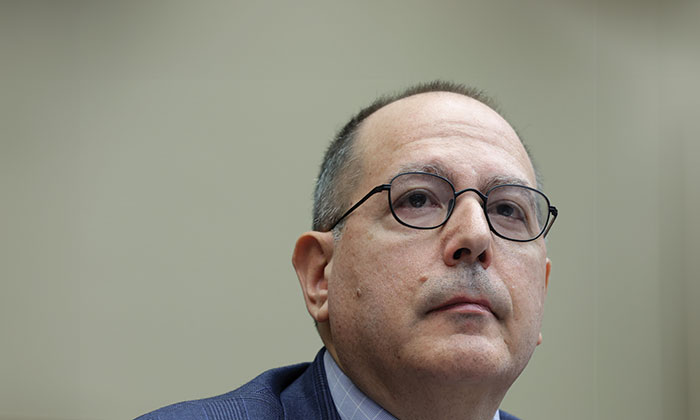
Former dean David Schizer of Columbia Law School, whose term coincided with seven years of my participation on the law school faculty (although I must confess that I have no recollection of ever meeting him) sat next to the university’s president, Minouche Shafik, at the witness table for her appearance on April 17.
Schizer’s introductory statement at the House hearing was appalling, deserving a failing grade in his school’s constitutional law course. He declared that on Columbia’s campus, “the right to protest has to be protected,” as if protest on grounds owned by Columbia — a private, not a government-owned or run, institution — is public speech shielded by the First Amendment guarantee against “abridging the freedom of speech.”
Schizer should know that protest in a “public forum” is legally and constitutionally very different from protest on private premises. I may legally control what is said in my home and exclude anyone from my private premises if he or she says anything that offends my family or other guests. Free speech does not extend to declarations that the owner of the premises chooses to forbid for any reason—or, for that matter, for no reason at all.
Schizer listed for the House Committee four areas that his remedial committee on antisemitism identified. The first, he said, was “better rules about where and when protests can be held.” Only “where and when?” As if all protests were mandatory and the only restrictions the Columbia administration might impose were on their location and timing.
Would Columbia permit a “protest” calling for a return to slavery of all blacks? What if a “protest” is called on the Columbia campus to repeal the 19th Amendment and again deny suffrage to females?
The First Amendment might entitle a provocateur to carry a sign on a public street or deliver an address with either of these messages in a town square. But the owner of premises, even if they are open to the public for certain purposes, could not be compelled to allow this opinion to be expressed on his property.
This is not a dubious constitutional proposition. In 1972, sustaining the right of a shopping center owner to bar the distribution of handbills protesting the war in Vietnam, the Supreme Court “vigorously and forthrightly” rejected “the assumption that people who want to propagandize protests or views have a constitutional right to do so whenever and however and wherever they please.” (LloydCorp. v. Tanner, 407 U.S. 551, 568, 1972.)
Schizer is simply wrong in declaring that “free expression and academic freedom” demand that all “protests” be permitted on campus so long as they “don’t disrupt classes and other activities.”
Schizer is simply wrong in declaring that “free expression and academic freedom” demand that all “protests” be permitted on campus — no matter how they affect portions of Columbia’s invited student population — so long as they “don’t disrupt classes and other activities.” Columbia has always had the legal right and moral obligation to decide that certain opinions, even if called “protests” to energize and inflame its adherents, should not be tolerated.
Nathan Lewin is a Washington, D.C., attorney with a Supreme Court practice who has taught at leading national law schools including Harvard, Columbia, Georgetown and the University of Chicago.
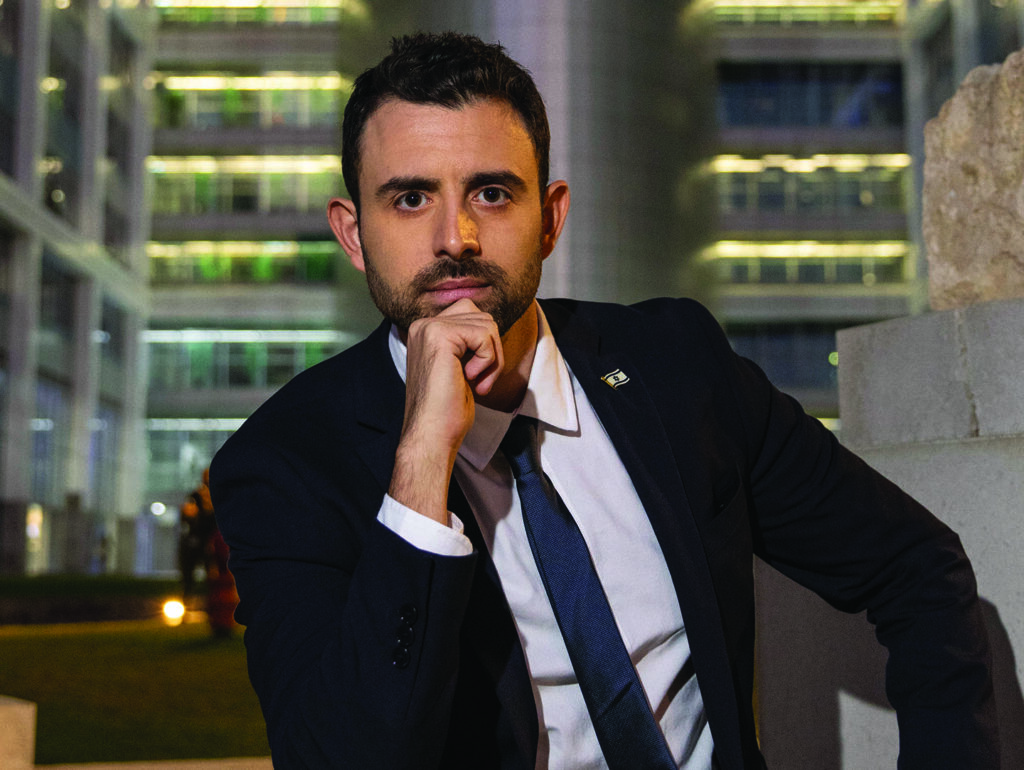
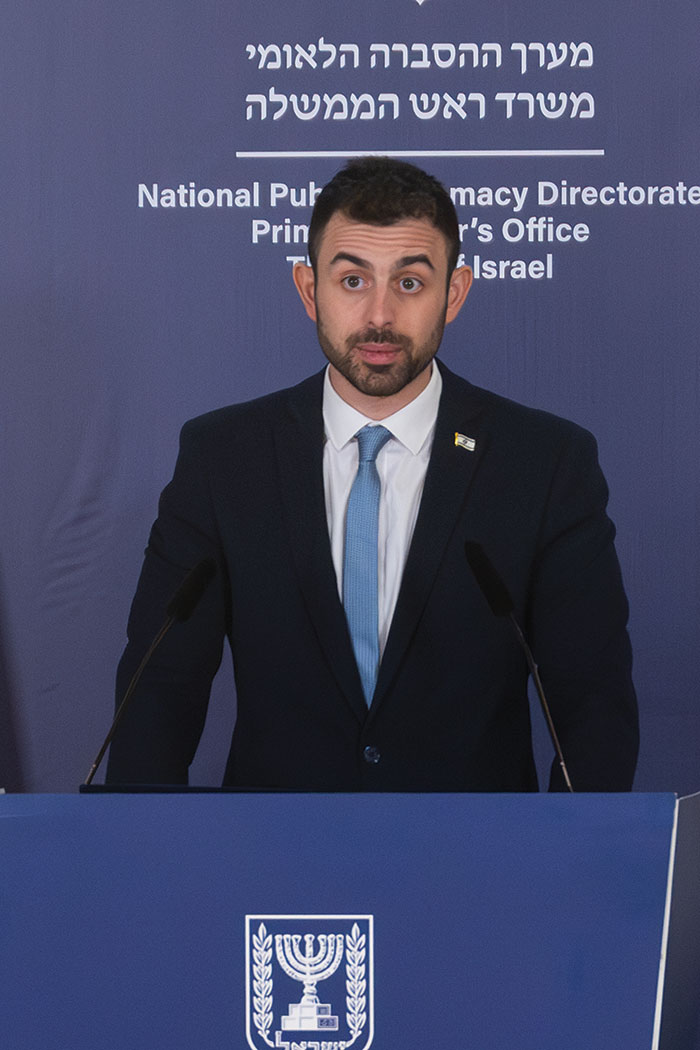
Eylon Levy was sitting in the prime minister’s office with the Israeli flag behind him, answering questions about the hostage situation from reporter Kay Burley of Sky News. It was November of 2023, one month after the Israel-Gaza War began, and Levy talked about how he hoped the hostages would be returned soon.
The interview was pretty standard; Levy was a well-versed on-air personality at this point, having conducted hundreds of interviews as a spokesperson for Israel since Oct. 7. But then, Burley asked a question that stunned Levy.
“I was speaking to a hostage negotiator this morning, and he made the comparison between the 50 hostages that Hamas has promised to release as opposed to the 150 prisoners that are Palestinians that Israel has said it will release,” she said. “He made the comparison between the numbers and the fact that does Israel not think that Palestinian lives are valued as highly as Israeli lives?”
Alexi J. Rosenfeld/Getty Images
Levy raised his eyebrows in disbelief and paused for three seconds before answering: “That is an astonishing accusation. If we could release one prisoner for every one hostage, we would obviously do that. We are operating in horrific circumstances. We’re not choosing to release these prisoners who have blood on their hands. We are talking about people who have been convicted of stabbing and shooting attacks. Notice the question of proportionality doesn’t interest Palestinian supporters when they’re able to get more of their prisoners out, but really it is outrageous to suggest that the fact that we are willing to release prisoners who are convicted of terrorism offenses – more of them than we are getting our own innocent children back – somehow suggests that we don’t care about Palestinian lives? Really? That’s a disgusting accusation.”
And with that, Levy went viral. The video got hundreds of thousands of views, Sky News apologized for the blunder and the Jewish community proudly supported the PM’s most prominent spokesperson. There were also plenty of memes about Levy’s eyebrows going around – a silly moment during an otherwise tense time.
Before Oct. 7, Levy was more or less a private citizen; he had served as an adviser to President Isaac Herzog, and had media training through this work as a correspondent at i24NEWS and IBA English News in Israel.
“I had control of my time, and I was anonymous,” Levy told the Journal.
But when Oct. 7 happened, his life changed overnight. He set up his camera in his living room and started giving interviews to the press about that tragic day, articulating the facts and stating the truth while being a fierce supporter of the Jewish State.
Soon enough, Prime Minister Benjamin Netanyahu’s office noticed Levy and reached out, making him an official government spokesperson. His job? To give interviews to international media outlets day and night, rarely taking breaks, to present Israel’s case to the world and defend it from a tsunami of misinformation. After the Sky News interview, he was catapulted into stardom.
“Everything has been inverted in the months since Oct. 7,” Levy said. “I suddenly became very recognizable in Israel, especially after the eyebrows incident. It’s definitely a very stark change that is taking some getting used to.”
Since the start of the war, Levy has conducted an estimated 280 interviews, participated in press conferences and created informative, pro-Israel posts on social media.
“No two days looked the same,” he said. “At the peak of the war, I was giving 10 interviews a day as part of the team at the prime minister’s office. We were working around the clock in exhaustion. We couldn’t afford to abandon a single battlefield.”
While he doesn’t believe that the media in general is anti-Israel, their sources are clearly biased against the Jewish State.
There was so much propaganda that Levy had to combat, from lies about the “genocide” happening in Gaza to claims of ethnic cleansing and brutality used by IDF forces. While he doesn’t believe that the media in general is anti-Israel, their sources are clearly biased against the Jewish State.
“The problem is that the information landscape is anti-Israel,” he said. “You have the World Health Organization accusing Israel of attacking hospitals while covering up the fact that Hamas is waging war in those hospitals. You have U.N. relief agencies accusing Israel of restricting aid to Gaza to cover up the fact that they aren’t distributing it. The Red Cross is more interested in weaponizing international law against Israel than campaigning for the hostages. This means that even the best journalists are getting their information from actors who have, to put it bluntly, taken Hamas’ side during this war. Even journalists who aren’t hostile to Israel will look around and say, ‘Can someone with a U.N. logo on their business card be wrong? Can the whole world be wrong? Is Israel the only one that’s right?’”
There is also the difficulty of dispelling myths about the establishment of modern-day Israel.
“There is the lie that Israel is a settler colonialist state, as if this country of Iraqi and Tunisian refugees along with a few Holocaust survivors are the emissaries of some global empire to which they have no connection because, remember, Jesus was a Palestinian, right?” Levy said.
The exact opposite is true – Levy and Israel’s supporters know that – but Israel is outnumbered, so the myths live on.
“It’s very difficult for the Arab and Islamic world to look at this map of the Middle East and, in a sea of green, see this tiny little area where a downtrodden minority is standing up and demanding to be treated as equals.”
“Rep. Ritchie Torres [D-N.Y.] made this point that Zionism is the ultimate example of decolonization,” he said. “It’s the only story of people returning to their ancestral homeland and claiming independence, sovereignty and dignity in a region that was under imperial successor states. So obviously, we face this hostility. It’s very difficult for the Arab and Islamic world to look at this map of the Middle East and, in a sea of green, see this tiny little area where a downtrodden minority is standing up and demanding to be treated as equals.”
Levy, whose parents are Israeli with Iraqi roots, grew up in London. He called his hometown “a magnificent city with an incredible Jewish community,” where he didn’t experience any antisemitism as a child. His first encounter with it was in 2013, when British politician George Galloway stormed out of a debate at Oxford with Levy upon discovering that he was Israeli.
“I don’t debate with Israelis,” Galloway said. “I don’t recognize Israel and I don’t debate with Israelis.”
Eleven years ago, Levy, quoted in The Guardian, was just as eloquent and bold as he is now. “I am appalled that an MP would storm out of a debate with me for no reason other than my heritage,” he said. “To refuse to talk to someone just because of their nationality is pure racism, and totally unacceptable for a member of Parliament.”
The next year, Levy witnessed “a significant burst of antisemitism in the U.K.,” he said, when the 2014 Gaza War, Operation Protective Edge, began.
“It was something that troubled me greatly,” he said. “It’s very sad to think that what unfolded 10 years ago was only a prelude to what’s going on now.”
Seeing what Israel was going through, and wanting to help, Levy made aliyah, enlisted in the IDF and served as a coordinator of government activities in the territories. He wrote for The Times of Israel back in 2015 that he would “help Israel by helping the Palestinians,” and work on promoting the reconstruction of Gaza, advancing infrastructure projects and “exploring innovative solutions to bottlenecks preventing progress on issues of common interest to Israelis and Palestinians … Sometimes I felt like I was working for the Israeli branch of an international aid organization. But this is a real unit in the Israeli army, acting in clear accordance with the political directives of the democratically elected government.”
Once out of the IDF, Levy worked as a journalist and nonfiction book translator before his two-year stint with Herzog. And when the call came in after Oct. 7 from the PM’s office, he quickly became a social media sensation, with countless admirers in the Israeli and Diaspora Jewish communities.
It came as a shock, then, when news broke that Levy had been suspended from his position in late March. The Jerusalem Post reported that a clash with British Foreign Secretary David Cameron on X was the reason, while a Times of Israel article stated that Levy never received an official notice that he was being let go. Instead, he changed his social media profile to say Former Israeli Government Spokesman and subsequently resigned, tweeting, “You don’t need to be a spokesperson to speak up for Israel.”
Regarding his suspension, Levy said, “Israeli media has widely reported that the prime minister’s wife, Mrs. Netanyahu, was trying to get me fired because before the war, I participated in anti-government protests like half of Tel Aviv. According to media reports, this caused some consternation that someone who had been protesting the government a week before the war had then become the face of it in the international media. I have no inside knowledge or smoking gun, but that’s what Channel 12 said.”
Levy didn’t let this suspension stop him from publicly supporting Israel. Instead, he went right back to speaking on Israel’s behalf as a private citizen – though this time, he wasn’t so private anymore.
“My life is different now,” he said. “It’s become very weird. If you had told me back then that in a few months, I’d be stopped in the street everywhere I went, and people would ask me for selfies with my eyebrows, I’d have no idea what this meant or why this was happening.”
Before taking on his role as spokesperson, Levy had 230 followers on his Instagram. “Now, I have over 230,000 followers,” he said. “It’s a platform I’ll use to tell Israel’s story instead of posting pictures of breakfast, like I used to do.”
Following his suspension, Levy also started a podcast, “State of a Nation,” where he interviews pro-Israel voices like U.S. Rep. Ritchie Torres, Douglas Murray, Einat Wilf and Elon Gold.
“I’ll use the shockingly large platform I’ve somehow built over the last few months to continue getting the message out.”
“I’ve taken the volunteer team working with me since Oct. 7,” he said. “It’s an independent, international public diplomacy initiative – a civilian spokesperson office if you will. I will continue giving interviews and briefings and adapting materials for social media. I’ll use the shockingly large platform I’ve somehow built over the last few months to continue getting the message out.”
It’s work that needs to be done, in a time when social media as well as mainstream media are flooded with misconceptions about Israel. Some people may not have access to the truth behind the conflict, while others don’t care to find it out, because all they want to do is continue to push their bias. Case in point: the media in Ireland.
“The Irish media is irredeemable,” said Levy. “Their hostility towards Israel is informed by a mix of Catholic antisemitism together with a narrative around the conflict where they cast themselves as the Palestinians and the Israelis as the British settlers. They have such a profound identification with Palestinians that it’s difficult to make any headway with them.”
There is also Al Jazeera, which the Israeli government could temporarily shut down in Israel because it’s been deemed a security risk.
“Al Jazeera made up allegations of rape, which they retracted later,” said Levy. “The media also says that Israel is targeting civilians and using genocide. The sad fact is that Hamas knows that there is a sizable portion of international public opinion that is automatically primed to believe the worst about the Jews. They can say anything. I’m shocked they haven’t accused us of massacring the dinosaurs yet.”
Levy and those like him are fighting what he knows is a coordinated campaign against Israel.
“What is more disturbing is not to think of it as something coordinated – as if there are people sitting behind computers, sending out message sheets to activists around the world – but to understand the broader historical patterns this fits into,” he said. “What we are seeing now is the modern incarnation of antisemitism. As much as people may wish to deny or turn a blind eye to it, there is an increasing realization that this is the problem. Anti-Zionism and antisemitism are not separate phenomena.”
At a recent event for the Hillel International Israel Summit in Atlanta, Levy spoke about how Gen Z can become Gen Zionist and fight for the Jewish State, especially on college campuses, where antisemitism has been rampant.
“I told these students they need to stand up to the bullies and not let them push you around,” he said. “The most Zionist thing they can do is to stand up for Israel.”
”These students are coming under increasing abuse and intimidation on campus to the point where I call the other side pro-Hamas protesters. They don’t even show their faces. Jewish students fear their peers have turned on them, while academics are leading the charge and faculty has abandoned them.”
When Levy saw the reports about college campuses from afar and then visited the U.S., he said the situation was “much worse than I realized, and I thought I was following it closely,” he said. “These students are coming under increasing abuse and intimidation on campus to the point where I call the other side pro-Hamas protesters. They don’t even show their faces. Jewish students fear their peers have turned on them, while academics are leading the charge and faculty has abandoned them.”
There is also trouble brewing in London, with the frequent anti-Israel protests attended by thousands of people. Still, Levy won’t promote aliyah for the wrong reasons.
“The situation there is disturbing, but not existential,” Levy said. “Jews around the world who want to move to Israel because they want to should, and we’ll welcome them with open arms. If not, they should stand their ground and fight for their place in Western society. It’s their right. It’s not a lost cause. In order to have a safe and secure Jewish homeland, we need allies around the world. If everyone in the diaspora packed up and left, we wouldn’t live in a world that is safe for a Jewish State.”
For now, Levy will keep posting the truth on social media, giving interviews from Israel and recording his podcast. He’s currently crowdfunding for the show, which has a pledge from The Ministry of Diaspora Affairs to match donations up to a certain amount.
Even though it’s unpopular to advocate for Israel, Levy, who has faced a barrage of hate, encourages his fellow Jews to do it however they can.
“We need the whole Jewish world to speak up during this incredible diaspora awakening, to share facts and not let the lies go uncontested,” he said. “The future will be extremely, unimaginably bleak if large sections of society believe that Israel is guilty of genocide or starvation. We need to give people strength, courage and moral support, and remind them that they are on the right side of history.”
What gives Levy hope is that this start-up nation he chose to be a part of is tough and bravely defended themselves many times throughout history. The Iranian missile strike and threats of a bigger war with the Islamic Republic are coming to the forefront now, but he’s not worried about his country’s future.
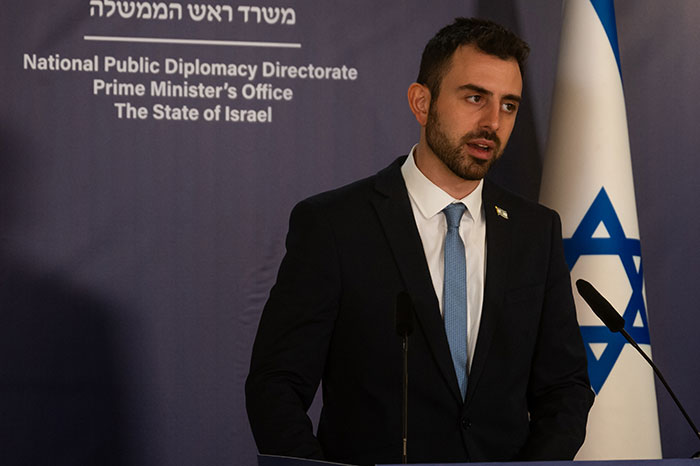
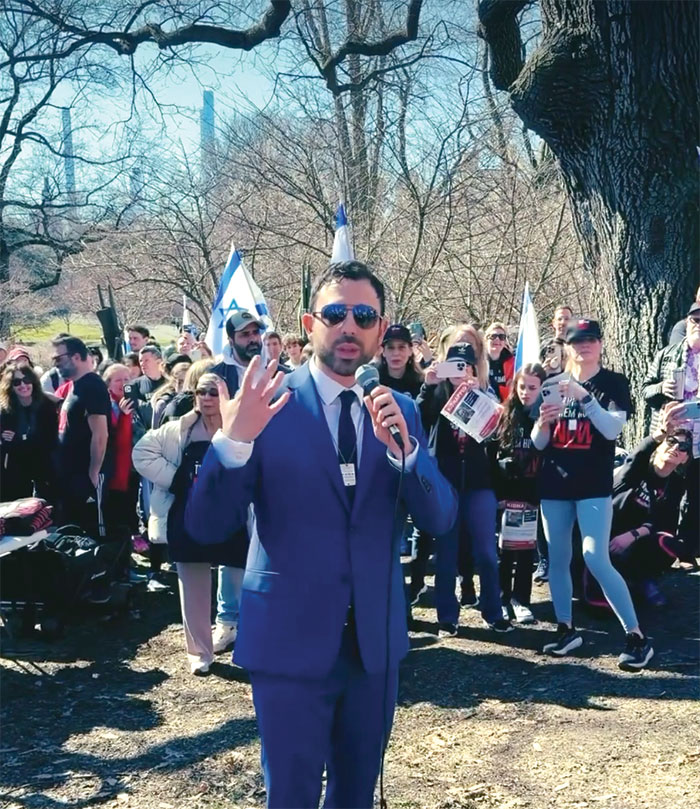
Eylon Levy speaking in New York (Screenshot from Twitter)
“It’s important to remember, Iran has been attacking Israel every day since Oct. 7, and for decades before—through its proxies,” he said. “With its massive and unprecedented attack, Iran stopped hiding behind its proxies and stepped out of the shadows. People are anxious, but in any normal country, you’d expect reports of an imminent Iranian missile strike to spark riots and looting. Israelis are going on with their lives, because they know you can’t let the bullies disrupt normal life.”
Israel has gotten through worse, and they’ll get through this, too.
“The leader of Hezbollah once gave a speech comparing Israel to a spider’s web, saying that with a little pressure, we would snap and break,” he said. “But a spider’s silk has five times the strength of steel. Israeli society is tremendously resilient and dynamic and has a powerful source of strength that other countries only hope they could tap into.”
“We embrace life and live it. I am optimistic about the future of our country, and of our people.”
He continued, “We’re used to trying to find normality in the most abnormal circumstances. We embrace life and live it. I am optimistic about the future of our country, and of our people.”
One verse, five voices. Edited by Nina Litvak and Salvador Litvak, the Accidental Talmudist
And [as for] the one who does not know to ask, you open for him. As the Torah says, “You must tell your child on that day, saying, ‘For the sake of this, HaShem acted for me when I left Egypt.’”
– Passover Haggadah
Yehudit Wolffe Founder, Bais Chana of California and KosherSofer.com
At the Seder we will be telling the son “that doesn’t know how to ask”: “For the sake of THIS Hashem acted for me when I left Egypt.” This son will ask what is “THIS”?
What causes Hashem’s miracles? Why did G-d allow evil/suffering before miracles? Chassidus delves deeply into these questions: To see our pain; G-d hiding; a confused world; evil within the plan of creation.
G-d’s plan is for us to see an infinite G-d in a finite world, for us to bring the world to its ultimate intention/purpose which is to understand an infinite G-d. Can limited humans see an infinite G-d? YES! The Lubavitcher Rebbe clarified: Evil, a cover of truth, only has power if we consider it powerful and valid. When we follow Hashem’s will, and act with goodness, evil has no power. It cannot frighten/overpower us. Through us persevering with good deeds during dark times, doing Hashem’s will, we overpower evil … by revealing the truth: the power of an infinite Hashem in this world! Our light expels darkness! We see Hashem performing miracles.
How do we persevere with conviction and empowered leadership being forces of good? We have power by understanding Torah, internalizing the teachings of Hashem; His will and wisdom, especially with the inner dimensions of Chassidus we understand/become G-dl’y conscious.We see Hashem continuously performing miracles for us! Doing goodness/kindness despite darkness, breaking veils, exposeing miracles/our purpose in creation. By thanking/acknowledging Hashem we complete G-d’s intention for us. Thank you Hashem!!!
Rabbi Chaim Singer-Frankes Multi-Faith Chaplain, Spiritual Care Guide, Kaiser Panorama City
The Passover seder is modeled on the classical Greek symposium, inviting each of us at the table to become a philosopher. With that first glass of wine, we may exit our narrow intellectual and spiritual slaveries and let the Haggadah refract each of us in rays of personal insight. Every page illuminates a palace to be explored for innermost truths. But of them all, the “four children” invite us to the most captivating introspection. The sons enchant as arresting archetypes, and with each year we recognize different aspects of ourselves nestled within them. We fathom which son to identify with, locating one to express our particular nature. From lowliness to curiosity, discernment to radical selfishness, wisdom to tongue-tied naivete.
Indeed, with the fourth son, the Haggadah’s authors may have concealed that most imperative quality so easily dismissed: Awe. Curious and ironic, it is the fourth child who in his mute astonishment may in fact “say” the most. Maybe it is the improbable and outlandish notion that “God was present for all of it” which leaves this child dumbfounded. Consider things which leave you agape or utterly breathless. The spectacle of our deliverance from bondage? Well sure! But isn’t it all a Divine pageant: A breathtaking sunset, a few bars by Mussorgsky, or the miracle of birth? With God as gem cutter, even pedestrian facets of daily life bedazzle and inspire us to apprehend that what we don’t know is the gateway to eternity.
Rabbi Yoni Dahlen Congregation Shaarey Zedek, Southfield MI
The brilliance of the Passover Haggadah comes from its ability to transcend. The Haggadah isn’t just a map for navigating the Seder; it’s a map for navigating our hearts, our minds, our neshamas.
Case in point, this incredible section known as the Four Children, which encourages the seder participants to witness the diversity of human thought and emotion, but also, critically, to recognize that diversity within the complexity of the self. We are all four of the children, and also, without contradiction, none of them. We change: We take steps forward, we take steps backwards. We can be at our best, and we can be at our worst. And so as far as that paradigm of the Four Children goes, the “child who does not know how to ask” is us at our most vulnerable. It’s not an explosion of emotion like the “wicked child,” and it’s not a display of sagacity like the “wise child.” It is a humble acknowledgement of life’s complexity by embracing the awe and wonder of Creation.
It is a moment of taking everything in: Slavery, redemption, freedom, responsibility, and getting our voice caught in our throat at the overwhelming immensity of it all. And in a way, that is the holiest response imaginable. It is pure. Not sullied by our attempts to articulate the ineffable. Not refracted to make sense of that which is beyond our understanding. It is a true moment of freedom. And on Pesach, it is freedom that we seek.
Maharal of Prague understands this “know” not as brain-knowledge, but connection-knowledge (as in “Adam knew Eve”). This unconnected child, perhaps adult in years, fails to ask because he is indifferent. Is his indifference antagonistic or benign? Maharal writes that we do not know.
So, we respond to his indifference not with our own indifference, but with concern and conviction, with Show and Tell™. The Hebrew instruction “you open for him” uses the feminine pronoun with the masculine verb. Not gender dysphoria, but advice to harmonize these distinct energies. As parents, we should speak with one voice. As Jews, we ought to invite, interest and encourage one another in the richness and responsibility of our “emunah” (faith). These need to be done with genuine camaraderie and honesty.
And if it arises, acknowledge your own apathy toward Torah and mitzvahs. Don’t turn your back on it. Take yourself in hand. Show and tell your child/self that “for the sake of my mitzvahs HasShem acts for me. He’s involved in my life. He liberated me and gave me the privilege and opportunity of being a Torah-living Jew. That’s freedom! May your Afikomen present be ever-renewing enthusiasm for faith in HasShem, His Torah and all His people — including you!
Yehudit Garmaise Freelance writer, Master’s Degree Student of Marriage and Family Therapy
Instead of falling into despair about our hostages, worldwide antisemitism, and escalating attacks on Israel, chas v’shalom, Rebbe R. Hershel’le of Rimonov, encourages us to try to be more like the child who does not know how to ask questions. “Believe me,” the Rebbe would say, “The children who do not know how to ask do better than all of them. The simple emunah [faith] of such children is so strong and confident that they don’t feel the need to question, nor complain.”
“When we say ‘Shema Yisroel,’ says Reb Elimelech Biderman, “we cover our eyes because only when we aren’t looking around, speculating, wondering, nor doubting, can we truly feel, ‘Hashem Echad.’” Jews who allow the news to infuriate them, expend energy deflecting illogical and hateful arguments, and tirelessly engage on social media “will end up understanding much less than Jews who go with temimus [purity],” says Reb Biderman.
The Haggadah urges us to remind each other and our most pure, believing selves: “Hashem acted on our behalf when we left Mitzrayim.”
We don’t know how or when, but we need to stand strong and daven. We must bolster our faith and trust in eventual victory, safety, and freedom. “The process of recovery is a rewriting of our story,” says Rabbi Joey Rosenfeld. We know how this story ends and ultimately, we will write it.
For Am Yisroel, Pesach reminds us, Hashem will bypass His usual rules of nature to give us reasons to sing in gratitude and celebration.
In 1995, Audrey Ickovits was an electronics engineer. In the 49th mile of a 50-mile bicycle tour, she inexplicably fell, suffered a concussion and was laid up for months.
“It was Tisha b’Av/Shabbos,” she recalled. “I started studying Kabbalah after that.”
Two years later, she was diagnosed with breast cancer. “Hashem called me twice,” she said. “The second time I got it really right.” Piecing her life back together, she decided she wanted to study mysticism, “whatever that is.”
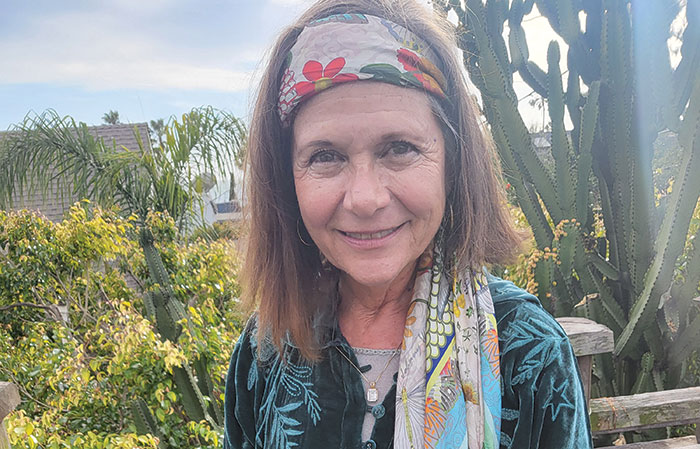
Today she is Rabbi T’mimah Ickovits, ritual leader, spiritual companion and founder/leader of Holistic Jew, a center for devotion and study near the ocean in Santa Monica. After an 18-year engineering career, her life abruptly changed. “I have always loved God,” she said. “I wanted to know God better. I was curious.”
For more than a decade, Rabbi T’mimah studied with leading scholars, including Rabbi Jonathan Omer-man at Metivta, a center for contemplative Judaism, and Rabbi Zalman Schachter-Shalomi, father of the Jewish Renewal movement. When Audrey Ickovits was diagnosed with cancer, Reb Zalman suggested Audrey become T’mimah. “T’mimah,” she explained, “has a gematria of 495– 4 plus 9 plus 5 is 18, chai. That is what I wanted.”
”How does Hashem manifest Kabbalah? One way is through the absence or presence of light.”
Talking about 2007, Rabbi T’mimah, the erstwhile engineer explained her career change: “I tell people my last job in industry was helping people test absence or presence of light through technology. It segues back into loving and studying Kabbalah, which also is, how does Hashem manifest Kabbalah? One way is through the absence or presence of light.”
While Kabbalah may be an impenetrable mystery to some Jews, for Rabbi T’mimah, it was revelatory. “I like structure, and there is a structure in Kabbalah where we can track how the universe operates,” she said. As for a link between Kabbalah and engineering, she swiftly identified the absence and presence of light as a foundational link. Math is another link; an appreciation for numbers and the potency they have.
The tinkling of a Moroccan mobile provided the soundtrack, as the rabbi seated comfortably on a balcony of her two-story home and surrounded by the greenery she passionately loves, reflected on her second life. From where does she seek guidance? “Hashem for sure, tradition for sure, nature for sure.”
Enjoying her pleasant surroundings not far from the Pacific Ocean, Rabbi T’mimah said she feels as if she has been preparing for these qualitative moments her entire life. “The thing about Kabbalah,” she explained, “is not about it being out there, esoteric. It’s about bringing it home. It’s about seeing Hashemin nature. Take nature – the 12 simple letters, the 12 tribes, the 12 constellations of the Zodiac, the Secret of 12. All are interconnected. It becomes like wheels turning, getting a sense where the synchronicity is and what the message is. It is tracking nature.”
Marriage between Earth and science is one of the rabbis passions. She identifies three circles: Earth spinning on its axis every 24 hours, Earth orbiting the sun every 365¼ days, moon orbiting Earth every 29-plus days. “Those three aspects define Earth’s space-time continuum.,” she says. “This is ours. This is what Jewish practice is based on.”
Rabbi T’mimah laughs when asked if she feels isolated, since a relatively small portion of the Jewish community shares her passion for this dimension. “There aren’t many people I can talk to about these things, but I have friends I can call from time to time.” Asked what turned her toward the rabbinate, she said “I had no idea Judaism was this cool.”
In her student days at Hillel Hebrew Academy and Yavneh, Audrey Ickovits wanted to be Mary Tyler Moore: the iconic hat she flings through the air, the cool businesswoman. In the classroom, she remembered being told what she couldn’t do on Shabbat, “but no one told me what I get to do on Shabbat.” She reflected on the late ‘60s and mid-70s as a post-Shoah environment.“Everybody was scared of getting the rules wrong. Fear. Don’t make God angry.” She learned the opposite from Reb Zalman. He urged his students to serve God with joy. “I didn’t get that growing up in yeshiva, or maybe it was there and I didn’t see it,” Rabbi T’mimah said.
“I try to pay attention to what Hashem wants from me,” she says. “There’s not a whole lot I want. I am happy and content. I really want to be of service.”
The rabbi also davens and is active at the Shul on the Beach. As a member of the Green Team, “we have agreed for Kiddush to compost all of our paper plates and table cloths. [Fellow congregant] Kelsey Liber and I dreamed that up together. Probably the first Orthodox shul in Southern Cal that is composting.”
At Holistic Jew, Rabbi T’mimah hosts Shabbat services about once a month and a Shabbat afternoon service — all this apart from learning sessions. She also has compiled the “Holistic Jew Weekday Shahareet Siddur.”
All food at community meals is ethically sourced. “Much of it is grown right here,” the rabbi said. “For Passover, we do karpas that is really fun from all these different spicy and wheat leaves [framing her property]. Our meat is ethically sourced, 100% pasture-raised.”
Is she where she wants to be in her life? “No, not quite,” Rabbi T’mimah said. “I would like to have more impact. I have Torah to teach, and I want to reach more people. I need to tell everyone how amazing Jewish practice is – it honors the time cycles, it tells us how we can meet the Holy One in our space/time continuum. I love davening, and teaching people how to daven. It’s exciting.”
Fast Takes with Rabbi T’mimah
Jewish Journal: Your favorite moment of the week?
Rabbi T’mimah: Receiving Shabbat.
J.J.: Your favorite Jewish food?
RT:Latkes. I was born on the seventh candle of Hanukkah.
J.J. Your main unfulfilled desire?
RT: To share more Torah far and wide. To find ways to meet the hearts of people and let their hearts be expanded with Torah.