On opening night of Ronald Harwood’s "Taking Sides," revolving around Hitler’s favorite conductor, viewers accosted the playwright. A woman said, ‘How could you do this to such a great artist?’" Harwood recalled. "Then a man grabbed me and said, ‘Wilhelm Furtwängler was an absolute s—.’ So I thought I’d done my job rather well."
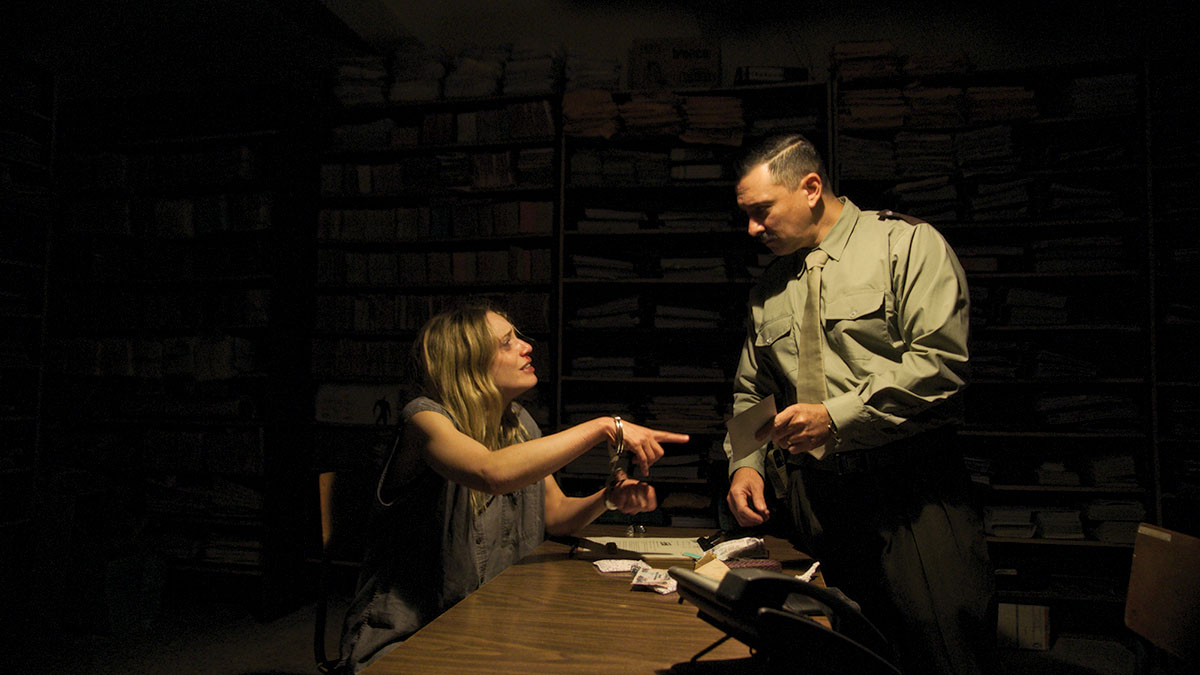
His 1996 play, now an Istvan Szabo film, pits Furtwängler against a brash fictional American interrogator out to nail "Hitler’s bandleader" in denazification proceedings.
In the film, Furtwängler (Stellan Skarsgård) insists he remained in Germany rather than cede his culture to the Nazis and that he used his clout to save Jews.
Maj. Steve Arnold (Harvey Keitel) counters that Furtwängler made only token efforts at resistance while supporting the murderers, including performing at Hitler’s birthday. In return, the maestro enjoyed a lavish lifestyle and numerous mistresses.
Speaking from his London home, the droll, precise Harwood — who won a screenwriting Oscar for "The Pianist" — said he tried not to take sides while writing the play and the film.
"I attempted to make both arguments compelling because I want viewers to ask themselves what they would have done in Furtwängler’s place," he said. "’Was protesting from the inside a legitimate moral response to Hitler? Can art remain separate from politics?’ These are some of the questions I want people to explore."
The film is the latest in a body of work on the moral ambiguities of the period, including Michael Frayn’s play, "Copenhagen" and Tim Blake Nelson’s Auschwitz-themed drama, "The Grey Zone."
Harwood’s analysis of an artist’s responsibility under a dictatorship personally resonated for the Hungarian Szabo ("Sunshine"), who survived the communists and won a 1981 Oscar for "Mephisto," about a Nazi-era actor.
"The audience must be able to pick up on the contemporary dilemma in the conflict," he said of "Taking Sides." "Is it right and justifiable to survive a dictatorship by compromises?"
Harwood continued to field criticism as the film opened in New York earlier this month.
"I still get angry letters from people saying I’ve got it all wrong," he said. "Many Americans in particular can’t bear Maj. Arnold, whom they regard as a caricature, a bully, a Philistine. But I always point out that he’s the only character in the entire piece who talks about the dead. Everyone else talks about art and music and culture, but Arnold has seen the carnage at Belsen and it haunts him."
Harwood (né Horwitz), 68, was similarly haunted by concentration camp footage he saw in his native South Africa at age 12.
"The Reform synagogue took all the Jewish children to see these awful newsreels, and it had a terrible effect on me," he said. "I had nightmares, and it’s scarred me all my life."
Meanwhile, Harwood’s father, who had fled Lithuanian pogroms, regarded apartheid as someone else’s problem.
"He’d say, ‘Just thank God it isn’t us,’" the author said. "It was a prevalent sentiment among Jewish refugees in Cape Town after the war. But it seemed to me that oppressed people should care about the fate of other oppressed people."
Harwood, for his part, wrote several anti-apartheid novels after moving to England to attend the Royal Academy of Dramatic Art in 1951. After his 1980 play, "The Dresser," was made into an Oscar-nominated film, he served as president of the human rights organization International PEN.
But eventually, he began to feel uneasy about taking sides from a distance.
"It was quite fashionable and risk free to criticize South Africa from London," he said wryly. "I was extremely brave, from 6,000 miles away."
Harwood wondered how outspoken he would have been had he lived in a totalitarian society — which is why he was riveted by a 1994 book on Furtwängler’s dilemma.
"I loved the ambiguity of his case," said the author, who views Hitler’s favorite filmmaker, Leni Riefenstahl as an "unabashed Nazi."
He went on to comb archives for denazification transcripts and to interview officials who had supervised such proceedings.
"They were morally brutal," he said. "They bullied people, and they did behave in an extreme way. But they had just seen the camps, and no one in the world had seen that before."
After director Roman Polanski saw "Taking Sides" in Paris, he asked the author to write another film involving music and the Holocaust, 2003’s "The Pianist." But even Polanski doesn’t know which side Harwood personally takes regarding Furtwängler.
"Look, I won’t even tell my wife," Harwood said.
"Of course, I might leave a little note to be opened after my death," he added, coyly. "But I want audience members to make up their own minds. I don’t want them to think I’m plugging a line."
The film opens today in Los Angeles.