For most Americans, Deuteronomy is an unlikely book to read as the nation continues to commemorate America’s 250th anniversary. It should be toward the top of the list.
As anyone who has been to synagogue these past couple of months for the public reading of the last of the Five Books of Moses can tell you, the great Jewish leader’s farewell address is devoted largely to a question that every free people eventually confront: What do you do with liberty once you have obtained it?
No wonder, then, that the Puritan leader John Winthrop, in establishing the Massachusetts Bay Colony in 1630, instructed his community to recall the “exhortation of Moses, that faithful servant of the Lord, in his last farewell to Israel, Deut. 30. Beloved there is now set before us life and good, Death and evil, in that we are commanded this day to love the Lord our God, and to love one another, to walk in his ways and to keep his Commandments … that we may live and be multiplied, and that the Lord our God may bless us in the land whither we go to possess it. But if our hearts shall turn away, so that we will not obey, but shall be seduced, and worship and serve other Gods, our pleasure and profits, and serve them; it is propounded unto us this day, we shall surely perish out of the good land whither we pass over this vast sea to possess it; Therefore let us choose life that we, and our seed may live, by obeying His voice and cleaving to Him, for He is our life and our prosperity.”
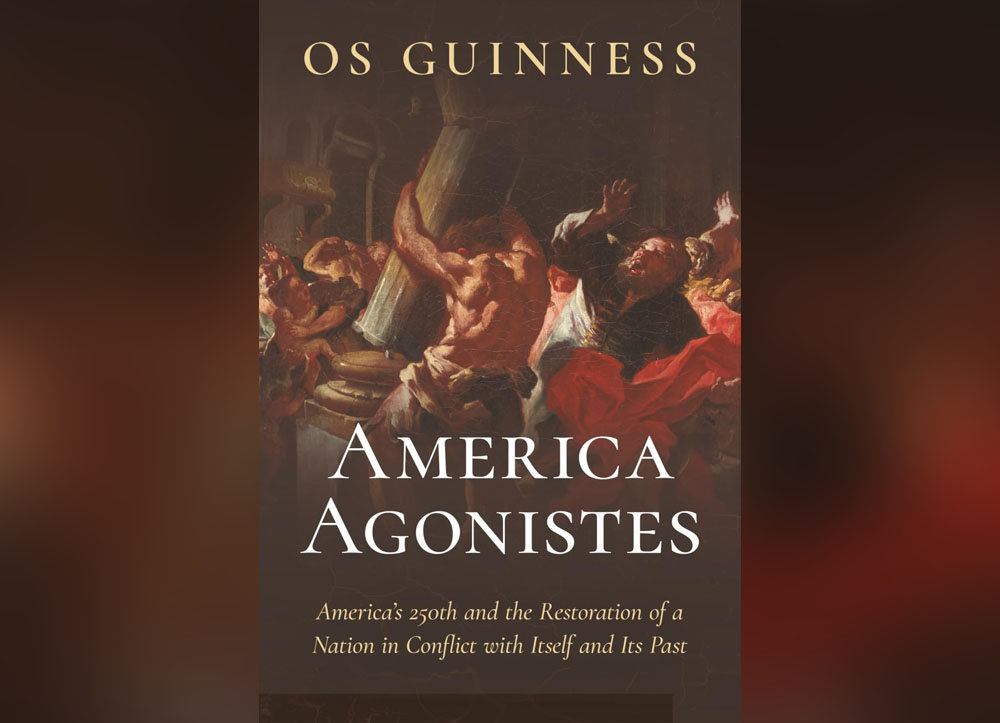
Remembering how Deuteronomy’s directions have served as a clarion call for our country’s character sits at the heart of Os Guinness’ “American Agonistes,” a meditation on the sources and future of American freedom.
Guinness argues that Americans have never fully appreciated how deeply their understanding of independence was shaped by the Hebrew Bible in general and the themes of Deuteronomy in particular.
While historians tend to tell the story of American liberty through the prism of Athens, Rome, and the Enlightenment, Guinness asks us to look further back — to the border of the Jordan River. The biblical idea of covenant, lyrically and lovingly articulated in Moses’ last words, supplied a distinctive way of thinking about freedom. Human beings, Moses reminded the Israelites, are capable of choosing. Their decisions matter. Their freedom creates obligations. A covenant makes a people responsible for one another. “Socrates was right,” Guiness writes, “the unexamined life is not worth living … But the Hebrews were right too: the uninstructed life is not worth living, and the prize this wisdom offers is a good life and a good society.”
Of course, Exodus has received some credit as the great story of independence, serving as a source of America’s fight for freedom from Britain. As President Calvin Coolidge put it in 1925, “It required no great stretch of logical processes to demonstrate that the children of Israel, making bricks without straw in Egypt, had their modern counterpart in the people of the colonies, enduring the imposition of taxation without representation.”
But Deuteronomy designs the next steps, asking what happens after liberation. Moses understood that the dangers ahead in the Promised Land were different from the dangers they had left behind. In Egypt, the problem was oppression. In the wilderness, it was survival. In the land, the challenge for the Israelites would be remembering who they were and what their role was as a society.
The land itself was an inheritance, a great privilege coming with responsibility on the part of both the collective and the individual. While “You are a people consecrated to the Lord your God” (Deuteronomy 14:2) is a communal charge, it is every woman and man who are told “You shall love the stranger, for you were strangers in the land of Egypt” (Deuteronomy 10:19). The treatment of those suffering though trying times becomes a test of the character of the society.
Freedom, in Deuteronomy, is therefore a political and moral project. As Guinness elaborates: “Covenantal citizenship … demands responsibility, initiative and the confident engagement of every citizen in the public affairs of the community and nation. Translated into American terms, every American is responsible for the American Republic, and the condition of the American Republic is the health of the relationships of American citizens at large. Like the Hebrew Republic, the American Republic should always be cherished with the strength of liberty, loyalty and love.”
That is a strikingly different conception of citizenship from the one that dominates so much of contemporary political life. The citizen is not simply someone who possesses rights and expects government to protect them. She is a participant in the fate of the republic.
Deuteronomy makes the same point repeatedly, and it does so through remembrance. “Take care and watch yourselves scrupulously, lest you forget the things that you saw with your own eyes” (Deuteronomy 4:9). Later, Moses warns, “Take care lest you forget the Lord your God” (Deuteronomy 8:11). The Israelites are entering a land of abundance, and Moses understands that abundance itself can become a danger. “When you have eaten your fill, and have built fine houses to live in … and your silver and gold have increased … beware lest your heart grow haughty” (Deuteronomy 8:12–14).
As Guinness puts it: “The truth is that freedom is always the greatest enemy of freedom. Forgetting is a more dangerous cause of decline than external foes. Ease and prosperity are harder on enduring freedom and responsibility than crisis and war.”
In our age, in which previously unimaginable technology is at our fingertips, deaths of despair and loneliness continue to plague our country (though social media companies would claim we are more connected than ever) and radicals on both left and right offer ahistorical articulations of our country’s ethos. “Our pleasure and profits,” to cite Winthrop, have clouded our sense of purpose. What Guiness calls a “cultural climate change” has resulted in faith being marginalized, truth relativized, relationships fraying and trust — the social foundation of freedom — collapsing.
Deuteronomy’s recipe for national renewal is therefore more urgent than ever as we seek to remember the revolution and revelations that came before us.
We should remember the generations who built the country, fought its wars, expanded its freedoms and sacrificed for institutions they would never live to see fully developed.
We should remember the religious and moral traditions that shaped American ideas about human dignity and equality.
We should remember that the American experiment was never simply an exercise in individual autonomy — it was and is a project in self-government, a project that asks our soul to choose soundly.
At a moment in which antisemitism is finding a constantly-growing audience in parts of American society, there is something particularly perverse about forgetting how deeply Jewish ideas helped shape the country in which that Jew-hatred now appears.
“I have put before you life and death, blessing and curse. Choose life” (Deuteronomy 30:19). In this year of national reflection, Moses’ words beckon, asking us to consider: What have we inherited? What did it cost? What are we doing to preserve and protect it? What are we teaching our children about the meaning of freedom? Will they receive from us a country whose citizens understand that liberty requires character, gratitude and responsibility?
Moses’ speech was addressed to people standing on the threshold of a new chapter. The American story is similarly turning a new page.
The Israelites had been given their freedom. Now they had to learn how to live with it and how to choose.
So do we.
Rabbi Dr. Stuart Halpern is Senior Adviser to the Provost of Yeshiva University and Deputy Director of Y.U.’s Straus Center for Torah and Western Thought. His books include the newly released “Jewish Roots of American Liberty,” “The Promise of Liberty: A Passover Haggada,” “Esther in America,” “Gleanings: Reflections on Ruth” and “Proclaim Liberty Throughout the Land: The Hebrew Bible in the United States.”