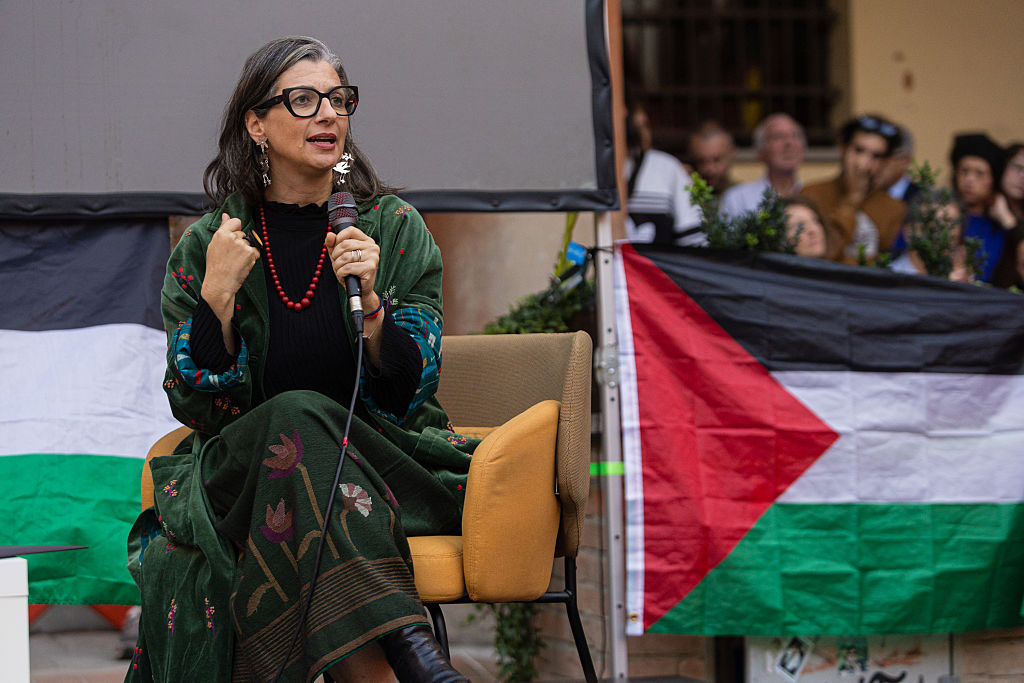
This summer I traveled to Spain, Gibraltar and Portugal. There were many highlights, but perhaps the most unexpected came in one hour in Granada, Spain. Through a former student and now cherished colleague, I was connected to a documentary filmmaker and tour guide, who arranged for me to meet a woman named Batsheva.
Batsheva is an Orthodox Jew from Paris whose ancestors lived in Spain until the expulsion in 1492. At 18, despite her parents’ objections, Batsheva moved to Granada. Today, she and the family she created are one of only five Jewish families there.
Batsheva told me that the locals don’t really talk to her and that while she has her house in Granada, she “lives” in Malaga, where she travels every week — except during the short winter days when Shabbat starts too early.
“Why do you stay?” I asked her.
She gave me two reasons.
First: family legacy. What she inherited from her Spanish ancestors was hers to reclaim and carry forward.
Second: She motioned toward the space in front of us. The entire bottom floor of her house is a museum of Spanish Jewry, one she created single-handedly, with no government assistance.
Why?
“I have to tell the story,” she said.
I haven’t stopped thinking about her response and knew almost immediately that I needed to share her story as we begin the new year, which begins at sundown on Sept. 11 with Rosh Hashanah.
Perhaps we are all Batsheva with the same questions: If I don’t tell the story, maybe the story won’t be told. If I don’t make Shabbat, maybe there won’t be a Jewish Shabbat here.
What would become essential? What would be yours to carry? What would keep you going?
These questions take us to the Jewish idea of shlichut — mission, responsibility, vocation. What is mine to do?
The Mishnah Sanhedrin teaches: “Therefore, a single human being was created. Therefore, every person must say bishvili nivra ha’olam — for my sake the world was created.”
Listen to the first-person language: bishvili — for my sake. Not simply: I am valuable. Something has been placed in front of me. The world has been entrusted to me. And the same Mishnah teaches every other person the exact same thing.
Bishvili nivra ha’olam is not narcissism. It’s responsibility.
My life matters. And so does yours. I have something that only I can contribute. And so do you. That is the very essence of shlichut. We are not simply here to ask: What do I want to do? We are here to ask: What have I been given — and for what?
We are more than what we do. Beyond tasks or titles is a more fundamental question: Who are you becoming? And for what?
A career asks: What do I want to do? Divine mission asks: What is being asked of me?
God says to Abraham: “Lech Lecha — Go forth from your land.”
Literally, something like “Go to yourself.” Abraham is told to leave the place that has defined him before he knows who he will become.
That is an important image for entering this Jewish year. None of us are finished products. We have histories, assumptions, strengths, questions, dreams and fears. And I am certain that this year, each one of us will change.
Something will challenge that which you thought you knew. Someone will teach you the unexpected. You might try something new and fail — and perhaps, as I learned from my teachers, fail better. You may discover that the person you thought you would become is not the person you are meant to become.
That is lech lecha. The journey outward becomes a journey inward.
The Torah marks Abraham’s transformation with a change in name from Avram to Abraham. He is still himself. But he is not exactly who he was.
That is what formation means — becoming more fully yourself. A self stretched by life, community, responsibility and encounter and identified by your own unique mission.
Who are you becoming, and toward what?
There is no one single path to purpose. Sometimes it is revealed through a commandment or a need in the world; sometimes through the gifts we have been given or the particular life we have been given.
The Yom Kippur liturgy includes a strange piece: “My God, before I was created I was not worthy, and now that I have been created it is as though I had not been created.”
What could it mean to say that before I was created, I was not worthy?
Rav Abraham Isaac Kook points out the most basic fact imaginable: I wasn’t here.
Before I was created, there was an almost limitless expanse of time in which I did not exist. If my particular existence had been necessary earlier — if there were something only I could have contributed — then I would have been created earlier.
But I wasn’t.
I was created now. Because, as he continues: “the time has arrived when I am needed to fulfill something toward the completion of reality.”
What a remarkable claim. Your existence at this moment is not simply a chronological accident. It is in this this time, this world, this reality in which your presence matters.
And our own life circumstances may contain clues to what is ours to do.
Why was I born when I was born? Why this moment? What have I inherited? What does the world look like because I am here?
Simply being created is not enough. The question is what we do with the fact that we have been created.
The answers may change. The world changes. We change. What the world needs from us changes. Divine purpose isn’t necessarily about discovering some grand, hidden destiny. It may simply be learning to ask:
Given the life I have actually been given, what is being asked of me now?
I’m not sure if Batsheva would describe her life as a divine mission. But I do wonder if Rav Kook would recognize something of his teaching in her story.
She had a place. She had a particular history. And she came to believe: “I have to tell the story.”
Not that one person completes the world. None of us could.
But there is some small piece of reality that will be different because we were here. A person we taught. A community we strengthened. A tradition we carried forward. A wound we helped heal.
Entering this year, ask yourself these significant questions.
What does this particular world need from who I am becoming?
What is mine to carry? To teach? To repair? To do?
To do so, however, we also have to let go of some things.
First: Let go of the need to know exactly where the journey ends. Abraham is told: Go. He isn’t given a plan or a map.
Can we ask instead: What am I learning right now? What is the next step?
Second: Let go of comparison.
Pirkei Avot asks: “Who is rich? One who rejoices in their portion.” Their portion, not someone else’s.
This year, let go of comparison. Ask instead: What is my portion — and what am I going to do with it?
Third: Let go of the illusion that you must do it alone. We Jews pray in the plural — heal us, forgive us, bless us. Not me. Us. That is the genius of havruta: two people encounter Torah together, and each sees something the other cannot.
We need one another to become who we are capable of becoming.
I want to return one last time to Batsheva.
She could have looked at a Jewish community of just five families and concluded that nothing she did would matter.
Instead, she reached the opposite conclusion:
Because there are only five of us, what I do matters.
And she acted.
That is what I hope for everyone this year.
Not that you figure out your entire life. Not that you become perfect. Not that you know exactly where you are going. But that you begin to listen for what is yours.
What have I inherited that I am responsible for carrying forward?
And, if you don’t know the answers, that’s okay.
Every day, we have the opportunity to ask those questions better — to sit with them longer, to listen more deeply and to allow the answers to emerge.
At first, we may ask: What do I want to do with my life?
And eventually we may learn to ask:
What does my life ask of me?
That is the beginning of shlichut. And perhaps it is also the path to self-fulfillment.
So as we begin this year, I want to bless you that you listen deeply; allow life to unsettle you as well as inspire you. Let yourself be changed. Discover your portion. Have courage to take the next step before you know the whole path.
May you come to understand that the person you are — with your particular gifts, experiences, limitations, passions and possibilities — is not incidental to your calling. It is the essence from which your shlichut will be made.
And may you have the courage to say, as Batsheva did:
I have to tell the story.
I must repair this piece of the world.
This is mine to do.
Rabbi Cheryl Peretz is the interim dean at American Jewish University’s Ziegler School of Rabbinic Studies. She delivered these remarks at a luncheon marking the new academic year at the Ziegler School.