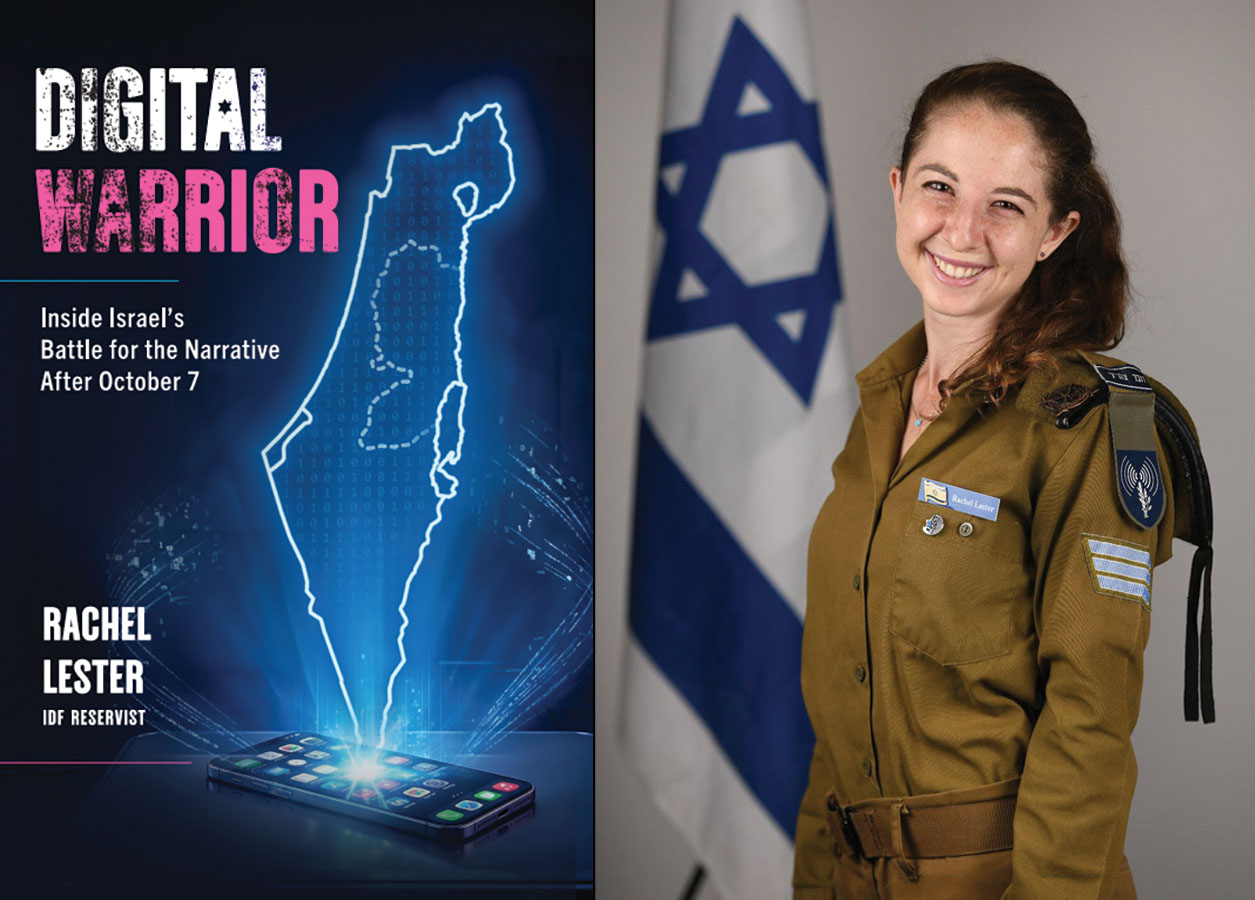
One of the most intense chapters in Rachel Lester’s new book, “Digital Warrior: Inside Israel’s Battle for the Narrative After October 7,” comes when the action stops being about missiles, troops or politicians and moves into an internal group chat.
Lester recounts the hours surrounding the Al-Ahli Hospital explosion in Gaza, Oct. 17, 2023. Members of the IDF Spokesperson’s Unit tried to determine what had happened while reports blaming Israel spread across the world. The IDF concluded that a Palestinian fired a rocket misfired and hit the hospital.
“The night of the explosion at Al-Ahli Hospital was, bar none, the most interesting event in the entire war. It’s definitely the story I’m most excited to be sharing with you,” she writes. She goes through minute-by-minute what was going on behind the scenes in the spokesperson’s unit when the Al-Ahli Hospital incident happened and reveals what was going on in an internal group chat in search of truth. She chronicles the frustrations of everybody in the unit who was trying to get some sort of information out.
“We were being told that we couldn’t yet, and I was afraid that the IDF would ask me to take that out [of the book] because it was kind of revealing a somewhat inside scoop, revealing somewhat personal details, but they didn’t take it out,” Lester told The Journal. “They didn’t have any problem with it, thankfully.”
That section captures what makes “Digital Warrior” work. Lester, a Los Angeles native who made Aliyah and served in the IDF Spokesperson’s Unit, brings the reader into the communications operation during the war: the videos, arguments, mistakes, debates over what to post and the race to respond to events moving faster than any communications office could control. The book moves through Oct. 7, Gaza evacuation orders, Al-Ahli, Shifa Hospital, hostage releases and rescues, campus protests, Hezbollah and the war with Iran.
Lester is also willing to tell the reader where she thinks Israel got things wrong. In one of the book’s final chapters, Lester criticizes IDF soldiers who brought phones into Gaza and Lebanon, filmed themselves and posted inappropriate material. At the time she wrote it, Lester thought the punishment was inadequate. But after the book was published, Lester said a combat commander told her that soldiers can face punishment and removal from combat or reserve service for misconduct. She has since changed her tenor.
“I wish I could clarify that or take that sentence out and add like, ‘I guess what I’ve been really frustrated about is actually happening and I just didn’t know,’” Lester said. The book captures snapshots of wartime Israel alongside Lester’s reflections on where its communications efforts succeeded and failed. Some details have changed since Lester finished writing it, but that does not diminish what the book offers: an account of how Israel tried to make its case during a war in which the information battle could shift from one hour to the next.
Lester is just as willing to criticize mistakes made by Israel’s supporters in the Diaspora. Asked what Americans who care about Israel should keep in mind when talking with people outside the Jewish community, Lester started with one of the most loaded words in the conversation.
“A couple of things that are important for me is that I think people should not call everyone ‘an antisemite’ or [anyone] that they don’t like ‘antisemitic’ because the word has really lost meaning recently or really not even so recently in the last decade or so,” Lester said. “A real antisemite won’t care that they’re being called an antisemite. But a person who means well, criticizing something that they feel passionately about, if you call them an antisemite, you’re just shutting down the conversation and pushing them further toward real antisemites.”
She writes, “Young troops and reservists alike should be reminded before every single mission what’s at stake if they post something inappropriate. This kind of education needs to come from home, too: The Israeli public needs to stop idolizing soldiers and shame them for their bad behavior instead of excusing it or ignoring it (or worse, encouraging it.)”
She told The Journal, “even though Israel is amazing and the IDF is incredibly moral and probably is really the most moral army in the world, saying these kinds of things and putting them into the zeitgeist, I would say just put its expectations in a really unrealistic place.” Lester said that view leaves supporters unprepared when a soldier acts outside IDF values.
“And then as soon as one soldier does something that is not in line with the IDF’s values, then this perception kind of crumbles and American Jews don’t know how to move forward and often just stop supporting Israel completely,” Lester said. “Whereas if you just had more realistic expectations, then it wouldn’t be such a dramatic shift to handle bad news.”
Some of her own most viral videos show the range of Lester’s “Rachel In Reserves” Instagram account, which has more than 15,000 followers. In some posts, Lester makes direct arguments about responsibility in Gaza: she has argued that anger over civilians having few places to go should be directed at Hamas for creating those conditions. She’s challenged the U.N. to hold Gaza’s government accountable. She responded to the Jabalia camp strike in October 2023 by calling the aftermath “awful” while arguing that a Hamas leader had chosen to operate from a refugee camp. On the flip side, in a facetious reel posted this past spring, Lester mocked Iranian claims that “Israelis are afraid to leave their homes” — so she posted a video showing her and fellow Israelis doing some outdoor morning Zumba.
The final piece in the book is an afterword about PTSD and seeking mental-health care. To address her traumas since Oct. 7, she only had two appointments with an IDF psychologist in early 2024. After over a year of resisting treatment, and being fired from her job, she checked herself into an inpatient mental health care facility for a week. Lester wrote the chapter on the day she sent the book to the publisher.
When asked what supporters of Israel in Los Angeles should do if they want to help, Lester points them right back to that chapter. “Read the last chapter about my mental health —and see how important it is that you donate to causes that support mental healthcare for IDF soldiers and reservists, and really all Israelis, because I think every Israeli has some form of PTSD since the war,” Lester said. “I’ve been very vocal my entire time since I served that mental healthcare is the best way you can spend your dollars. And I would just want everyone, any potential donors, to focus on organizations that subsidize or promote mental health care for soldiers and for reservists.”
And when Lester is away from the IDF, Instagram and the book, she engages in multiple forms of daily self-care. Lester fosters dogs when she can and volunteers with SOS Herzliya —a massive dog and cat adoption event that happens every Saturday. In early 2025, Lester’s mother visited and brought a Chihuahua mix named Sadie all the way to Israel from Los Angeles.
“She’s named after the Pacific Palisades because we got her right after the fires,” Lester said.
Lester will be appearing throughout the U.S. and Canada to promote “Digital Warrior” in September and October. Details and booking information can be found on her Instagram account, www.instagram.com/rachel.in.reserves