fbpx

September 3, 2026

New Book, ‘Digital Warrior,’ Goes Inside Israel’s Message War

One of the most intense chapters in Rachel Lester’s new book, “Digital Warrior: Inside Israel’s Battle for the Narrative After October 7,” comes when the action stops being about missiles, troops or politicians and moves into an internal group chat.

Lester recounts the hours surrounding the Al-Ahli Hospital explosion in Gaza, Oct. 17, 2023. Members of the IDF Spokesperson’s Unit tried to determine what had happened while reports blaming Israel spread across the world. The IDF concluded that a Palestinian fired a rocket misfired and hit the hospital.

“The night of the explosion at Al-Ahli Hospital was, bar none, the most interesting event in the entire war. It’s definitely the story I’m most excited to be sharing with you,” she writes. She goes through minute-by-minute what was going on behind the scenes in the spokesperson’s unit when the Al-Ahli Hospital incident happened and reveals what was going on in an internal group chat in search of truth. She chronicles the frustrations of everybody in the unit who was trying to get some sort of information out.

“We were being told that we couldn’t yet, and I was afraid that the IDF would ask me to take that out [of the book] because it was kind of revealing a somewhat inside scoop, revealing somewhat personal details, but they didn’t take it out,” Lester told The Journal. “They didn’t have any problem with it, thankfully.”

That section captures what makes “Digital Warrior” work. Lester, a Los Angeles native who made Aliyah and served in the IDF Spokesperson’s Unit, brings the reader into the communications operation during the war: the videos, arguments, mistakes, debates over what to post and the race to respond to events moving faster than any communications office could control. The book moves through Oct. 7, Gaza evacuation orders, Al-Ahli, Shifa Hospital, hostage releases and rescues, campus protests, Hezbollah and the war with Iran.

Lester is also willing to tell the reader where she thinks Israel got things wrong. In one of the book’s final chapters, Lester criticizes IDF soldiers who brought phones into Gaza and Lebanon, filmed themselves and posted inappropriate material. At the time she wrote it, Lester thought the punishment was inadequate. But after the book was published, Lester said a combat commander told her that soldiers can face punishment and removal from combat or reserve service for misconduct. She has since changed her tenor.

“I wish I could clarify that or take that sentence out and add like, ‘I guess what I’ve been really frustrated about is actually happening and I just didn’t know,’” Lester said. The book captures snapshots of wartime Israel alongside Lester’s reflections on where its communications efforts succeeded and failed. Some details have changed since Lester finished writing it, but that does not diminish what the book offers: an account of how Israel tried to make its case during a war in which the information battle could shift from one hour to the next.

Lester is just as willing to criticize mistakes made by Israel’s supporters in the Diaspora. Asked what Americans who care about Israel should keep in mind when talking with people outside the Jewish community, Lester started with one of the most loaded words in the conversation.

“A couple of things that are important for me is that I think people should not call everyone ‘an antisemite’ or [anyone] that they don’t like ‘antisemitic’ because the word has really lost meaning recently or really not even so recently in the last decade or so,” Lester said. “A real antisemite won’t care that they’re being called an antisemite. But a person who means well, criticizing something that they feel passionately about, if you call them an antisemite, you’re just shutting down the conversation and pushing them further toward real antisemites.”

She writes, “Young troops and reservists alike should be reminded before every single mission what’s at stake if they post something inappropriate. This kind of education needs to come from home, too: The Israeli public needs to stop idolizing soldiers and shame them for their bad behavior instead of excusing it or ignoring it (or worse, encouraging it.)”

She told The Journal, “even though Israel is amazing and the IDF is incredibly moral and probably is really the most moral army in the world, saying these kinds of things and putting them into the zeitgeist, I would say just put its expectations in a really unrealistic place.” Lester said that view leaves supporters unprepared when a soldier acts outside IDF values.

“And then as soon as one soldier does something that is not in line with the IDF’s values, then this perception kind of crumbles and American Jews don’t know how to move forward and often just stop supporting Israel completely,” Lester said. “Whereas if you just had more realistic expectations, then it wouldn’t be such a dramatic shift to handle bad news.”

Some of her own most viral videos show the range of Lester’s “Rachel In Reserves” Instagram account, which has more than 15,000 followers. In some posts, Lester makes direct arguments about responsibility in Gaza: she has argued that anger over civilians having few places to go should be directed at Hamas for creating those conditions. She’s challenged the U.N. to hold Gaza’s government accountable. She responded to the Jabalia camp strike in October 2023 by calling the aftermath “awful” while arguing that a Hamas leader had chosen to operate from a refugee camp. On the flip side, in a facetious reel posted this past spring, Lester mocked Iranian claims that “Israelis are afraid to leave their homes” — so she posted a video showing her and fellow Israelis doing some outdoor morning Zumba.

The final piece in the book is an afterword about PTSD and seeking mental-health care. To address her traumas since Oct. 7, she only had two appointments with an IDF psychologist in early 2024. After over a year of resisting treatment, and being fired from her job, she checked herself into an inpatient mental health care facility for a week. Lester wrote the chapter on the day she sent the book to the publisher.

When asked what supporters of Israel in Los Angeles should do if they want to help, Lester points them right back to that chapter. “Read the last chapter about my mental health —and see how important it is that you donate to causes that support mental healthcare for IDF soldiers and reservists, and really all Israelis, because I think every Israeli has some form of PTSD since the war,” Lester said. “I’ve been very vocal my entire time since I served that mental healthcare is the best way you can spend your dollars. And I would just want everyone, any potential donors, to focus on organizations that subsidize or promote mental health care for soldiers and for reservists.”

And when Lester is away from the IDF, Instagram and the book, she engages in multiple forms of daily self-care. Lester fosters dogs when she can and volunteers with SOS Herzliya —a massive dog and cat adoption event that happens every Saturday. In early 2025, Lester’s mother visited and brought a Chihuahua mix named Sadie all the way to Israel from Los Angeles.

“She’s named after the Pacific Palisades because we got her right after the fires,” Lester said.

Lester will be appearing throughout the U.S. and Canada to promote “Digital Warrior” in September and October. Details and booking information can be found on her Instagram account, www.instagram.com/rachel.in.reserves 

New Book, ‘Digital Warrior,’ Goes Inside Israel’s Message War Read More »
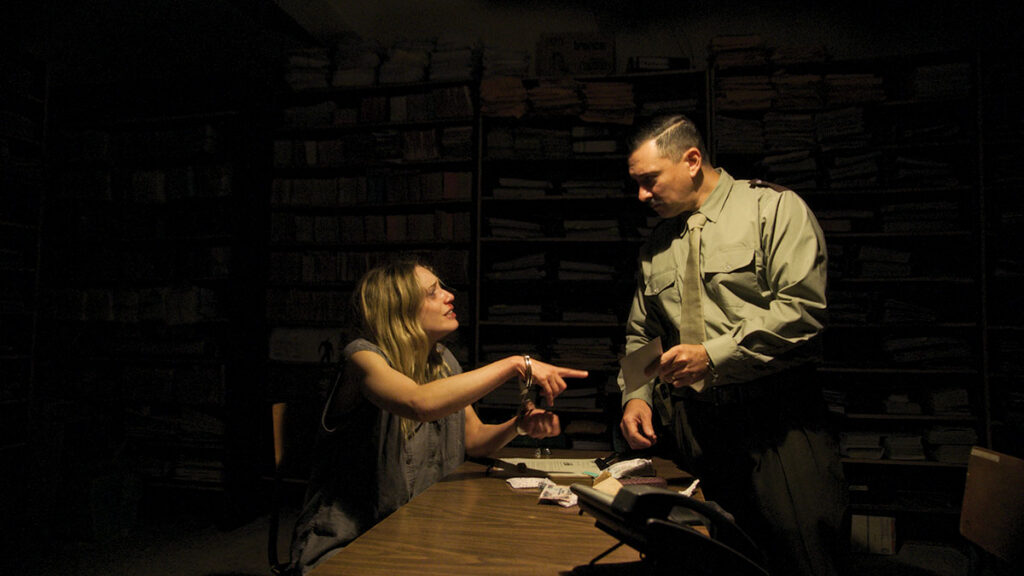
Love, Drugs and Prison: The True Story Behind ‘10 Kilos’

In her early 20s, Sharon Yitzhaki boarded a plane in Bolivia carrying a suitcase she believed belonged to the man she was in love with. She had no idea that the decision would change her life forever.

Police pulled her off the plane and accused her of attempting to smuggle 10 kilos of cocaine. Yitzhaki, who says she was framed, was arrested, interrogated in a language she did not understand and eventually sentenced to five years in Bolivia’s notorious Miraflores women’s prison.

The film follows the torture she endured there, her romance with the head of a drug cartel, an unlikely love story with a transgender woman and the creation of a family with a baby they adopted — all inside the prison walls.

Yitzhaki also descended into drug addiction before eventually turning her life around and escaping Bolivia. She later turned her extraordinary experience into the bestselling memoir “10 Kilos of Cocaine.”

The story made headlines in Israel when Yitzhaki was arrested in Bolivia in 1997. But it was decades later, when Israeli filmmaker Doron Eran read her book, that he decided he had to bring her story to the screen.

From the beginning, Eran said, he knew the story was more than a conventional prison drama. He also wanted audiences to see a side of the Bolivian prison system rarely portrayed on screen, where mothers can raise their children behind bars.

“There is a law in Bolivia that prohibits separating mothers from their children,” Eran said. “Because many of the fathers have been killed in cartel wars, the children remain with their mothers. There are babies born in prison who stay there with their mothers for many years. This is the first time a prison of this kind has been portrayed on the big screen.”

The award-winning director initially considered filming in the Dominican Republic but abandoned the idea after learning that productions there were routinely approached for protection money by local gangs. He then decided to film in Guatemala, which offered a workable alternative, although it came with its own extraordinary complications.

“We discovered that almost everything we were using belonged to the same crime family in Antigua,” Eran said. “The house, the school, the catering, the hotel where the crew stayed. Basically, there was one person who controlled the entire production. It was amazing.”

Guatemala is considered one of the most violent countries in the world, so Eran was accompanied by three bodyguards. During the second week of filming, he was confronted with an unexpected demand: $5,000 in cash in exchange for being allowed to continue filming at the school. With the production already underway, he had little choice but to pay.

The production itself was enormous, with approximately 1,000 Indigenous women from surrounding villages working as extras. After 14-hour shooting days, Eran found himself sitting with a pile of cash, paying the women individually.

Despite the fear and pressure, however, he says he never regretted filming there.

“The people in Guatemala are very nice,” Eran said. “They love Israelis — perhaps more than anywhere else in the world.”

The casting of Yitzhaki was another lengthy process. Eran said the production conducted more than 100 auditions before a casting agent contacted him about Daniella Kertesz, the Israeli actress known for playing Segen in “World War Z,” in which she starred alongside Brad Pitt.

At the time, Kertesz was living in Paris, so they scheduled a Zoom meeting. However, it did not go smoothly.

“She started asking me about the nudity in the film, which is a part of the story, and we began to argue about it,” Eran said. “I told her, ‘You know what, just forget about it.’ We hung up, and then she called me back and said, ‘Let’s start the conversation over. This part is mine.’”

Kertesz read the book and felt a special connection to the character. Determined to win the part, she sent Eran five audition clips. “They were perfect,” Eran said.

Yitzhaki herself remained closely involved throughout the production and flew with the crew to Guatemala for the shoot. “It was the first time I met her, right there on the set on the first day of shooting,” Kertesz recalled. “It was extremely stressful. We had just filmed the scene depicting the abuse in the showers, followed by the week of her withdrawal from drugs — very difficult scenes. It’s unsettling to portray someone while she is standing there watching you play her.

“It wasn’t easy for her either, because it brought her right back to that place. After the shoot, we went outside, got to know each other and hugged. She was very encouraging.”

At one point, after the crew shot a scene in a dungeon, Yitzhaki turned to Eran and said, “The smell of this place is killing me.” The experience transported her back to the Bolivian prison.

“After that, she left,” Eran said.

The director hopes the film will serve as a warning to young women who can be manipulated by the men they trust. “Prisons across South and Central America are filled with American and European women who have been turned into drug mules,” Eran said. “It’s always the same story: they fall in love with someone, and then they are used as pawns and handed over to the local authorities.”

After completing the film, Eran took it to the Cannes Film Market, where the response initially seemed extremely promising. The film generated enthusiastic reactions from distributors, and Eran thought he was finally on the verge of finding international buyers. But the timing was difficult. It was shortly after Oct. 7, 2023, and, Eran said, distributors did not want to touch a film with Israel attached to it.

“They would come out of the screening and say, ‘Wow, what a movie,’” Eran recalled. “And then they would go online and start Googling. Suddenly they realized that the story and the director were Israeli. And then they walked away. Nobody wanted to cooperate.”

There was another obstacle. In September 2025, a group calling itself Film Workers for Palestine launched “Film Workers Pledge to End Complicity” with an open letter signed by thousands of actors, filmmakers and other entertainment professionals who pledged to boycott Israeli film institutions and productions they considered complicit in Israel’s policies toward the Palestinians. The pledge specifically called on film workers to refuse to work with Israeli production and distribution companies, sales agents, cinemas and other film institutions.

“For three years I chased distribution companies,” Eran said. “And then I reached Breaking Glass Pictures. They are a very experienced, professional company. They went crazy for the film and decided to bring it here.” The company ultimately acquired the U.S. distribution rights, giving “10 Kilos” a path to American audiences.

Eran also edited additional footage into a four-part television series, incorporating material that was cut from the theatrical version. The series is currently in talks with Netflix for potential acquisition.

“10 Kilos” premiered at the TCL Chinese Theatre last month and is now screening at Laemmle theaters in Los Angeles. On Sept. 4, “10” Kilos will screen at Laemmle Town Center 5 in Encino, followed by a Q&A.  Additional screenings are planned in Miami, New York and Toronto. 

Love, Drugs and Prison: The True Story Behind ‘10 Kilos’ Read More »

Hanging Out at the Jewish American Summit

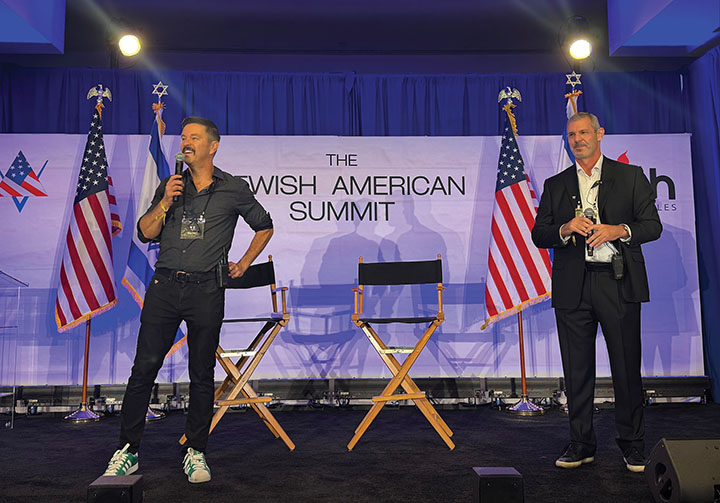
At 8 a.m. on Aug. 30, a crowd was already queuing at the doors of Above the Block banquet space in West Los Angeles for the third annual Jewish American Summit (JAS). Over 1,000 people attended, with at least 100 present to stake out a good seat when the doors opened.

The JAS was conceptualized at an Israel Bonds mastermind group three years ago on what co-founder Boris Epstein called “just another Thursday.” Epstein said Rabbi Aryeh Markman, executive director of Aish LA, came to the group with a problem: the Jewish banquet concept was outdated.

“Who goes to banquets? Maybe people still go to banquets, I don’t know, but that was what he felt at the time, and we needed a refreshed concept for the banquet,” Epstein said. JAS co-founder and Co-Executive Producer Mike Drath said, “To see more than a thousand passionate, smiling and engaged people from across our community come together in the big tent we created with JAS, inspired and invigorated by such powerful voices, was deeply fulfilling and emotional.”

The opening speaker was Jay Sures, vice chairman of United Talent Agency and one of 18 University of California Regents. Sures said the response to antisemitism on UC campuses has changed since the UCLA encampments in 2024, when Jewish students were blocked from parts of campus. The room groaned when Sures spoke about pro-Palestinian protesters coming to his home, surrounding his wife in her car and putting bloody handprints on the property. He said LAPD sent 75 officers within 20 minutes. “When it crosses the line into hate, it needs to be aggressively called out,” Sures said. “Leadership isn’t about calling it out, it’s about calling it out even if you know that calling it out is going to be unpopular.”

When Sures brought up Hollywood figures who have faced criticism over comments about Israel — specifically Susan Sarandon and Mark Ruffalo — the audience groaned again. Sures said the decision to stop representing Sarandon came from her two Jewish agents after conversations with the actress. On Ruffalo, Sures said conversations with the actor left him satisfied that Ruffalo is not an antisemite, though Sures objected to language Ruffalo has used.

Steve Hilton, the Republican nominee for Governor of California, spoke in the afternoon about the economy, education, ethnic studies and state government. After he stepped offstage, The Journal asked him what he would say to Jewish American Democrats who have never voted Republican and are concerned about the rise in antisemitism.

“You don’t have to become a Republican. You don’t have to support President Trump. You just have to vote. You don’t have to change your politics. You don’t have to change your party. You just have to vote for change in this election,” Hilton told The Journal. “And if you’re happy with the way that the government of California is representing itself in relation to the Jewish community, if you’re happy with all of that, vote for the other guy. But if you think we need change, then I’m your only choice.”

Yechiel “Michael” Leiter, Israel’s ambassador to the United States appointed in January 2025, sat with The Journal in a private green room after his appearance. Leiter’s eldest son, Maj. Moshe Yedidya Leiter, 39, a physician and father of six, was killed in battle in Gaza on Nov. 10, 2023. He insisted that The Journal take a copy of a 60-page booklet produced by the Embassy of Israel in Washington titled “Manufacturing A Modern Blood Libel: Genocide, Starvation and the Language of Dehumanization.” The interview also covered relationships Leiter has formed with diplomats whose governments have major disputes with Israel. He named Sir Christian Turner, Britain’s ambassador to the United States.

“We have a tremendous divide between Israel and the U.K. today — the U.K. is pursuing us in every international forum, but Christian Turner is a real mensch and it’s a pleasure breaking bread with them,” Leiter told The Journal. “There are others, there’s some African ambassadors, there’s the Middle East. One of my best friends in Washington is the ambassador of the UAE.” The UAE ambassador is Yousef Al Otaiba, who is also a UAE Minister of State. Leiter also said Mathilde Mukantabana, Rwanda’s ambassador to the United States, had been a dinner guest.

“They’re not so much Shabbat dinners, I try to get a few hours of rest on Shabbat, but during the week dinners I put together ambassadors with congressmen. Sometimes I have dinner with journalists,” Leiter said. The one thing he demands, he said, “is factual clarity.”

U.S. Ambassador to Israel Mike Huckabee spoke candidly for more than 30 minutes to the summit via Zoom from Jerusalem. He sat relaxed behind his embassy desk in a blue blazer, with American and Israeli flags, a printer and a MacBook charger behind him.

“There is one thing that I am witnessing that I think the world needs to understand. Oct. 7 did one particularly important thing. It eliminated the division of the left and the right when it comes to the national security of Israel,” Huckabee said. “There is no left of center that is substantial enough to make much of a difference because Israelis throughout the spectrum see that they must make their national security number one.” 

He responded to an audience question about Israel’s public image. “I’ll tell you what I’d say to the Israelis in the government all the time, ‘You’re the best people I know at fighting a kinetic war, but you really need to up the game at fighting an information war where a lot of the battles are being waged,’” Huckabee said. “They know that. I think they’re beginning to recognize the need to dramatically increase their messaging. And by messaging, I don’t mean propaganda. I mean just getting a spotlight on the truth.”

Among the other speakers, Adam Milstein, a real estate investor, philanthropist and co-founder of the fast-growing Impact Forum, also urged attendees to frame antisemitism as an American issue and not just a Jewish issue. Dillon Hosier, founder of Israeli-American Civic Action Network (ICAN), urged attendees this fall to “pay attention to state and local elections, where CAIR- and DSA-aligned radical candidates are building the records, networks and name recognition that carries them into higher office.” Near the end of the day, every seat was still full when author Gad Saad spoke about the roots of Jew-hatred, which he explores in his new book, “Suicidal Empathy: Dying to Be Kind.”

Away from the stage, six young men spent the day asking attendees to wrap tefillin. Hamsa Club sold cheeky Jewish couture and StopAntisemitism gave away coasters depicting David Ben-Gurion and Golda Meir in sunglasses. Other booths included Mount Sinai Memorial Park, StandWithUs and a group benefiting Israel’s Special Forces Unit 669. One floor below, Jonah Platt recorded episodes of “Being Jewish with Jonah Platt.” He later came upstairs to moderate a conversation with Mosab Hassan Yousef, known as the “Son of Hamas.” 

A young professionals afterparty followed with DJ sets from Nova Festival survivor Rom El-Hai and producer Erez Safar. Therapist Milla Zeltzer came to JAS as a private attendee and said the draw was spending the day around people with whom she felt comfortable discussing Jewish issues. Zeltzer told The Journal that part of the draw was “connecting with the community and standing strong, being proud of who we are. Another one that I really like as a mental health person is empathy for people that don’t think exactly the same way you do and actually connecting and talking and finding common grounds, not just fighting, but also being empathetic and human and connecting with people.”

Hanging Out at the Jewish American Summit Read More »

Eyal Shani’s Recipe for Kosher Cuisine: Wild, Bold and Full of Life

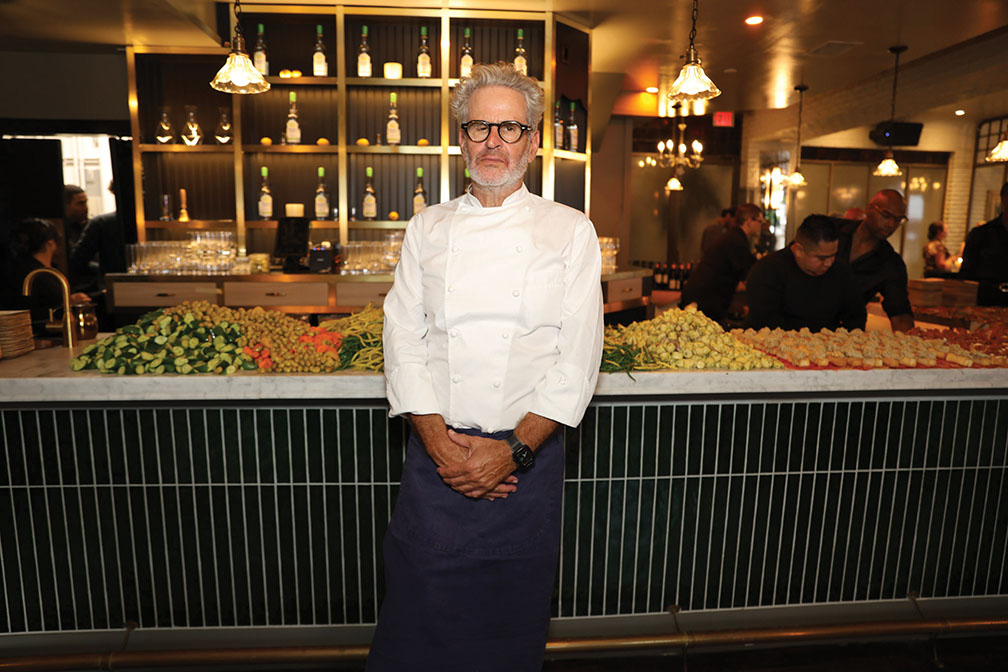
During the opening night of Malka, the new kosher restaurant in the SIXTY Beverly Hills hotel, Chef Eyal Shani, who is known for turning the dining experience into a theatrical performance, provided the evening’s main show. Standing before the crowd, he spread a huge platter of hummus with his bare hands, moving his fingers through the creamy mixture in wide, circular motions as if he were an artist working with clay. There was no spoon or other kitchen utensil — just Shani and his hummus. When he finished spreading it across the enormous platter, he continued drizzling it with a garlic-lemon sauce. Around him, guests cheered, applauded and pulled out their phones to capture the spectacle. Then the dozens of guests filling the restaurant were invited to grab a pita and dig in — fingers and all.

But don’t be too disappointed — or relieved — if you don’t receive the same experience at Malka. The giant hummus performance was Shani being Shani: part chef, part entertainer and always eager to turn a meal into a show.

At his restaurants in Israel and abroad, he is known for cooking in front of diners, feeding guests with his hands and creating an atmosphere that is as much theater as it is a meal. His unconventional presentations, whether serving food on paper, as at Miznon in Los Angeles, or creating dramatic displays directly on the table, are all part of his distinctive culinary language. 

The hummus performance certainly made a splash, with the video quickly generating tens of thousands of views online.

Beverly Hills is Shani’s fifth Malka location, following restaurants in Tel Aviv, West Palm Beach, New York’s Upper West Side and the Dumbo neighborhood in Brooklyn. He opened the restaurant in partnership with L.A.-based Pagani Projects, and its kitchen and management are led by Loel Miller, who also serves as chef of Malka in New York and will split his time between the two cities.

The Beverly Hills menu features some of Malka’s best-known dishes, including the Queen Malka Schnitzel, Branzino Hraime, onglet served with roasted white peaches and Israeli-style hummus. The Los Angeles location also introduces dishes created specifically for the city, including Melanzana, Niçoise Salad and Wild King Ora Salmon Bruschetta. The menu will evolve with the seasons, drawing on California produce such as figs, pluots and peaches.

Branzino Hraime. Photo courtesy of Malka Restaurant

Until he opened his first Malka in Tel Aviv in 2018, Shani’s restaurants were not kosher. Since then, he has expanded the concept internationally while continuing to operate a wide-ranging restaurant empire that includes Miznon, Shmoné, Port Sa’id and HaSalon in New York, as well as Miznon locations in cities including Paris, London, Toronto, Panama City and Singapore.

So why did a chef with an already successful international restaurant empire decide to enter the kosher world, with its additional requirements and restrictions?  For Shani, the answer was simple: he saw people who wanted to eat his food but couldn’t because they were keeping kosher. 

“They were standing like cats on a fence, licking their lips and wanting to devour my food, but they couldn’t,” he told The Journal. “So I decided to open a kosher restaurant so they could eat it too. Their gratitude fills me with happiness.”

Don’t expect Malka to be “fine dining.” According to Shani, although the food is certainly refined, it is too “wild, kicking, living and full of energy” to fit the traditional definition of fine dining.

He believes that sense of vibrancy is precisely what has been missing from kosher dining. “Usually, in a kosher restaurant, there is a kind of cloud hanging above it — a cloud of kosher restrictions that limits the restaurant,” he said. “I haven’t really seen a kosher restaurant that is full of joy, that is alive, contemporary, turbulent and extremely energetic. That’s what it will be here.”

Shani rejects the idea that kosher cooking necessarily limits his culinary creativity. 

“For me, there are no limitations,” he said. “I don’t cook with dairy anyway. I believe in olive oil. It gives the food a very transparent expression.”

Butter, he explained, tends to soften and homogenize flavors, while olive oil allows the ingredients to retain their individual character.

Shani never minces his words. Interviewing him is less like conducting a traditional interview and more like listening to a poet recite a love song to food. He speaks about vegetables as if they have souls, ingredients as if they have desires, and cooking as a way of revealing the life hidden inside them.

Arriving in Los Angeles, Shani was excited to discover the abundance of fresh produce grown right here. Vegetables are often the stars of his menu, even when meat or poultry is the main course, and his talent for turning simple ingredients such as tomatoes and cauliflower into exquisite dishes is well established. One of the first things he did after arriving in L.A. was visit the local farmers’ markets.

“I couldn’t believe it. I said, ‘Oh, thank God — food that doesn’t have to travel long distances. Food that grows in this sunshine.’ It reminded me of Israel. Sunshine is one of my ingredients. Where there is sunshine, things want to grow and exist. That’s true of human beings as well as ingredients.”

Shani said he was drawn to Los Angeles not only because of its produce and sunshine, but also because of the sense of freedom he associates with the West Coast. Compared with New York, he finds Los Angeles more open, relaxed and curious. “Here, it feels like people live with fewer rules.” As an Israeli, he added, he feels more at ease with the way people connect with one another on the West Coast. That openness is also reflected in the clientele he hopes Malka will attract. While Jewish diners will likely be among the first to discover the kosher restaurant, he does not see Malka as a restaurant exclusively for Jews. “I expect them to bring their friends,” he said.

“I’ll give you an amazing statistic,” Shani said. “In New York, when a new restaurant opens, 72%  of its customers in the first year are Jewish. They’re the first to discover it, become curious about it and give it a try.” 

He believes that curiosity is one of the qualities that defines Jewish diners. “They are the first to be brave, and willing to experience something new,” he said.

With his dozens of restaurants, television shows and larger-than-life personality, Shani reminds me of an Israeli Gordon Ramsay — only with his own distinctly Israeli flair. 

“There is something about Malka that creates that atmosphere more than our other restaurants that aren’t kosher. There is this feeling that everyone can come and sit around the same table. It’s a very warm way of eating, and I think that’s what people love so much about it.”

“In the end, you know what Malka reminds me of most? Italian restaurants,” he said as he was getting ready for his big opening day. “You walk in and see a 95-year-old grandmother and grandfather, and then their children, grandchildren and great-grandchildren, all sitting around one table, shouting at the top of their voices, enjoying themselves to the heavens, drinking wine and just being happy.”

Eyal Shani’s Recipe for Kosher Cuisine: Wild, Bold and Full of Life Read More »

A Festive French Roast

As I contemplate Rosh HashanaH  5787, my heart and mind are a little torn because our youngest daughter Shevy won’t be at the table. Baruch Hashem, she will be celebrating the holidays with her friends, teachers and rabbis at Midreshet Moriah, a seminary in Jerusalem. I am so happy for her to have this incredible opportunity — learning Torah in the holy city.

Even though we will miss Shevy’s presence at our table, the show must go on. I will prepare all the Simanim that are described in the Babylonian Talmud to comprise the Rosh Hashanah Seder and we will say the Yehi Ratzon prayers.

We will eat dates for an end to animosity and for sweetness. Leeks, asking G-d to cut off our enemies and those who wish us harm. Spinach, asking that adversaries and negative decrees depart from us.

Squash, asking G-d to tear any evil decrees and to proclaim our good merits. Extra long string beans, expressing the wish that our merits, good deeds and blessings will multiply.

Pomegranate, a prayer that our good deeds and mitzvot are as numerous and full as the seeds of the pomegranate.

A fish head, a blessing asking to be “the head and not the tail,“ symbolizing leadership, progress and initiative for the coming year.

Apple jam, a prayer to renew for us a good and sweet year.

I will make the delicious roast beef recipe that we share here with you. And we will rejoice in the many blessings that Hashem has given us.

L’Shana Tova U’Metuka!

To a happy sweet new year.

—Sharon

One of my favorite things to cook for the Jewish holidays is a beautiful French roast. It’s so very festive and is perfect to feed a hungry crowd.

I usually choose a second-cut French roast, a cut with a little more fat left on it. That extra fat keeps the meat moist, tender and flavorful during a long, slow cook.

At the beginning of my cooking career, I had my share of roasts that came out hard, dry and disappointing. But through trial and error, I learned a few tricks that made all the difference.

First, I pat the roast with a dry rub of salt and pepper and granulated garlic powder. Then comes the most important step which is to sear the meat. This creates a beautiful crust and lends a deep, rich flavor to the finished roast.

I warm a heavy bottomed pan over very high heat, I add extra virgin olive oil and brown the roast on all sides. Then I add the classic elements of a French roast — a good Dijon mustard and a dry red wine.

Depending on the occasion, the season, or my mood, I add more seasonings. Sometimes I will add herbs, like thyme and spices, like sweet paprika. Other times, I’ll add a little honey, date syrup or pomegranate syrup for sweetness and depth.

For Rosh Hashanah, I especially love throwing a handful of prunes into the pot because they add a subtle sweetness and a slightly tangy, caramel-like flavor to the roast and its juices.

Once the meat is beautifully seared, I add my marinade and seasonings, cover the pot tightly, and cook in a slow oven for two to three hours, depending on the size of the roast. Low and slow is definitely the way to go.

Once the roast is fork tender, I remove it from the oven and let it rest for a good 20 to 30 minutes. Then I carefully remove the roast from the pot and slice it. Finally, I return the sliced roast to the pot, allowing every slice to soak up all those delicious juices.

One of my favorite tricks, especially when I’m cooking for a holiday, is to make the roast ahead of time and freeze it.

I learned from my mother to let the sliced roast cool, then freeze it in an airtight container. A day before the meal, I allow it to defrost slowly in the refrigerator.

My mother always believed that freezing the roast in its juices somehow made it even more tender, and after doing it myself over the years, I have to agree. I don’t know the science behind it, but I know that it works. The meat becomes incredibly tender and flavorful, having had even more time to absorb all those wonderful juices.

It’s wonderful to have your roast prepared ahead of time when there’s so much to do right before the holiday. It’s just one less thing to worry about. 

Some of the best things I’ve learned in the kitchen have come through trial and error. But the really special ones are the things passed down from our mothers—the little tricks and bits of wisdom that may never be written in a recipe, but somehow always make their way into our cooking.

—Rachel

French Roast Recipe

4-5 lb French roast

Salt and black pepper, to taste

Extra-virgin olive oil, for searing

2 large onions, sliced

6 cloves garlic, roughly chopped

6 large Yukon Gold potatoes, peeled and cut into 4 wedges 

For the marinade:  

2 Tbsp tomato paste

2 cups red wine

2 Tbsp Dijon mustard

2 Tbsp silan, date syrup

¼ cup extra virgin olive oil

1 tsp sweet paprika

1 tsp salt

½ tsp pepper


Preheat the oven to 300°F.

Season the French roast generously on both sides with salt and pepper.

Warm a large Dutch oven or roasting pan over high heat. Add the olive oil and warm over medium high heat, place the roast in the pot and sear until both sides of the meat have a nice brown crust. Remove pot from heat and place the potatoes, onions and garlic around the meat.

In a bowl, whisk together the tomato paste, red wine, Dijon mustard, silan, olive oil, paprika, salt and pepper. Pour the marinade over the roast and let it settle into the potatoes, onions and garlic.

Cover the pan tightly with a lid or a layer of wet, scrunched parchment and heavy duty aluminum foil.

Roast for 2 1/2 hours.

Raise the oven temperature to 350°F. Remove the cover from the meat and continue for about 20 minutes, until the potatoes are golden.

Remove the roast from the pot, leaving the potatoes, onions, garlic and juices in the pan. Allow the roast to rest for 20 minutes, then slice thinly and return to the pan and baste with the beautiful red wine juices.

Spoon the onions, garlic and sauce over the meat and serve alongside the golden potatoes.

Sharon Gomperts and Rachel Emquies Sheff have been friends since high school. Their cooking and storytelling project has grown into a devoted following on Instagram @sephardicspicegirls and on Facebook at Sephardic Spice SEC Food. Website sephardicspicegirls.com/full-recipes.

A Festive French Roast Read More »

Table for Five: Nitzavim-Vayelech

One verse, five voices. Edited by Nina Litvak and Salvador Litvak, the Accidental Talmudist

The hidden things belong to the Lord, our God, but the revealed things apply to us and to our children forever: that we must fulfill all the words of this Torah.

– Deuteronomy 29:28


Gilla Nissan

Author, Teacher, SeekAleph.com

 Secrets want to be revealed. Not every secret, and not at any time. There will always be a hiddenness that belongs to the mystery of Hashem alone. But some things are hidden because their time has not yet come. They wait for the right person, the right generation, the right articulation, the right opening. And when their time arrives, what belongs to the hidden crosses the threshold into the known. Esoteric knowledge attracts whoever is ready — not many, but enough to make a difference. 

Perhaps that is why the paragraph chosen for this parsha does not end with knowledge, but with action: “to do all the words of this Torah.” The purpose of revelation is not simply that we should know more. It is that what becomes known should change the way we live and be grounded in the “world of deeds.” Why? Because we are here to sanctify the physical world. Not because all of creation is not already holy, but because an ongoing creation needs us as vessels and messengers, continually carrying the sacred flow of life into our physical world.

 And this is very close to the biblical idea of revelation. Revelation is not merely receiving information. It is something concealed becoming accessible because the human being, the generation, or the historical moment has become capable of receiving it. As the new year approaches, we pray: “A new light You will spread on Zion.” May something truly new be revealed and bring us ever closer to Torat Emet. Amen.


Lou Shapiro

Criminal Defense Attorney/Legal Analyst

Rashi explains that we are not responsible for the secret sins of others. We cannot be held accountable for something we could not possibly know. But when wrongdoing is known, we have a responsibility to address it. This reflects the principle that Jews are responsible for one another. Simply put, we are not responsible for what is hidden from us; we are responsible for what we know and have the ability to address. 

I heard from Eli Stefansky of Merkaz Daf Yomi another beautiful way to understand this pasuk. Our mitzvot have to be sincere and cannot just be for show. What is happening inside of us, our relationship with Hashem, and the sincerity behind what we do are enormously important. But there also has to be a revealed part, especially for our children. Our children need to see us doing mitzvot. 

They need to see us davening, learning Torah, making Shabbat important, giving tzedakah, and making time for mitzvot even when life is busy. Our relationship with Hashem may be deeply personal, but when it comes to transmitting Torah to the next generation, sincerity alone isn’t enough. Hashem knows what is in our hearts, but our children learn from what they see.


Rabbi Brett Kopin

Executive Director, The Six11 Project

While the classical commentators read this verse in its specific context, referring to the idolatry mentioned in the preceding verses, the dynamic of concealed versus revealed Torah plays a deeply prominent role in the unfolding journey of Torah study itself. As we approach the end of the Torah and turn back to the opening of Bereshit, we begin to anticipate the joy that comes with starting again from those first verses. We understand, as a people who have read the Torah cyclically for millennia, that beginning again means uncovering secrets and subtle details we did not notice in previous cycles. Perhaps even the smallest detail will reframe something entirely, casting the Torah, and the wisdom of the tradition, in new light. When this happens, the Torah is revealed again, as if we were standing once more at Sinai. Jewish continuity depends on this unfolding revelation, the understanding that the journey continues, and that our generation has a role to play in the ongoing story of our people. The hidden things are the eternally flowing wellspring that waters the community, generation after generation. But the verse does not leave us only with mystery; it insists that the revealed things are “for us and our children forever” to act on. Each new layer deepens our love for Torah and mitzvot, strengthens our connection to God, and renews our joy as a people, year after year, precisely because what is revealed always calls us back to the words we are commanded to fulfill.


Rabbi Ari Averbach

Temple Etz Chaim, “Moral Courage” Podcast

As someone who grew up watching classic films, I read almost everything as if it were a scene from a movie. I imagine how different directors would approach this scene. For this week’s quote, we have a moment that feels like noir – a character about to do something naughty looks out through slatted blinds to make sure no one saw them enter the building, then turns the blinds to complete their evil task in mere shadow. We know, as voyeurs, watching the scene, that this character is nefarious. But we also know that no other character will be able to pin the crime on them. 

The Torah tells us – reminds us – how inappropriate it is to do something evil, thinking it doesn’t affect the world around us. Every one of these selfish acts, even if no one else sees, might just change the world. 

And what if someone sees? What if it is done overtly? Then it is the community’s responsibility to say something, to stand up for what is right. Which is easy on paper, when the characters are vague and faceless, but difficult in real life, when the perpetrators are loved ones, politicians, celebrities we admire. Can we see the evil they do and call it out? 

What’s on the line is the world we want to create. The world we want to live in. The world as our Creator envisioned it. All God needs is our help in making it come to fruition.


Yehudit Garmaise

Associate Marriage and Family Therapist

What is hidden to all but Hashem in this passage? Sins done in private and Jews who are so assimilated that they are hidden to all but Hashem, who promises to include every Jew, no matter how hidden, in our nation when Moshiach comes, says Rashi. What is absolutely the most hidden to all but Hakadosh Baruch Hu, however, is His essential nature. 

In Otzrot Chaim or “Treasures of Life,” Rabbi Chaim Vitale describes the existence before Creation. “At the origin of everything, all of existence was just a singular simple light that is referred to as Ein Sof: without limit. And there was no vacant space whatsoever. Nor was there any empty air. Rather everything was just the infinite light.” 

Torah and Chassidus reawaken in us an idea of Hashem that is as familiar and intuitive as “an ancient echo that feels more familiar than anything can possibly be,” in Rabbi Joey Rosenfeld’s translation. As finite beings with finite minds, however, we can only begin to grasp Hashem when we finally accept His essential ungraspability. 

The paradox of Jewish existence is that while we can easily seek and reach Hashem who is everywhere and everything, at the same time the infinite essence of Hakadosh Baruch Hu remains unnamable, ungraspable, and unthinkable. While we can discuss G-d’s qualities, such as infinitude, light or presence, Hashem’s Absolute Essence is simply unknowable. Perhaps we can better “coronate Hashem as our King” when we accept that Hashem is something infinitely far beyond human comprehension.

Table for Five: Nitzavim-Vayelech Read More »

The Genius of the Marx Brothers

The greatest comedic minds of the 1930s have a message for us in 2026, and it isn’t funny. 

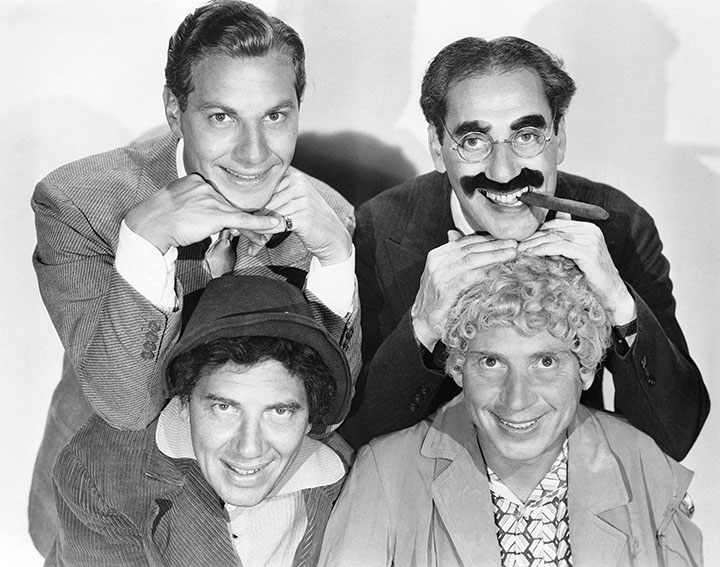
Who were the Marx Brothers? They were five brothers born in New York City of Jewish immigrant parents, and they set the standard for American comedy. They started in vaudeville doing slapstick but were not particularly well-received. They did find success on Broadway and especially with the 13 movies which established their reputation. They worked with S. J. Perelman, George S. Kaufman, Morrie Ryskind and others who constituted some of the greatest comedy writers of their time. But why is their brand of comedy so enduring? It is because, like all true art, it speaks as much to our time as to theirs. 

Of course, there are countless differences between our current time and the 1930s. But the Marx Brothers’ movies resonate now because we recognize the concerns and issues they revealed, both on economic and political issues, as well as social and moral values. 

The movies are very different from one another, but there is a fundamental theme. I will discuss “Duck Soup” as an example, but other great Marx Brothers’ movies, like “Monkey Business” and “A Night at the Opera,” exhibit a similar idea. 

In “Duck Soup,” four of the brothers – Groucho, Harpo, Chico and Zeppo – appear in the imaginary country of Freedonia.

The political leaders of Freedonia squandered a fortune gifted by a wealthy widow, Mrs. Teasdale. She announces that she will grant the country another fortune only if the government accepts an unknown to be their leader. Rufus T. Firefly, as the name implies, is an arrogant incompetent who immediately throws the country into even greater chaos. 

Elaborate costumes and trumpets playing at the investiture give the appearance of a royal court, but the frantic pace and the absurd declarations by Firefly make a mockery of the ceremony and his leadership: he announces that a new law will jail people who chew gum. He arrives late at his own inauguration. He insults everyone and yet he is warmly received. All hail His Excellency.

Firefly’s non sequiturs, drivel and political doublespeak make a fool of him and the gullible crowd. No matter how outlandish the laws passed by Firefly, only one member of the government perceives the danger and protests. But he resigns and is never heard from again. 

Freedonia has a neighbor and enemy, the fictional state of Sylvania. Both Firefly and the ambassador of Sylvania, Trentino, vie for the hand of the wealthy Mrs. Teasdale. Firefly insults Trentino, accusing him of an imaginary slight, and Trentino declares war on Freedonia. 

Two of the Marx Brothers characters work as spies for Trentino and attempt to steal the war plans of Freedonia. Like Firefly, the brothers are fumbling fools who know nothing of spying and prove that both countries are led by idiots who can’t tell the difference between competence and nonsense.

The movie is replete with scene after scene of hilarious high jinks, songs and dances, all of which are distractions from the real issues that plague the nation – like the bread and circuses of the Roman Empire. 

Consider the famous mirror scene in which Groucho and Harpo, clothed the same, see each other in what appears as a mirror. Each is trying to discern if he is looking at a reflection of himself or someone else. The scene highlights the central theme of the movie: a mirror symbolizes perceiving one’s true self, but the illusion of a mirror in the movie is a denial of introspection and contemplation. 

One of the Marx Brothers, Chico, is put on trial for treason because he tried to steal the war plans. Firefly (Groucho) is the judge, and the proceedings are pure farce. The slapstick makes a mockery of the justice system in a dictatorship. The scene is so fast-paced that there is little time to reflect on the meaning and impact, but the overall impression is one of extraordinary ineptitude and corruption. 

Wordplay is constant throughout. One talks of taxes and another responds with a comment on Texas; one mentions lemonade and someone responds about eliminate. Not just politics but language is corrupted in Freedonia. Every character is saying nothing, and one is left with a stream of meaningless talk in a world that conceals more than it reveals.

When the attempt to prevent war fails, the two countries go to battle, in a world where nothing makes any real sense. In a further absurdity, preparation for war is portrayed in Broadway-style song and dance, joyous and enthusiastic, a veritable glorification of war. Soon after, the Freedonians are overwhelmed by the enemy, and the political and military authorities only make matters worse with their chaotic directives. 

All is saved when Freedonia captures Trentino and pelts him with oranges until he surrenders. Freedonia is elated. Mrs. Teasdale breaks into song and the film ends with her being pelted with oranges as well. 

The movie clearly shows that when there is a country in financial crisis, at war, with no real leadership, the situation is dangerous not only because the leaders are greedy and incompetent, but also because the citizens are blindly credulous of these fools. The chaos, farce and absurdity are a source of laughter, but also make us aware of the sad fact that so many problems are the result of human failure: both leaders and those they lead. 

The Marx Brothers may not have been religious, but their values were Jewish. They challenged the established order where they saw injustice, self-aggrandizement, corruption and blind obedience to those unworthy of the people’s trust. 

Like the greatest satirists, such as Jonathan Swift and Mark Twain, they chose comedy over accusation to mock the folly of society and add levity to dark times. But their aim was not levity alone. Their satire was a pointed critique of deeply sinister forces that destroy societies, time and again. That is why their film speaks to our era too, offering the much-needed clarity that is best received when it begins with a laugh.


Dr. Paul Socken is Distinguished Professor Emeritus and founder of the Jewish Studies program at the University of Waterloo.

The Genius of the Marx Brothers Read More »

AKLA Rises

A few years ago, AKLA was an experiment.

The Los Angeles-based Jewish teen program had a simple but ambitious premise: What if Jewish encounters for young teens looked less like a classroom or synagogue and more like an adventure?

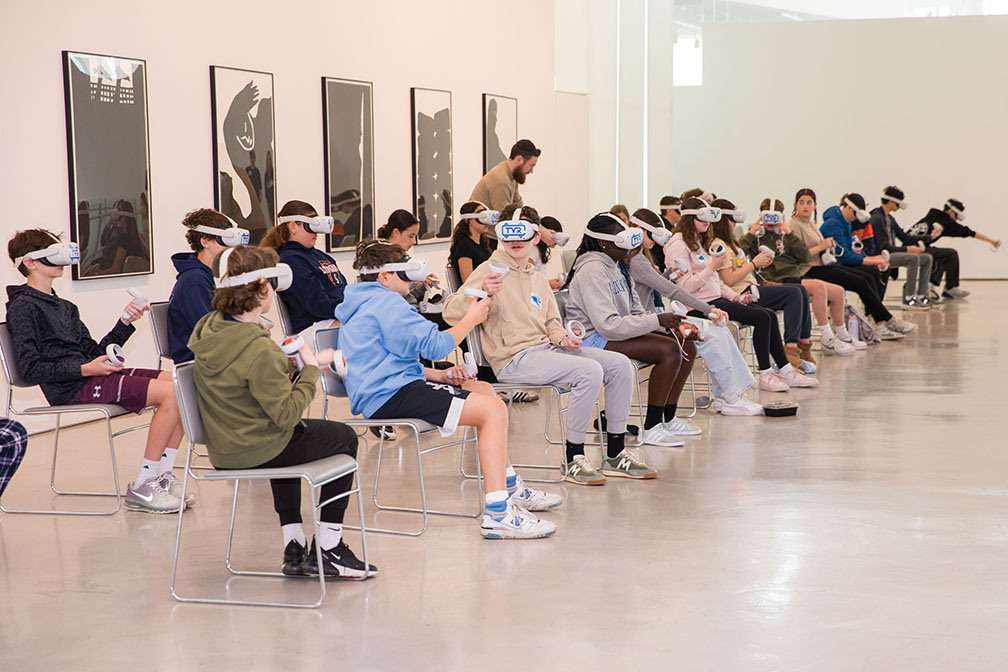
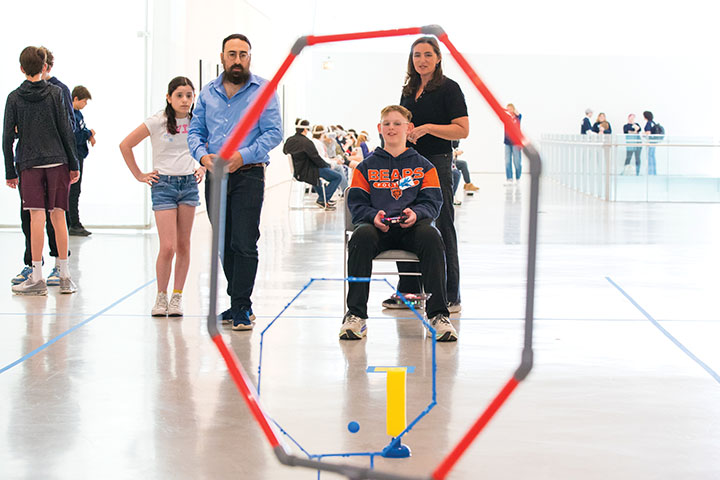
Instead of spending five Sundays, for example, learning about Jewish history from a textbook, teenagers could strap on virtual-reality headsets and “meet” Albert Einstein. They could watch a drone demonstration, learn about Israeli water technology, practice CPR at Cedars-Sinai Medical Center and discover the Jewish origins of Hollywood.

The goal was not to teach teenagers what they should think about being Jewish. It was to show them something they might not have encountered elsewhere: the extraordinary things Jews and Israelis have built, invented and contributed to the world.

When The Journal profiled AKLA in June 2024, the question was whether the fledgling program could influence “the future of Jewish pride.”

Today, the answer is beginning to look like positive. Tonia Barber, co-founder and executive director of AKLA, says AKLA — which currently offers programming in Los Angeles, Chicago and New York — is now preparing for another major step: A two-year grant from the Jewish National Fund-USA will help the organization open a fourth city — in either Dallas, Kansas City or Philadelphia.

AKLA is a Hebrew street word meaning awesome, excellent or great. What began as a local group program for 12- to 14-year-olds has evolved into what AKLA calls “the premier Jewish teen fellowship,” a free five-week initiative designed to deepen Jewish identity through innovation, leadership and experiential learning. The program remains intentionally small. But its ambitions are considerably larger.

The upcoming Los Angeles cohort, happening Oct. 18-Nov. 15, is expected to include 120 teens — a significant increase from the program’s early cohorts.

“Our goal is to excite kids who are 12- to 14-years-old, b’nai mitzvah age, to get them on a track to be enthusiastic about this amazing community and understand the breadth of the Jewish people’s accomplishments,” AKLA President and Co-Founder Jeff Polak told The Journal.

That idea has remained at the center of AKLA even as it has grown.

Learning Outside the Classroom

AKLA is designed to be a pre- or post-b’nai mitzvah experience, a period when many Jewish teenagers are beginning to determine what their relationship with Judaism will look like. The fellowship combines workshops, discussions, guest speakers, hands-on activities and visits to institutions that have a Jewish connection or demonstrate Jewish and Israeli innovation.

The result is a distinctly different kind of Jewish education.

A teenager might learn about Waze and SodaStream, unpack the Jewish origins of Superman or Barbie, explore drone technology or hear from a Jewish professional working at the forefront of medicine or technology. In Los Angeles, where the program first convened in 2022, past cohorts have visited and heard from Cedars-Sinai, the Skirball Cultural Center, the Jewish Journal, the Academy Museum of Motion Pictures and Warner Bros. Studios, among many others.

The experiences are deliberately designed to produce what AKLA leaders call “Jewish pride” without turning the program into a traditional religious-school curriculum. “We’re not religious or political,” AKLA’s Barber told The Journal. “We’re just celebrating the awesome accomplishments and contributions of the Jewish community to society.”

That distinction is central to AKLA’s appeal.

Its teens come from different Jewish backgrounds. Some are highly connected to Jewish life; others have little involvement beyond their families or schools. Rather than requiring a particular level of observance, AKLA starts with a different question: What might make a Jewish teenager curious about being Jewish?

The answer, AKLA believes, is not always another lesson about Jewish holidays. Sometimes it is a movie studio, or a technological innovation developed in Israel. And sometimes it is simply discovering that something the teenager already knows has a Jewish story hiding behind it.

From Los Angeles to Chicago and New York

The expansion into Chicago and New York marks the most significant change to AKLA over the past couple of years. 

Five-week cohorts are happening in Los Angeles and Chicago, and a jampacked one-day event in New York, designed for a slightly older age group, coincides with the upcoming Los Angeles cohort. In Chicago, AKLA has partnered with the Jewish United Fund (JUF) and developed a program that includes experiences at places including Wrigley Field, Northwestern University’s Feinberg School of Medicine and the Adler Planetarium, as well as Jewish learning connected to the Illinois Holocaust Museum’s pop-up site in downtown Chicago. “It wasn’t in our mindset when we started this program to be a national organization,” Barber said. “But it’s only made sense as we’ve been moving down the path.”

Chicago was the first test of whether the AKLA model could travel. Expanding beyond Los Angeles was “a heavy lift,” Barber said, particularly because the organization knew what it took to produce the program in Los Angeles. But once Chicago was up and running, the idea of going elsewhere seemed much less daunting. “Once we did it, I said, ‘Oh, this is what it’s going to be to get into other cities,’” Barber said. “And it didn’t seem so far-fetched anymore.”

The Chicago program has also demonstrated how AKLA’s philosophy can work without simply importing Los Angeles programming. Without Warner Bros., Barber began looking for another institution that could provide the kind of behind-the-scenes access and Jewish connections that AKLA seeks. She landed on Wrigley Field and discovered a wealth of Jewish connections involving the ballpark’s owners, players and history. Two Jewish tour guides helped develop an experience that included the stadium’s tour box, press box and batting cages.

That kind of discovery is central to AKLA’s approach. The organization does not rely on a fixed curriculum. Instead, its programming team is constantly looking for new and cool things happening in the world and asking how they might become a vehicle for Jewish learning.

The Chicago program reflects the philosophy AKLA developed in Los Angeles: Start with places and subjects teenagers already find interesting, then reveal the Jewish connection. At Northwestern, for example, teens can participate in hands-on medical learning and meet Jewish health-care leaders and Israeli innovators. 

New York is presenting a different challenge. Barber said the city’s teenagers have an enormous number of extracurricular options. Rather than reproduce the five-week fellowship exactly, AKLA is developing a one-day immersive experience for New York that it plans to offer quarterly, with content tailored to older teens.

The programming can be just as unconventional. In New York, teens can encounter a squadron program featuring IDF flight simulators that allow them to experience what it is like to pilot a jet. Israeli jiu-jitsu champion Peter Paltchik will participate in programming, traveling from Israel to New York.

The expansion also demonstrates that AKLA’s model is not dependent on Los Angeles’ unusually dense concentration of Jewish institutions, Hollywood connections and technology companies.

The underlying idea can travel.

The People Behind the Program

For an organization with increasingly national ambitions, AKLA remains remarkably small. Its core team consists of Polak, its president and co-founder; Barber, its executive director and co-founder; and Programming Coordinator Rebecca Webb. Polak brings the philanthropic vision. Barber has become the driving force behind AKLA’s experiential and creative programming, transforming what began as a local fellowship that received fiscal sponsorship into an independent nonprofit that reaches multiple communities.

At AKLA, Barber has applied a creative sensibility to Jewish education, emphasizing immersive media, technology, storytelling and live experiences. One example is the virtual-reality experience developed with the Technion-Israel Institute of Technology, which has allowed AKLA participants to interact with Einstein while learning about Israeli innovation.

Now that the organization has its own nonprofit status, it no longer operates under the David and Janet Polak Foundation, though the foundation continues to provide financial support. Because the foundation no longer covers the full cost of the program, AKLA has had to move more aggressively into fundraising. 

A Different Kind of Jewish Pride

The timing of AKLA’s growth is significant.

When The Journal first profiled the organization in 2024, the Oct. 7 Hamas attack and the ensuing war in Gaza had already transformed the Jewish communal landscape. Jewish teenagers were confronting antisemitism in ways that their parents and grandparents had not necessarily expected them to experience in their own communities.

That environment has only reinforced AKLA’s argument that young Jews need opportunities to understand and feel connected to their Jewish identity. But Barber is careful to distinguish AKLA’s role from programs specifically designed to combat antisemitism. “There’s a number of great organizations out there that do focus on that,” Barber said. “That’s not what we do.”

Instead, AKLA helps teenagers become comfortable with who they are and discover reasons to feel proud of that identity. It tells teenagers that Jewish identity can be expansive, creative and fun. Barber describes AKLA “as a bridge between the b’nai mitzvah experience and Birthright” — a period when teenagers may have finished their formal preparation for becoming Jewish adults but have not yet found the next meaningful Jewish experience.

“It’s such a big empty space, that time between the b’nai mitzvah and college,” Barber said. “They receive all kinds of information, and they’re looking for a way to break out and make their own voice.”

AKLA meets them through their existing interests — medicine, security, gaming, fashion, entertainment, sports and science — and then reveals the Jewish history embedded in those subjects. The program calls these areas “themes.” “I’m really proud that such a small group of people have done so many great things in the world,” a teenager from AKLA’s 2024 fall cohort said. The sentiment gets at what AKLA is trying to accomplish.

Barber calls those discoveries “aha moments.” A teen might learn that Barbie was created by Ruth Handler, who was Jewish, or discover the Jewish cultural parallels of “The Mandalorian.” At a recent cohort meeting, cosmologist Brian Keating, an observant Jew, began a session with AKLA teens by fielding their first question — whether aliens exist — and then lead them into a conversation that drew on Torah wisdom.

“Kids get a lot of information,” Barber said. “We try to be a rare space of positivity.”

What Happens After Five Weeks?

The challenge for AKLA now is different from the one it faced in 2024. Then, the question was whether the concept worked. Now, the question is whether it can scale without losing what made it compelling in the first place.

So far, AKLA’s strategy has been to preserve the model while adapting it to each city. The organization has also encountered a challenge that would have been difficult to anticipate when the program began: antisemitism can affect the seemingly simple logistics of putting on an event. Barber said AKLA has faced antisemitism when trying to book venues, as well as the false starts caused by COVID-19 in the program’s early years.

Barber is reluctant to reduce AKLA’s impact to a single metric. Some former participants have gone on to volunteer at Cedars-Sinai. Others have developed ambitions such as screenwriting. Early participants have returned as chaperones or interns. What matters, she said, is the enthusiasm that grows from it — teenagers who leave feeling excited about being Jewish and curious about where that identity might take them next.

In 2024, AKLA was described as a bold new initiative trying to make Jewish identity feel “awesome.” Two years later, it is no longer simply a Los Angeles experiment but a growing fellowship operating in three cities and attempting to establish a new model for experiential Jewish education.

For Barber, Polak and their small team, the mission remains remarkably straightforward: Give Jewish teenagers an opportunity to encounter their heritage not as something they are obligated to inherit, but as something they can be excited to explore.

And perhaps, along the way, to discover that being Jewish is not merely something they are — it is something they can do.

AKLA Rises Read More »

Rosner’s Domain | What Do You ‘Know’ About Altalena?

Symbols matter in every election cycle. The historic 1996 campaign slogan “Peres will divide Jerusalem” was an exercise in symbolism. “United Jerusalem” is the symbol, and Shimon Peres was framed as the man endangering it. The derogatory 1981 slang term “Chahchahim” was also a symbol. The entertainer Dudu Topaz used it to hint to left-wing voters that casting a ballot for the opposing camp meant voting for a mob. But Likud’s Menachem Begin expertly inverted the symbol: he offered the interpretation that Chahchahim didn’t describe a deplorable mob, but rather the proud Jews of Middle Eastern descent. He turned the insult into a symbol of left-wing condescension.

Altalena is a symbol. 

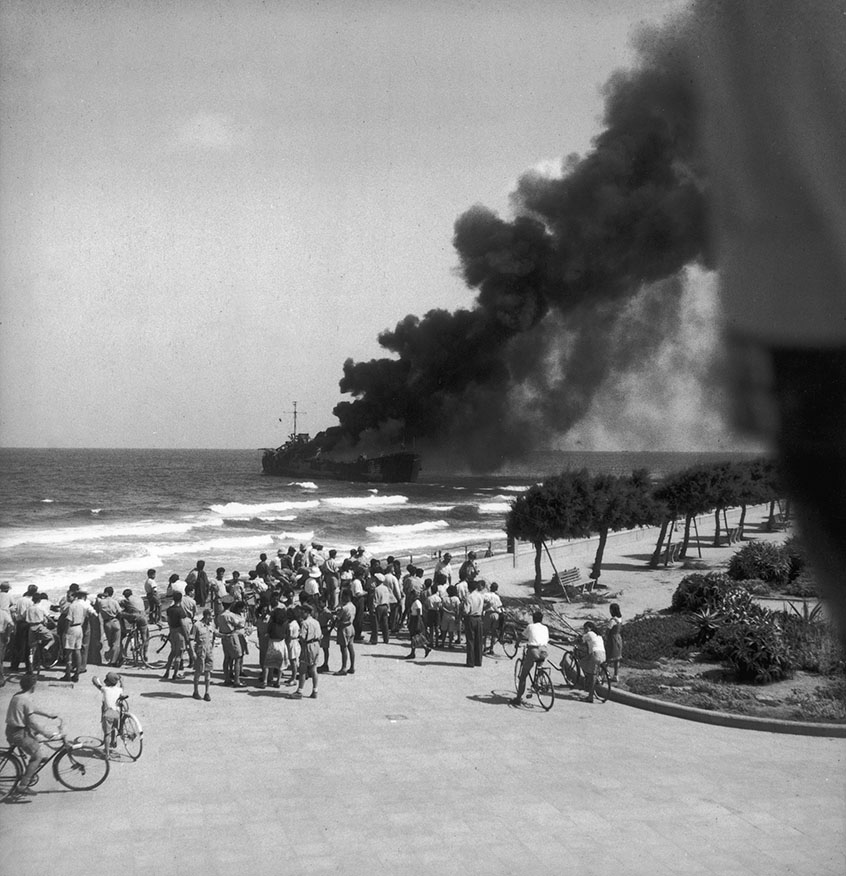
The Altalena was a munitions ship fired upon and sunk by the newly formed Israel Defense Forces in 1948. The ship was brought to Israel by Menachem Begin’s rightist Irgun militia. P.M. David Ben-Gurion demanded that the cargo be turned over to the newly formed IDF. Begin refused. Ben Gurion ordered to bomb the ship. Begin instructed his followers to refrain from retaliation to prevent a civil war. 

Last week, the wreckage of the sunken ship was discovered underwater, and the political system immediately geared up to exploit it. A symbol is a flexible thing, and the battle is often over who can successfully charge that symbol with the meaning most useful for a specific political moment.

One could use the Altalena to invoke the left’s willingness to use draconian force against brothers. One could use it as a stark warning that incitement and polarization can lead to disaster. One could use the Altalena to remember that in a sovereign state power must be concentrated solely in the hands of the government. 

For a symbol to be used effectively, the public actually has to understand it. “Peres will divide Jerusalem” was easy to grasp. But how well do Israelis actually know the Altalena affair? Clearly, less than they know Jerusalem. In fact, when Minister Itamar Ben-Gvir remarked upon the ship’s discovery that “the Altalena affair is a bleeding wound in the history of Israel,” he wasn’t entirely accurate. The Altalena is a wound that could have been healed a long time ago. It’s politicians like him who make sure to scratch at the scab frequently, and make it bleed, metaphorically speaking, of course.

They want to preserve the Altalena as a symbol of tyranny (once Ben-Gurion, today Supreme Court Justice Yitzhak Amit); a symbol of the willingness to harm fellow Jews (once Ben-Gurion, today the left); a symbol of the proud endurance of the right (once Begin, today Netanyahu). They do not treat the affair  to teach about the absolute necessity of the state’s monopoly on force. Or about the urgent need to calm raging tempers before they descend into bloodshed. 

Is the symbol effective? We asked Israelis whether Ben-Gurion’s decision to open fire was right or wrong. Truthfully, it’s a very difficult question. It isn’t easy for an Israeli in 2026 to put themselves in the shoes of a prime minister in 1948. Because it is so complex, it is no wonder that a very large portion of the respondents took the easy way out and answered: “I don’t know.” Did Ben-Gurion make the right call? Nearly half of all Israelis today, and 44% of Jewish Israelis, simply do not know.

I suspect that it is especially hard for Israelis to state that Ben-Gurion did the right thing. It is difficult for them to admit that sometimes, firing directly at fellow Jews is the correct course of action for a leader trapped in a complex, high-pressure and existential situation. One can easily understand this reluctance to retroactively validate such a violent act. It is a healthy instinct. On the other hand, clear-eyed historical thinking requires acknowledging that circumstances can arise where firing directly at fellow citizens is indeed a leader’s only correct recourse (an easy historical parallel for Americans: Abraham Lincoln and the secession of the Southern states). 

If we think carefully, this tension might explain the abundance of “don’t knows” in our poll. How can it be that so many Israelis don’t know what to think about such a dramatic, endlessly debated historical decision? Israelis – as anyone who lives here knows – are citizens with far too many opinions, not too few. Yet suddenly, on an issue of this magnitude, they struggle to find their voice. Of course, maybe it’s just a symptom of poor education, not reading enough history books or skipping heritage lessons. Then again, this question wasn’t asked during a random, uneventful week; it was asked during a week saturated with media chatter about the Altalena. Anyone who didn’t know the history beforehand could have easily found out and formed an opinion – if not their own, then at least the talking points dictated by their political camp.

So perhaps this reveals the true meaning behind “I don’t know.” Some genuinely do not know. But others think that Ben-Gurion did the right thing, yet they feel deeply uncomfortable saying it aloud. They stay quiet either because the moral implication is stark – or because admitting it would hand the opposing side a political weapon.

Something I wrote in Hebrew

The final days before the parties must register in their final form for the coming election are a race against the risk of losing crucial votes below the electoral threshold of 3.25%:

Add it all up: more than 11% of the national vote is currently projected to go to parties polling below the 3.25% electoral threshold. That is one in every nine votes – the equivalent of around 15 Knesset seats. A massive chunk of those are right-wing votes – or votes that once belonged to the right, or that the right expects and wants to compete for. Notice the striking asymmetry. The anti-Netanyahu “Change bloc” is wasting virtually no votes. The Democrats, Yashar, Beyachad, and Avigdor Lieberman’s Yisrael Beiteinu are all comfortably clearing the threshold … By contrast, the right-wing coalition bloc is leaking like a sieve. Every vote drained by hardline or breakaway figures … is a vote that could, at least in theory, sit in a Netanyahu-led coalition.

A week’s numbers

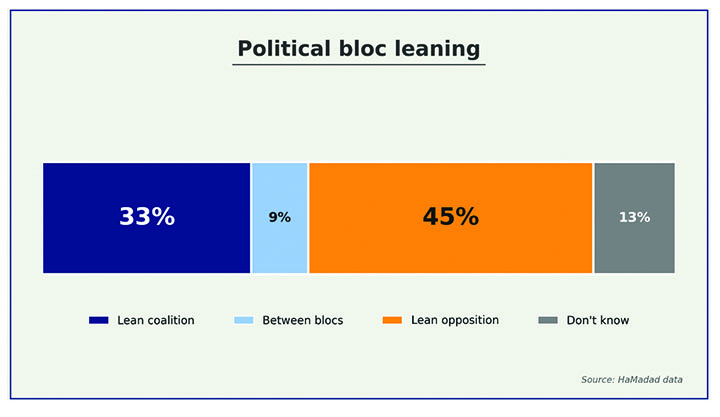
Next week, the parties must settle on their final form: that’s when the real race begins. In the meantime, here’s what Israelis are saying about the choice of political blocs:

A reader’s response

Dor writes: I support the settlements, but the leaders must control the chaos we see there. Answer: They must. Chaos is the worst enemy of a state.  


Shmuel Rosner is senior political editor. For more analysis of Israeli and international politics, visit Rosner’s Domain at jewishjournal.com/rosnersdomain.

Rosner’s Domain | What Do You ‘Know’ About Altalena? Read More »