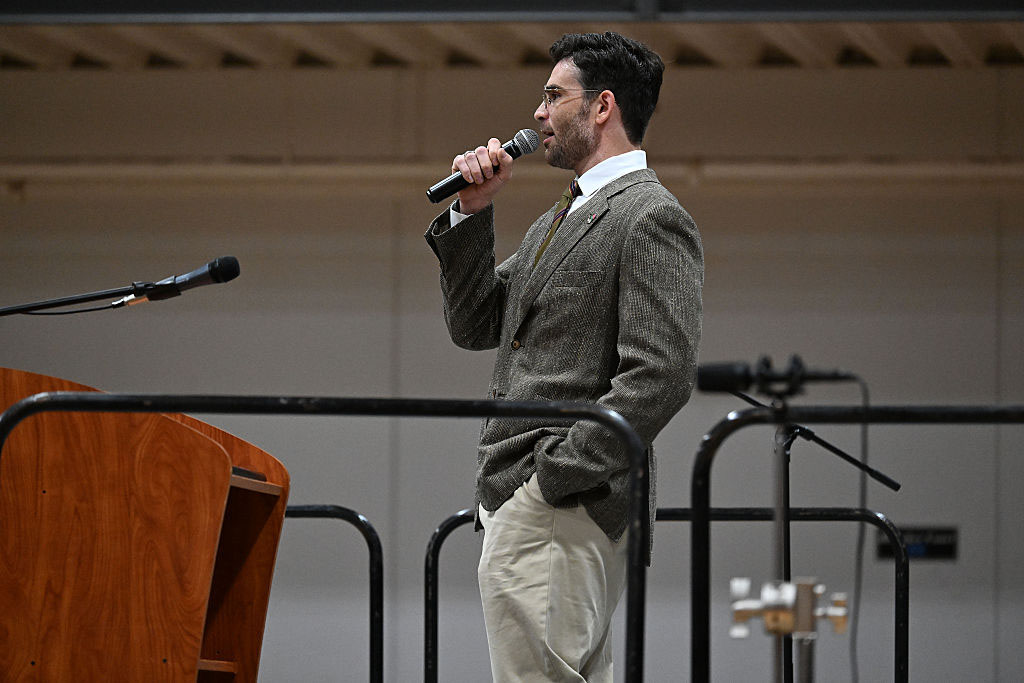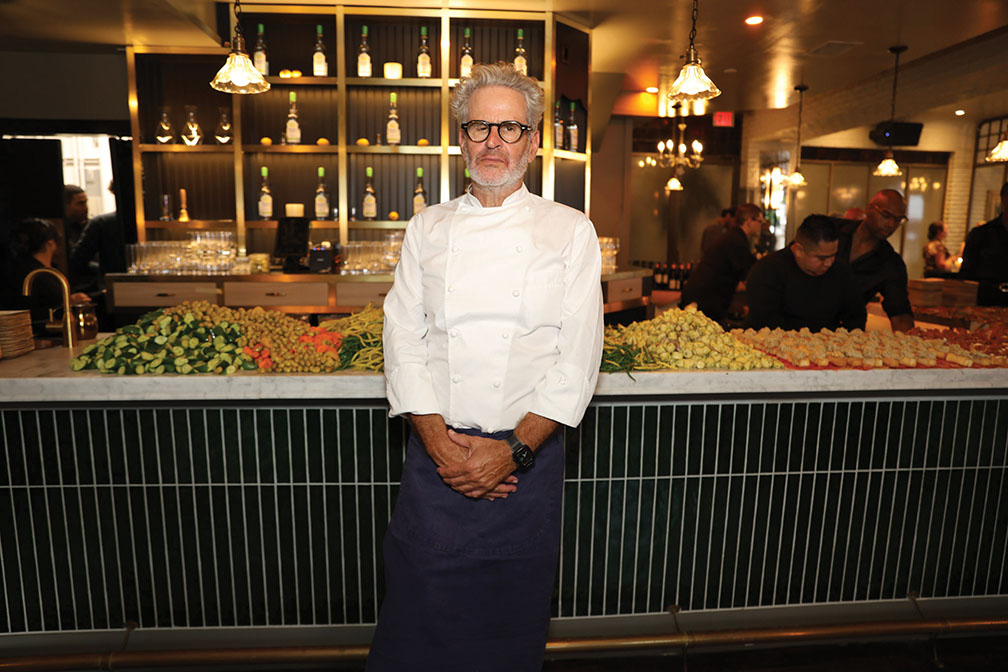
During the opening night of Malka, the new kosher restaurant in the SIXTY Beverly Hills hotel, Chef Eyal Shani, who is known for turning the dining experience into a theatrical performance, provided the evening’s main show. Standing before the crowd, he spread a huge platter of hummus with his bare hands, moving his fingers through the creamy mixture in wide, circular motions as if he were an artist working with clay. There was no spoon or other kitchen utensil — just Shani and his hummus. When he finished spreading it across the enormous platter, he continued drizzling it with a garlic-lemon sauce. Around him, guests cheered, applauded and pulled out their phones to capture the spectacle. Then the dozens of guests filling the restaurant were invited to grab a pita and dig in — fingers and all.
But don’t be too disappointed — or relieved — if you don’t receive the same experience at Malka. The giant hummus performance was Shani being Shani: part chef, part entertainer and always eager to turn a meal into a show.
At his restaurants in Israel and abroad, he is known for cooking in front of diners, feeding guests with his hands and creating an atmosphere that is as much theater as it is a meal. His unconventional presentations, whether serving food on paper, as at Miznon in Los Angeles, or creating dramatic displays directly on the table, are all part of his distinctive culinary language.
The hummus performance certainly made a splash, with the video quickly generating tens of thousands of views online.
Beverly Hills is Shani’s fifth Malka location, following restaurants in Tel Aviv, West Palm Beach, New York’s Upper West Side and the Dumbo neighborhood in Brooklyn. He opened the restaurant in partnership with L.A.-based Pagani Projects, and its kitchen and management are led by Loel Miller, who also serves as chef of Malka in New York and will split his time between the two cities.
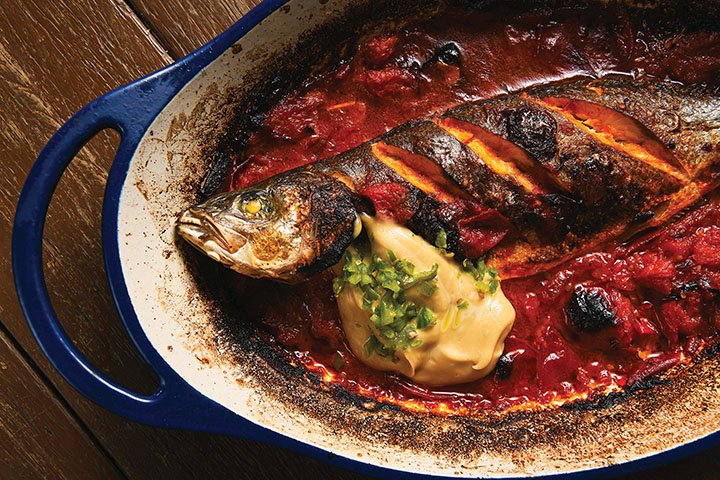
The Beverly Hills menu features some of Malka’s best-known dishes, including the Queen Malka Schnitzel, Branzino Hraime, onglet served with roasted white peaches and Israeli-style hummus. The Los Angeles location also introduces dishes created specifically for the city, including Melanzana, Niçoise Salad and Wild King Ora Salmon Bruschetta. The menu will evolve with the seasons, drawing on California produce such as figs, pluots and peaches.
Until he opened his first Malka in Tel Aviv in 2018, Shani’s restaurants were not kosher. Since then, he has expanded the concept internationally while continuing to operate a wide-ranging restaurant empire that includes Miznon, Shmoné, Port Sa’id and HaSalon in New York, as well as Miznon locations in cities including Paris, London, Toronto, Panama City and Singapore.
So why did a chef with an already successful international restaurant empire decide to enter the kosher world, with its additional requirements and restrictions? For Shani, the answer was simple: he saw people who wanted to eat his food but couldn’t because they were keeping kosher.
“They were standing like cats on a fence, licking their lips and wanting to devour my food, but they couldn’t,” he told The Journal. “So I decided to open a kosher restaurant so they could eat it too. Their gratitude fills me with happiness.”
Don’t expect Malka to be “fine dining.” According to Shani, although the food is certainly refined, it is too “wild, kicking, living and full of energy” to fit the traditional definition of fine dining.
He believes that sense of vibrancy is precisely what has been missing from kosher dining. “Usually, in a kosher restaurant, there is a kind of cloud hanging above it — a cloud of kosher restrictions that limits the restaurant,” he said. “I haven’t really seen a kosher restaurant that is full of joy, that is alive, contemporary, turbulent and extremely energetic. That’s what it will be here.”
Shani rejects the idea that kosher cooking necessarily limits his culinary creativity.
“For me, there are no limitations,” he said. “I don’t cook with dairy anyway. I believe in olive oil. It gives the food a very transparent expression.”
Butter, he explained, tends to soften and homogenize flavors, while olive oil allows the ingredients to retain their individual character.
Shani never minces his words. Interviewing him is less like conducting a traditional interview and more like listening to a poet recite a love song to food. He speaks about vegetables as if they have souls, ingredients as if they have desires, and cooking as a way of revealing the life hidden inside them.
Arriving in Los Angeles, Shani was excited to discover the abundance of fresh produce grown right here. Vegetables are often the stars of his menu, even when meat or poultry is the main course, and his talent for turning simple ingredients such as tomatoes and cauliflower into exquisite dishes is well established. One of the first things he did after arriving in L.A. was visit the local farmers’ markets.
“I couldn’t believe it. I said, ‘Oh, thank God — food that doesn’t have to travel long distances. Food that grows in this sunshine.’ It reminded me of Israel. Sunshine is one of my ingredients. Where there is sunshine, things want to grow and exist. That’s true of human beings as well as ingredients.”
Shani said he was drawn to Los Angeles not only because of its produce and sunshine, but also because of the sense of freedom he associates with the West Coast. Compared with New York, he finds Los Angeles more open, relaxed and curious. “Here, it feels like people live with fewer rules.” As an Israeli, he added, he feels more at ease with the way people connect with one another on the West Coast. That openness is also reflected in the clientele he hopes Malka will attract. While Jewish diners will likely be among the first to discover the kosher restaurant, he does not see Malka as a restaurant exclusively for Jews. “I expect them to bring their friends,” he said.
“I’ll give you an amazing statistic,” Shani said. “In New York, when a new restaurant opens, 72% of its customers in the first year are Jewish. They’re the first to discover it, become curious about it and give it a try.”
He believes that curiosity is one of the qualities that defines Jewish diners. “They are the first to be brave, and willing to experience something new,” he said.
With his dozens of restaurants, television shows and larger-than-life personality, Shani reminds me of an Israeli Gordon Ramsay — only with his own distinctly Israeli flair.
“There is something about Malka that creates that atmosphere more than our other restaurants that aren’t kosher. There is this feeling that everyone can come and sit around the same table. It’s a very warm way of eating, and I think that’s what people love so much about it.”
“In the end, you know what Malka reminds me of most? Italian restaurants,” he said as he was getting ready for his big opening day. “You walk in and see a 95-year-old grandmother and grandfather, and then their children, grandchildren and great-grandchildren, all sitting around one table, shouting at the top of their voices, enjoying themselves to the heavens, drinking wine and just being happy.”