A few years ago, AKLA was an experiment.
The Los Angeles-based Jewish teen program had a simple but ambitious premise: What if Jewish encounters for young teens looked less like a classroom or synagogue and more like an adventure?
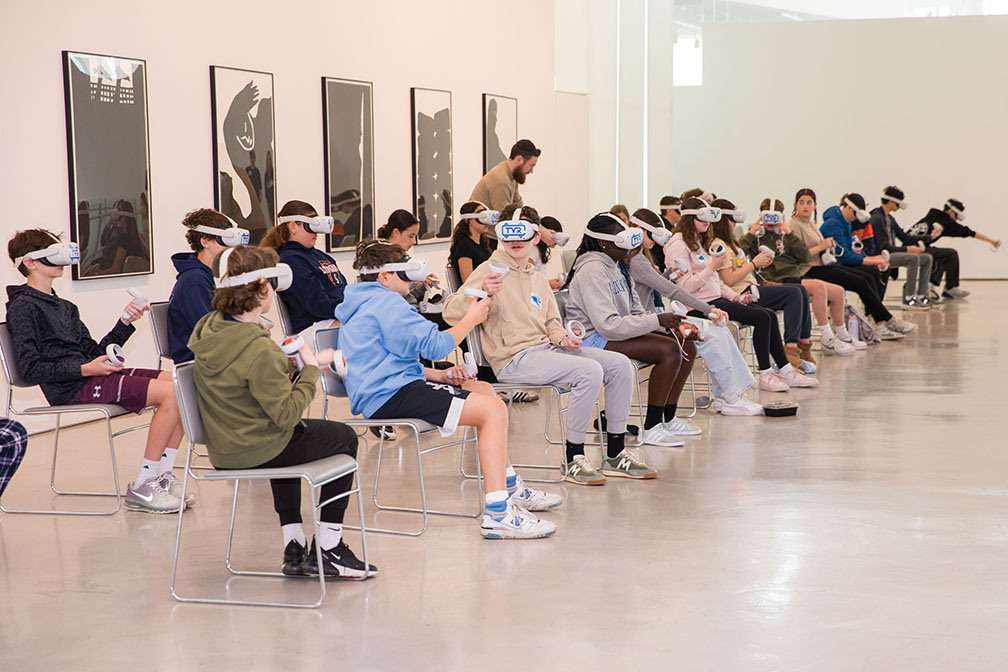
Instead of spending five Sundays, for example, learning about Jewish history from a textbook, teenagers could strap on virtual-reality headsets and “meet” Albert Einstein. They could watch a drone demonstration, learn about Israeli water technology, practice CPR at Cedars-Sinai Medical Center and discover the Jewish origins of Hollywood.
The goal was not to teach teenagers what they should think about being Jewish. It was to show them something they might not have encountered elsewhere: the extraordinary things Jews and Israelis have built, invented and contributed to the world.
When The Journal profiled AKLA in June 2024, the question was whether the fledgling program could influence “the future of Jewish pride.”
Today, the answer is beginning to look like positive. Tonia Barber, co-founder and executive director of AKLA, says AKLA — which currently offers programming in Los Angeles, Chicago and New York — is now preparing for another major step: A two-year grant from the Jewish National Fund-USA will help the organization open a fourth city — in either Dallas, Kansas City or Philadelphia.
AKLA is a Hebrew street word meaning awesome, excellent or great. What began as a local group program for 12- to 14-year-olds has evolved into what AKLA calls “the premier Jewish teen fellowship,” a free five-week initiative designed to deepen Jewish identity through innovation, leadership and experiential learning. The program remains intentionally small. But its ambitions are considerably larger.
The upcoming Los Angeles cohort, happening Oct. 18-Nov. 15, is expected to include 120 teens — a significant increase from the program’s early cohorts.
“Our goal is to excite kids who are 12- to 14-years-old, b’nai mitzvah age, to get them on a track to be enthusiastic about this amazing community and understand the breadth of the Jewish people’s accomplishments,” AKLA President and Co-Founder Jeff Polak told The Journal.
That idea has remained at the center of AKLA even as it has grown.
Learning Outside the Classroom
AKLA is designed to be a pre- or post-b’nai mitzvah experience, a period when many Jewish teenagers are beginning to determine what their relationship with Judaism will look like. The fellowship combines workshops, discussions, guest speakers, hands-on activities and visits to institutions that have a Jewish connection or demonstrate Jewish and Israeli innovation.
The result is a distinctly different kind of Jewish education.
A teenager might learn about Waze and SodaStream, unpack the Jewish origins of Superman or Barbie, explore drone technology or hear from a Jewish professional working at the forefront of medicine or technology. In Los Angeles, where the program first convened in 2022, past cohorts have visited and heard from Cedars-Sinai, the Skirball Cultural Center, the Jewish Journal, the Academy Museum of Motion Pictures and Warner Bros. Studios, among many others.
The experiences are deliberately designed to produce what AKLA leaders call “Jewish pride” without turning the program into a traditional religious-school curriculum. “We’re not religious or political,” AKLA’s Barber told The Journal. “We’re just celebrating the awesome accomplishments and contributions of the Jewish community to society.”
That distinction is central to AKLA’s appeal.
Its teens come from different Jewish backgrounds. Some are highly connected to Jewish life; others have little involvement beyond their families or schools. Rather than requiring a particular level of observance, AKLA starts with a different question: What might make a Jewish teenager curious about being Jewish?
The answer, AKLA believes, is not always another lesson about Jewish holidays. Sometimes it is a movie studio, or a technological innovation developed in Israel. And sometimes it is simply discovering that something the teenager already knows has a Jewish story hiding behind it.
From Los Angeles to Chicago and New York
The expansion into Chicago and New York marks the most significant change to AKLA over the past couple of years.
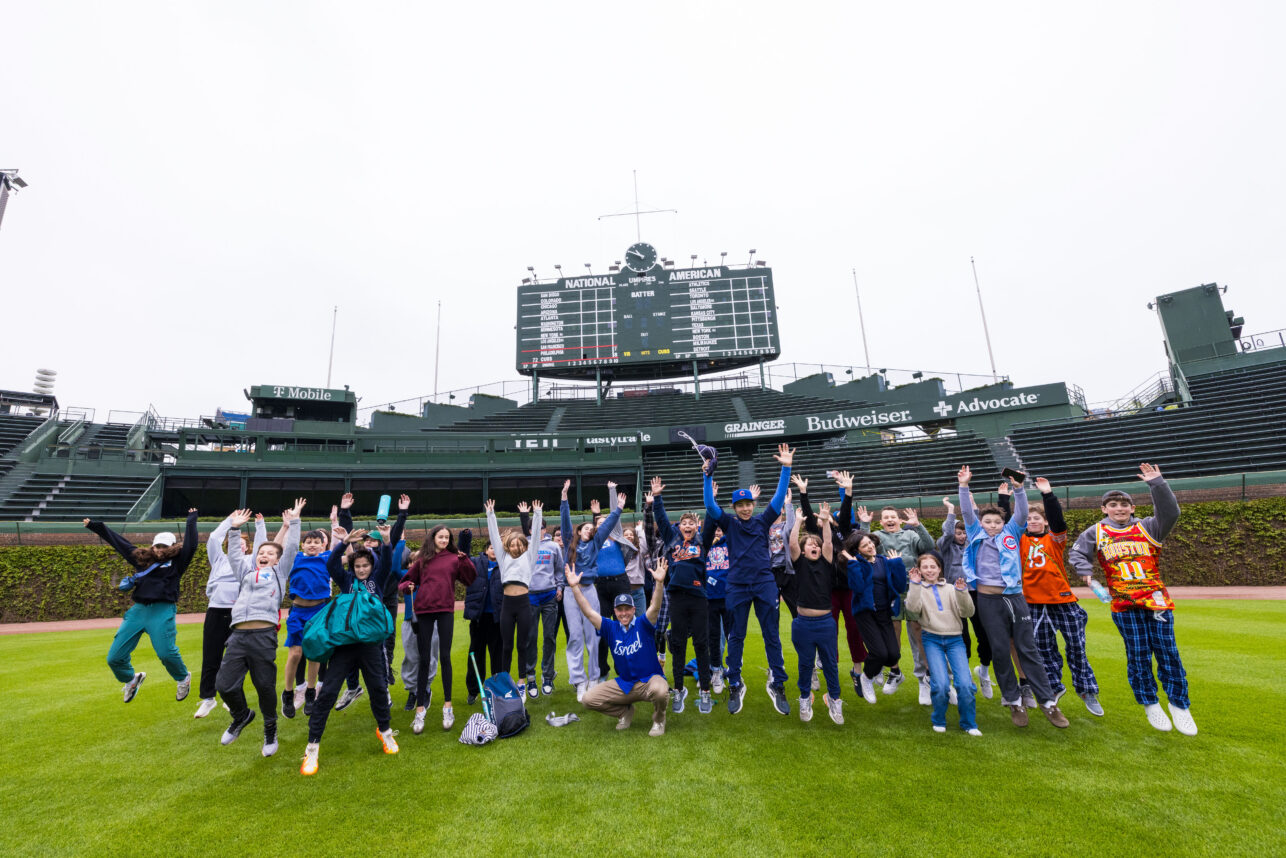
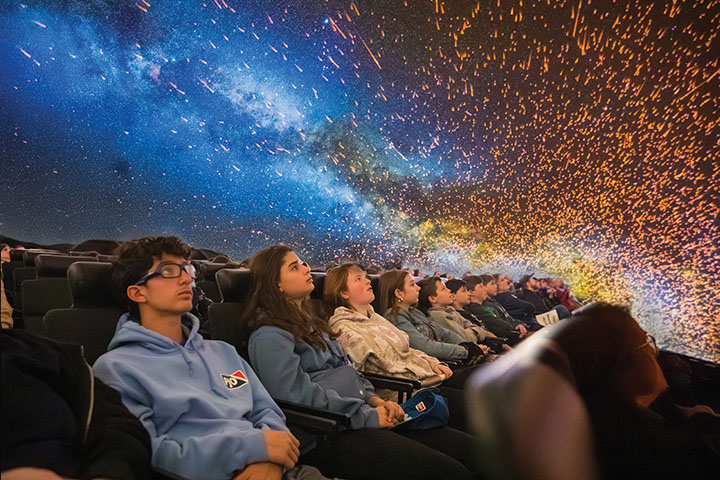
Five-week cohorts are happening in Los Angeles and Chicago, and a jampacked one-day event in New York, designed for a slightly older age group, coincides with the upcoming Los Angeles cohort. In Chicago, AKLA has partnered with the Jewish United Fund (JUF) and developed a program that includes experiences at places including Wrigley Field, Northwestern University’s Feinberg School of Medicine and the Adler Planetarium, as well as Jewish learning connected to the Illinois Holocaust Museum’s pop-up site in downtown Chicago. “It wasn’t in our mindset when we started this program to be a national organization,” Barber said. “But it’s only made sense as we’ve been moving down the path.”
Chicago was the first test of whether the AKLA model could travel. Expanding beyond Los Angeles was “a heavy lift,” Barber said, particularly because the organization knew what it took to produce the program in Los Angeles. But once Chicago was up and running, the idea of going elsewhere seemed much less daunting. “Once we did it, I said, ‘Oh, this is what it’s going to be to get into other cities,’” Barber said. “And it didn’t seem so far-fetched anymore.”
The Chicago program has also demonstrated how AKLA’s philosophy can work without simply importing Los Angeles programming. Without Warner Bros., Barber began looking for another institution that could provide the kind of behind-the-scenes access and Jewish connections that AKLA seeks. She landed on Wrigley Field and discovered a wealth of Jewish connections involving the ballpark’s owners, players and history. Two Jewish tour guides helped develop an experience that included the stadium’s tour box, press box and batting cages.
That kind of discovery is central to AKLA’s approach. The organization does not rely on a fixed curriculum. Instead, its programming team is constantly looking for new and cool things happening in the world and asking how they might become a vehicle for Jewish learning.
The Chicago program reflects the philosophy AKLA developed in Los Angeles: Start with places and subjects teenagers already find interesting, then reveal the Jewish connection. At Northwestern, for example, teens can participate in hands-on medical learning and meet Jewish health-care leaders and Israeli innovators.
New York is presenting a different challenge. Barber said the city’s teenagers have an enormous number of extracurricular options. Rather than reproduce the five-week fellowship exactly, AKLA is developing a one-day immersive experience for New York that it plans to offer quarterly, with content tailored to older teens.
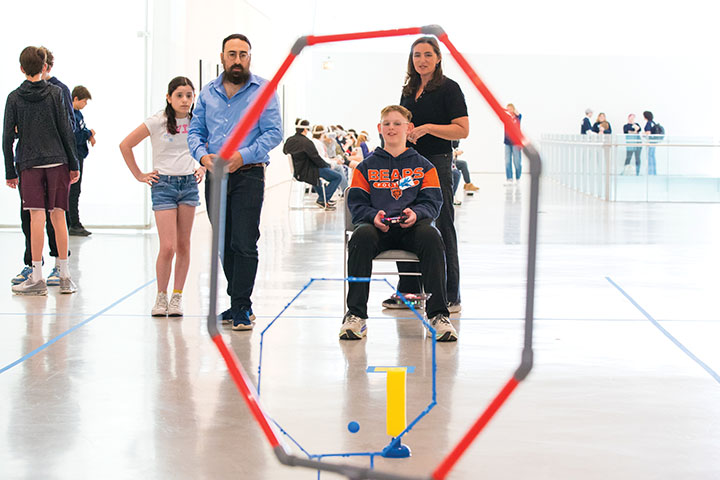
The programming can be just as unconventional. In New York, teens can encounter a squadron program featuring IDF flight simulators that allow them to experience what it is like to pilot a jet. Israeli judo champion Peter Paltchik will participate in programming, traveling from Israel to New York.
The expansion also demonstrates that AKLA’s model is not dependent on Los Angeles’ unusually dense concentration of Jewish institutions, Hollywood connections and technology companies.
The underlying idea can travel.
The People Behind the Program
For an organization with increasingly national ambitions, AKLA remains remarkably small. Its core team consists of Polak, its president and co-founder; Barber, its executive director and co-founder; and Programming Coordinator Rebecca Webb. Polak brings the philanthropic vision. Barber has become the driving force behind AKLA’s experiential and creative programming, transforming what began as a local fellowship that received fiscal sponsorship into an independent nonprofit that reaches multiple communities.
At AKLA, Barber has applied a creative sensibility to Jewish education, emphasizing immersive media, technology, storytelling and live experiences. One example is the virtual-reality experience developed with the Technion-Israel Institute of Technology, which has allowed AKLA participants to interact with Einstein while learning about Israeli innovation.
Now that the organization has its own nonprofit status, it no longer operates under the David and Janet Polak Foundation, though the foundation continues to provide financial support. Because the foundation no longer covers the full cost of the program, AKLA has had to move more aggressively into fundraising.
A Different Kind of Jewish Pride
The timing of AKLA’s growth is significant.
When The Journal first profiled the organization in 2024, the Oct. 7 Hamas attack and the ensuing war in Gaza had already transformed the Jewish communal landscape. Jewish teenagers were confronting antisemitism in ways that their parents and grandparents had not necessarily expected them to experience in their own communities.
That environment has only reinforced AKLA’s argument that young Jews need opportunities to understand and feel connected to their Jewish identity. But Barber is careful to distinguish AKLA’s role from programs specifically designed to combat antisemitism. “There’s a number of great organizations out there that do focus on that,” Barber said. “That’s not what we do.”
Instead, AKLA helps teenagers become comfortable with who they are and discover reasons to feel proud of that identity. It tells teenagers that Jewish identity can be expansive, creative and fun. Barber describes AKLA “as a bridge between the b’nai mitzvah experience and Birthright” — a period when teenagers may have finished their formal preparation for becoming Jewish adults but have not yet found the next meaningful Jewish experience.
“It’s such a big empty space, that time between the b’nai mitzvah and college,” Barber said. “They receive all kinds of information, and they’re looking for a way to break out and make their own voice.”
AKLA meets them through their existing interests — medicine, security, gaming, fashion, entertainment, sports and science — and then reveals the Jewish history embedded in those subjects. The program calls these areas “themes.” “I’m really proud that such a small group of people have done so many great things in the world,” a teenager from AKLA’s 2024 fall cohort said. The sentiment gets at what AKLA is trying to accomplish.
Barber calls those discoveries “aha moments.” A teen might learn that Barbie was created by Ruth Handler, who was Jewish, or discover the Jewish cultural parallels of “The Mandalorian.” At a recent cohort meeting, cosmologist Brian Keating, an observant Jew, began a session with AKLA teens by fielding their first question — whether aliens exist — and then lead them into a conversation that drew on Torah wisdom.
“Kids get a lot of information,” Barber said. “We try to be a rare space of positivity.”
What Happens After Five Weeks?
The challenge for AKLA now is different from the one it faced in 2024. Then, the question was whether the concept worked. Now, the question is whether it can scale without losing what made it compelling in the first place.
So far, AKLA’s strategy has been to preserve the model while adapting it to each city. The organization has also encountered a challenge that would have been difficult to anticipate when the program began: antisemitism can affect the seemingly simple logistics of putting on an event. Barber said AKLA has faced antisemitism when trying to book venues, as well as the false starts caused by COVID-19 in the program’s early years.
Barber is reluctant to reduce AKLA’s impact to a single metric. Some former participants have gone on to volunteer at Cedars-Sinai. Others have developed ambitions such as screenwriting. Early participants have returned as chaperones or interns. What matters, she said, is the enthusiasm that grows from it — teenagers who leave feeling excited about being Jewish and curious about where that identity might take them next.
In 2024, AKLA was described as a bold new initiative trying to make Jewish identity feel “awesome.” Two years later, it is no longer simply a Los Angeles experiment but a growing fellowship operating in three cities and attempting to establish a new model for experiential Jewish education.
For Barber, Polak and their small team, the mission remains remarkably straightforward: Give Jewish teenagers an opportunity to encounter their heritage not as something they are obligated to inherit, but as something they can be excited to explore.
And perhaps, along the way, to discover that being Jewish is not merely something they are — it is something they can do.