Symbols matter in every election cycle. The historic 1996 campaign slogan “Peres will divide Jerusalem” was an exercise in symbolism. “United Jerusalem” is the symbol, and Shimon Peres was framed as the man endangering it. The derogatory 1981 slang term “Chahchahim” was also a symbol. The entertainer Dudu Topaz used it to hint to left-wing voters that casting a ballot for the opposing camp meant voting for a mob. But Likud’s Menachem Begin expertly inverted the symbol: he offered the interpretation that Chahchahim didn’t describe a deplorable mob, but rather the proud Jews of Middle Eastern descent. He turned the insult into a symbol of left-wing condescension.
Altalena is a symbol.
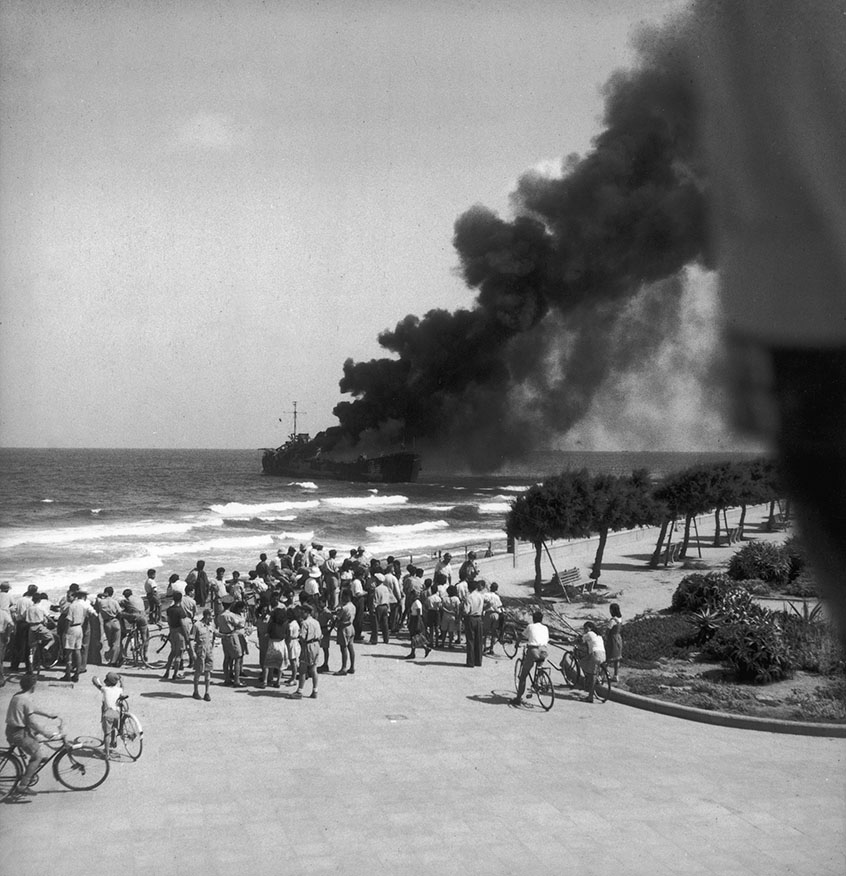
The Altalena was a munitions ship fired upon and sunk by the newly formed Israel Defense Forces in 1948. The ship was brought to Israel by Menachem Begin’s rightist Irgun militia. P.M. David Ben-Gurion demanded that the cargo be turned over to the newly formed IDF. Begin refused. Ben Gurion ordered to bomb the ship. Begin instructed his followers to refrain from retaliation to prevent a civil war.
Last week, the wreckage of the sunken ship was discovered underwater, and the political system immediately geared up to exploit it. A symbol is a flexible thing, and the battle is often over who can successfully charge that symbol with the meaning most useful for a specific political moment.
One could use the Altalena to invoke the left’s willingness to use draconian force against brothers. One could use it as a stark warning that incitement and polarization can lead to disaster. One could use the Altalena to remember that in a sovereign state power must be concentrated solely in the hands of the government.
For a symbol to be used effectively, the public actually has to understand it. “Peres will divide Jerusalem” was easy to grasp. But how well do Israelis actually know the Altalena affair? Clearly, less than they know Jerusalem. In fact, when Minister Itamar Ben-Gvir remarked upon the ship’s discovery that “the Altalena affair is a bleeding wound in the history of Israel,” he wasn’t entirely accurate. The Altalena is a wound that could have been healed a long time ago. It’s politicians like him who make sure to scratch at the scab frequently, and make it bleed, metaphorically speaking, of course.
They want to preserve the Altalena as a symbol of tyranny (once Ben-Gurion, today Supreme Court Justice Yitzhak Amit); a symbol of the willingness to harm fellow Jews (once Ben-Gurion, today the left); a symbol of the proud endurance of the right (once Begin, today Netanyahu). They do not treat the affair to teach about the absolute necessity of the state’s monopoly on force. Or about the urgent need to calm raging tempers before they descend into bloodshed.
Is the symbol effective? We asked Israelis whether Ben-Gurion’s decision to open fire was right or wrong. Truthfully, it’s a very difficult question. It isn’t easy for an Israeli in 2026 to put themselves in the shoes of a prime minister in 1948. Because it is so complex, it is no wonder that a very large portion of the respondents took the easy way out and answered: “I don’t know.” Did Ben-Gurion make the right call? Nearly half of all Israelis today, and 44% of Jewish Israelis, simply do not know.
I suspect that it is especially hard for Israelis to state that Ben-Gurion did the right thing. It is difficult for them to admit that sometimes, firing directly at fellow Jews is the correct course of action for a leader trapped in a complex, high-pressure and existential situation. One can easily understand this reluctance to retroactively validate such a violent act. It is a healthy instinct. On the other hand, clear-eyed historical thinking requires acknowledging that circumstances can arise where firing directly at fellow citizens is indeed a leader’s only correct recourse (an easy historical parallel for Americans: Abraham Lincoln and the secession of the Southern states).
If we think carefully, this tension might explain the abundance of “don’t knows” in our poll. How can it be that so many Israelis don’t know what to think about such a dramatic, endlessly debated historical decision? Israelis – as anyone who lives here knows – are citizens with far too many opinions, not too few. Yet suddenly, on an issue of this magnitude, they struggle to find their voice. Of course, maybe it’s just a symptom of poor education, not reading enough history books or skipping heritage lessons. Then again, this question wasn’t asked during a random, uneventful week; it was asked during a week saturated with media chatter about the Altalena. Anyone who didn’t know the history beforehand could have easily found out and formed an opinion – if not their own, then at least the talking points dictated by their political camp.
So perhaps this reveals the true meaning behind “I don’t know.” Some genuinely do not know. But others think that Ben-Gurion did the right thing, yet they feel deeply uncomfortable saying it aloud. They stay quiet either because the moral implication is stark – or because admitting it would hand the opposing side a political weapon.
Something I wrote in Hebrew
The final days before the parties must register in their final form for the coming election are a race against the risk of losing crucial votes below the electoral threshold of 3.25%:
Add it all up: more than 11% of the national vote is currently projected to go to parties polling below the 3.25% electoral threshold. That is one in every nine votes – the equivalent of around 15 Knesset seats. A massive chunk of those are right-wing votes – or votes that once belonged to the right, or that the right expects and wants to compete for. Notice the striking asymmetry. The anti-Netanyahu “Change bloc” is wasting virtually no votes. The Democrats, Yashar, Beyachad, and Avigdor Lieberman’s Yisrael Beiteinu are all comfortably clearing the threshold … By contrast, the right-wing coalition bloc is leaking like a sieve. Every vote drained by hardline or breakaway figures … is a vote that could, at least in theory, sit in a Netanyahu-led coalition.
A week’s numbers
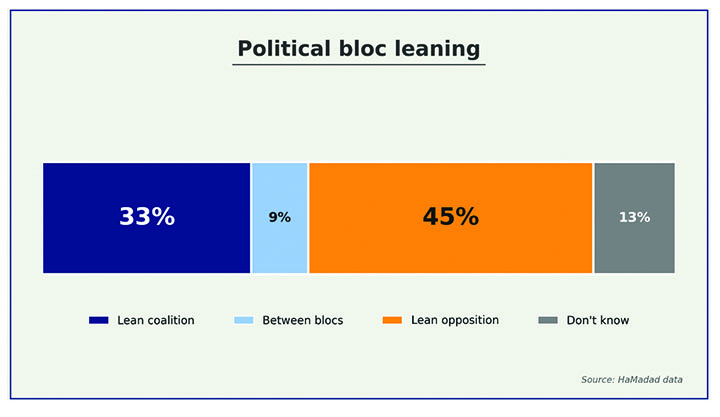
Next week, the parties must settle on their final form: that’s when the real race begins. In the meantime, here’s what Israelis are saying about the choice of political blocs:
A reader’s response
Dor writes: I support the settlements, but the leaders must control the chaos we see there. Answer: They must. Chaos is the worst enemy of a state.
Shmuel Rosner is senior political editor. For more analysis of Israeli and international politics, visit Rosner’s Domain at jewishjournal.com/rosnersdomain.