The greatest comedic minds of the 1930s have a message for us in 2026, and it isn’t funny.
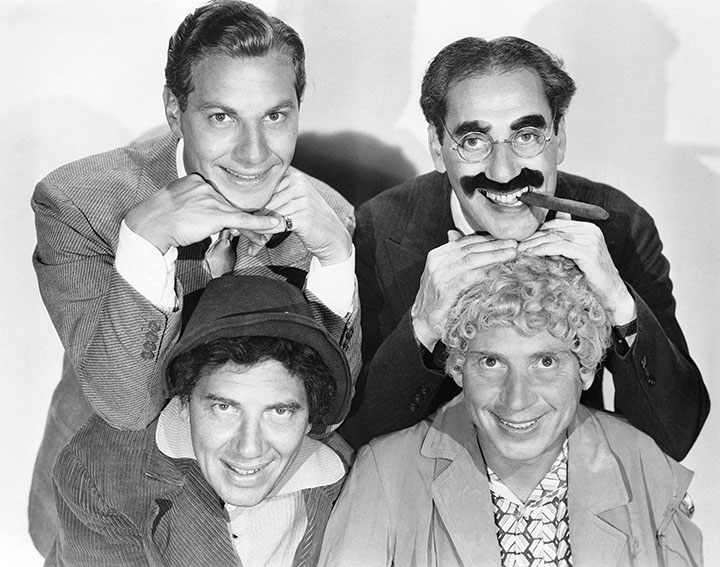
Who were the Marx Brothers? They were five brothers born in New York City of Jewish immigrant parents, and they set the standard for American comedy. They started in vaudeville doing slapstick but were not particularly well-received. They did find success on Broadway and especially with the 13 movies which established their reputation. They worked with S. J. Perelman, George S. Kaufman, Morrie Ryskind and others who constituted some of the greatest comedy writers of their time. But why is their brand of comedy so enduring? It is because, like all true art, it speaks as much to our time as to theirs.
Of course, there are countless differences between our current time and the 1930s. But the Marx Brothers’ movies resonate now because we recognize the concerns and issues they revealed, both on economic and political issues, as well as social and moral values.
The movies are very different from one another, but there is a fundamental theme. I will discuss “Duck Soup” as an example, but other great Marx Brothers’ movies, like “Monkey Business” and “A Night at the Opera,” exhibit a similar idea.
In “Duck Soup,” four of the brothers – Groucho, Harpo, Chico and Zeppo – appear in the imaginary country of Freedonia.
The political leaders of Freedonia squandered a fortune gifted by a wealthy widow, Mrs. Teasdale. She announces that she will grant the country another fortune only if the government accepts an unknown to be their leader. Rufus T. Firefly, as the name implies, is an arrogant incompetent who immediately throws the country into even greater chaos.
Elaborate costumes and trumpets playing at the investiture give the appearance of a royal court, but the frantic pace and the absurd declarations by Firefly make a mockery of the ceremony and his leadership: he announces that a new law will jail people who chew gum. He arrives late at his own inauguration. He insults everyone and yet he is warmly received. All hail His Excellency.
Firefly’s non sequiturs, drivel and political doublespeak make a fool of him and the gullible crowd. No matter how outlandish the laws passed by Firefly, only one member of the government perceives the danger and protests. But he resigns and is never heard from again.
Freedonia has a neighbor and enemy, the fictional state of Sylvania. Both Firefly and the ambassador of Sylvania, Trentino, vie for the hand of the wealthy Mrs. Teasdale. Firefly insults Trentino, accusing him of an imaginary slight, and Trentino declares war on Freedonia.
Two of the Marx Brothers characters work as spies for Trentino and attempt to steal the war plans of Freedonia. Like Firefly, the brothers are fumbling fools who know nothing of spying and prove that both countries are led by idiots who can’t tell the difference between competence and nonsense.
The movie is replete with scene after scene of hilarious high jinks, songs and dances, all of which are distractions from the real issues that plague the nation – like the bread and circuses of the Roman Empire.
Consider the famous mirror scene in which Groucho and Harpo, clothed the same, see each other in what appears as a mirror. Each is trying to discern if he is looking at a reflection of himself or someone else. The scene highlights the central theme of the movie: a mirror symbolizes perceiving one’s true self, but the illusion of a mirror in the movie is a denial of introspection and contemplation.
One of the Marx Brothers, Chico, is put on trial for treason because he tried to steal the war plans. Firefly (Groucho) is the judge, and the proceedings are pure farce. The slapstick makes a mockery of the justice system in a dictatorship. The scene is so fast-paced that there is little time to reflect on the meaning and impact, but the overall impression is one of extraordinary ineptitude and corruption.
Wordplay is constant throughout. One talks of taxes and another responds with a comment on Texas; one mentions lemonade and someone responds about eliminate. Not just politics but language is corrupted in Freedonia. Every character is saying nothing, and one is left with a stream of meaningless talk in a world that conceals more than it reveals.
When the attempt to prevent war fails, the two countries go to battle, in a world where nothing makes any real sense. In a further absurdity, preparation for war is portrayed in Broadway-style song and dance, joyous and enthusiastic, a veritable glorification of war. Soon after, the Freedonians are overwhelmed by the enemy, and the political and military authorities only make matters worse with their chaotic directives.
All is saved when Freedonia captures Trentino and pelts him with oranges until he surrenders. Freedonia is elated. Mrs. Teasdale breaks into song and the film ends with her being pelted with oranges as well.
The movie clearly shows that when there is a country in financial crisis, at war, with no real leadership, the situation is dangerous not only because the leaders are greedy and incompetent, but also because the citizens are blindly credulous of these fools. The chaos, farce and absurdity are a source of laughter, but also make us aware of the sad fact that so many problems are the result of human failure: both leaders and those they lead.
The Marx Brothers may not have been religious, but their values were Jewish. They challenged the established order where they saw injustice, self-aggrandizement, corruption and blind obedience to those unworthy of the people’s trust.
Like the greatest satirists, such as Jonathan Swift and Mark Twain, they chose comedy over accusation to mock the folly of society and add levity to dark times. But their aim was not levity alone. Their satire was a pointed critique of deeply sinister forces that destroy societies, time and again. That is why their film speaks to our era too, offering the much-needed clarity that is best received when it begins with a laugh.
Dr. Paul Socken is Distinguished Professor Emeritus and founder of the Jewish Studies program at the University of Waterloo.