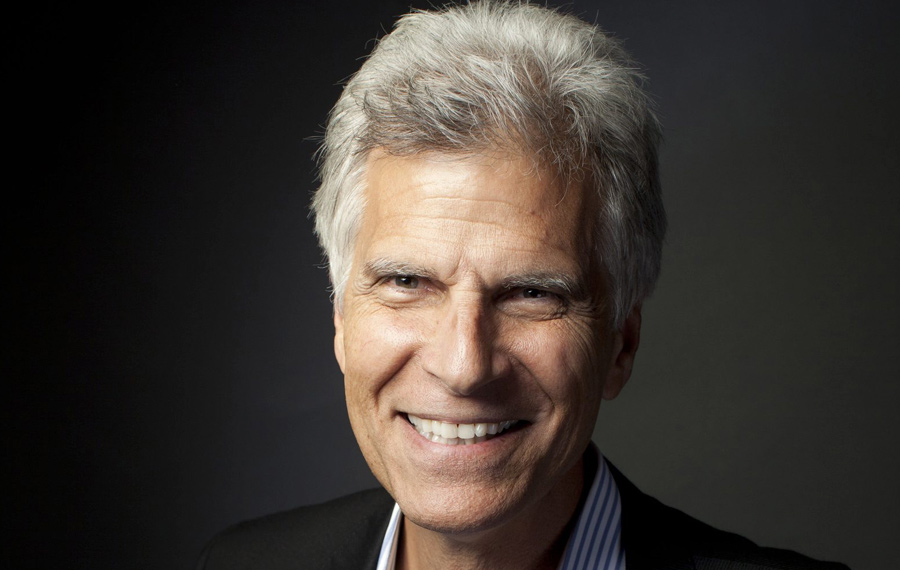
In 1972, swimmer Mark Spitz won seven gold medals at the Summer Olympics in Munich, setting a record that stood until Michael Phelps broke it with eight in 2008. Spitz instantly became a hero, a Jewish American idol with his own best-selling poster. He parlayed his fame into lucrative licensing deals for swimwear and other products.
Now, as the national spokesman for the Holocaust Education Film
Foundation, Spitz is using his celebrity status to draw attention to a series of survivor documentaries.
“The mission is to produce full-length documentaries about Holocaust survivors and share their impactful stories,” Spitz, 68, told the Journal. “We’re running out of time. It’s so important now because we don’t want these stories to die with them. We’re continuing to raise money so we can produce as many as we’re able to until their time has run out.”
Spitz has partnered with a friend, Anchor Media Group’s Ron Small, to make the films, the first of which is “To Auschwitz and Back: The Joe Engel Story,” now available on DVD. Two more documentaries will follow this year, one featuring “Hogan’s Heroes” actor Robert Clary, a Buchenwald survivor, and the other about Dr. Susan Spatz, who survived Birkenau and Ravensbrück.
Originally from Northern California, Spitz grew up in a Reform Jewish home, went to Sunday school, became a bar mitzvah and celebrated the holidays. He didn’t otherwise focus on Judaism. But when his Olympic achievements, as he puts it, “added a page to the Jewish sports book,” he constantly had to answer questions about it from the press. “I never shied away from the fact that I was Jewish, but here it was being thrown in my face,” he said. “It’s an interesting responsibility, to be honest.”
But Spitz never could have imagined that his religion would put him in jeopardy. In the early hours of Sept. 5, 1972, Palestinian terrorists broke into the Olympic Village, taking 11 members of the Israeli team hostage, eventually killing all of them. Spitz was unaware of the crisis until he arrived in the media center for a scheduled press conference. Police escorted him back to his room, where German Chancellor Willy Brandt greeted him and explained the plans for ensuring his safety. Spitz flew to London that night, where he had guards outside his hotel room. When he ultimately landed in Sacramento, “[Gov.] Ronald Reagan greeted me at the gate,” he said.
Spitz competed in the Maccabiah Games in Israel in 1965, winning four gold medals. He picked up six more four years later, then returned to the games in 1985 to carry the torch and light the cauldron. He was accompanied by two young girls who were the daughters of murdered Israeli Olympians.
“My gold medals are in a bank vault. They’ve been there since I brought them home. I don’t need to display them. And they’re safer there.” — Mark Spitz
Spitz had intended to go to dental school after the Olympics, but opted to take advantage of business deals he was offered. Over the years he’s been involved in a variety of endeavors, including real estate development, a prepaid phone card company that was bought by AT&T, stock brokerage, financial advising and private equity investments, and motivational speaking. “Not everything I do turns to gold, but I’ve done pretty well,” he said.
He moved to Los Angeles after the ’72 Olympics, married his wife, Suzy, the following year and is a longtime member of Stephen S. Wise Temple, where his sons, now 27 and 37, were educated. His Westside home has a pool, but he uses it “not enough,” Spitz said.
As for his gold medals, “They’re in a bank vault,” he said. “They’ve been there since I brought them home. I don’t need to display them. And they’re safer there.” He has taken them out four times: twice for publicity purposes and twice more when each of his sons turned 7, for the family photo album. They wore Speedos and donned the gold to recreate their father’s famous poster shot.
Today, Spitz is “proud of my success as an athlete, but my biggest success was marrying Suzy,” he said. “Life is a moving target but we keep growing together.”
Asked about his to do-list of things to accomplish, Spitz considered the question thoughtfully. “I once thought it would be cool to go up in the Space Shuttle, but I’m not that much of a risk-taker,” he admitted. “I’m not sure. I’ve done a lot. I’ve flown a 747. I’ve met a lot of famous people, kings and queens and presidents and chancellors. When I was competing I always had a timeline. In the last 15 years, I’ve relished that I don’t have a timeline. But I do have responsibilities and projects, and I love those challenges.”
Those projects include his work with the Holocaust Education Film Foundation. “Anything that can shine a light on our past is a positive thing,” he said. “And a lesson for generations to come, so they don’t forget.”