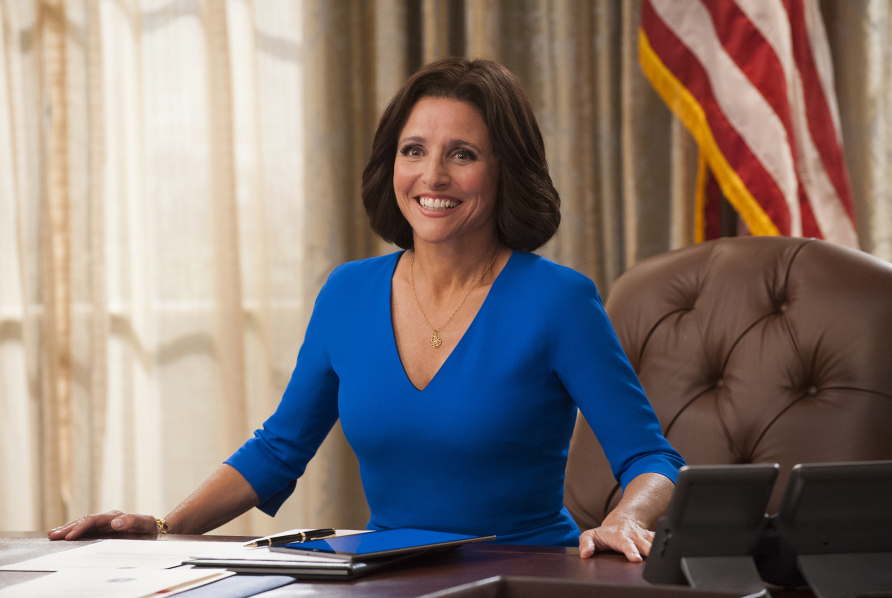
Next month, Julia Louis-Dreyfus will add one more accolade to a list of honors that includes the 11 Emmys and a Golden Globe she won for “Veep” and “Seinfeld.” The actress will receive the 21st Annual Mark Twain Prize for American Humor at the Kennedy Center on Oct. 21.
Jerry Seinfeld, Tina Fey, Stephen Colbert, Tony Hale, Abbi Jacobson and Keegan-Michael Key will be on hand for the ceremony, which PBS will broadcast on Nov. 19.
“Merely to join the list of distinguished recipients of this award would be honor enough, but, as a student of both American history and literature, the fact that Mr. Twain himself will be presenting the award to me in person is particularly gratifying,” Louis-Dreyfus joked.
“Veep” is scheduled to return to HBO for its seventh and final season in spring 2019. Louis-Dreyfus, who underwent surgery for breast cancer last year, posted a photo of herself on social media in February celebrating her return to health, captioning it, “Hoorah! Great doctors, great results, feeling happy and ready to rock after surgery.”
Criticizing Israeli policies or actions is legitimate. Characterizing the Jewish state—and no other—as a "racist endeavor" is antisemitic. That this is happening in the heart of London is shocking. https://t.co/sxzoRAyDMz
According to Jewish News, London Palestine Action took responsibility for the signs.
“Israel, as a Jewish majority state, could not have been established without the ethnic cleansing of indigenous Palestinians,” London Palestine Action wrote on their Facebook page. “Those Palestinians and their descendants, that were forced to leave in 1947/48, have not been allowed to return to their homes and land because they are not Jewish. Over 60 Israeli laws already exist that restrict the rights of Palestinian citizens of Israel, and Israel has recently enacted the ‘Nation-State law’ declaring that only Jews have the right to self-determination in the country, and has stripped Arabic as an official language, entrenching the Apartheid that exists on the land.”
Transport for London (TfL) said in a statement that the signs were not authorized for that advertising space and they were working to take them down.
“These adverts are absolutely not authorized by TfL or our advertising partner JCDecaux,” a TfL spokesperson said. “It is flyposting and therefore an act of vandalism which we take extremely seriously. We have instructed our contractors to remove any of these posters found on our network immediately.”
As the Jewish News noted, the signs came the day after Labour Party Leader Jeremy Corbyn attempted to add a statement to the Labour Party’s adoption of the International Holocaust Remembrance Alliance (IHRA) definition of anti-Semitism describing “Israel, its policies or the circumstances around its foundation as racist.” Corbyn’s attempt was rejected.
The Jewish Chronicle’s Daniel Sugarman noted that calling Israel “a racist endeavor” references an IHRA example as to criticism of Israel that amounts to anti-Semitism.
“I see it as clear evidence that Labour’s inability/unwillingness to deal with anti-Semitism gives credibility to these views,” Saul Schneider, who saw one of the signs in Bloomsbury, told Sugarman. “So worrying that people just walk by and take it in.”
Last December, I was a “guest” at Cedars-Sinai Medical Center for a week that felt like an eternity. Every day I prayed that I would be well enough to go home and every day brought new problems. It was impossible to keep the dark thoughts at bay.
One of the most important things that kept my spirits buoyed was a visit from Senior Rabbi and Director of the Spiritual Care Department Jason Weiner, along with one of the other Jewish chaplains. They came with little prayer cards, get well wishes, and they helped allay my fears.
It was an absolute blessing at a time when I was feeling incredibly vulnerable. So how much more vulnerable must someone feel to be in the hospital during the High Holy Days — a time when we are supposed to confront our mortality? I reached out to Rabbi Weiner to ask.
“It’s a very difficult time for people, it’s a lonely time,” Weiner said. “It’s a time when they want to be with their families or want to be in the synagogue.”
At this time of year in particular, Weiner said there are so many conflicting emotions for patients, “especially on Yom Kippur, when there’s so much talk about the Book of Life and the Book of Death. Often an existential crisis comes up and patients wonder if it’s a bad omen if they’re starting their year in the hospital.”
“Often an existential crisis comes up and patients wonder if it’s a bad omen if they’re starting their year in the hospital.”
— Rabbi Jason Weiner
Weiner said his job is to listen to patients “and let them articulate their fears and provide support and compassion.”
Patients sometimes ask him, “Does this mean I’m likely to die this year because I’m in the hospital over the High Holy Days?”
Weiner said, “I tell them ‘There’s no Torah source that says that.’ I’m more likely to say, ‘Why is that on your mind right now?’ and then explore it with them and help them through it.”
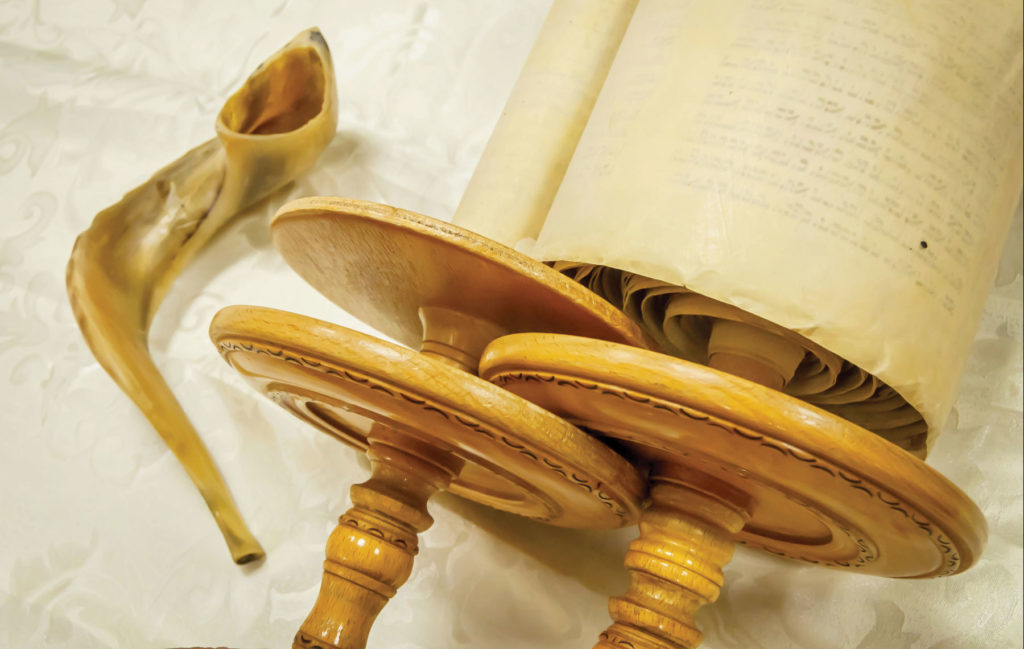
Weiner and his staff do a lot to help make the holidays special for patients. Sometimes they reserve rooms and have entire families come in for Rosh Hashanah dinners. The hospital’s kitchen prepares a special kosher meal and hands out apples and honey and sweet cake. There are pre-recorded High Holy Days services that patients can watch on the television from their beds, and the chaplains will blow the shofar in every room where patients request it.
“We try to give the patients extra TLC and talk about the holidays,” Weiner said.
For those who are well enough to leave their rooms, they can attend services. While the hospital has on average 180-200 Jewish patients over the holidays, services have to be moved from the chapel to the Harvey Morse Auditorium because close to 600 people attend.
“The services are geared for the patients,” Weiner said. “They sit in the front row and we have their nurses with them. But we also have a lot of [Jewish] staff who are working attend, as well as past patients and even people who live in the neighborhood.”
Weiner leads the services himself with Cantor Jordan Gorfinkel, and the hospital has its own machzor in Hebrew, Hebrew transliteration, English and English commentary. The services are truncated. “We call it a learning service,” Weiner said. “There are full Torah readings and a full shofar blowing, but for the prayers, we skip around a bit.” On Yom Kippur afternoon, however, there are full services.
“We try to [hold services] in a way that Orthodox, Conservative, Reform and unaffiliated will all feel comfortable,” Weiner said.
The full Neilah service at the end of Yom Kippur is something Weiner cherishes. “There are so many tears because people are literally praying for their lives.” He recalled a particularly moving moment when he saw two women hugging and crying. “One said, ‘I was praying for your husband,’ and the other said, ‘I was praying for your son.’ It was so profound,” Weiner said. “And really meaningful.”
There will be more “Law & Order” on TV when NBC launches a spinoff of “Law & Order: SVU,” likely next year.
From Dick Wolf and former “SVU” showrunner Warren Leight, the seventh and latest series in the venerable franchise is “Law & Order: Hate Crimes,” based on the Hate Crimes Task Force in New York City. The spinoff’s characters will be introduced in an episode of “SVU” in the latter part of the season.
“As ‘Law & Order: SVU’ enters its remarkable 20th season, it is exciting to get back into business with Dick Wolf on a new ‘Law & Order’ incarnation that feels extremely timely,” said Lisa Katz, Co-President of Scripted Programming at NBC. “Considering that last year there was a double-digit rise in hate crimes in our 10 largest cities — the highest total in over a decade — it seemed like this topic is begging to be explored.”
“As with all of my crime shows, I want to depict what’s really going on in our cities and shine a light on the wide-ranging victims and show that justice can prevail,” Wolf said. “Twenty years ago when ‘SVU’ began, very few people felt comfortable coming forward and reporting these crimes, but when you bring the stories into people’s living rooms…a real dialogue can begin. That’s what I hope we can do with this new show in a world where hate crimes have reached an egregious level.”
The real Hate Crimes Task Force works under the Special Victims Unit, so expect lots of crossover with both “Law & Order” shows.
In 2016, when artist Wanda Peretz was at the POLIN Museum of the History of Polish Jews in Warsaw, she looked up and fell in dizzying and enduring love.
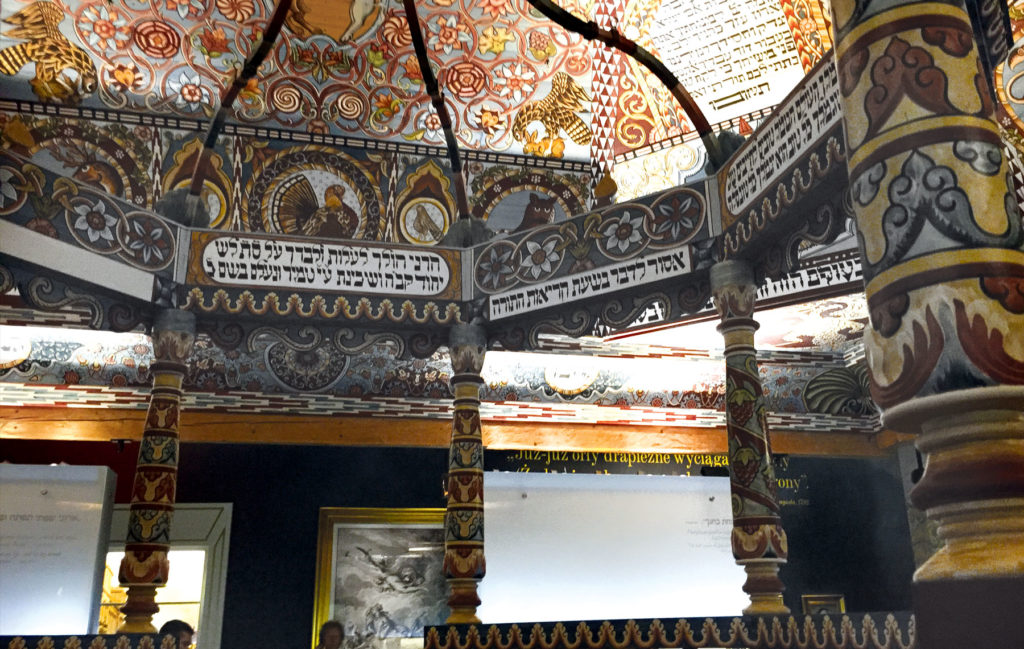
Peretz found herself gazing at a reconstruction of a ceiling from the Gwozdziec Synagogue, a 17th-century building that was destroyed twice, first in World War I, then by the Nazis during World War II. The ceiling, painted with elaborate and colorful zodiac figures, had been painstakingly reconstructed as one of the permanent exhibits for the POLIN Museum, which opened in 2014.
“Standing underneath the actual replica was one of the most intensely emotional reactions I have had to a thing as opposed to a person,” Peretz said.
Inspired by the art and the history of the synagogue, Peretz embarked on extensive research surrounding the art and the artisans, and let the inspiration come. One project that grew from this fascination is about to come to fruition at her synagogue, Temple Beth Am in Los Angeles, where she previously had done many art projects themed to Jewish holidays.
But this project will be different in scale and content. It is a replica of and homage to that resurrected art of the Gwozdziec Synagogue, suspended in the alcove above the bimah in the Dorff-Nelson Chapel, where the Library Minyan — Beth Am’s volunteer-led, participatory prayer group — will meet for the High Holy Days. To make sure that the community was on board and engaged, Peretz invited them to help create it.
This project is what Beth Am Senior Rabbi Adam Kligfeld called “a meaningful nod to the fact that the chapel deserved some kind of love,” especially this year, as the synagogue’s sanctuary undergoes major reconstruction.
“It’s a way of giving a gift to the people who daven there,” Kligfeld said. “Giving the space some loving attention is a nod toward hiddur mitzvah [beautifying the mitzvah] for that room.”
When it is installed in advance of Rosh Hashanah, the project will testify to the massive achievement of Polish synagogues and serve as a remembrance of the destruction that all but eradicated the synagogues from existence.
The reconstruction of the Gwozdziec ceiling Peretz saw in Warsaw came about when, in 2011, the Association of the Jewish Historical Institute of Poland together with the Museum of the History of Polish Jews and Handshouse Studio launched an educational project that saw students, historians, architects, artisans and artists working together to rebuild the synagogue’s roof structure and polychrome wooden ceiling.
As much as possible, the team used only construction and painting methods that would have been used in the 16th century. Once the project was underway, the team held workshops in seven Polish cities, in each town’s synagogue, generating interest and buy-in from local residents. The roof and its decorative ceiling were mounted inside the museum’s building at the beginning of 2013.
Under Peretz’s stewardship, Temple Beth Am is engaged in a somewhat parallel process. The community is learning about the synagogue and its history while working to re-create a portion of it. For the last few months, congregants have been coming to Peretz’s art studio in Beverlywood to color in art panels. Peretz traces the images from the Gwozdziec murals, enlarges them and then presides over others who follow the color guides.
“I love watching everyone use the oil pastels — all beautiful, rich and varied colors but still with the comforting boundaries of a limited palette — and seeing the black-and-white images suddenly transform into art that is bright and alive with color,” she said.
Peretz also organized a recent screening at Beth Am of “Raise the Roof,” a documentary about the reconstruction process of the Warsaw synagogue roof and ceiling. She brought in Thomas Hubka, professor emeritus at the University of Wisconsin-Milwaukee and an architectural historian, to talk about the project. Hubka said that the two major components in the Gwozdziec prayer hall were the ark and the bimah. Beth Am’s chapel also has a bimah in the middle, over which the Gwozdziec-inspired art will be installed.
“I so admire Rick and Laura Brown’s Handshouse Studio reconstruction at the POLIN Museum,” Peretz said. “I just wanted to re-create a much simpler, much smaller and quicker version of what their teamwork accomplished over three summers — their stunning permanent exhibition for the world to visit in Poland. Our alcove is for whoever comes into the Dorff-Nelson Chapel to daven for the High Holy Days this year, and in memory of Israel and Isaac [the painters whose signatures are visible in the Gwozdziec murals],” she said.
“A wide array of Beth Am Jewfolk have found themselves involved in this,” Kligfeld said. “People are just drawn to it.”
The art installation will remain through a Hoshana Rabbah Live music Hallel with singer Josh Warshawsky and will be taken down right after Simchat Torah.
“What [Peretz] is creating isn’t intended to be that enduring a project,” Kligfeld said. “But everyone who’s been involved understands that Jewish art in synagogues made these synagogues treasures. It connects the kahal (congregation) to that and opens the mind to what a synagogue could look like.”
“This dream, this artwork, these images are part of the collective Jewish soul and memory,” Peretz said. “By interacting with those Gwozdziec images [through the act of coloring them in], we are opening the possibility of having an emotional experience, one that accesses the childhood simple joy of colors and crayons, the pleasure and satisfaction of participating in hiddur mitzvah, the beautifying of a sacred object.”
“It’s all her dream,” Kligfeld said.
A screening of “Raise the Roof,” will take place at American Jewish University in Bel Air at 1 p.m. on Sept. 27.
The popular video game Fortnite Battle Royale by Epic Games may not seem to have anything to do with Rosh Hashanah, but it does.
The game is simple: One hundred players parachute onto an island and furiously race to gather materials, weapons and gadgets inside a steadily shrinking safe zone. The last player standing wins a Victory Royale.
Then you do it again.
And again.
Fortnite is like “The Hunger Games” but without the viciousness. The game encourages wholesome play, rewards kindness to other players and dancing with opponents on the battlefield is considered completely normal.
Over the past year, the free-to-play video game has earned an estimated $300 million per month, mostly by selling cosmetic upgrades and fun dance “emotes.” Along the way, Fortnite transcended gaming culture and staked its place in popular culture. Celebrities and famous athletes teamed up with the biggest Fortnite players and streamed their matches to an online audience of more than 1 million viewers. NFL players celebrated touchdowns with iconic Fortnite emotes and Major League Baseball teams celebrated their victories with choreographed renditions of Fortnite dances.
The popularity of the game is certain. Less certain is the explanation for its massive popularity.
While playing a recent game of Fortnite with my son, who is a much better Fortnite player than me, I realized the secret of Fortnite’s success is also the secret of Rosh Hashanah.
“Rosh Hashanah is a personal reset button. Together we acknowledge the end of a year and we refresh our commitment to never stop engaging in the battle. If we do Rosh Hashanah right, our new year begins with a blank scoreboard and renewed optimism for our success.”
Rosh Hashanah is the great equalizer. All year, battles rage within us. Good vs. Evil. Right vs. Wrong. Generosity vs. Selfishness. We rack up some wins and we take our share of losses. Overall, we may have grown into better people or we may have succumbed to our lesser selves. It can be tempting to stop battling and fall into a permanent state of inertia, allowing us define ourselves by our greatest triumphs or our worst failures.
Rosh Hashanah is a personal reset button. Together we acknowledge the end of a year and we refresh our commitment to never stop engaging in the battle. If we do Rosh Hashanah right, our new year begins with a blank scoreboard and renewed optimism for our success. A true Rosh Hashanah has the power to erase our past and grant us a new year free from our baggage. This is the brilliance of Rosh Hashanah and why it resonates so deeply within us. Everyone wants to shed their baggage and star in their own redemption story.
Unlike many popular video games, the in-game purchases sold by Fortnite offer no competitive advantage. It is a truly free game, and Epic Games chose not to reward players who spend money with any in-game advantage. This counter-intuitive concept has resulted in hundreds of millions of dollars of monthly in-game sales. More significantly, Fortnite Battle Royale ensures a level playing field for all comers. No matter how many matches a player wins or loses, every player begins the next game on an equal footing. The opportunity to try again and leave the past in the past is irresistible. It is the power of Rosh Hashanah.
Fortnite is an infinite stream of fresh starts. There is no baggage or advantage that carries over from one game to the next. Every game is a new beginning. Every game is another Rosh Hashanah.
Eli Fink is a rabbi, writer and managing supervisor at the Jewish Journal.
For nearly three decades, the Chai Center — a nonprofit Jewish outreach group — has done things differently. In an effort to reach Jews who don’t attend High Holy Day services, the Chai Center holds free Rosh Hashanah and Yom Kippur services.
“We have always been targeting the Jews who are not interested,” Chai Center Rabbi Mendel Schwartz told the Journal in a telephone interview. “One of the ways we can grab those Jews is by taking away the biggest excuse, which is, ‘I don’t want to pay to pray.’”
The Chai Center is just one of many local organizations or synagogues that hosts free High Holy Day services. Others include Temple Ner Simcha, in Westlake Village; Beth Shirah Congregation at the Matrix Theatre on Melrose Avenue; Vital Transformations, a Kabbalistic community, which holds Erev Rosh Hashanah and Rosh Hashanah services at a private home in Pico-Robertson; and Bais Naftoli, an Orthodox congregation on La Brea Avenue.
Nevertheless, free High Holy Day services are pretty uncommon. Usually tickets are provided to synagogue members who have paid their dues and therefore are in good standing. Tickets are also often available to non-members but even those tickets can cost several hundred dollars. Many synagogues open their second day and evening services to the general public (see this issue’s High Holy Days calendar on pages 88-91).
While synagogue leaders have no choice but to charge for services to cover their overheads, an organization like the Chai Center, which has no building, has relatively few expenses and can therefore afford to put on free services, Schwartz said. The organization relies on a group of individual donors to pay for the $35,000 needed for annual High Holy Days services, which covers the rental space, the cantor, the advertising budget and the prayer books.
This year, the Chai Center will hold its Rosh Hashanah services at the Writers Guild Theater in Beverly Hills. Kol Nidre and Yom Kippur service will be held at the Landmark Regent Theater in Westwood.
“Sixty, maybe 65 percent of [Los Angeles] Jews, are still not going to temple [on High Holy Days],” Schwartz said. “Not Conservative, not Reform, not Reconstructionist. If you count all the temples and theaters, there are well over 250,000 seats, and a lot of temples all competing for the same minority of Jewish people that are interested in going to temple.”
Over the past three decades, The Chai Center has appealed to not only those looking to pray for free but to those who belong to a synagogue and find it difficult to connect with services. Despite coming from a Chabad background, Schwartz, who took over the organization in 2017 following the death of his father, Rabbi Shlomo “Schwartzie” Schwartz, leads services almost entirely in English.
“We don’t want people to feel left out of the service,” said Schwartz, 42, who describes himself as Chasidic Reform. “I can’t call my service an Orthodox service. No one gets bored. Everyone understands what is going on with the rabbi and the cantor.”
That effect is reflected in the number of attendees at the Center’s High Holy Day services each year, which Schwartz said averages around 3,000. Many of them are disengaged Jews, whom Schwartz hopes become involved in the Chai Center’s year-round programming following a positive High Holy Days experience.
“For a Jew that’s secular, that’s not involved, we feel that their gateway and their potential entrance into the Jewish religion would be through the High Holy Days,” he said, “because they carry the most weight.”
The Chai Center’s strategy has had an impact. Offering free services has inspired people to step up and support Cantor Estherleon Schwartz’s Beth Shirah Congregation. She said people are happy to donate because they are grateful for the free services.
“I would not have the courage to do this if not for the example of Rabbi Shlomo ‘Schwartzie’ Schwartz of blessed memory. He did this for a long time.”
— Rabbi Michael Barclay
“I do not feel comfortable asking for money in a sacred space when one is yearning to be with God,” the cantor said via email. “People give generously from free choice.”
Temple Ner Simcha’s Rabbi Michael Barclay runs his synagogue without membership dues and offers free High Holy Days services because of the Chai Center.
“I would not have the courage to do this if not for the example of Rabbi Shlomo ‘Schwartzie’ Schwartz of blessed memory,” Barclay said in a phone interview. “He did this for a long time.” FREE HIGH HOLY DAY SERVICES TEMPLE NER SIMCHA
Free services with the Agoura Hills community, which blends Reform and Conservative Judaism. Reserve tickets early. Erev Rosh Hashanah 7:30 p.m. Rosh Hashanah Day and Second Day 9 a.m. Kol Nidre 7:30 p.m. Yom Kippur 9 a.m. All services held at Canyon Club, with the exception of tashlich at the Westlake Village Inn. Canyon Club, 28912 Roadside Drive, Agoura Hills. (818) 851-0030.
BAIS NAFTOLI
The Orthodox congregation holds free services for the community. Rosh Hashanah both days 8:30 a.m. Kol Nidre 6:30 p.m. Yom Kippur 8:30 a.m. Neilah 6 p.m. Bais Naftoli, 221 S. La Brea Ave., Los Angeles. (323) 931-2476.
BETH SHIRAH CONGREGATION
Led by Cantor Estherleon Schwartz. Erev Rosh Hashanah 7:30 p.m., Rosh Hashanah Day 10 a.m., Kol Nidre 7:30 p.m., Yom Kippur 10:30 a.m. Free. Matrix Theatre, 7657 Melrose Ave., Hollywood. (323) 653-7420.
VITAL TRANSFORMATION
Free Erev Rosh Hashanah and Rosh Hashanah services with Kabbalist and Rabbi Eliyahu Jian. Erev Rosh Hashanah 7:15 p.m. Rosh Hashanah Day and Second Day
morning service 9 a.m., Rosh Hashanah Torah and lecture 9:45 a.m., shofar 10:45 a.m. Free lunch provided after Rosh Hashanah Day and Second Day services. RSVP mandatory at debbiejian@gmail.com or (561) 400-7796. Private home, 1471 S. Crest Drive, Los Angeles.
THE LAUGH FACTORY
For 35 years, the Sunset Boulevard comedy club has opened its doors for free High Holy Days services. Led by Reform Rabbi Bob Jacobs with music by Robin Winston, the services place a premium on community. Rosh Hashanah, 10 a.m. to 1 p.m., followed by refreshments; Kol Nidre 5 p.m.; Yom Kippur 11 a.m. to 1 p.m.; Neilah 5:30 p.m. to 6:15, followed by a break-fast. Services tend to fill up quickly, so officials recommend that you get there at least an hour early.
On a recent Friday night, more than a dozen guests filled Jenn Weingarten’s cozy Inglewood home. The young-adult crowd — all in their 20s or 30s — chatted over drinks as planes roared overhead taking off and landing at Los Angeles International Airport. A couple of young children fiddled with board games and banged on a toy piano. Molly, a ginger cat, jumped down from her felt play structure. “She scratches, so watch out,” Weingarten warned cheerfully, wine glass in hand.
The dance of dinner prep and socializing took place in the cramped kitchen. Garlic knots were brushed with olive oil and shoved in the oven. More wine was poured and downed. Assorted salads were tossed. Lasagna bubbled in a slow cooker. Rotisserie chicken and a challah from Ralphs arrived.
The storm before the calm of Shabbat.
“It’s hectic but this is just most Friday nights around here,” someone said as everyone gathered around three joined tables. But it was OneTable, a Jewish non-profit, that had brought together everyone.
Weingarten, 37, who works for UCLA’s Travel Studies program and runs a dairy-free baking business on the side, hosts at least 10 guests comprising Jews and non-Jews every other Friday night with the help of OneTable, a startup with a mission to inspire young adults developing a lifelong Shabbat practice. Over the past three years, 85,000 unique participants have attended more than 14,000 OneTable dinners in 125 cities across the country.
Andalucia Lopezrevoredo, OneTable’s associate director of West Coast programs, said her organization has set its sights on attracting people in their 20s and 30s out of college. “That’s the population where we feel it’s easiest to opt out of a Friday night ritual,” she said. “We’re finding that this target audience, when given the tools, is opting in with a fervent desire to be a part of the community.”
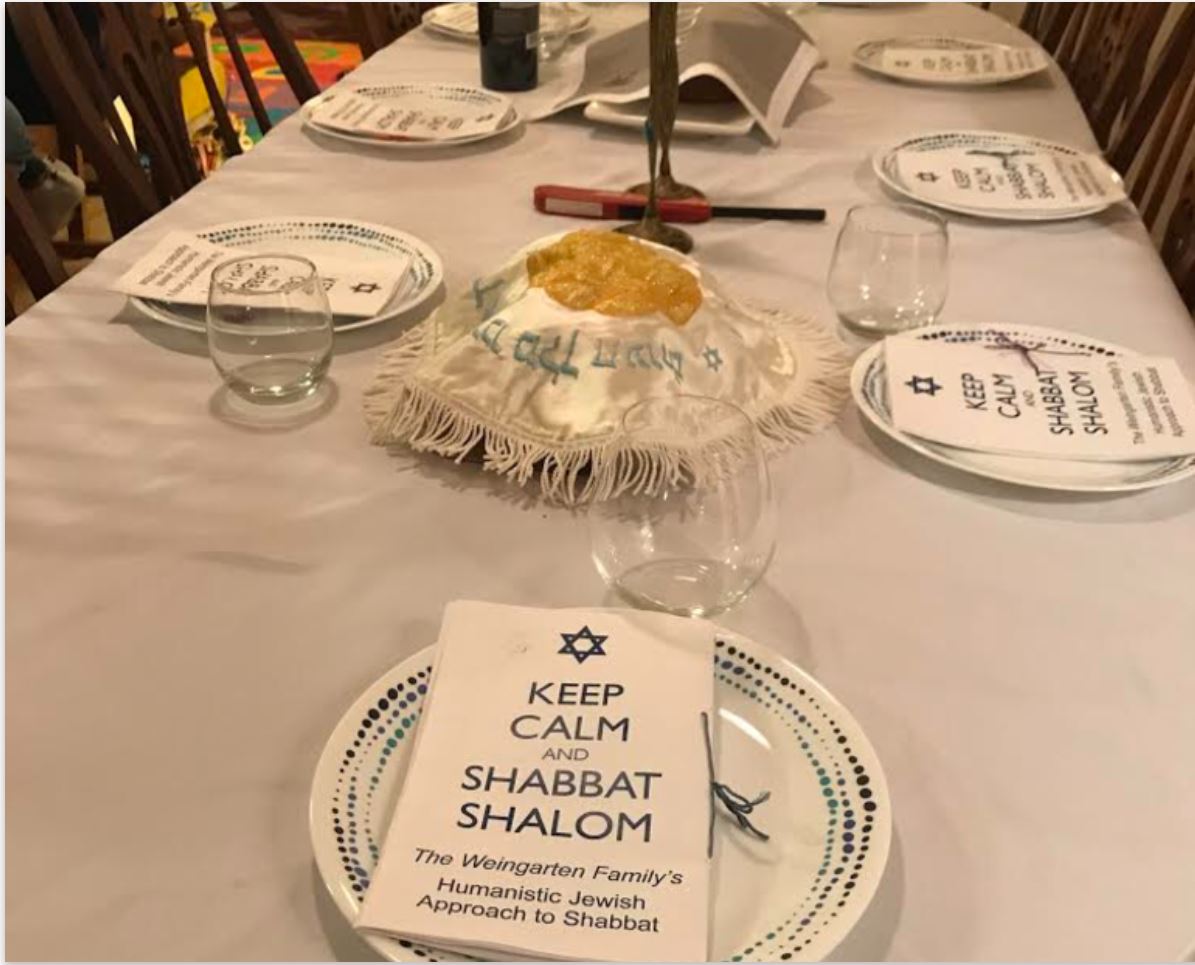
Place settings from OneTable Shabbat.
In Los Angeles, where the organization is supported by a Cutting Edge grant from the Jewish Community Foundation of Los Angeles, some 4,500 unique guests have attended nearly 600 OneTable Shabbat dinners.
“Without OneTable, I couldn’t do this, and I love opening my home to new people and sharing this with them,” Weingarten said. “I wouldn’t even be able to afford it.”
Aside from “Shabbat coaching” services from veteran hosts, OneTable also provides “nourishment,” which covers $10 a head for closed dinners (open only to your friends) and $15 a head if you host a public dinner (open to anyone who registers ahead of time on the OneTable website or app). When necessary, Weingarten pre-approves strangers via brief email correspondence and scanning of social media accounts.
“One tradition from Weingarten’s childhood was included in the dinner. ‘My dad had a tradition of going around and asking what’s making you happy. Even after a really horrible week, we had to come up with something.’”
— Jenn Weingarten
Weingarten’s dinners include roommates, co-workers, friends, friends of friends, significant others, her 2-year-old daughter, Lishai, and the occasional walk-in.
“A few weeks ago, I had a college student home for summer come just because he wanted to get out of his parents’ house for a bit,” Weingarten said. “He played with Lishai a bunch and he was great.”
With dinner ready, Weingarten directed everyone to haggadah-like booklets with “Keep Calm and Shabbat Shalom” on the cover. Led by their host, they held a short service singing modified versions of songs including “Havah Nagilah,” reciting prayers and reading English passages about the Sabbath.
During a rare moment of quiet, Weingarten, who grew up Conservative with a traditional Shabbat practice every week, said, “This is very open and inclusive. It’s more humanistic Judaism, where we take a relevant spin on aspects and traditions and show you how you can actually program some of it into your daily life.”
But one tradition from Weingarten’s childhood was included in the dinner. “My dad had a tradition of going around and asking what’s making you happy,” she said. “Even after a really horrible week, we had to come up with something.”
But first, Weingarten whipped out a selfie stick and instructed everyone to crowd the frame for a “Shabbat selfie” — a staple of her dinners.
“I’m just so happy to be here. My Jewish grandmother would be even happier,” a half-Taiwanese, half-Jewish USC undergrad student said.
Alejandra Priede-Schubert, 34, one of Weingarten’s closest friends and frequent guest, brought two friends who were visiting from Mexico. It was their first Shabbat and first Jewish ritual experience of any kind. “This is very special for us, to be here with all of you on this occasion,” one of them said.
“There are a lot of people who’ve never encountered Jews before,” Weingarten said afterward. “All they have to go on might be what they hear in the media, which isn’t always kind. Exposing them to these kinds of beautiful values of Judaism in a way they can relate to and connect to is really lovely.”
Weingarten was a part of Priede-Schubert’s first Shabbat a decade ago. While growing up in Mexico, her family had traditions like avoiding pork products and lighting candles on Friday night. It wasn’t until around the time she met Weingarten while earning her doctorate at UCLA that she discovered her prewar, European-Jewish roots and began celebrating Jewish holidays.
“Every Shabbat now is an opportunity to learn something about the Jewish traditions,” she said. “I think I’ll always want some form of Shabbat, at least
this type of weekly family gathering, in my life.”
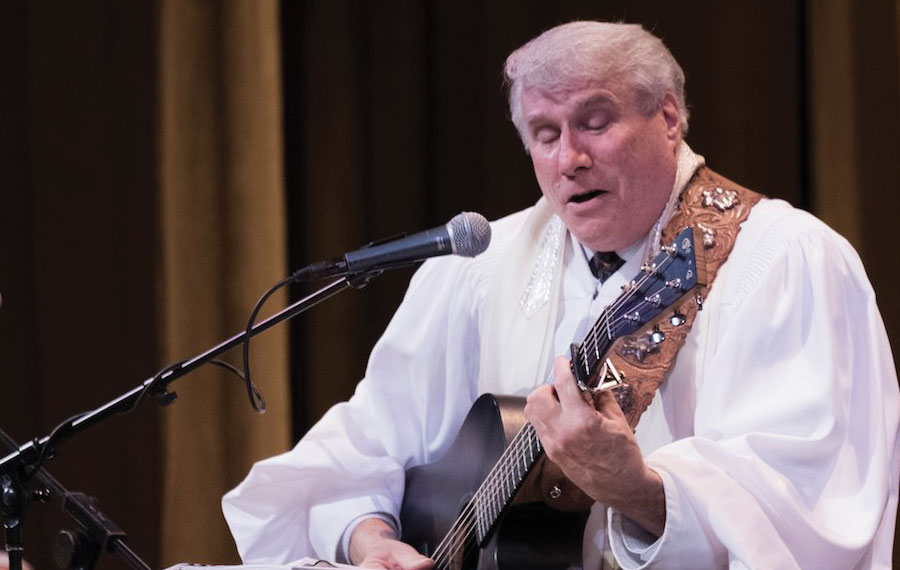
During High Holy Days services 15 years ago, Congregation Or Ami Cantor Doug Cotler took a failed musical risk that haunts him to this day.
Along with the serious prayers including Avinu Malkeinu, Kol Nidre and Misheberach — the “war horses,” as Cotler calls them — he played an original song parody, “Back in the Temple,” a spoof of the Gene Autry country-western classic “Back in the Saddle Again.”
“I only do this once, thank God it will be 11 months until I’m back in the temple again,” Cotler sang over a hillbilly-rhythmic guitar. Unfortunately, all it produced was puzzled expressions among worshippers attending services for teshuvah, not satire, Cotler recalled during a phone interview.
“Some enjoyed it. But for most people, I think they are coming to High Holy Days services for introspection,” he said. “Performing that song may [have been] entertaining, but it did not function as prayer.”
Cotler, 68, doesn’t only serve as a cantor at his Reform synagogue. His resume extends beyond the bimah, including co-writing credit on “Manhunt,” which appears on the Grammy-winning 1983 soundtrack to “Flashdance.”
If marrying secular music with liturgy seems a strange combination, Cotler doesn’t seem to think so. “Imagine if John Lennon or Paul Simon wrote Jewish music,” he said. “That’s my approach.”
In that vein, he performs the late Debbie Friedman’s version of the Misheberach, a prayer for people in need of healing, because her music makes the Hebrew accessible, he said. “It’s very pop. It is not a complicated musical structure. It doesn’t demand operatic vocals. It’s music for the folk.”
“Imagine if John Lennon or Paul Simon wrote Jewish music. That’s my approach.”
— Cantor Doug Cotler
The son and grandson of cantors, and raised in a small farming town in California, Cotler said when it comes to choosing songs for services, he follows a model popularized by weddings: something old, something new, something borrowed and something blue.
Something from his grandfather’s era — “the old country” — or a hymn he learned during his childhood would qualify for something old. There is a lot to choose from, he said. “Jewish music is incredibly rich in its history.”
Something new, he said, could be a song by a contemporary musician. Cotler plans to perform a song by Daniel Cainer, a London-born artist whose intelligent lyrics highlight his tune “On Yom Kippur,” Cotler said.
“I may not be religious, it may all be hot air, but if I’m sincere for at least one day of the year, maybe I’ll find God there,” Cainer sings.
“He is having a conversation with God in the song, and he goes through a process,” Cotler explained. “It is a challenging song. Not everybody will relate to it. Not everybody is skeptical, but it is something new.”
For something borrowed, Cotler pointed to Cantor Azi Schwartz of New York’s Park Avenue Synagogue, and his rendition of “Adon Olam,” sung to the tune of “You’ll Be Back” from the Broadway hit “Hamilton.”
“It has a la-da-die part that occurs a few times [that] I thought would be a neat way to end Rosh Hashanah services as people leave to go to the beach for tashlich,” he said.
Finally, for something blue, Cotler said anything rock-and-roll, pop or “out of the Jewish realm for the High Holy Days” works. Just no forays into musical comedy, he quipped.
“I’m not so interested in shaking people up so much in that way during the High Holy Days,” Cotler said. “I’m mainly interested in people feeling at home, shaking them up internally, rather than forcing something so strange they’re more concerned about how weird it is musically.”
In the dimness of night
Of eerie shadows
Haunted by visions
Of bygone horrors.
I see my Dear Mother
No wrinkles, no gray hair
Her face like some portrait, ageless in space.
Through the years her image unchanged
But the Dead do not age
And I wipe a tear off my face.
I dream of my Little Sister
So innocent, so frail
The presence of heavenly angels
Lifted her soul with grace
Dear Chajku — thirteen in age
And I wipe a tear off my face.
Life is but a passing parade
An endless motion from place to place.
I flow with the crowd feeling safe
Till the nightfall takes over
With another nightmare.
Haunted by death camps
That rule my dreams
I struggle through the night
In a blanket of fear.
The morning comes
The visions of horror sail through the air
The memories linger into the day
As evening approaches of what is in wait.