“Freedom Writers” opens with a montage of scenes from Long Beach two years after the Los Angeles riots. Images of gang life and the neighborhoods where members stage their brutal rites float on a stream of hip-hop sound.
Into this picture steps an eager but overdressed Erin Gruwell, a depiction of the real-life teacher whose blossoming as an activist provided the emotional catalyst for yet another alchemical performance by Oscar-winner Hilary Swank.
“Lovely pearls,” says the head of the English department at Woodrow Wilson High School, where Gruwell has taken a job teaching the freshman students nobody else wants in their classroom.
The film’s first 45 minutes chart Gruwell’s initially fruitless efforts to connect with teenagers hardened by violence. Then, when Gruwell intercepts a racist caricature of one of her African American students making the rounds on a typically frustrating day, she makes a discovery that eventually changes the lives of everyone in Room 203 — including hers.
“You all may think your gangs are pretty tough,” Gruwell says as her self-segregated black, Latino and Cambodian charges glower at one another from the turf each group has staked out for itself in Gruwell’s classroom. “But you’re nothing compared to the most famous gang of all. Who can tell me about the Holocaust?”
Stunned by the silence and blank stares she receives in reply, Gruwell — and, later, the team of students, actors and filmmakers who have brought “Freedom Writers” to the big screen — perceives an important opportunity.
“The kids you see in this film are living in a world this country denies exists,” said Richard LaGravenese, who directed and wrote the screenplay for “Freedom Writers.” “They’re children just trying to survive. That’s why the kids connected to Anne Frank.”
When Gruwell introduces her students to Frank’s diary, they discover a youthful voice describing a violent world with similarities to their own. Empathy and the deep fulfillment of self-expression begin to stir in the students as Gruwell encourages them to record the loss and trauma in their own lives.
Gruwell’s visit with her students to the L.A. Museum of Tolerance is also recounted in a scene shot at the museum, including appearances by real-life Holocaust survivors who regularly volunteer there — Elisabeth Mann, Gloria Ungar, Eddie Ilan and Renee Firestone.
“This is not the story of a white person coming to the rescue of non-whites,” LaGravenese said. “All Erin did was listen, and listening transformed her and the kids.”
In an interview, the real-life Gruwell herself likened her talent as a teacher to a peculiar knack her father brings to his work as a baseball scout.
“My dad doesn’t carry a radar gun when he goes to college games — he can tell a ball’s speed just by watching it,” she said. “I’m kind of like that. Sometimes I can see a student’s ability even before it begins to blossom.”
That skill figures into one of the most affecting moments in “Freedom Writers.”
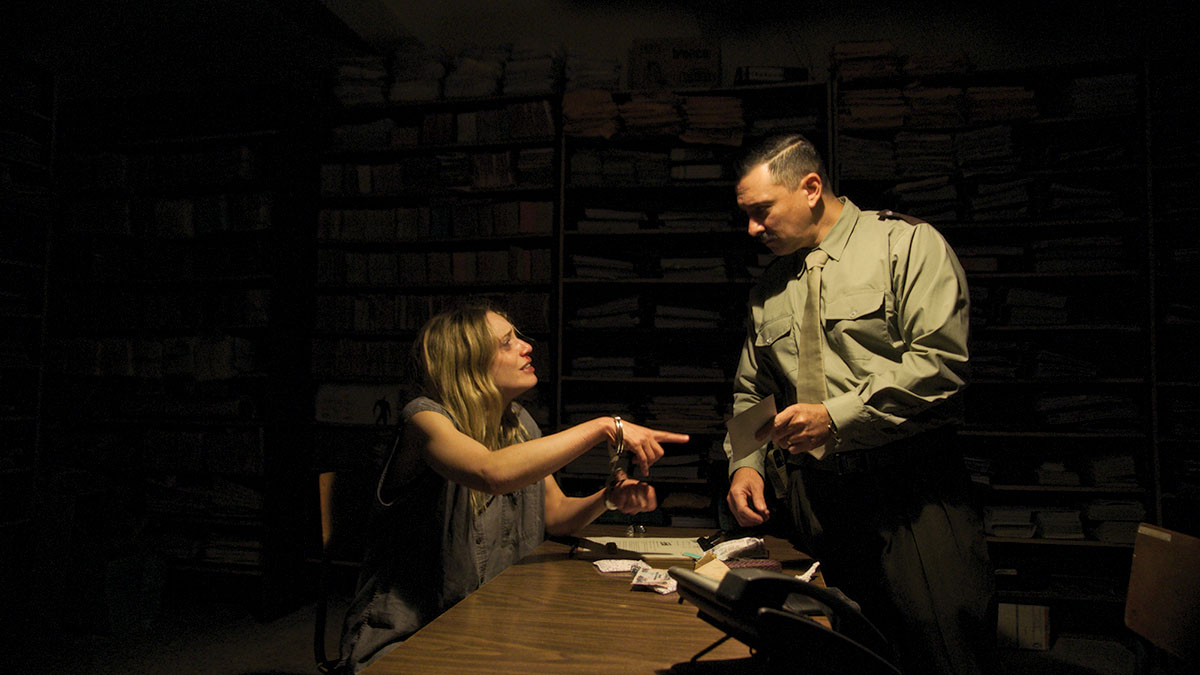
“The scene in the hall with Hilary and Mario” (the single-name singer is another actor in the film) “is verbatim what happened with me and one of my students,” Gruwell said. “He had given himself an F on a personal evaluation, and I told him that was like giving me a big F— you. ‘I see you,’ I told him, ‘and you are not a failure.'”
The exchange is jarring, not least because it’s the only time the word is used in the film.
“Richard’s original script had 27 F-words,” Gruwell said. “For a PG-13 rating you can only have one F-word. Eventually we were unanimous that there should be only one F-word to get a PG-13 and reach as many kids as we can.”
LaGravenese, whose writing credits include “The Horse Whisperer,” “Beloved” and “The Fisher King,” described his work on “Freedom Writers” as one of the most extraordinary experiences of his life. He also admits it has been among the most grueling.
“I wrote 22 drafts,” he said. “It was tough, because I was adapting the script from diaries. I also got to know Erin and the ‘Freedom Writers’ very well, and I didn’t want to invent.”
Having to direct the Holocaust survivors who met Gruwell’s students and who play themselves in the film was also difficult for LaGravenese.
“I thought it was a beautiful idea — I told them, ‘Just tell your stories.’ But then I had to say ‘cut.’ It was really traumatic,” he said.
Still, that day of filming brought storytelling opportunities that LaGravenese hadn’t expected.
“I was too shy to ask Gloria [Ungar] to reveal her number, then she walked up and offered,” LaGravenese said. “Seeing her show her number to the kids in that scene is one of the most powerful moments in the film for me.”
Since the period of her life depicted in Freedom Writers, Gruwell has taught in the College of Education at Cal State Long Beach. Many of the students she met at Woodrow Wilson followed her to CSULB and are beginning teaching careers of their own. Together they’ve established the “Freedom Writers” Foundation to provide training to teachers who want to replicate Gruwell’s success with at-risk students in their own classrooms.
“We see our activism as a movement to spark education reform,” Gruwell said. “An education system can both liberate and oppress. The only way it can liberate is if we change the idea that there’s only one way to teach children.”
“Reel Talk” with Stephen Farber will be screening “Freedom Writers” Jan. 8 at 7 p.m. Wadsworth Theatre, on the Veterans Administration grounds, 11301 Wilshire Blvd., building 226 Los Angeles. $20.