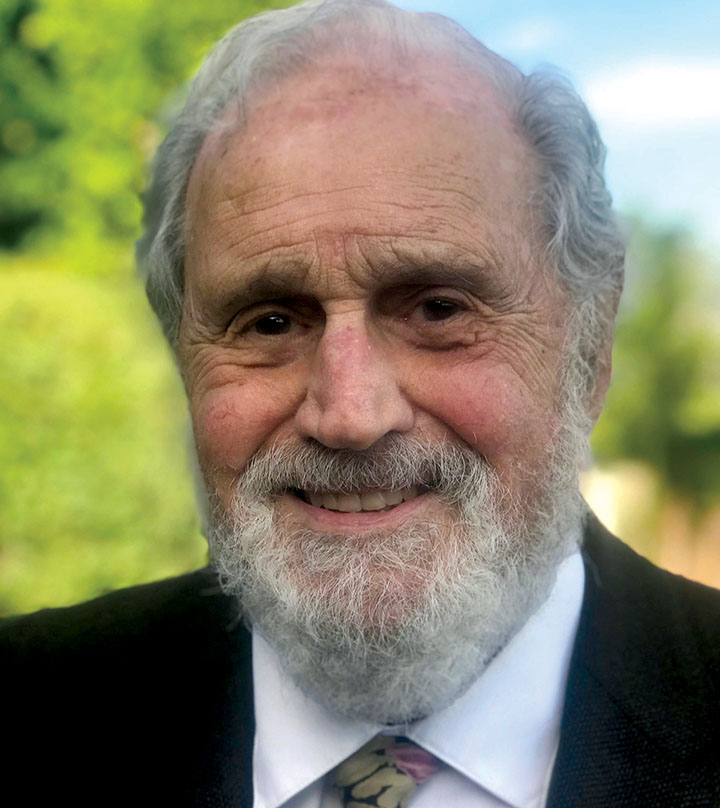
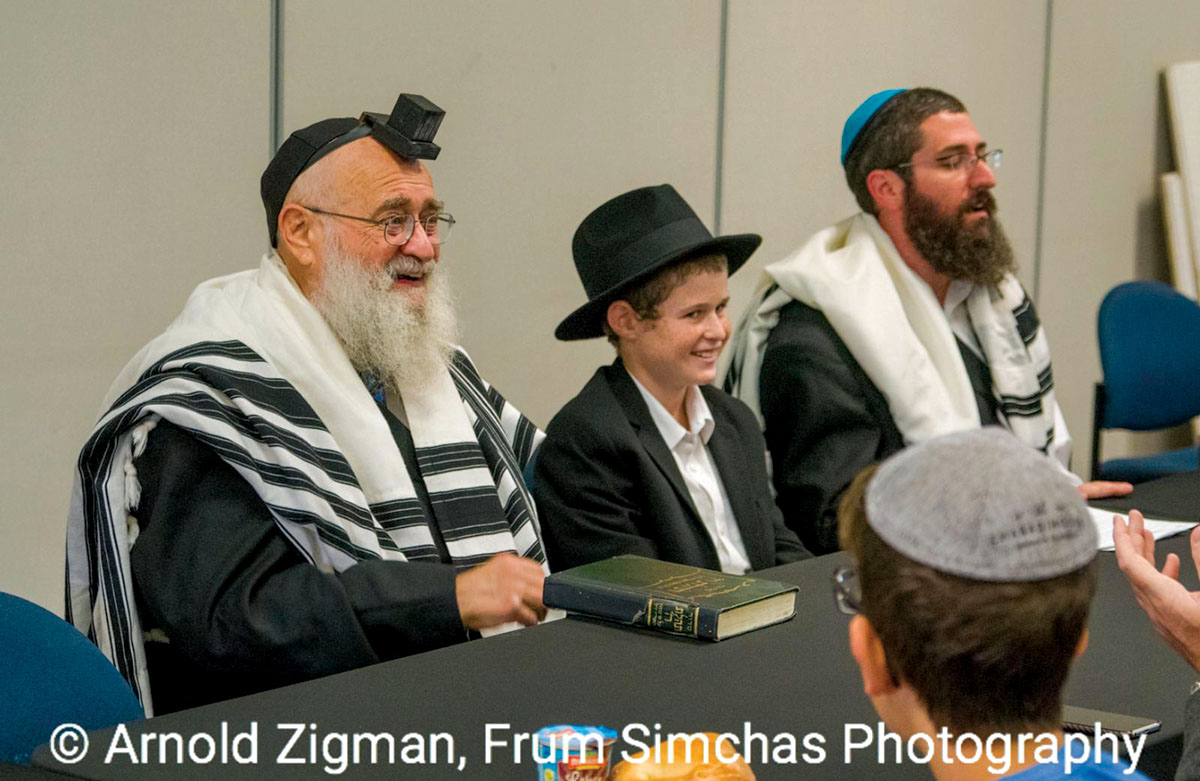
After teaching first grade for 43 years at the Hebrew Academy in Long Beach before retiring, and raising a family of seven children and many grandchildren, Rabbi Moishe Y. Engel did something new this year: he will be publishing his first book, “Shabbos in a Gas Station, and Other Personal Inspirational Stories.”
Not only that — the Montreal native is already working on a second book. He is not a man to waste time on distractions, large or small. In five months, Rabbi Engel, who was born in 1947 in a Displaced Persons camp in Germany, speaking into a microphone he calls “Dragon,” wrote nearly 100 stories.
A Chabad rabbi, Engel is quick to explain to the curious reader how and why the title story came about. It opens in 1971 in San Francisco, when Chabad Rabbi Chaim Itche Drizin, new to the community, was contacted by a Reform temple in Sacramento.
The Reform congregation operated a camp for Jewish teenagers in the mountains, and they wanted Rabbi Drizin to lead a Hassidic-style Shabbat for the teens, introduce the campers to a new dimension of Judaism. The rabbi agreed – but only if three conditions were met:
• No open violations of Shabbos.
• He would arrange the food.
• During prayers, there would be a mechitzah separating the boys from the girls.
Rabbi Drizin contacted two rabbinic friends, Rabbi Engel and Rabbi Avrohom Levitansky. Drizin was excited to give 100 teens a taste of a traditional Shabbat. Likely, none of them ever had experienced one.
The travel schedule from LAX to Sacramento was the first problem. The two rabbis could not leave until 3 p.m., they would arrive at 5, and Shabbat began at 7. Told that after they landed, it was 40 minutes to their destination, they worried. When the two rabbis landed and were met by a driver, they learned it was two hours, not 40 minutes, to their destination!
Rabbi Levitansky told the driver he would need to drive at 90 miles an hour to arrive before Shabbat. The driver thought he was kidding. The rabbis were serious. They continued to urge the driver “Faster! Faster!” Jack the driver thought it was a joke. When his two passengers kept bellowing “Faster! Faster!” Jack pressed harder until he reached a speed of 90.
After half an hour, he wordlessly lightened up on the accelerator.
“You can’t slow down!” the two worried rabbis hollered. “Keep moving.”
Jack the driver, nervous, knew better. “There’s a cop behind me,” he said.
When the cop quit the freeway, the rabbis resumed their chant: “Jack! Jack! Faster! Faster!”
In the plan-detouring excitement, Jack spotted a problem. A turnoff 15 minutes earlier had been missed. All Jews know Shabbat does not wait.
By 6:30 p.m., half an hour before Shabbat, the rabbis knew they were not going to make it. They wondered (aloud!) about their options. Should they knock on a stranger’s door? Or sleep in a Northern California forest? The driver asked whether they were serious. He was assured they were. “A hundred kids are waiting,” one rabbi said. “But we don’t drive on Shabbos.”
The two rabbis were invited because they keep Shabbos. “The temple asked for us,” said Rabbi Levitansky, “because we believe in Shabbos so much that we never would drive on Shabbos. If we drove, even just a little, it would invalidate everything we believe in. We would have nothing to offer those kids.”
Jack the driver got the message. He kept driving. At 6:59 p.m., one minute before Shabbat, the rabbis announced they would be leaving the car. Fate (HaShem) intervened. At 6:50, they had passed a sign announcing the destination was six miles distant. Could they walk the rest of the way?
That question is answered in the title story of “Shabbos in a Gas Station.”
His Work Schedule
Rabbi Engel’s work schedule for the book was not complicated. “It was whenever I had a secretary, and it depended on her work time,” he said. “After I dictated into a microphone, then she and I went over it, corrected it, made it legible.”
But that was only the first step of Rabbi Engel’s ambitious project. He forwarded the manuscript to four kinds of people. “Each,” he said, “has a different area of expertise.” They were longtime friend Rabbi Gershon Schusterman, Helen Malmad, Yuriy Rakhlin and Karen Asraf.
“Rabbi Shusterman,” Engel said, “is a very wise man in Long Beach. He has long been a colleague of mine – an educator, an advisor. He knows so much of everything. He understands the readership. When I sent my copy to him, sometimes it contained a halachic question.”
Who will be Rabbi Engel’s readership? “The Jewish people,” he quickly responded. “I chose Rabbi Schusterman because we are both outreach persons. He was in that field for years. For example, if I wanted someone to teach chassidus (mystical teachings of Judaism) to a class or anyone, he is the one I would call. He is one of the most knowledgeable people of chassidus in California. He teaches all kinds of people. Rabbi Schusterman made many comments about what I wrote.”
“After I send to these four people, I take their corrections. Sometimes they make suggestions and I won’t agree with them.” In one recent story, “Rabbi Schusterman said I didn’t present it well. I rewrote the whole story. We decided if he feels that now it is presented well, it will be in the book. If not, we will leave it out.”
Fast Takes with Rabbi Engel
Jewish Journal: What is your favorite holiday?
Rabbi Engel: Purim. Most rabbis don’t dress up on Purim. But I do. At our school, all rabbis and students come in costume.
J.J.: Your favorite travel destination?
R.E.: One place only, Israel. I love going there. My late mother moved to Israel 23 years ago.
J.J.: What is the best part of Shabbos?
R.E.: When we sit around the Shabbos table with guests. I love it with a passion.