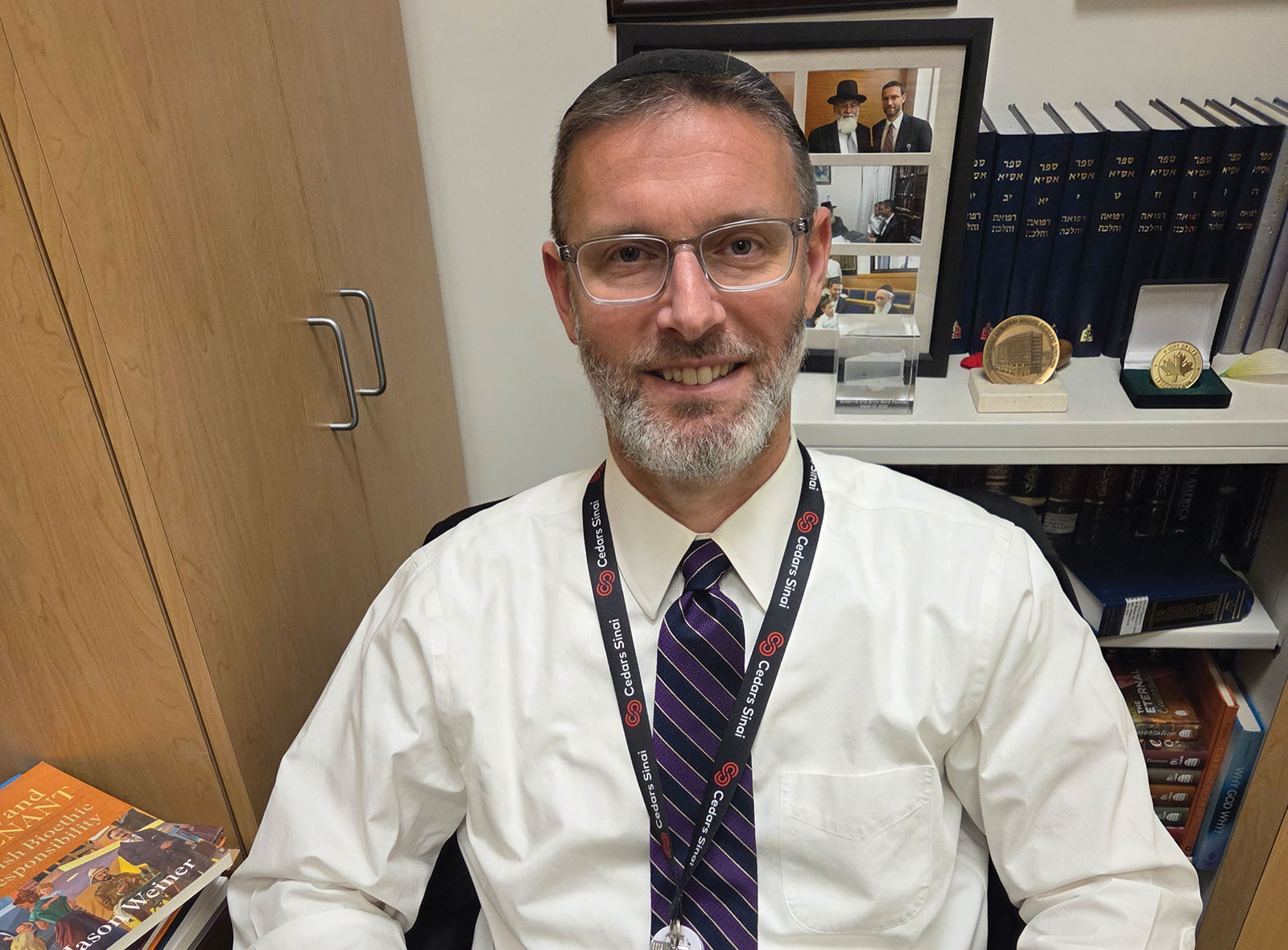
Ask any boy or girl what they want to be when they grow up, and becoming the spiritual care director of a large hospital would not make the list — especially after they discover how remarkably demanding the position is.
In 2007, Rabbi Dr. Jason Weiner joined Cedars-Sinai Medical Center as the temporary spiritual care director for the ailing Rabbi Levi Meier. Rabbi Weiner was professionally happy as an assistant at Young Israel of Century City, but it wasn’t to be. Eighteen years on, he may be the busiest, happiest, most contented rav in Los Angeles. Leading a staff of 15 employees and 10 interns training to be chaplains, he described their basic responsibility: “In a hospital where we recognize how important it is to care for people’s physical well-being – that is why they are in the hospital – we know that healing also is about the spiritual, emotional, psychological and relational.”
His duties are wider than you might suspect. They span “not just the patient but also the staff, to make sure the staff is cared for — someone to look after their well-being.” The rabbi cited some examples of staff needs. The first is obvious,” he said. “The religious things, whether holidays or specific rituals. Then there are things people from various religious backgrounds want to be able to observe. There are holidays, specific rituals, certain dietary regulations. For people from a variety of backgrounds, those are the obvious. Also there are considerations like spirituality that people want to observe when they are in the hospital.”
There are also wider needs. Among them are the emotional struggles patients of all kinds have while staying in the hospital – “encountering deaths, especially tragic deaths. Then there is trying to understand theological questions they may have, things they are asked to do that may gave them certain moral traumas. They can be struggling against their moral values – whether that means keeping someone alive whom they think is suffering or whether that means allowing them to die when they think they have a chance to live. Patients feel burdened by it. They want somebody to talk to about it and help them put it in perspective, help them understand what they are experiencing.”
You might go to the hospital to visit an ailing friend or family. But Cedars-Sinai Medical Center has 49,634 admissions, 127,626 emergency visits and 1,897,179 outpatient visits annually.
Rabbi Weiner supervises all of the chaplains. He described it this way: “I make sure our department is integrated into the hospital, that we are getting referrals, that everyone knows how to reach us, that our chaplains are working to capacity and not burning themselves out, that they are constantly innovating and coming up with new programs, ideas and ways of integrating into the hospital, that they are working together as a team and that we are responding to the changing needs of the hospital, like trying to be abreast of what’s happening in the hospital in ways that we can be most helpful and relevant to the hospital.”
Rabbi Weiner identified what he loves about the job. First is the diversity. “You encounter every walk of life, every type of human, lifecycle, life struggle. Everything you can imagine happens in a hospital. So there’s a broad diversity of issues. It’s like the frontlines of life and death. It really is important. It makes a difference. People genuinely are in need. They’re struggling. There are some institutions you could analogize to country clubs. Nothing wrong with country clubs. They are wonderful. But they are at times for a certain demographic. Sometimes there are barriers. Not everyone always feels welcome.”
A hospital, the rabbi explained, is the opposite. The hospital “is a place where everyone ends up sometimes. Maybe they don’t want to be. But there are no barriers to entry. Everyone is going to be here.” He cited “a great saying by my predecessor, Rabbi Levi Meier. He used to say ‘The hospital is where the temporarily well take care of the temporarily not well.’ It’s so true. It’s like being on the frontlines of life and death.”
His staff has an opportunity “to help people when they are most in need. Also, from an ethics perspective, my personal interest, there are such incredible advances happening, such ability to prolong life and advance life that also have potential unintended consequences, harms that can be caused while trying to be at the forefront of assuring that things are done in a responsible, careful, beneficial manner for as many people as possible.” Rabbi Weiner finds his work fascinating “because it’s always changing. Always new developments that shock and amaze.”
The rabbi, who speaks in a soft, comforting tone, sounded refreshingly wide-eyed, as if it were his first day. “Cedars is one of the top research hospitals in the country,” he said. “A 10-story research tower is going up in addition to the other research towers already here. The idea here is that this should not be just a university where people are doing research. It should be integrated with patient care. You have people who care for patients, doing research and patients are receiving experiential treatments. It’s all integrated into trying to help people thrive.”
When he first arrived in 2007, “nothing” about joining Cedars appealed to Rabbi Weiner. He said Rabbi Elazar Muskin, “my boss at Young Israel,” volunteered me to just help out while Rabbi Meier was sick. I came reluctantly because I didn’t think I had the skills.”
When he started, he hoped his stint would be brief. But over time, he “totally fell in love with it.” What changed his mind? “Synagogue work is great,” said Rabbi Weiner, “but there is the diversity of people that a synagogue does not have, a certain demographic. Here you encounter every walk of life that you can imagine, really from the extremes, the poorest, most vulnerable people and the wealthiest, most famous people.”
Fast Takes with Rabbi Weiner
Jewish Journal: What is your favorite Shabbat moment?
Rabbi Weiner: Blessing my (five) children Friday night before dinner.
J.J.: Do you have an unmet challenge in your professional or personal life?
Rabbi Weiner: There always is the challenge of becoming a better, kinder, more patient human being.
J.J.: Has your perception of Israel changed over the years?
Rabbi Weiner: I have a deeper appreciation of the struggles and challenges of Israel.