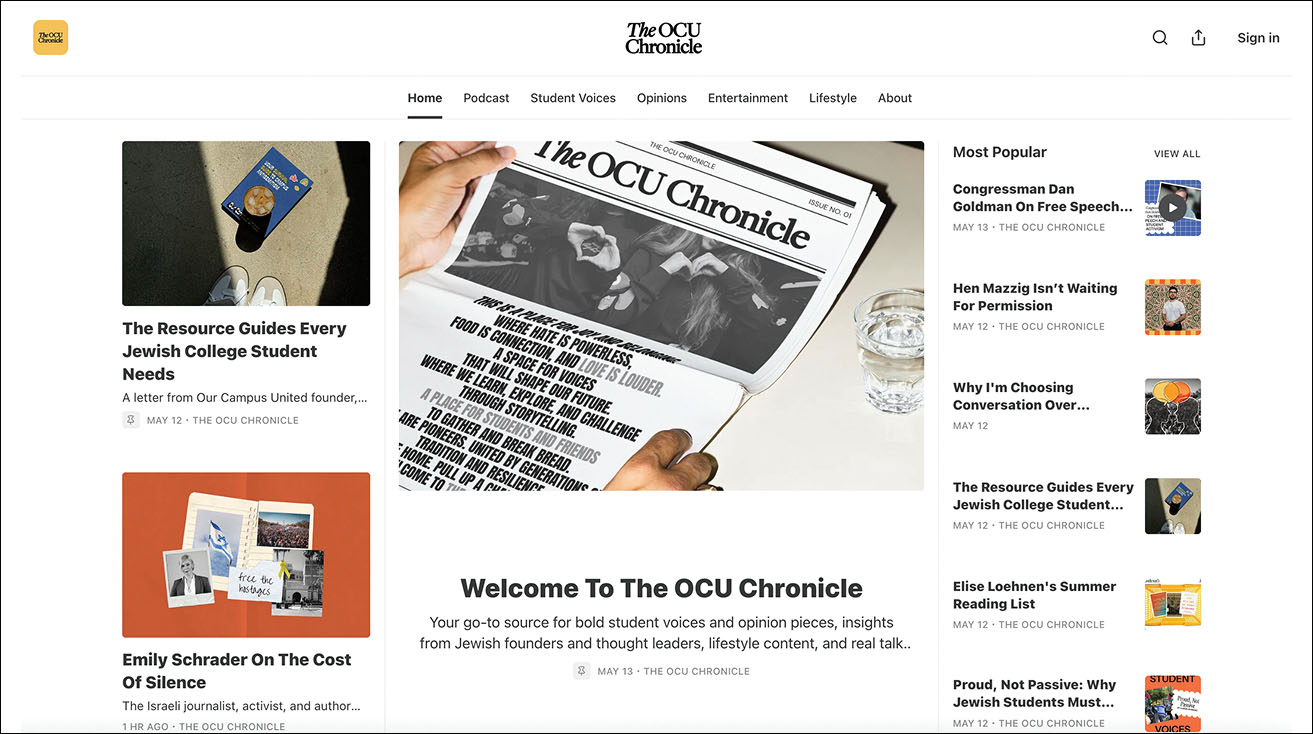
At a time when free expression and cultural identity feel like they are under threat, a powerful new platform has emerged to amplify Jewish voices and those of their allies across college campuses worldwide. The OCU Chronicle — a quarterly Substack publication created by students, for students — is more than just a newsletter. It’s the spirited companion to Our Campus United, offering a bold, unapologetic space where Jewish students can speak freely, celebrate who they are, and find strength in the community.
From thought-provoking opinion pieces to cultural commentary, lifestyle content, music playlists and exclusive interviews with Jewish founders and thought leaders, The OCU Chronicle is redefining what student journalism can be: joyful, resilient, and unafraid. The platform also features a companion podcast, where stories are deepened through raw, personal conversations — allowing voices that are often ignored in mainstream spaces to finally be heard.
Many Jewish students have faced resistance from editors at campus newspapers when trying to express their views — particularly on topics involving Israel, antisemitism, the recent pro-Palestinian encampments and more. Their opinions were often censored or dismissed outright.
(On a personal note, when my daughter was writing for The Daily Californian, the independent student-run newspaper serving the University of California, Berkeley, she referred to Hamas as a terrorist organization in an article. To her surprise, the editor refused to allow that description and removed it. When she asked for an explanation, the editor replied, “They also called Nelson Mandela a terrorist.”)
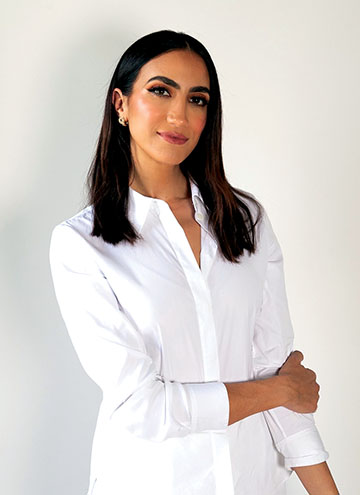
Editor-in-Chief Mandana Dayani spoke with The Journal about what inspired the creation of The OCU Chronicle. After speaking with students from universities across the U.S., one sentiment kept coming up.
“They felt they were being silenced and pushed out of their campus newspapers,” said Dayani. “They weren’t allowed to present their point of view. My philosophy is to meet students where they are. When you look at trends, we noticed that a lot of them are on Substack, and that’s what inspired the idea to create a new space for these students so they won’t be silenced anymore — and can share whatever point of view they have.”
To give voice to Jewish students who felt unheard, Dayani and her organization, the Calanet Foundation, launched The OCU Chronicle. It offers a dynamic and unapologetic platform where Jewish students and their allies can speak freely. Its content spans everything from powerful opinion pieces and Jewish cultural commentary to entertainment, interviews and even a curated playlist by a renowned DJ.
Contributors include Jewish students, emerging leaders, and prominent voices such as Miami Marlins owner Ari Ackerman, Nova Festival Exhibit CEO Josh Kadden, and actors Jonah Platt and Emmanuelle Chriqui.
The OCU Chronicle features a range of fascinating stories and thought-provoking articles. Forty contributors took part in the inaugural issue, which officially launched on May 12 and is available online to anyone who registers. One particularly compelling piece was written by an anonymous author who described inviting pro-Palestinian demonstrators and individuals from the encampments out for coffee or lunch — an effort to open dialogue and explore the possibility of finding common ground.
Israeli journalist and activist Emily Schrader was interviewed by The Chronicle about the cost of staying silent in the face of rising antisemitism. Columbia student Eden Yadegar, who testified before Congress about her experiences on campus, sat down with U.S. Representative Dan Goldman (D-N.Y.) for a candid conversation. And Josh Kadden opened up about his life after Oct. 7 and the personal mission that now drives him.
“There is no reason why these students need to be silenced,” said Dayani, “especially when they are telling their own truth and their own personal stories. I think The Chronicle became a place for all of us to just have this conversation. I think because of my work, I’ve always believed that storytelling is the most important way to shape culture and change narratives,” Dayani said. “For these students not to be able to tell their stories feels like such a tragedy. You can actually see how much people are learning from each other through these conversations and podcasts we have. It’s really moving.”
Dayani hopes to welcome even more contributors in the coming months, including younger voices from high schools around the country. “The more the merrier — we want to see this platform growing,” she said.
The second issue of the OCU Chronicle is slated for the fall, just in time for back-to-school season.
Visit the OCU Chronicle at theocuchronicle.substack.com. If you are interested in contributing to The OCU Chronicle, write to: chronicle@ourcampusunited.com