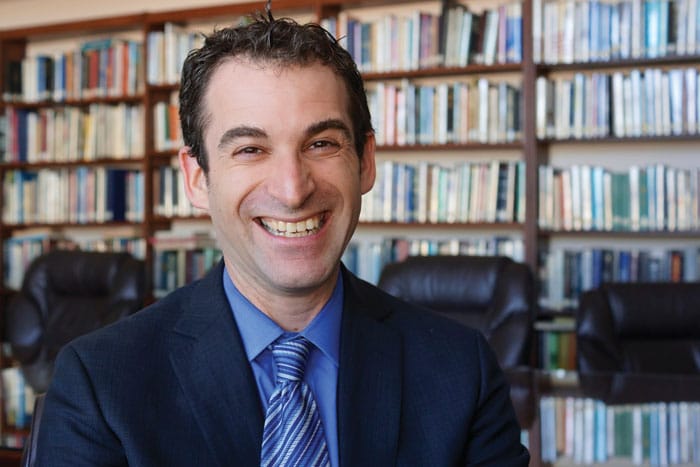
When Rabbi Zach Shapiro of Temple Akiba of Culver City was 11 years old, he knew he wanted to be a rabbi when he grew up. He played Jewish songs on the guitar at his Reform summer camp and met other song leaders there who inspired him to take a rabbinical path.
“I said, ‘Wow, I want to do this too,’” he told the Journal. “It was that love of Jewish music that really began my journey toward becoming a rabbi. I realized at an early age my mission in life was to bring good into this world, and I had the treasures of Judaism to guide me in the process.”
While music was what Shapiro said “stirred his soul,” he didn’t think that becoming a cantor was for him.
“I thought about it, but music was more of a hobby than anything else. Once I started diving into rabbinic texts, that became much more of a passion for me.”
After Shapiro graduated from high school, he headed to Colby College, a small liberal arts school in Maine. It was important to him to attend college and expand his worldview before entering the rabbinate.
“Growing up, my rabbis said if I wanted to be a rabbi not to major in Jewish studies, because then I wouldn’t know anything except for Judaism,” he said. “They told me to get a well-rounded liberal arts education so I could understand a little bit more about how the world works.”
After earning his degree in Spanish, Shapiro spent five years at Hebrew Union College-Jewish Institute of Religion (HUC), where he studied in Israel for a year and then Cincinnati for another four. In 1997, his final year at HUC, the rabbi, who is gay, applied for jobs all over the United States.
“It was still early on in the movement for congregations to hire gay rabbis,” he said. “One congregation told me that they hired a gay cantor and they couldn’t have two gay clergy members. I said, ‘I’m sorry, I need to remove myself from this interview.’”
Shapiro interviewed at University Synagogue, where they didn’t judge him for his sexual orientation. “I said I was gay and they said it’s a non-issue,” he said. “They asked me to join their team.”
While the rabbi enjoyed the eight years he was there, he didn’t plan on staying in Los Angeles long-term. However, that changed when he met Ron Galperin, an attorney and part-time cantor in Montebello, at a break-the-fast event after Yom Kippur.
“We’ve been together ever since we met,” said Shapiro, who married Galperin, now the Los Angeles City Controller. The two are proud parents to 3-year-old twins, Maya and Eli.
Since 2006, Shapiro has been the rabbi of Temple Akiba. Back then, there were 250 families at the synagogue, and today, there are more than 400.
“I love this community,” he said. “It’s such an incredible gem in the LA area. We’re an eclectic, down-to-earth and heimish community.”
Shapiro was a visionary; he could see how Culver City was flourishing and would continue to do so in the years ahead.
“When I first came here, Culver City was just entering a renaissance of renewal,” he said. “A lot of young families were flocking here, and the city had just gone through a renewal program. I knew this was the right place for a Jewish renaissance, and that’s exactly what happened.”
What matters most to Shapiro is that when people come to Temple Akiba, they feel at home.
“We have members waiting at the gate and the door, welcoming people as they walk in,” he said. “They ensure no one walks in alone. I’m always outside on Sunday mornings greeting religious school families.”
“I want people to realize they are a link in the chain, and they have a sacred responsibility to make sure they are not only a descendant of Judaism, but also an ancestor.”
“I want people to realize they are a link in the chain, and they have a sacred responsibility to make sure they are not only a descendant of Judaism, but also an ancestor,” Shapiro said. “They are carrying a torch that will not end on their watch, but instead inspire others to begin their journeys.”
Fast Takes With Zach Shapiro
Jewish Journal: What is your favorite Jewish food?
Zach Shapiro: It’s the food I’m sure Moses ate in the desert: toffee-covered matzah.
JJ: What do you buy too much of on Amazon?
ZS: Books about airports and airline history. I love aviation. Logan Airport in Boston is my favorite.
JJ: What would you be doing if you weren’t a rabbi?
ZS: I would be a YouTube vlogger who talked about the airlines of the world.
JJ: What do you do when you have a day off?
ZS: Before we had kids, I would go to the airport and watch airplanes. I would fly somewhere because I love flying so much. Now, I take our kids to the airport and they watch with me while we enjoy a picnic lunch.