When Avi Rokah finished his service with the Israel Defense Forces at age 21, the Ramat Gan native had one passion he knew he wanted to pursue: karate.
“The IDF teaches many forms of self-defense, but I had been studying karate since age 14,” Avi, 61, said. “I love how it trains the body and mind to work as one. I knew it was my calling.”
That calling led Avi to seek out the best karate master in the world to continue his training. He soon learned it was Grand Master Hidetaka Nishiyama. “I had to find and study with him,” he said. “But I didn’t know where he was. I thought I would have to go and live in Japan. Then I learned he was right here in Los Angeles.”
Avi moved to Los Angeles in 1982 for the single purpose of studying with Nishiyama. “I didn’t know anybody here but it didn’t matter,” he said. “As long as I could study with the master, that’s all that mattered to me.”
Already an accomplished karate teacher, Avi studied with his mentor Nishiyama and taught karate at YULA Boys High School while also giving private lessons. It was then that a YULA parent, who was also Avi’s student, suggested he open a karate school. Soon, he started one in the Fairfax district.
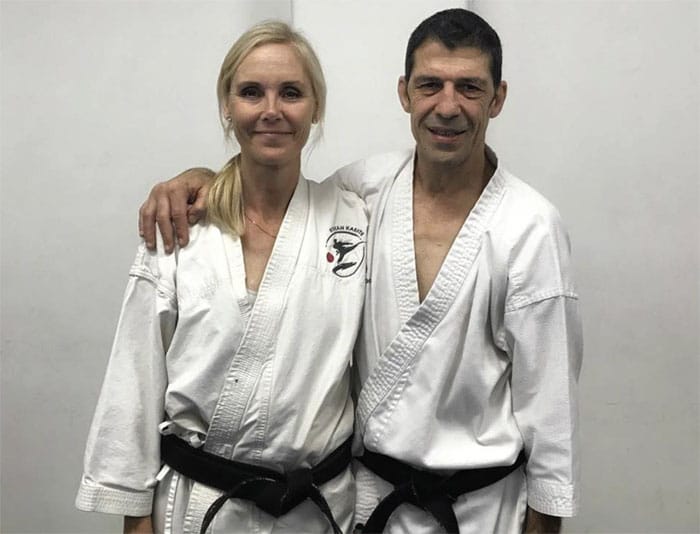
As he focused on teaching karate, little did Avi know his teaching would lead him to the one person who would change his life. In 1993 a woman, originally from Sweden, enrolled as a karate student. She was a gymnast and taught at a local gymnastics school. It wasn’t long before the karate student, Ruth, would become Avi’s wife and fellow karate teacher.
“I started to study karate with Avi. Before long I fell in love with the sport and my teacher as well.”– Ruth Rokah
How did a gymnast become a karate teacher? “All the gymnast trainers were into karate, so I thought I would give it a try,” Ruth said. “I started to study karate with Avi. Before long I fell in love with the sport and my teacher as well.”
Today, Avi and Ruth have four children together, each accomplished in karate and academics. “We actually had three weddings,” Ruth said. “A civil ceremony, another ceremony in Sweden for my family and a third Jewish wedding in Los Angeles after my Orthodox conversion.”
In 1998, while living in Pico-Robertson, they noticed a space for rent on Pico, two blocks west of Doheny Drive and right across the alley from where they were living. “It was more rent, but we thought, ‘What a great location,’” Avi said. They moved Rokah Karate to Pico, where it still is now.
Avi and Ruth lost no time becoming an integral part of the Pico-Robertson Jewish community. Ruth worked as a school nurse at Harkham Hillel Hebrew Academy, taught PE at YULA Girls High School and ran a Karate Club for special needs children together with her son in cooperation with the Friendship Circle.
Over the years, Avi and Ruth have taught thousands of students of all age groups and backgrounds, but mostly from the Jewish community. “We have parents coming in with their kids who tell me I taught them karate when they were in high school,” Avi said proudly. “It is great to see how I can help pass karate from generation to generation.”
Though their studio is a success, Avi and Ruth have also experienced their fair share of challenges over the years, especially during the pandemic.
“When the pandemic struck, we had 150 students. As soon as the lockdown happened, 100 canceled,” Ruth said. “We panicked. This is our livelihood. We didn’t know what to do, so we had to be creative.”
That creativity took the form of teaching on Zoom. “We also set up a studio in the outdoor parking area [and] taught in parks and at the beach,” Ruth said. “I drove to students’ homes and gave lessons in their backyards, in their driveways and on sidewalks. We did what we had to do for our business, but also knew students needed the physical activity after being on Zoom all day doing schoolwork. They loved it.”
Avi and Ruth are not only karate teachers, but also accomplished karate masters. Avi is an 8th degree blackbelt (there are 10 degrees in karate, but the 10th degree is only achieved after a person dies and the belt is placed on their grave, signifying that nobody reaches perfection in this life). He holds the distinction of being the 1994 world champion, and five-time U.S. champion.
Ruth is a 3rd degree black belt as well as a holder of five regional championship titles and the U.S. National Championship Gold for sparring.
The couple shows no signs of slowing down. With a student roster of 250 and waiting list of 100, their passion for karate only grows stronger.
“When Avi and I were dating, someone warned me that he was already married,” Ruth said. “I was shocked. She then said he was married to karate and I would always be second to his love of karate. I have learned to accept that and am totally fine with it.”