fbpx

October 7, 2021

Oscar-Winning Filmmaker Hopes New Documentary Inspires Law Students

By nature, judges are not glamorous subjects to watch on film. They’re impartial (or supposed to be, at least), always dressed in the same black robe and, at their essence, referees of court proceedings. 

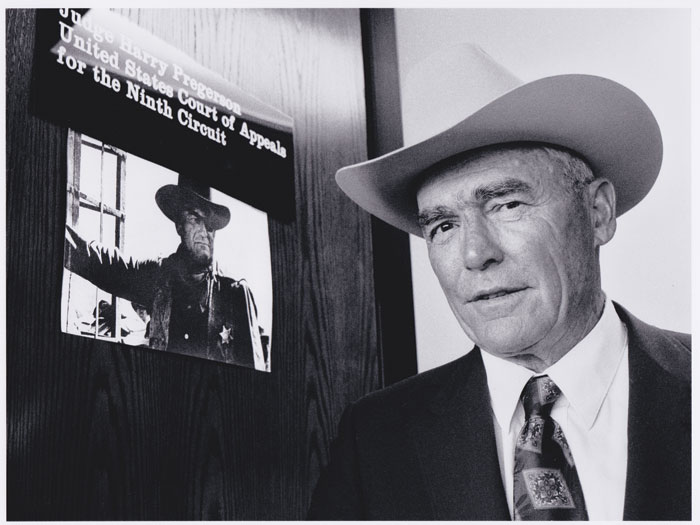
Academy Award-winning documentarian Terry Sanders (“A Time Out of War,” “Maya Lin: A Strong Clear Vision”) found a way to take a story of a federal judge and make it not only watchable, but inspiring as well. That documentary is “9th Circuit Cowboy: The Long, Good Fight of Judge Harry Pregerson.” Pregerson wasn’t just any judge with a lifetime appointment, and calling him a man of integrity would be an understatement. 

Sanders takes viewers on Pregerson’s journey, from his childhood in the Jewish community of Boyle Heights in the 1920s and 1930s all the way through his 50 years on the federal bench, until his passing in 2017.

Along the way, Pregerson enlists in the U.S. Marine Corps, where he endures the antisemitism that motivates him to be a force of good as an arm of the law. His humanitarianism is exhibited throughout the documentary; one such instance is his commitment to visit the defendants whom he sentenced to prison while they were incarcerated, often checking on the conditions they lived in and their own rehabilitation.

‘My conscience is a product of the Ten Commandments, the Bill of Rights, the Boy Scout Oath and the Marine Corps Hymn.’ – Judge Harry Pregerson

A pivotal moment in the documentary stems from Pregerson’s confirmation hearing at the U.S. Senate in 1967. When questioned about the role his conscience would play in his decisions as a federal judge, he answered with the following: “My conscience is a product of the 10 Commandments, the Bill of Rights, the Boy Scout Oath and the Marine Corps Hymn. If I had to follow my conscience or the law, I would follow my conscience.”

Great documentarians don’t do it just for the Oscars — they do it to shine a light on a story. And that’s what director Sanders did here. 

“This is an extraordinary man, who every day of his life got out of bed to help people,” said Sanders. “It fits in with the ideas I’ve had over the years as a filmmaker, how people enjoy films about evil and it’s very hard to make a film about a good person. You can make it, but people aren’t that interested.”

The documentary begins at Pregerson’s funeral service. Sanders was the only one to capture on film the eulogies by Pregerson’s children and former colleagues. Sanders himself only met the judge in passing once many years ago, but was moved by his story. 

Still making films at the age of 90, Sanders described himself as a “luddite” with technology but clearly isn’t one. Even after over 60 years in show business, he still is active in the editing process, moving various digital clips around in Adobe Premiere on his iMac, and filming some scenes on his iPhone X. He does employ an associate editor who works on the “finer details” that Sanders says he “doesn’t want to learn.”

Sanders’ intent with “9th Circuit Cowboy” is to inspire the next generation of lawyers and judges with Pregerson’s character while administering justice. He said he finds it most gratifying to learn that various law schools like Fordham, UCLA and UC-Davis are screening his documentary to students. 

“And the American Bar association liked it,” Sanders said. 

It was Pregerson’s fighting for the powerless and looking out for the vulnerable that struck Sanders so much, and even more so after making the documentary. 

“The character of the people is as important as their legal philosophies, and for Harry, his character was more important than anything,” Sanders said. “Eventually I’d like every law school to show it.”

“9th Circuit Cowboy” is available on Vimeo On Demand and Amazon Prime. 

Oscar-Winning Filmmaker Hopes New Documentary Inspires Law Students Read More »

Rokah Karate: From Generation to Generation

When Avi Rokah finished his service with the Israel Defense Forces at age 21, the Ramat Gan native had one passion he knew he wanted to pursue: karate. 

“The IDF teaches many forms of self-defense, but I had been studying karate since age 14,” Avi, 61, said. “I love how it trains the body and mind to work as one. I knew it was my calling.”

That calling led Avi to seek out the best karate master in the world to continue his training. He soon learned it was Grand Master Hidetaka Nishiyama. “I had to find and study with him,” he said. “But I didn’t know where he was. I thought I would have to go and live in Japan. Then I learned he was right here in Los Angeles.”

Avi moved to Los Angeles in 1982 for the single purpose of studying with Nishiyama. “I didn’t know anybody here but it didn’t matter,” he said. “As long as I could study with the master, that’s all that mattered to me.”

Already an accomplished karate teacher, Avi studied with his mentor Nishiyama and taught karate at YULA Boys High School while also giving private lessons. It was then that a YULA parent, who was also Avi’s student, suggested he open a karate school. Soon, he started one in the Fairfax district.

As he focused on teaching karate, little did Avi know his teaching would lead him to the one person who would change his life. In 1993 a woman, originally from Sweden, enrolled as a karate student. She was a gymnast and taught at a local gymnastics school. It wasn’t long before the karate student, Ruth, would become Avi’s wife and fellow karate teacher. 

“I started to study karate with Avi. Before long I fell in love with the sport and my teacher as well.”– Ruth Rokah

How did a gymnast become a karate teacher? “All the gymnast trainers were into karate, so I thought I would give it a try,” Ruth said. “I started to study karate with Avi. Before long I fell in love with the sport and my teacher as well.”

Today, Avi and Ruth have four children together, each accomplished in karate and academics. “We actually had three weddings,” Ruth said. “A civil ceremony, another ceremony in Sweden for my family and a third Jewish wedding in Los Angeles after my Orthodox conversion.”

In 1998, while living in Pico-Robertson, they noticed a space for rent on Pico, two blocks west of Doheny Drive and right across the alley from where they were living. “It was more rent, but we thought, ‘What a great location,’” Avi said.  They moved Rokah Karate to Pico, where it still is now.  

Avi and Ruth lost no time becoming an integral part of the Pico-Robertson Jewish community. Ruth worked as a school nurse at Harkham Hillel Hebrew Academy, taught PE at YULA Girls High School and ran a Karate Club for special needs children together with her son in cooperation with the Friendship Circle.

Over the years, Avi and Ruth have taught thousands of students of all age groups and backgrounds, but mostly from the Jewish community. “We have parents coming in with their kids who tell me I taught them karate when they were in high school,” Avi said proudly. “It is great to see how I can help pass karate from generation to generation.”

Though their studio is a success, Avi and Ruth have also experienced their fair share of challenges over the years, especially during the pandemic. 

“When the pandemic struck, we had 150 students. As soon as the lockdown happened, 100 canceled,” Ruth said. “We panicked. This is our livelihood. We didn’t know what to do, so we had to be creative.”

That creativity took the form of teaching on Zoom. “We also set up a studio in the outdoor parking area [and] taught in parks and at the beach,” Ruth said. “I drove to students’ homes and gave lessons in their backyards, in their driveways and on sidewalks. We did what we had to do for our business, but also knew students needed the physical activity after being on Zoom all day doing schoolwork. They loved it.” 

Avi and Ruth are not only karate teachers, but also accomplished karate masters. Avi is an 8th degree blackbelt (there are 10 degrees in karate, but the 10th degree is only achieved after a person dies and the belt is placed on their grave, signifying that nobody reaches perfection in this life). He holds the distinction of being the 1994 world champion, and five-time U.S. champion.  

Ruth is a 3rd degree black belt as well as a holder of five regional championship titles and the U.S. National Championship Gold for sparring. 

The couple shows no signs of slowing down. With a student roster of 250 and waiting list of 100, their passion for karate only grows stronger.

“When Avi and I were dating, someone warned me that he was already married,” Ruth said. “I was shocked. She then said he was married to karate and I would always be second to his love of karate. I have learned to accept that and am totally fine with it.”

Rokah Karate: From Generation to Generation Read More »

All the Things — A poem for Torah Portion Noach

So long as the earth exists, seedtime and harvest, cold and heat,
summer and winter, and day and night shall not cease.”
-Genesis 8:22

There are at least half a dozen movies
in which the entire world is destroyed.
I would tell you what they are but
I don’t want to give away their endings.

There are many more films in which
the entire world is almost destroyed
but is saved at the end by the efforts
of the people we’re rooting for.

These make it easy for us to imagine
all of it going away. All of our buildings and legacies.
All the things we’ve written down.
All our recipes and shortcuts.

Floating away or incinerated or
simply vanishing with a snap.
Even the news is in on it, showing us
vanishing rainforests and rising coastlines.

Showing us the names of animals who
haven’t set foot on the Earth since
before our grandparents. The air we breathe
the layer of whatever that creates

a separation between space and us
so fragile, if you trust the scientists.
We do what we can. We go solar.
We replace our grass with rock.

We eventually turn off the faucet.
Hoping all of the faucets don’t
permanently turn off. This may be
what the Promiser had up their sleeve

when they told us so long as the earth exists.
You mean there could be a time when it doesn’t
is the question Noah never asked as the animals
filed off the ark, and he was given permission

to eat almost all of them.


God Wrestler: a poem for every Torah Portion by Rick LupertLos Angeles poet Rick Lupert created the Poetry Super Highway (an online publication and resource for poets), and hosted the Cobalt Cafe weekly poetry reading for almost 21 years. He’s authored 25 collections of poetry, including “God Wrestler: A Poem for Every Torah Portion“, “I’m a Jew, Are You” (Jewish themed poems) and “Feeding Holy Cats” (Poetry written while a staff member on the first Birthright Israel trip), and most recently “The Tokyo-Van Nuys Express” (Poems written in Japan – Ain’t Got No Press, August 2020) and edited the anthologies “Ekphrastia Gone Wild”, “A Poet’s Haggadah”, and “The Night Goes on All Night.” He writes the daily web comic “Cat and Banana” with fellow Los Angeles poet Brendan Constantine. He’s widely published and reads his poetry wherever they let him.

All the Things — A poem for Torah Portion Noach Read More »

Dave Chappelle Makes “Space Jews” Joke in Netflix Special

Comedian Dave Chappelle made a couple of jokes about a movie idea he had called “Space Jews” in his latest Netflix special “The Closer.”

Chappelle said that he has seen various videos about UFOs coming to Earth that prompted him to come up with the idea. “In my movie idea, we find that these aliens are originally from Earth, that they are originally from an ancient civilization that achieved interstellar travel and left the Earth thousands of years ago. Some other planet they go to, and things go terrible for them in the other planet, so they come back to Earth and decide they want to claim the Earth for their very own. It’s a pretty good plotline huh? I call it: ‘Space Jews.’”

He later told a story about how during the United States’ era of slavery, a slaveowner granted a Black man, one of his slaves, freedom; that man went on to own farmland and bought slaves of his own. “Not only was he a slave owner, he became a slave breeder and employed tactics that were so cruel even white slave owners were like, ‘Yo, my man.’ He was a wild dude, but he did it because that’s what successful people did at the time.” Chappelle asked how someone who had been a slave could “perpetuate the same evil on a person that looks just like him. It’s mind-blowing. And shockingly, they’re making a movie about him. Ironically, it’s called… ‘Space Jews.’”

In an October 7 Twitter thread, StandWithUs acknowledged that while Chappelle’s schtick is offending everyone, his comments provide a “teachable moment.” “In his bit about ‘Space Jews’ he implies Jews collectively left their homeland by choice (because they had ‘achieved interstellar travel’),” the pro-Israel education organization wrote. “If the joke had been rooted in historical facts, the ‘Space Jews’ would have left because they were forced out by oppressive empires.”

They added that the part about the “Space Jews” leaving for another planet is not the “full story” because “Jews were defeated by an oppressive colonial force, gradually scattered across the world, and continued to suffer persecution across Europe and the Middle East… After 1,900 years of life as an oppressed minority, Jews would indeed claim their homeland as their own, and rightfully so.”

As for the second part of Chappelle’s “Space Jews” joke about the former slave turned slaveowner, “he seems to imply that ‘Space Jews’ are now perpetrating the worst crimes that were previously committed against them (i.e. the Holocaust),” StandWithUs tweeted, proceeding to link to an Instagram post where they explain why it’s a “dehumanizing and slanderous accusation.”

“Jokes tend to be funnier when they reflect reality on some level, rather than awkwardly distorting it,” the thread concluded.

Former New York Democratic Assemblyman Dov Hikind, who heads the Americans Against Antisemitism watchdog released a video saying that while he is a Chappelle fan, he is “very, very disappointed” with Chappelle’s “Space Jews” bit. “It implies that these people from outer space came back to the world and they basically took something away from someone else. What you have done is going to contribute to further hate against the Jewish people.”

Hikind pointed out that members of the audience shouted, “Free Palestine!” during the “Space Jews” bit. “They got your message. They understood. It wasn’t funny. It was commentary, it wasn’t comedy.”


Brian Koppelman, Co-Creator of “Billions on Showtime,” didn’t appear to be offended by the “Space Jews” bit. “Have you sold the rights to Space Jews yet?” he tweeted to Chappelle. “If not, let’s hondle.” Hondle is a Yiddish word for “bargain.”

https://twitter.com/briankoppelman/status/1445470675720814594?s=20


Nathan Wurtzel, who describes himself as a proud Jew and Zionist, tweeted, “Half the audience didn’t laugh on Space Jews. And [ realized it right away. I think maybe he got it right there. Otherwise, he has the right to be horribly wrong. If Dave Chappelle ever wants to know how it actually went down, we’d be happy to talk. But he’s wrong.”

He added in a subsequent tweet: “But the special is funny as f otherwise and I ain’t cancelling the guy for being wrong.”

https://twitter.com/NathanWurtzel/status/1446178161042116611?s=20

https://twitter.com/NathanWurtzel/status/1446178248749207555?s=20

Dave Chappelle Makes “Space Jews” Joke in Netflix Special Read More »

Ordinary Greatness

Thomas Carlyle argued for the “great man” theory of history, that “the history of the world is but the biography of great men.” The unique traits of great leaders allows them to transform everyone and everything around them, and change the course of history. And while the great man theory has lost favor in recent years, undoubtedly it is partially true. There are many historical figures that did change the world; for example, America would not be the same without Washington and Lincoln, and Israel would not exist without Herzl.

At first glance, the narrative of the Tanakh is also the biography of great men; most of the focus is given to larger than life individuals. Characters such as Avraham, Yoseph, Moshe, David and Shlomo take the center stage, and then direct the course of action. The abilities of these heroes is amplified in the Midrashim and other Rabbinic commentaries, leaving them with truly larger than life attributes. These great men are our heroes.

This focus on greatness has had a profound impact on Jewish culture, and has made greatness a life goal to be embraced. Many have taken the view that the entire educational system should be focused on developing the elite students, even if it means abandoning the needs of the other students. Rav Eliyahu Dessler, when contrasting the Lithuanian Yeshiva system with the educational system of early-20th-century German orthodoxy, wrote that the goal of the Lithuanian system is to create great scholars, even if it means under-serving the other students. He based his view on a Midrash that says “one thousand students enter to study Bible and only one comes out as a great Talmud scholar.”

This aspiration for greatness affects the perspective of parents as well. Maimonides makes a telling remark when he writes that a person “should set his heart to have a son who perhaps will be a wise and great man in Israel.”

This is the “great man” theory of child rearing, in which our expectations for our children are geared to greatness. David Bader highlights this in a comic Haiku entitled the “Jewish Mother’s Lament”:

“Is one Nobel Prize
so much to ask from a child
after all I’ve done?”

For better or for worse, the Jewish community has put the “great man” theory into practice.

For better or for worse, the Jewish community has put the “great man” theory into practice.

But there are other models of a proper life. Noach, the title character of our Parsha, is a perfect example of ordinary greatness. The Torah itself is unclear on how to describe Noach. He is considered worthy of being saved because he is a “righteous man,” which is high praise; but we are also told that “he found favor with the Lord,” which implies that he was somewhat undeserving, and saved because of his charisma. And then in a third verse there is a qualifier, “righteous before Me in this generation,“ which leads one to wonder whether Noach’s righteousness was merely relative to the rest of his generation, who were deeply immoral. For this reason, the Rabbis of the Talmud debate whether Noach would have been greater had he lived at a different time, and they speculate whether or not he could have been as great as Avraham.

But perhaps we need to stop comparing Noach to Avraham, because Noach does not conform to the usual models of greatness. Instead, he is a good person who steps up to the plate when needed, the right man who arrives at the right time. The Torah’s ambiguity about Noach is intentional, because Noach is both good and great at the same time.

Noach’s character defies the rigid fundamentalism of greatness; he reminds us that one can be a humble man of the earth and still save the world. And he is far from the only one in the Tanakh who exhibits ordinary greatness; Ruth, Esther and all the leaders in the Book of Judges are ordinary people who make an extraordinary impact. Their goodness is their greatness.

Ordinary greatness is the foundation of the Chassidic tradition of the “lamed vuv tzadikim,” the 36 hidden righteous men who uphold the world. They appear like ordinary men and live ordinary lives, yet in undertaking an important act of piety or charity, these ordinary Joes save the world. The lamedvuvnik offers us an alternative paradigm of greatness: a good man quietly doing good things, on the periphery and away from the limelight. The beauty of the lamedvuvnik tradition is that it forces us to consider that anyone might be great, even the common man; and who knows, maybe the gruff, grizzled and wrinkled water carrier in the back of the tiny synagogue is carrying the fate of the entire world on his shoulders.

Gershon Scholem has noted that this idea of hidden righteous men, lamedvvuniks, has some basis in the Talmud; and in a larger sense, there are many talmudic stories about jesters, pimps and thugs who find a distinguished place in the world to come because of the good deeds that they do. It is interesting that the Chassidic movement, which is oriented around the tzaddik (a great man who functions as a divine intermediary), gave so much attention to the simple looking lamedvuvnik.  But perhaps that is the point: even when recognizing great heroes, the quiet contributions of everyday heroes must never be forgotten.

This lamedvuvnik is an excellent role model for those who feel conflicted about their goals, uncertain about whether they must always pursue the next great possibility. Parents in particular are often torn between their career and their children. And, for anyone, every new opportunity requires new sacrifices. There are times when people don’t choose the path of greatness because they have other priorities, and the lesson of the lamed vuv tzadikim is you don’t need to do it all; you just need to do good.

The lamedvuvnik life is a model of understated greatness, to change the world one person at a time. George Elliot expresses this idea beautifully when she writes at the end of “Middlemarch”: “The growing good of the world is … half owing to the number who lived faithfully a hidden life, and rest in unvisited tombs.”

The lamedvuvnik life is a model of understated greatness, to change the world one person at a time.

In the course of my career I have met many people from all walks of life, but it’s the lamedvuvniks that inspire me the most. One of them was Harold, who was the “candyman”  of my previous congregation; he was the person who gave out sweets to all the children in the synagogue, and the greeter who helped people find their seats. When he passed away his funeral was filled to capacity; the staff at the funeral home were curious, wondering why Harold was famous. Harold’s resume said he was a retired insurance salesman, but as I explained in my eulogy, Harold was a lot more:

“What was it about Harold that was special? Harold was not a wealthy man, (although he was more contented than virtually anyone). He was not a Nobel prize winning scientist, (although he had more common sense than anyone); he was not an Olympic athlete, not a cabinet minister, and you didn’t see his name in the newspaper. Fame and fortune were not Harold’s calling card.

What was special about Harold was a simple trait; Harold never passed people by. Every person he met, big or small (oh, how he loved children!) famous or unknown, important or unimportant, were treated to Harold’s brand of friendship, good humor and charm. What was special about Harold was that he made everyone he met feel special.”

Harold knew the lamedvuvnik credo: change the world one person at a time. In the course of our lives, every one of us has met our own, personal, lamedvuvnik: a parent, teacher, friend, or even a stranger who has made an enormous difference in our lives.

Sometimes, you can be great just by being good.


Rabbi Chaim Steinmetz is the Senior Rabbi of Congregation Kehilath Jeshurun in New York.
Ordinary Greatness Read More »

Ohio Woman Throws Bottle At 13-Year-Old Jewish Girl, Shouts Antisemitic Slurs

An Ohio woman reportedly threw a beer bottle at a 13-year-old Jewish girl while hurling antisemitic slurs at her on October 5.

The Cleveland Jewish News and Fox8 reported that the woman, described as being middle-aged and wearing a baseball cap, threw the bottle out of a black SUV at Naava Prero in the University Heights neighborhood. Prero was wearing her school uniform from Fuchs Mizrahi School, an Orthodox Jewish day school and had just gotten off the school bus. The woman allegedly shouted “F—ing Jews, you’re f—ing idiots Jew” at Prero after throwing the bottle at her.

Prero’s mother, Rachel, told Fox8 that Prero is “emotionally scarred” from the incident, as she “has asked me to take her to the bus, walk her to the bus, walk her back from the bus, which she was never worried about before.”

Rachel also told The Cleveland Jewish News that Prero is happy that they’re taking action. She reported the incident to Stop Antisemitism and encouraged the Preros to report the incident to the police.

“The perpetrators need to know we’re going to take a stand,” Rachel told The Cleveland Jewish News. “We’re not just going to allow this to happen.” She also told Fox8 that “we have a wonderful community supporting us and the police and a wonderful neighborhood and we’re going to keep it that way.”

Anti-Defamation League Cleveland tweeted, “This latest antisemitic attack is truly reprehensible and unacceptable. There is no room in our communities for antisemitism and hate. We have reached out to local law enforcement and are here to assist.”

Ohio Woman Throws Bottle At 13-Year-Old Jewish Girl, Shouts Antisemitic Slurs Read More »

A Bisl Torah: Know Before Whom You Stand

A few days ago, I encountered some poor customer service. I made an appointment, arrived, was told the appointment had changed, and asked to come back later. I rearranged my schedule, came back for the new appointment, and was informed to return in a few hours.

At this point, I could feel my face turning red, my volume increasing, and physical stance growing rigid and straight. My voice betrayed me, “Don’t you know that I have work to do?” I almost didn’t recognize myself as I grew angry over the way I was being treated. The employee and I continued to banter back and forth.

Without thinking, I brushed the hair out of my eyes and felt the bobby pin of my kippah starting to slip. My kippah. Within seconds, I shut my mouth, thanked the employee for their time and explored my next steps to getting what I needed. Thank God for my kippah.

In the Talmud, Rabbi Eliezer’s students asked him to teach the “pathways of life.” Which principles should guide our lives? Among other pieces of advice, he offers, “Know before Whom you stand.” When I felt the bobby pin slide, causing the kippah to slightly tilt, I knew that I was forgetting Rabbi Eliezer’s advice. I forgot that I was speaking with one of God’s creations. I forgot that people watch my behavior and model accordingly. I forgot to take a path of patience and understanding. I forgot before Whom I stand.

I was lucky to be wearing my kippah. A gentle reminder to step up and be mindful. That God cares about my behavior, and I can certainly do better. We all can.


Rabbi Nicole Guzik is a rabbi at Sinai Temple. She can be reached at her Facebook page at Rabbi Nicole Guzik. For more writings, visit Rabbi Guzik’s blog section from Sinai Temple’s website.

A Bisl Torah: Know Before Whom You Stand Read More »

“Free Palestine,” “From the River to the Sea” Graffiti Found at UCLA

Graffiti stating “Free Palestine” and “From the River to the Sea” was found inside a classroom at UCLA’s Bunche Hall on October 5.

Author and educator Ben M. Freeman tweeted out two photos of the graffiti. “Hey @UCLA, one of your Jewish students sent me these images of genocidal Jew-hate that has been pained on your walls. Would you like to comment? Would you like to engage in training to make sure your Jewish students feel safe on your campus?”

The university said in a statement to the Journal, “UCLA condemns anti-Semitism and other forms of ethnic hostility. We removed the graffiti immediately after being notified about it.”

The student who found the graffiti, Carmel Abramov, told the Journal that the university needs to do more. She wrote in an email to Vice Chancellor for Equity, Diversity and Inclusion Anna Spain Bradley, “I am very pleased that the proper departments took this concern seriously and took action. However, I am writing to ask that you, in your role as Dean of Diversity and Inclusion, please make a public comment to the UCLA community signaling that hate, antisemitism and anti-Zionism has no place in a first-rate institution such as UCLA. It would mean so much to the Jewish community and to everyone fighting to eradicate all forms of hate if this was acknowledged.

“If you could please include the International Holocaust Remembrance Alliance’s definition of antisemitism in your statement, Jewish students on your campus would be incredibly grateful. This definition is the State Department’s Working Definition of Antisemitism and is very relevant to the graffiti that occurred on campus yesterday.”

Abramov added that the statement should not be diluted “by stating that there is no room for hate. As victims of antisemitism, not stating the nature of the crime is a form of denial of the crime. UCLA must stand firm and state that there is no room for antisemitism on this campus.”

Judea Pearl, Chancellor Professor of Computer Science at UCLA, National Academy of Sciences member and Daniel Pearl Foundation President, said in a statement to the Journal, “The UCLA administration acts like [Palestinian Authority President] Mahmoud Abbas, condemning ethnic hostilities with one hand, and inviting them with the other. On May 21 this year, the Department of Asian-American-Studies posted (on UCLA Website) a racist statement that criminalizes Israel’s very existence; it was tacitly approved by an administration that, today, condemns the logical consequences of such criminalization. Jewish students and faculty expect UCLA to be clear on whether Zionist and Israeli students are welcome on campus, by condemning Zionophobia explicitly and unequivocally. 

“Thus far the word ‘Zionism’ has not appeared in any of UCLA official statement, as if Israel, the culmination of Jewish history does not exist.”

Jewish groups condemned the graffiti. Associate Dean and Director of Global Social Action Agenda at the Simon Wiesenthal Center Rabbi Abraham Cooper said in a statement to the Journal that the graffiti consisted of “anti-Israel genocide-seeking slogans” and asked if the university has “any plan” on dealing with “the hate fueling” the graffiti.

StandWithUs CEO and Co-Founder Roz Rothstein also said in a statement to the Journal, “‘Free Palestine from the river to the sea’ is an antisemitic call to eliminate Israel, which is the only Jewish state in the world and is located between the Jordan River and the Mediterranean Sea. It echoes the genocidal rhetoric of Hamas and other racist terrorist groups. Since most Jews consider Israel part of their identity, this hate can contribute to a hostile learning environment for Jewish and Zionist students. 

“While we appreciate that UCLA quickly removed the graffiti, we call on the administration to do more to ensure their campus is a welcoming place for the Jewish community.”

American Jewish Committee Los Angeles Regional Director Richard S. Hirschhaut similarly said in a statement to the Journal, “While we may have grown accustomed to the insidious spread of antisemitism and hate online, the old-fashioned scrawling of crude and vulgar graffiti still evokes a sense of shock and revulsion. Just as its cowardly perpetrators intend. But for anyone serious about engaging in respectful dialogue about the Israel-Palestine conflict, especially on a college campus, such hateful expressions are a non-starter. They reveal a level of venom and disdain that must be expunged and condemned unequivocally, from the administration on down. 

“We are gratified that, once notified, UCLA officials condemned this act of antisemitism and removed the graffiti immediately. May this incident be a catalyst for reassuring Jewish students, and all who support Israel’s right to exist, that such hateful vandalism has no place on campus.”

“Free Palestine,” “From the River to the Sea” Graffiti Found at UCLA Read More »

How Cain Survived After All

When Cain killed his brother God exiled him in
a monosyllabiblical wasteland called Nod,
where he built a great city designed to be in-
tellectual, called Enoch, meaning educate. How odd!
The first man killer was an intellectual!
He thought his city would make his Lord God revoke
His harsh exile decree, thus rendered ineffectual,
most impressed by how Cain tried to make folk woke
in a city with a motto that was deep:
“Cogito ergo sum,” “I am, that’s why I think.”
He failed upon his slippery slope, since God’s asleep
quite often, causing Cain’s descendants all to sink
in the Flood because it’s clear that very sadly
He’s far less woke than many of our people are,
and likely to keep slumbering, behaving badly,
unless He’s woke-enlightened in a seminar.

The only good news I can tell you is this:
just one sole Cainite managed the Flood to survive.
Her name is Naamah, Tubal-Cain’s fair young sis.
She was the wife of Noah! Yes, she stayed alive,
the midrash tells us, since she used to smile and sing,
and also, I think, how to write some lovely verse,
which must be why she won from Noah a gold ring,
and nurtured their three sons, their midrash-mother nurse.

This poem was inspired by an article by Abe Mezrich in Tablet, 9/29/21   (“ Not to Kill”) which also inspired me not only to compose a longer response in prose(“Cain Builds a University: Abraham’s Fate is the Reverse of Cain’s, and led to exile and slavery of his  descendants”).


Gen. 4:
22 states:

כב  וְצִלָּה גַם-הִוא, יָלְדָה אֶת-תּוּבַל קַיִן–לֹטֵשׁ, כָּל-חֹרֵשׁ נְחֹשֶׁת וּבַרְזֶל; וַאֲחוֹת תּוּבַל-קַיִן, נַעֲמָה.  And Zillah, she also bore Tubal-Cain, the forger of every cutting instrument of brass and iron; and the sister of Tubal-Cain was Naamah.
Targum Pseudo-Jonathan explains why Naamah was so special:
וְאַחְתֵיהּ דְתוּבַל קַיִן נַעֲמָה הִיא הֲוַת מָרַת קִינִין וְזִמְרִין
. And the sister of Tubal-Cain was Naamah; she was mistress of elegies and songs.


Gershon Hepner is a poet who has written over 25,000 poems on subjects ranging from music to literature, politics to Torah. He grew up in England and moved to Los Angeles in 1976. Using his varied interests and experiences, he has authored dozens of papers in medical and academic journals, and authored “Legal Friction: Law, Narrative, and Identity Politics in Biblical Israel.” He can be reached at gershonhepner@gmail.com.

How Cain Survived After All Read More »

A Moment in Time: Shabbat – How to Create a Moment in Time

Dear all,

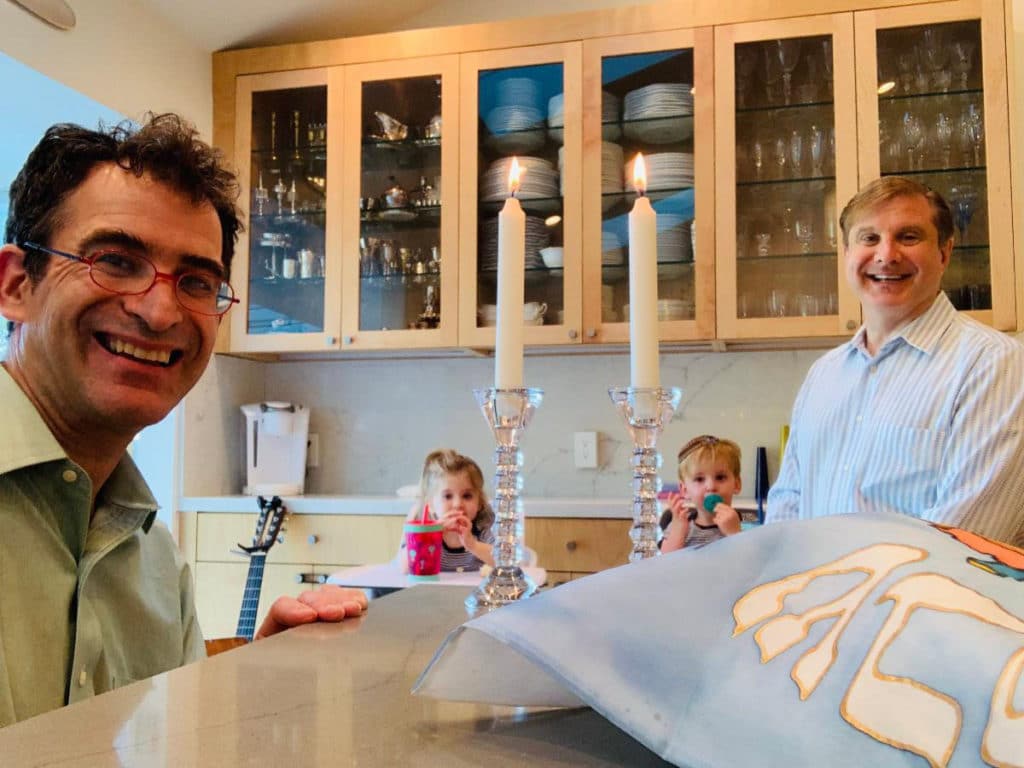
Each Friday before I head to Temple Akiba of Culver City for Shabbat, Ron and I share a ritual with our children. We sing, put money in the tzeddakah jar, light candles, drink juice, eat challah, and offer blessings to one another.

I have to admit. There are some Friday afternoons I feel a little rushed. I have not finished a sermon. I have yet to respond to emails. I have calls to make. And sometimes, if I am honest, I’m just not “feeling” it.

But special moments don’t magically appear. They happen because we make them happen. As rushed as I might be, I have never regretted creating this moment in time to stop, offer gratitude, and embrace those I love. Indeed, that time to pause is necessary to enable me to move forward.

Your ritual might look different. I hope is does! It belongs to you. Just make it regular – and allow it to lift your souls.

With love and shalom,

Rabbi Zach Shapiro

A Moment in Time: Shabbat – How to Create a Moment in Time Read More »