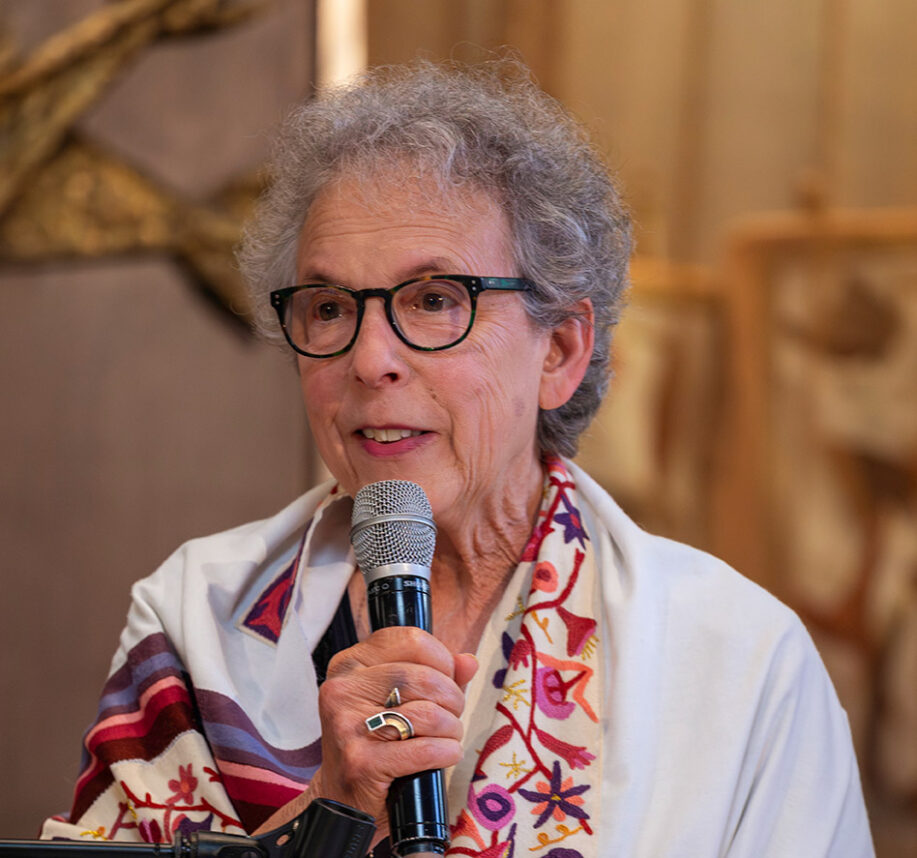
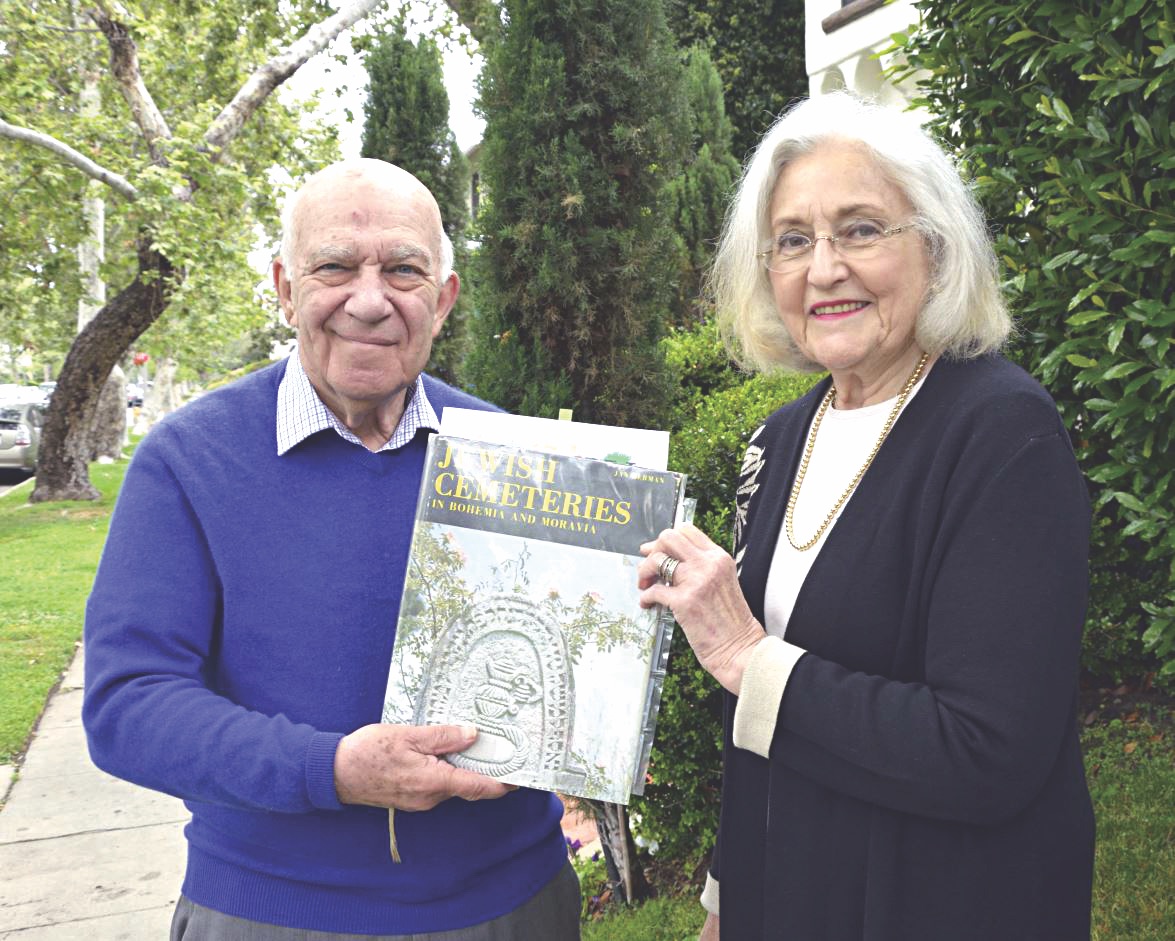
Madeleine Isenberg has a special skill. She translates and extracts information from Jewish tombstones to help people connect with their families’ pasts.
“I’m not good at matchmaking people who are living,” Isenberg said. “I do matchmaking between living people and their ancestors.”
A former software engineer who now lives in Los Angeles, the 70-something Isenberg was born in London, has a bachelor’s degree in mathematics from UCLA and an “all-but-master’s-thesis” in computer science from the Technion, the Israel Institute of Technology.
Isenberg calls herself a stelaeglyphologist. “Stelae are monuments that are taller than they are wide, glyphs are the things that are scribed, and an ologist is someone who studies it,” she explained.
“A tombstone, like an obituary, has very narrow margins,” she said. “There’s just so much you can cram in, so you use symbols. There are so many [that] if you don’t understand [the context], you can get really messed up.”
Isenberg noted there could be up to 14 or 15 ways to indicate an abbreviation. She cited one example on a Sephardic tombstone that employed the letters Kaf, Hay, Resh. “If you translated it directly, it would be, “Like a mountain,’ ” she said. “It was actually an abbreviation that read “Honorable rabbi.’ ”
Deciphering tombstones requires translating inscriptions and collecting information, and cross-referencing against birth, marriage and death records, Isenberg said. She also employs resources such as JewishGen.org and the Jewish Online Worldwide Burial Registry.
“It’s amazing to be able to put these pieces together,” she said. “It’s solving puzzles.”
Her interest in reading tombstones dates back to 1996. Isenberg, together with her husband, traveled to the Kezmarok cemetery in Slovakia, where they met up with her cousin in an attempt to locate family members who may have been buried there. Isenberg’s father grew up in Kezmarok and most of her Holocaust-surviving family members eventually emigrated from there to Israel in 1948.
Armed with a hand-drawn map, they made their way through the overgrown cemetery, where Isenberg discovered her great-grandmother’s grave. “It was beshert (meant to be),” she said. The weathered headstone was difficult to read, but it confirmed the history Isenberg knew: Her great-grandmother had died young while giving birth to her third child. Her father’s name was also on the headstone.
A few years later, when Isenberg wanted to get the stone restored, a cousin introduced her via email to Mikulas “Miki” Liptak, a small book publisher in Kezmarok, who would use markers to highlight the lettering on the gravestones and then send photos of them to Isenberg to decipher.
In 2004, Dr. Josef Jordan, a veterinarian in Kezmarok, received funding to preserve the Jewish cemetery. Liptak took pictures of all 550 tombstones. He reached out to Isenberg to translate the stones, and a working relationship ensued. Since then, Isenberg has read and deciphered several thousand tombstones from around the world. She continues to help people track down relatives and decipher their tombstones.
In August, Isenberg will be a guest speaker at the 38th International Association of Jewish Genealogy Societies (IAJGS) conference, which will take place in Warsaw, Poland, for the first time. She will be speaking on what can be gleaned from the Hebrew inscriptions on tombstones.
“I’m attempting to help beginning researchers who barely know the Hebrew alphabet to find and recognize certain pieces of information that should be of genealogical value as they research and build their family trees,” Isenberg said.
This work, she added, gives her purpose. “[It’s fun] finding something or being able to help somebody who has been searching.”