

Explaining the Israeli election, that’s a core mission for us in the coming months, until Election Day, Oct. 27 (when it will become the time to explain the even more complicated Israeli coalition building). Today, we focus on a problem the coalition has – a problem with the main opponent currently facing it.
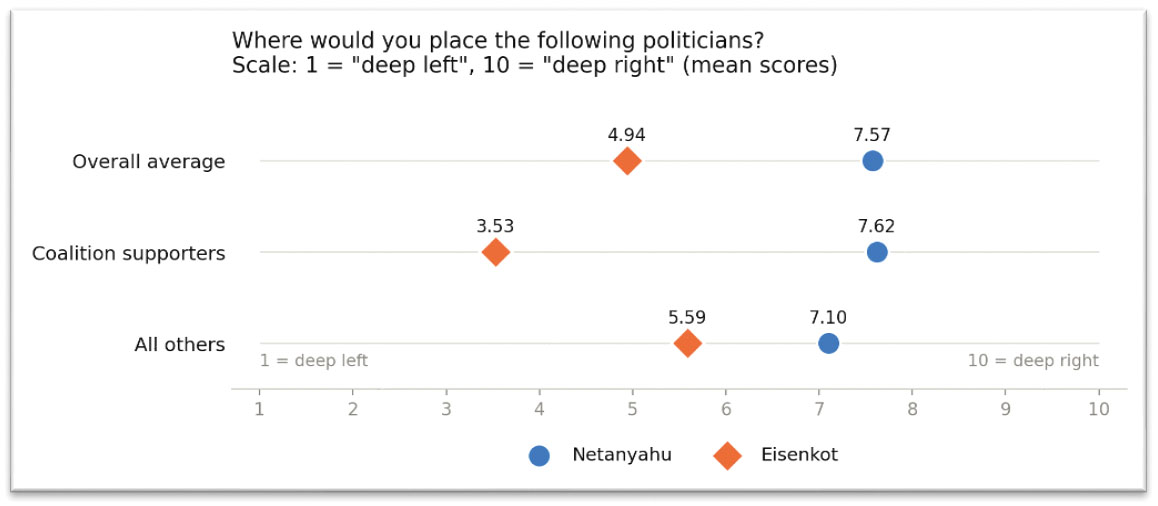
Gadi Eisenkot is a leader with very few traits that Israelis dislike. And this includes most coalition voters. When asked what they have to say about him, they mostly say good things. When asked what is bad about him, they find it hard to answer. What can they say – that he is a populist? Unpatriotic? Inexperienced? An extremist? It is hard to find a negative image that sticks to him. Thus, only one tool remains in their quiver of arrows: Gadi is a “leftist.” He is a good man, a dedicated man, a serious man, but what can you do, he is a leftist. Or, as Minister Amichai Chikli put it, he is a worthy political rival but a distinct man of the left.
Is he actually a leftist? Let us use the Eisenkot question to discuss the title “leftist” and its meaning in the Israeli context. Who is even a leftist? We can start with simple data, from which we learn that there are almost no leftists in Israel. The percentage of Jews in Israel who describe themselves as left-wing supporters stands at 5% on a good day. Even if you add supporters of the center-left, you will not reach a fifth of the Jewish population. The case of Arab citizens is more complex; they connect less with this scale, and when they do, it expresses different things. In other words, to assume Gadi is a leftist, one must assume he stands in a group comprising one-in-20 of all Jews, or perhaps one-in-five. He would be standing on an edge where very few actually stand.
Let us move forward. Perhaps it is not self-definition that determines where a person stands, but rather political positions. We then must ask: What is the position that turns an Israeli into a leftist? You might say it is support for a Palestinian state. But then we have to ask “support for it when” – now, or in some unforeseeable future? If we are talking about right now, again, there is no more than a handful of leftists in Israel. If it is about an unknown future, this too does not necessarily allow Eisenkot to be branded a leftist. The percentage of Jews who agree with the statement that Israel should try to reach a peace agreement with moderate Palestinians and allow the establishment of a Palestinian state that will live in peace alongside the State of Israel stands at 13%. This is a position held by most of those who call themselves left, less than half of those who call themselves center-left, and a fifth of those who call themselves centrists.
What other positions might define someone as a leftist? We have data on what defines Israelis as right-wing. In the eyes of the right itself, opposition to a Palestinian state is the most important clause. The next one in line is support for judicial reform. If so, one could argue that a leftist is not someone who supports a Palestinian state, because right now there are very few of those, but rather someone who does not support the judicial reform. Naturally, such a definition creates the opposite difficulty. If we go by the Palestinian state metric, it turns out there are too few leftists, meaning Eisenkot — who is not exactly a twig — must be squeezed into a very narrow drawer to call him a leftist. Conversely, if we go by opposition to the reform, the drawer will be large and comfortable enough, but then it would turn out there are more leftists than right-wingers in Israel, which is, of course, unthinkable.
What have we learned so far? Coalition supporters want to define Eisenkot as a leftist because leftist is a title most Israelis do not want their Prime Minister to hold. But this definition has inherent limitations.
So, what remains? What remains is the option to call Eisenkot a leftist without a convincing argument – a leftist in the sense of “he is not in favor of our coalition.” In this way, Avigdor Liberman is a leftist, Naftali Bennett is a leftist, Yoaz Hendel is a leftist, Matan Kahana is a leftist, and Ayelet Shaked is a leftist. All these right-wingers are leftists. In effect, this means that Israelis have been stripped of the right to determine for themselves whether they are leftists or not, and they have also been stripped of the ability to understand which positions characterize a leftist. If you want to rely on a high authority, this approach is similar to the position of the philosopher Isaiah Berlin regarding the question of “Who is a Jew?” When Berlin was asked by David Ben-Gurion, as part of a comprehensive inquiry he conducted via correspondence with the great minds of the Jewish people, who he considered a Jew, Berlin replied that there is a simple criterion: A Jew is whoever his neighbors, primarily his non-Jewish neighbors, consider to be a Jew.
Something I wrote in Hebrew
One more on left/right and our election:
Between the moderate-right and the center-right – that is the spot. From there to the right, the proportion of those who want a coalition similar to today’s begins to soar. From there to the left, the proportion of those who believe that a “more liberal state” is the decisive challenge … there is an attempt – mainly by the coalition – to paint a political landscape in which a battle is being waged between “right” and “left.” But the much more accurate picture of the landscape is the one in which we see a battle of right versus right. Of a right that wants a rerun of the current government, and a right that wants a different version of governance.
A week’s numbers
Where is Eizenkot on the Left-Right scale (see left hand column)? Here’s one possible answer:
A reader’s response
Jen Lewis writes: “I hope Israel finally gets a better government. We can’t defend a country with Netanyahu and his cronies at the top.” My response: Just curious — can you defend the U.S. with you-know-who on top?
Shmuel Rosner is senior political editor. For more analysis of Israeli and international politics, visit Rosner’s Domain at jewishjournal.com/rosnersdomain.