Han Solo’s perfect blend of charisma, kindness and cockiness make him everyone’s favorite sidekick. But Han’s real magic is a Torah secret of learning to live between two tensions in “Solo: A Star Wars Story.”
In the part of the movie that will most resonate with Jews, Han is given the surname Solo. In a scene reminiscent of Jewish immigrants being given secular-sounding surnames at Ellis Island, a border agent gives Han his last name because he is literally traveling solo. It’s the only time, however, he will travel solo in the film.
“Solo: A Star Wars Story” is Han’s coming-of-age tale. At the beginning of the film, Han is a bit too happy-go-lucky and far too reckless. By the end, he is patient, savvy and crafty. He got there because of one line in the movie that goes to the heart and soul of Judaism.
On Shavuot, I participated in a learning session with Rabbi Adam Kligfeld and Rabbi Ari Lucas moderated by Jewish Journal senior writer Danielle Berrin. Each rabbi staked out a position in defining the revelation at Sinai.Rabbi Ari Lucas posited that Judaism is a carefully curated group of teachings and rituals passed from generation to generation, called transmission. Rabbi Adam Kligfeld argued for transgression — that true Torah and religious meaning are products of breaking the Torah.
We must have winners and losers. But in real life, the object is to live in the tension between winning and losing.
I believe transmission and transgression are two destinations on the same path. Judaism is the process of going from transmission to transgression, and the tension between the two is where true Torah lives.
Similarly, as Han finds himself diving deeper into a dangerous adventure with higher stakes, his childhood friend Qi’ra says, “It’s not that kind of game. The object isn’t to win. Just stay in as long as you can.”
We all have a bias toward zero-sum games. We like winners and we dislike losers. We must have winners and losers. But in real life, the object is to live in the tension between winning and losing.
Qi’ra’s pithy advice hits its mark and changes the way Han thinks. It makes his many adventures into small battles instead of individual wars. Han embraces this kind of thinking and it becomes his superpower. By the end of the movie, Han and Chewbacca are off to seek adventure, with the focus not on the beginning or end of that adventure, but rather the space in between.
Han Solo lives in the tension between good and evil, virtue and vice, friend and foe. That is why we love him and his character endures. Han Solo is no leading man, but he is a complex man who embraces the tensions of life. That’s what leads him to greatness.
Eli Fink is a rabbi, writer and managingsupervisor at the Jewish Journal.
I would have given almost anything to spend a day with Philip Roth, literary king of American Jews. He was a storytelling powerhouse, a commander of American letters. Some might argue that he was the finest wordsmith of the 20th and early 21st centuries — a grand statement that’s hard to dispute.
But we lost him on May 22, and we’ll have to make do with everything he left behind. Fortunately for us, it’s quite a spectacular, if provocative, trove of more than 30 novels in addition to various short stories, interviews and essays.
More than 60 of Roth’s 85 years were spent publishing, and during these years, he tackled with precision subjects ranging from the broader issues of immigration and American fascism, racism and terrorism to the more controversial subject of the lecherous male. And, for Roth, this lecherous male was always Jewish and always reaching — reaching toward acceptance and the ability not just to pass in mainstream American culture but to command it. The picture of American Jews painted by Roth was one of a people ensnared by history and hounded by innate and largely inescapable flaws of character.
It’s no wonder that the man who achieved such literary notoriety (despite being repeatedly passed over by the Nobel committee) was also the subject of American-Jewish outrage.
Especially in the late 1950s and early 1960s, Roth’s work was seen as scandalous and transgressive. It was denounced by rabbis and many American Jews. He exposed us for who we are, but it wasn’t what he exposed that most incensed us. It wasn’t the depictions of lascivious men neglecting to tame their carnal desires. It wasn’t the image, famously described in “Portnoy’s Complaint” (1969), of a young man masturbating with a piece of liver that would later be eaten for dinner by the entire family. And it wasn’t the implicit suggestion in “Goodbye, Columbus” (1959) that a Jewish woman wishing to assimilate seamlessly and successfully must have a nose job. Rather, it was the audacity of this young, secular writer who pushed back on all that was most taboo that made us most uncomfortable.
But I’ve always thought that the real scandal was that we needed Roth to paint such a vivid picture of our humanity, that we were incapable of taking stock of our flaws without his impeccable eye to flesh it out for us.
And, speaking of flesh, Roth’s work is full of it. It is often filthy in its depictions of the quintessential American-Jewish male’s quest for dominance over the tall, blond and blue-eyed young woman: the shiksa. In “American Pastoral” (1997), which may very well be the most masterfully written American novel of and about the 20th century, Roth writes of Seymour Levov (“The Swede”): “He’d done it.” He had married Dawn Dwyer, a shiksa and former Miss New Jersey. He, “post-Jewish,” and she, “post-Catholic,” together should have been unstoppable. And yet they were not unstoppable. Their perfection became their demise. The perfectly and wholly assimilated American-Jewish family implodes finally with a bomb detonated by their daughter, Merry, on American soil: a domestic terrorist.
Continuing that thread, in 2004 Roth published “The Plot Against America,” a counter narrative recounting what could have happened if Charles Lindbergh, instead of Franklin D. Roosevelt, was elected president in 1940. It’s an interesting choice, three years after 9/11, to write a novel exploring not the fear of imported terrorism but of what we have always harbored within our borders. In this version of our history, Americans are not liberators of concentration camps. Instead, Jewish boys are sent to live with families in the South or the Midwest in an effort to “Americanize” them.
With the election of Donald Trump to the American presidency, “The Plot Against America” took on deeper significance. After the inauguration, social media posts urgently implored people to read the novel, which some claimed had predicted the rise to power of a demagogic celebrity like Trump. Articles noting this phenomenon began to pop up everywhere. And just a few months ago, David Simon, creator of “The Wire,” announced that he would be adapting Roth’s novel for a six-part miniseries.
For Roth, the violence and ugliness of life is not something imported from peoples and cultures unknown. It is always something we carry recklessly within us, something that necessarily bubbles just underneath the surface of every lovely veneer. He used humor and caricature to point this out, but those who are brazen enough to elucidate such things are often misread and misunderstood. Roth was no exception. He inspired the greatest praise and the harshest condemnation. He was polarizing. You loved him or hated him.
Some called him a misogynist, which never felt quite right to me despite the fact that some of his works depict unapologetic sexism. And in many cases, his depictions of women as objects are offensive and arguably unforgivable. His female characters were often one-dimensional, lacking complexity. Consequently, some have suggested that Roth hated women.
But I think the inescapable misery of his male characters with their impossible sexual and historical entanglements undermines the idea of Roth as misogynist. While it’s true that his female characters are hardly inspiring, his male characters are often repulsive and pathetic. They are dark and unruly, lustful and impotent, fearful not just of women but of the weight of their fathers’ reproach. Their anxiety overflows and rips into everything they create. And it is not just their own anxiety that haunts them. Each of Roth’s male characters shoulders the burden of a whole culture of memory. “To be alive, to him, is to be made of memory — to him if a man’s not made of memory, he’s made of nothing,” we read in the memoir “Patrimony” (1991).
I can’t imagine that an authentic misogynist would paint men in such a fashion. If he was a misogynist, his misogyny was flawed and incomplete. If he was much better at creating fascinating and psychologically complex male characters, it was because he was writing what he knew. He certainly wouldn’t dare to enter the consciousness of a woman.
Roth seemed bent on determining what, in fact, is lost in our quest to belong and in our desire to live fully. Is it dignity? Decency? Authenticity? Something else?
Roth’s work was funny, but it was also dark and “deadly serious.” It was not a darkness comprising ruminations on death or genocide, but of bold revelations of the American underbelly. In the Pulitzer Prize-winning “American Pastoral,” Jerry Levov, the Swede’s brother, tears into his brother’s desperate quest to “belong like everybody else.” He lashes out at his brother, still reeling from the bomb set off by his daughter, and says, “With the help of your daughter you’re as deep in the s— as a man can get, the real American crazy s—.” And then comes the repetition of a phrase that has haunted me since I first read it many years ago: “America amok! America amuck!”
Here Roth gives us the blueprint of America — as it was and as it will be. Assimilation comes with a cost. But so does simply living and breathing. We pay the price consistently and continually. Yet the nature of the price we pay is not always clear. Roth seemed bent on determining what, in fact, is lost in our quest to belong and in our desire to live fully. Is it dignity? Decency? Authenticity? Something else?
I’ve always found it interesting that Roth’s characters insist on getting everything right. Nathan Zuckerman obsesses over getting the Swede’s story right, and yet reveals — albeit only to careful readers — that he himself is creating the Swede’s story, imagining it and projecting it onto the Swede. And so it will never, in theory, be right.
And yet. “The fact remains that getting people right is not what living is all about,” he writes in “American Pastoral.” “It’s getting them wrong that is living, getting them wrong and wrong and wrong and then, on careful reconsideration, getting them wrong again. That’s how we know we’re alive: we’re wrong. Maybe the best thing would be to forget being right or wrong about people and just go along for the ride. But if you can do that — well, lucky you.”
None of us is so lucky. We can’t forget about being right or wrong, especially these days. “Writing turns you into somebody who’s always wrong,” Roth writes. “The illusion that you may get it right someday is the perversity that draws you on.”
Monica Osborne is scholar of Jewish literature and culture. She is the author of “The Midrashic Impulse and the Contemporary Literary Response to Trauma.”
(RE)VISION: EXPERIMENTS & DREAMS FROM EMERGING JEWISH COMMUNITIES The Jewish Emergent Network — an organization composed of seven Jewish communities from throughout the United States, including IKAR in Los Angeles — holds its inaugural public conference, a three-day event facilitating engagement in Torah and learning, justice and moral leadership, prayer and ritual, and inclusion and community models. Open to rabbis, cantors, Jewish professionals, lay leaders, academics, philanthropists, activists and interested Jews. The conference begins at 8 a.m. Friday with an optional Shacharit and a welcome breakfast at 9 a.m.; it adjourns at 4:30 p.m. Sunday. The $500 registration includes three full days of content, all meals and snacks (dietary laws observed). Discounts for IKAR members are available. Conference events will be held at The Mark, 9320 W. Pico Blvd.; Morry’s Fireplace, 9118 W. Pico Blvd.; and Shalhevet High School, 910 S. Fairfax Ave. More information is available at jewishemergentnetwork.org or by calling (323) 852-6920.
SOCIAL JUSTICE SHABBAT: BAIL REFORM Alex Sherman, attorney, journalist and co-chair of Bend the Arc: Jewish Action, speaks about the organization’s advocacy for the California Bail Reform Act, a bill (SB 10) introduced in the state legislature. Currently, people charged with crimes in California are often required to pay cash bail or post a bail bond in order to be released from custody and help ensure that they appear at court hearings. Those who cannot afford bail or a bond remain incarcerated and, consequently, can be at risk of losing their jobs or undergoing other hardships that impact them and their families. If passed, SB 10 would require a court to evaluate whether a defendant can safely be released while awaiting trial. 7-8:30 p.m. Free. Kehillat Israel, 16019 W. Sunset Blvd., Pacific Palisades. (310) 459-2328. ourki.org.
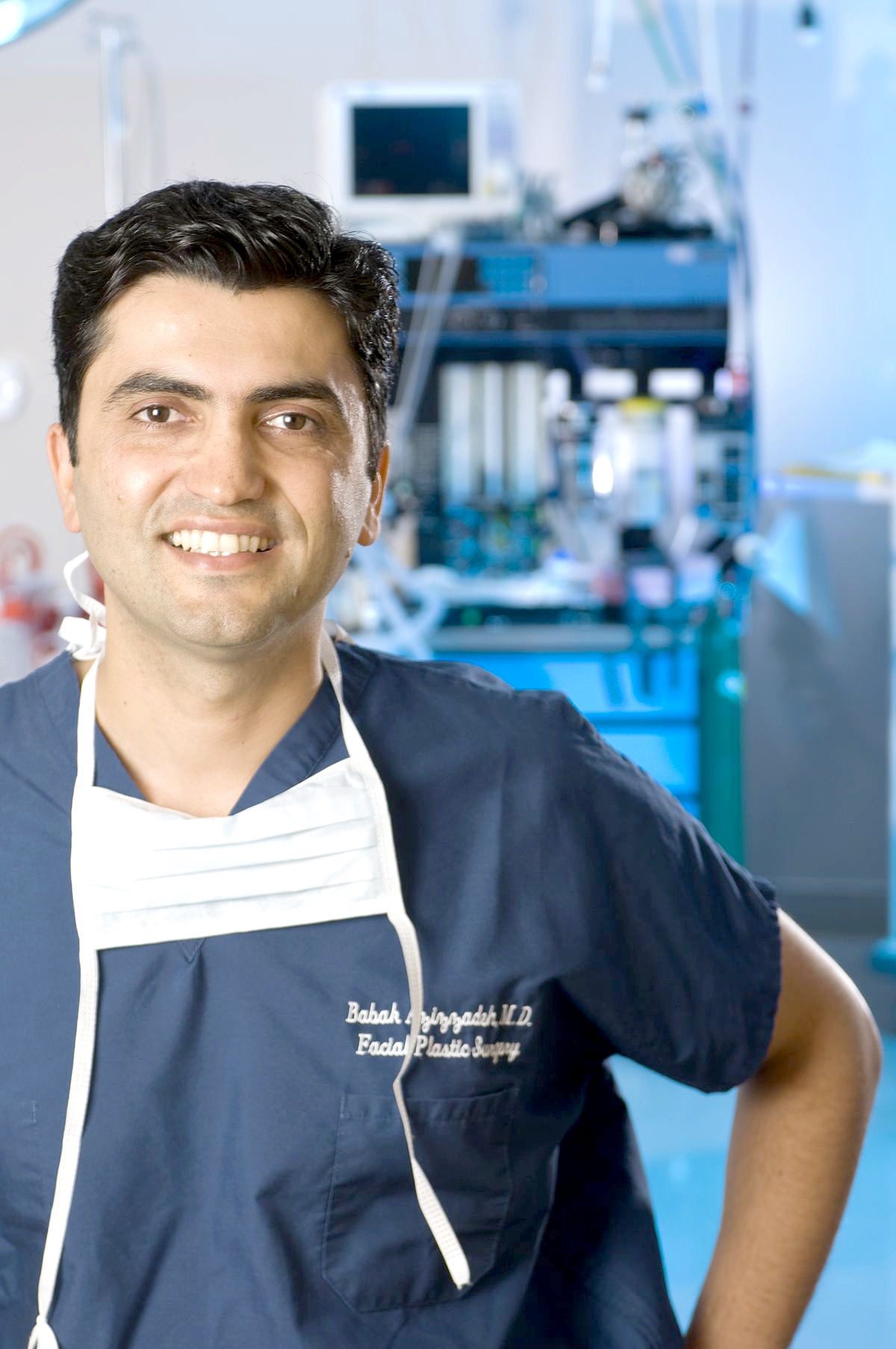
TECHNOLOGY AND THEFUTURE OF MEDICINE Plastic surgeon Babak Azizzadeh discusses the role technology will play in the future of medicine during a wine-and-cheese reception at 7:15 p.m. at Temple Emanuel of Beverly Hills. His remarks precede a Shabbat unplugged service at 8 p.m. Free. Temple Emanuel of Beverly Hills, 300 N. Clark Drive, Beverly Hills. (310) 288-3737. tebh.payquiq.com.
SAT JUNE 2
“AN INTRODUCTION TOAMERICAN MUSLIM LIFE” Speaker Haroon Moghul, a fellow in Jewish-Muslim relations at the Shalom Hartman Institute and author of “How to Be a Muslim: An American Story,” speaks at Shabbat morning services at Shomrei Torah Synagogue. Moghul’s book details his coming of age as an American Muslim and his struggle to forge his identity in a post-9/11 world. 9 a.m.-noon. Free and open to the public. Shomrei Torah Synagogue, 7353 Valley Circle Blvd., West Hills. (818) 854-7650. stsonline.org.
REP. BRAD SHERMAN SPEECH Congressman Brad Sherman (D-Sherman Oaks) delivers an address on “Checking Iranian Aggression: Supporting Our Ally Israel and Enhancing Mideast Security” during Shabbat services with the Beverly Hills Jewish Community Chabad Synagogue. In his remarks, Sherman will examine the effectiveness of U.S. sanctions against Iran in curbing Iran’s hostile actions in the Middle East and how the U.S. can help bolster Israel’s security, economic growth and technological innovations. Shabbat service 9:30 a.m., lecture 11:30 a.m. Free. Limited seating. RSVP at info@beverlyhillsjc.org. Beverly Hills Hotel, 9641 Sunset Blvd., Beverly Hills. (310) 276-4246. beverlyhillsjc.org.
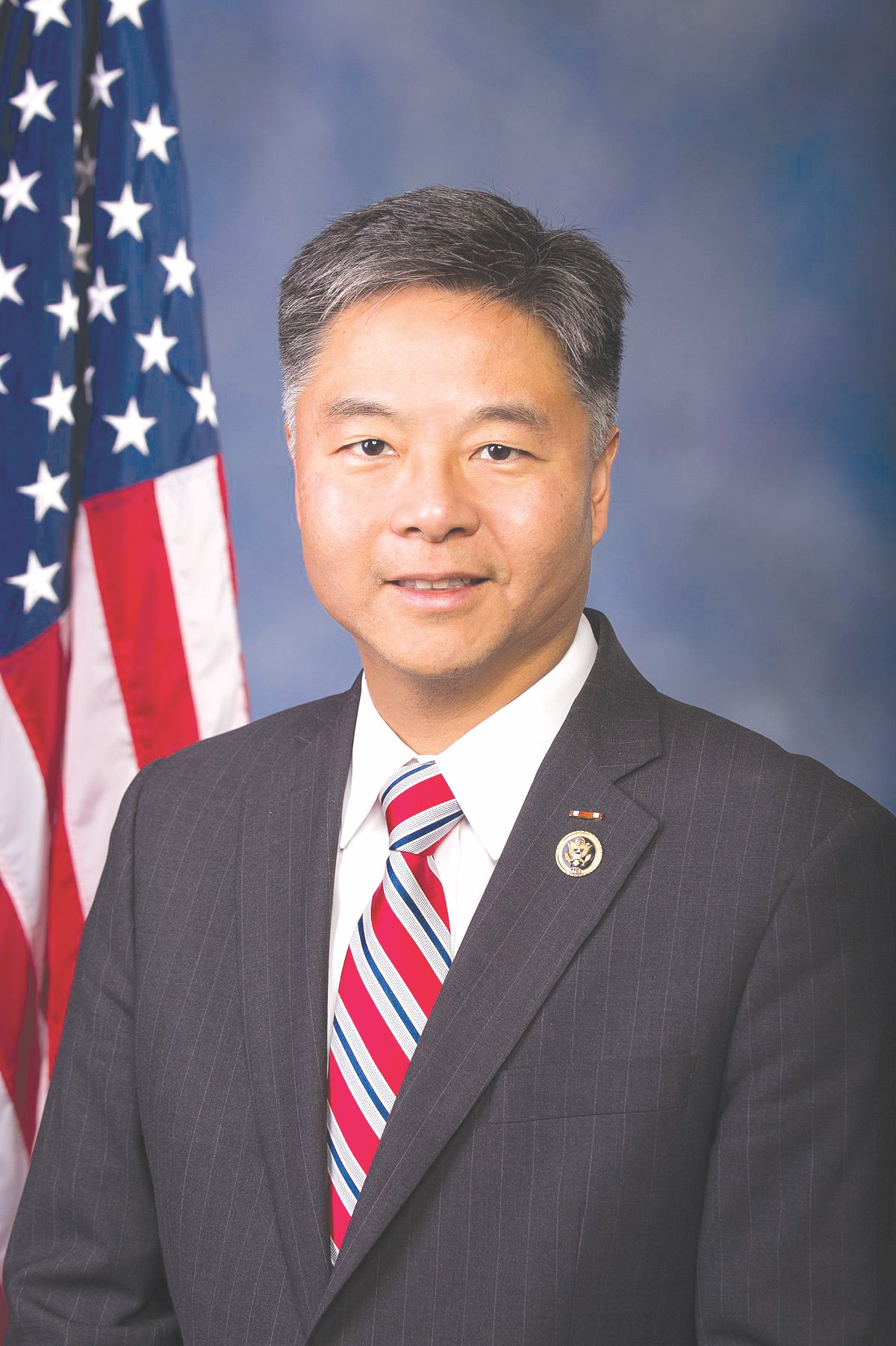
“KNOW YOUR REPS” Taiwan-born U.S. Rep. Ted Lieu, who represents California’s 33rd Congressional District, and IKAR Senior Rabbi Sharon Brous hold an open discussion over Shabbat lunch, following services. Lieu and Brous will examine the state and meaning of moral leadership from political and Jewish perspectives. Lieu was first elected to the House of Representatives in 2014 after a decade as a California assemblyman and state senator. 12:30 p.m. Free. Shalhevet High School, 910 S. Fairfax Ave., Los Angeles. (323) 634-1870. ikar-la.org
SUN JUN 3
BLOOD DRIVE The B’nai David-Judea community is holding an all-day blood drive from 10 a.m.-4 p.m. To make an appointment, visit redcrossblood.org and enter the sponsor code BDJ, or contact Mina Rush at (310) 351-8742 or iminarush@abcglobal.net. bnaidavid.com. B’nai David-Judea Social Hall, 8906 W. Pico Blvd., Los Angeles.
VISITING THE WETLANDS The Temple Isaiah Family Philanthropy Club organizes an outing into the Ballona Wetlands, where people of all ages can help protect the wetlands by removing invasive, non-native plant species and removing debris from the historic Ballona Creek. Members of Friends of the Ballona Wetlands will provide the needed tools. Participants must wear closed-toe shoes, should be prepared to get dirty and are encouraged to bring a reusable water bottle. 2-4 p.m. Free. RSVP required to Jessica at jpdabney@me.com. Directions to the wetlands will be sent following RSVP. (310) 277-2772. templeisaiah.com.
“FROM THE BIMAH TO BROADWAY” Temple Ramat Zion Hazzan Daniel Eli Friedman headlines “From the Bimah to Broadway,” an evening of live music. The concert features a cast of Friedman’s musical friends, including veteran stage performers Kevin McIntyre and Stefanie Morse, Cantor Lori Reisman Paterson of Congregation Ori Ami and Chazzan Lisa Peicott of Sinai Temple, under the musical direction of Tova Morcos. 7:30 p.m. $25 limited seating, $40 general admission, $75 reserved seats and $150 patrons. Temple Ramat Zion, 17655 Devonshire St., Northridge. (818) 360-1881. trz.org/concert.
TUE JUNE 5
NOAH POLLAK Writer Noah Pollak, a contributor to the publications Free Beacon, Commentary and the Weekly Standard, discusses the Taylor Force Act, a legislative bill that cuts aid to the Palestinians until they end stipends for convicted terrorists and families of slain attackers.Pollak, one of the architects of the act, which was named for an American killed in a 2016 terrorist attack in Tel Aviv, addresses how its passage will help stop the flow of U.S. dollars to Palestinian terrorists. Organized by the Sinai Temple Men’s Club. Men and women welcome. 6:30 p.m. $10 dinner. Free for Sinai Temple members. Sinai Temple, Ziegler Hall, 10400 Wilshire Blvd., Los Angeles. (310) 474-1518, ext. 3340. sinaitemple.org.
“FRUITHANDLER GONE WILD” After seven years at Sinai Temple, Rabbi Jason Fruithandler is leaving for the Woodbury Jewish Center in New York. Atid, Sinai Temple’s young professionals group, sends him off with a farewell party, featuring food, soft drinks and arcade games. 7:30-10:30 p.m. $10 food and soft drinks. $15 game card. Dave & Buster’s at the Howard Hughes Center, 6081 Center Drive, Los Angeles. RSVP by June 4. (310) 474-1518. atidla.com.
WED JUNE 6
HECKLES FOR SHEKELS Friends of the Israel Defense Forces (FIDF) holds a night of comedy at the Hollywood Improv. Comedians to be announced. The FIDF is a nonprofit that provides for the well-being of men and women serving in the Israel Defense Forces and supports families of fallen soldiers. 18-and-over only. 6:30-9:30 p.m. $45 early bird general admission; $55 general admission. Hollywood Improv, 8162 Melrose Ave., Los Angeles. (323) 843-2690. squadup.com/events/fidf-yl-comedy-night.
THU JUNE 7
“THE ETERNAL DISSIDENT” David Myers, president and CEO of the Center for Jewish History in New York, appears at the launch event for “The Eternal Dissident,” a new book about the life and thought of the late Rabbi Leonard Beerman, who led Leo Baeck Temple for 37 years. Friends and colleagues of Beerman — including Rev. Ed Bacon, Aziza Hasan, Mike Farrell, Rev. James Lawson, Salam al-Marayati, professor Nomi Stolzenberg and Rabbi Rachel Timoner — join Myers, who edited the book. Dessert reception follows. 7-9 p.m. Free. Leo Baeck Temple, 1300 N. Sepulveda Blvd., Los Angeles. (310) 476-2861. leobaecktemple.org.
TASTE OF ISRAEL Foodies and Israel lovers unite at the “biggest culinary event for Israel in the United States,” showcasing Israeli wines and cuisine from celebrity Israeli chef Eyal Shani; acclaimed chef and TV star Meir Adoni; local modern Israeli restaurant Jaffa and more. Certified kosher menu. Proceeds benefit Larger Than Life, which serves Israeli children with cancer. Black tie optional. 7-11 p.m. General admission $360. The tax-deductible ticket includes unlimited food from 20 gourmet chefs and 20 of Israel’s finest wineries. Skirball Cultural Center, 2701 N. Sepulveda Blvd., Los Angeles. tasteofisraella.com.
YOSSI KLEIN HALEVI Yossi Klein Halevi discusses his new book, “Letters to My Palestinian Neighbor,” at the Museum of Tolerance. Halevi, an American-born, award-winning author who has lived in Jerusalem since 1982, argues for Israelis and Palestinians to come to a a deeper and more soulful understanding of one another. David Suissa, publisher and editor-in-chief of the Jewish Journal, moderates a Q-and-A. A reception, book sale and book signing follow. 7:30 p.m. $12. Museum of Tolerance, 9786 Pico Blvd., Los Angeles. (310) 772-2505. museumoftolerance.com/letters.
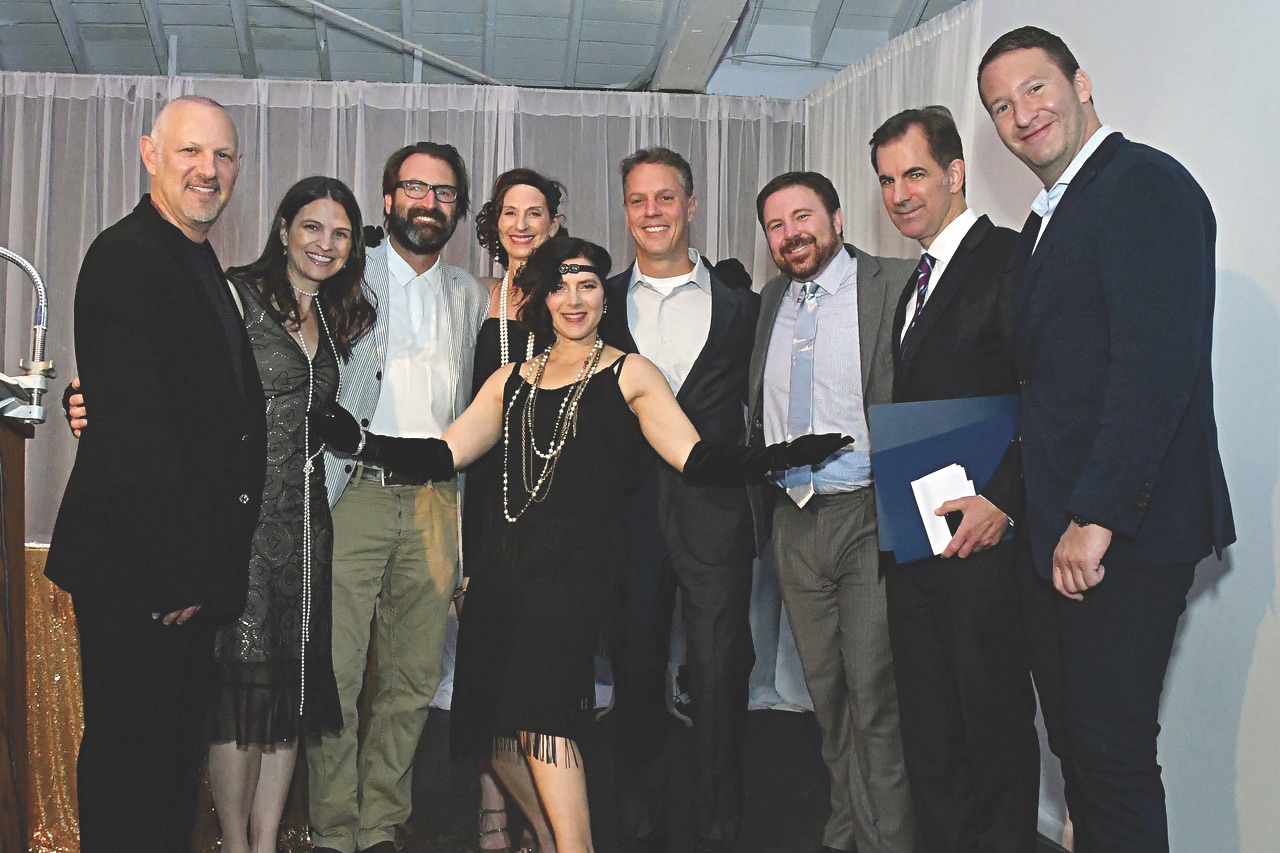
From left: Todd Kessler, Rabbi Sharon Brous, Fred Kramer, Melissa Balaban, Karen Hogan, Adam Miller, Yoni Fife, Jeff Hogan and Dave Alpern attended IKAR’s “Party With a Purpose.”
Pearls, fedoras, feather boas, flapper dresses and headbands were in fashion on May 17 as members of IKAR celebrated at their annual fundraising gala at The Mark on Pico Boulevard.
Cocktails flowed freely, a jazz band played, Charleston dance steps were taught and attendees piled their plates high at buffet stations offering a variety of items ranging from Chinese food, mock-brisket burgers and tater tots, to street tacos and corn on the cob.
Between a silent auction and a live auction, IKAR raised $385,000, which exceeded the goal set for the event, said IKAR Development Manager Elad Dash-Banks.
Formerly known as the Night of the Wandering Jew, this year’s event — celebrating IKAR’s 14 years of operation — was renamed “Party With a Purpose: A Night at the Speakeasy,” and honored outgoing board member Karen Hogan and her husband, Jeff. The couple and their four sons are moving to the East Coast after eight years at IKAR.
The Hogans’ involvement in IKAR began when their youngest son, Tyler, enrolled as a member of its Early Childhood Center’s inaugural class. Over the years, Karen served as the board’s assistant treasurer, its co-chair and ultimately its chair.
“Karen brought sophisticated thinking, well-honed analytical skills and deep love into every conversation,” said IKAR founder and Senior Rabbi Sharon Brous. “Jeff also modeled what it meant to be a partner and a truly supportive community member.”
Brous presented the Hogans with certificates of recognition from U.S. Rep. Karen Bass (D-Los Angeles) and Los Angeles Mayor Eric Garcetti, who is also an IKAR member and studies Talmud regularly with Brous.
Jeff, who isn’t Jewish, quipped, “As the great scholar Pope Francis said, ‘Inside every Christian is a Jew.’ IKAR is the place where I discovered my inner Jew.”
Karen spoke of her High Holy Days experience at IKAR and how she discovered an extraordinary connection to the hundreds of people at services despite knowing only a few of those in the room.
“To me, that is IKAR’s secret sauce,” she said. “Giving people the space in which to have a powerful personal and communal experience simultaneously.”
— Kelly Hartog, Senior Writer
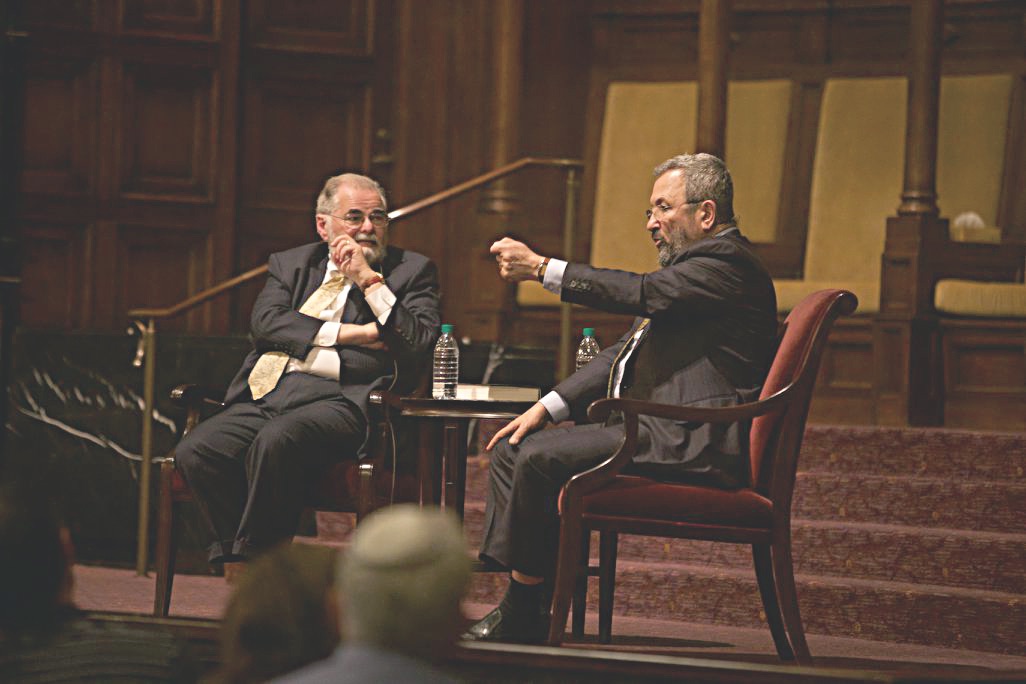
From left: Jewish Journal Book Editor Jonathan Kirsch and former Israeli Prime Minister Ehud Barak appeared in discussion at Wilshire Boulevard Temple, marking the release of Barak’s memoir, “My Country, My Life: Fighting for Israel, Searching for Peace.”
Former Israeli Prime Minister Ehud Barak promoted the release of his memoir, “My Country, My Life: Fighting for Israel, Searching for Peace,” with an appearance at Wilshire Boulevard Temple on May 17.
The former Israeli leader discussed with Jewish Journal Book Editor Jonathan Kirsch the recent protests at the Israel-Gaza border, the relocation of the U.S. embassy from Tel Aviv to Jerusalem, his experiences serving as Israel’s prime minister from 1999-2001 and more.
In regard to negotiating for peace with Yasser Arafat, Barak said the late Palestinian leader deserved an Academy Award for his acting skills. “Arafat was not a person to negotiate with,” Barak said.
Additional speakers included Wilshire Boulevard Temple SeniorRabbi Steve Leder, who noted that Barak’s life was interwoven with the narrative of Israel. “His life story is the story of Israel,” Leder said.
Barak also spoke about President Donald Trump’s recent decision to pull the United States out of the Iranian nuclear agreement, which removed sanctions against Iran in exchange for the country curbing its nuclear weapons program. He considered the agreement a bad deal that should have never been made but, because it was already in place, should have been left alone. He metaphorically compared his mixed feelings about the agreement to how he would feel if his mother-in-law drove his new BMW off a cliff.
— Ginger Vick, Contributing Writer
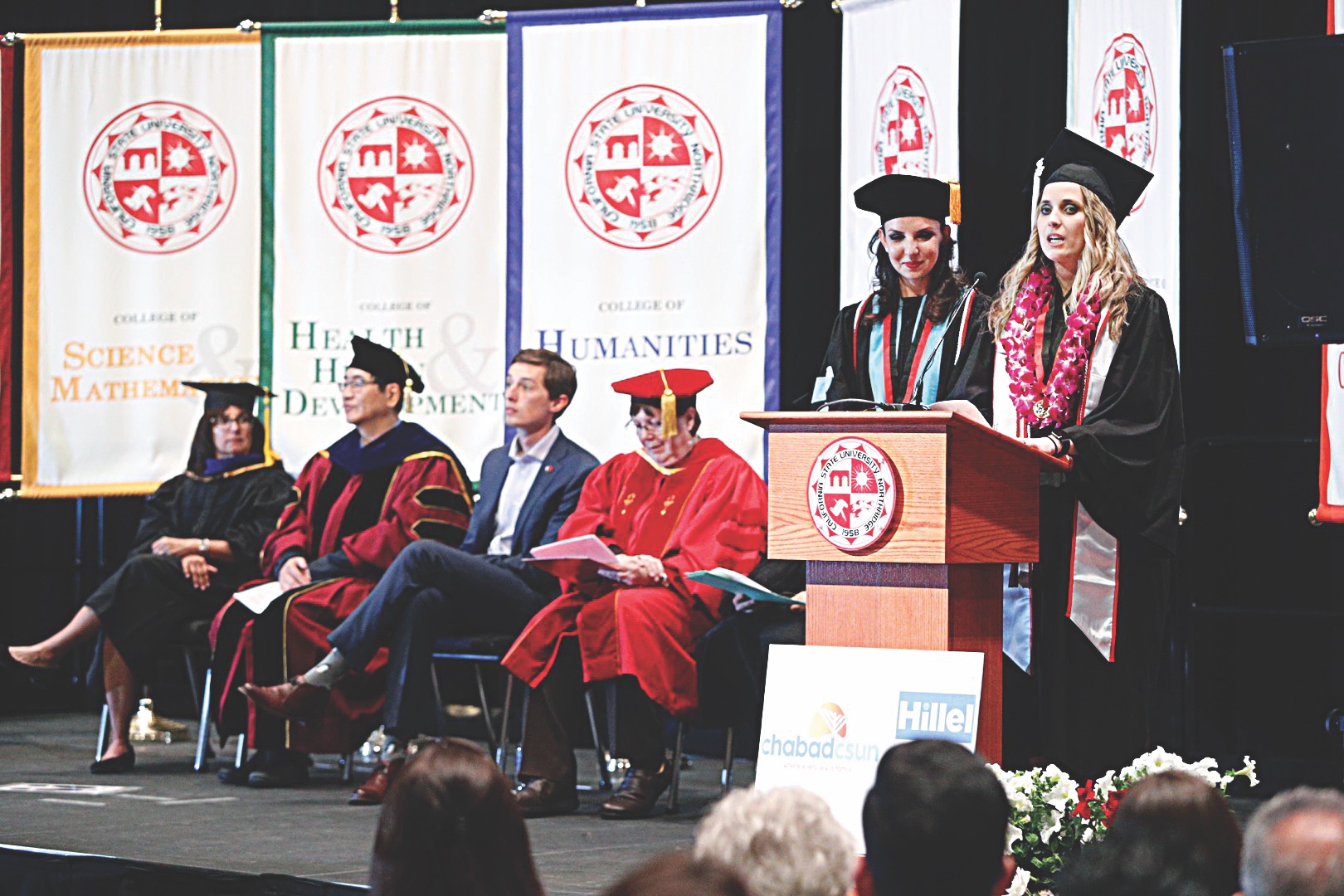
An alternate ceremony organized by the CSUN administration served Jewish students who could not attend the previous weekend graduation events due to Shabbat and Shavuot.
Joy and gratitude marked the Jewish student graduation ceremony on May 22 at Cal State Northridge (CSUN).
Jewish students who could not attend the previous weekend’s graduation events due to Shabbat and Shavuot were provided with an alternate ceremony organized by the CSUN administration, the College of Humanities and the Jewish Studies Program. A reception provided by Hillel 818 and CSUN Chabad followed the event.
More than 200 friends and family of graduates attended.
CSUN Dean of Humanities Elizabeth Say, Provost Yi Li, Director of Jewish Studies Jody Myers, Interim Director of Jewish Studies Terry Hatkoff and Associated Student President Jonathan Goldenberg presided over the ceremony.
Graduating students Leora Gabay and Orly Bitton served as honored speakers.
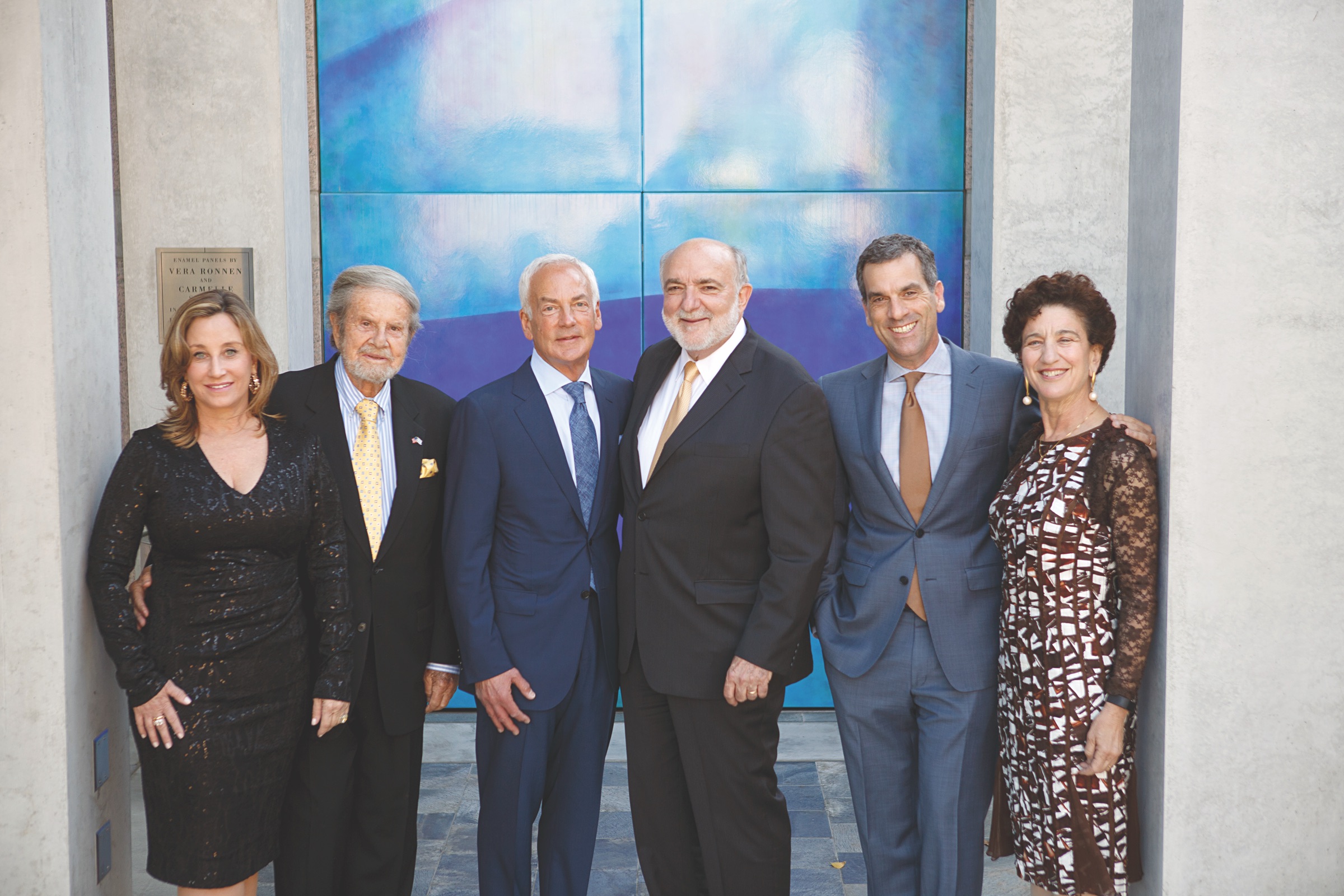
From left: Hebrew Union College-Jewish Institute of Religion (HUC-JIR) honorees Dianne Taube and Tad Taube; Jeffrey Farber, CEO of the Koret Foundation; HUC-JIR Interim President Rabbi David Ellenson; HUC-JIR Los Angeles Dean Joshua Holo; and Taube Family Foundation Executive Director Shana Penn.
Hebrew Union College-Jewish Institute of Religion (HUC-JIR) held its fifth annual gala on May 15 at the Skirball Cultural Center.
The event recognized husband-and-wife philanthropists Dianne and Tad Taube, whose Taube Philanthropies has provided support to Jewish causes and various other initiatives. The Taubes have committed more than half of their wealth to philanthropic causes.
The gathering also spotlighted Arthur Greenberg, former overseer of the Western region of HUC-JIR; Lee Wunsch, recently retired as president and CEO of the Jewish Federation of Greater Houston; and HUC-JIR’s Zelikow School of Jewish Nonprofit Matnagement’s 50th anniversary.
The event was touched by sadness due to the recent death of Rabbi Aaron Panken, HUC-JIR’s former president, who died in a plane crash on May 5 at the age of 53.
“I am confident that Aaron’s dreams will yet be realized through the foundations he constructed and the visions he has bequeathed us,” said Rabbi David Ellenson, who was appointed interim president of HUC-JIR following Panken’s death.
Ellenson praised the partnership the Taubes developed with Panken, including the opening of the Taube Family Campus at HUC-JIR’s Jerusalem campus in 2016, thanks to a $15 million grant provided by Taube Philanthropies.
During the event, Tad Taube announced to the 250 guests that a new $150,000 gift over three years would establish the Aaron Panken Merit Scholarship. Scholarships will go to rabbinical students, who will have an opportunity to study at the HUC-JIR Los Angeles campus.
Rabbi William Cutter, emeritus professor of human relations at HUC-JIR, introduced former HUC-JIR board member Greenberg, commending his leadership throughout the Los Angeles Jewish and legal communities.
Steven Windmueller, emeritus professor of Jewish communal service at HUC-JIR, introduced the recently retired Wunsch, who has been called “the face of Houston Jewry.”
— Ari L. Noonan, Contributing Writer
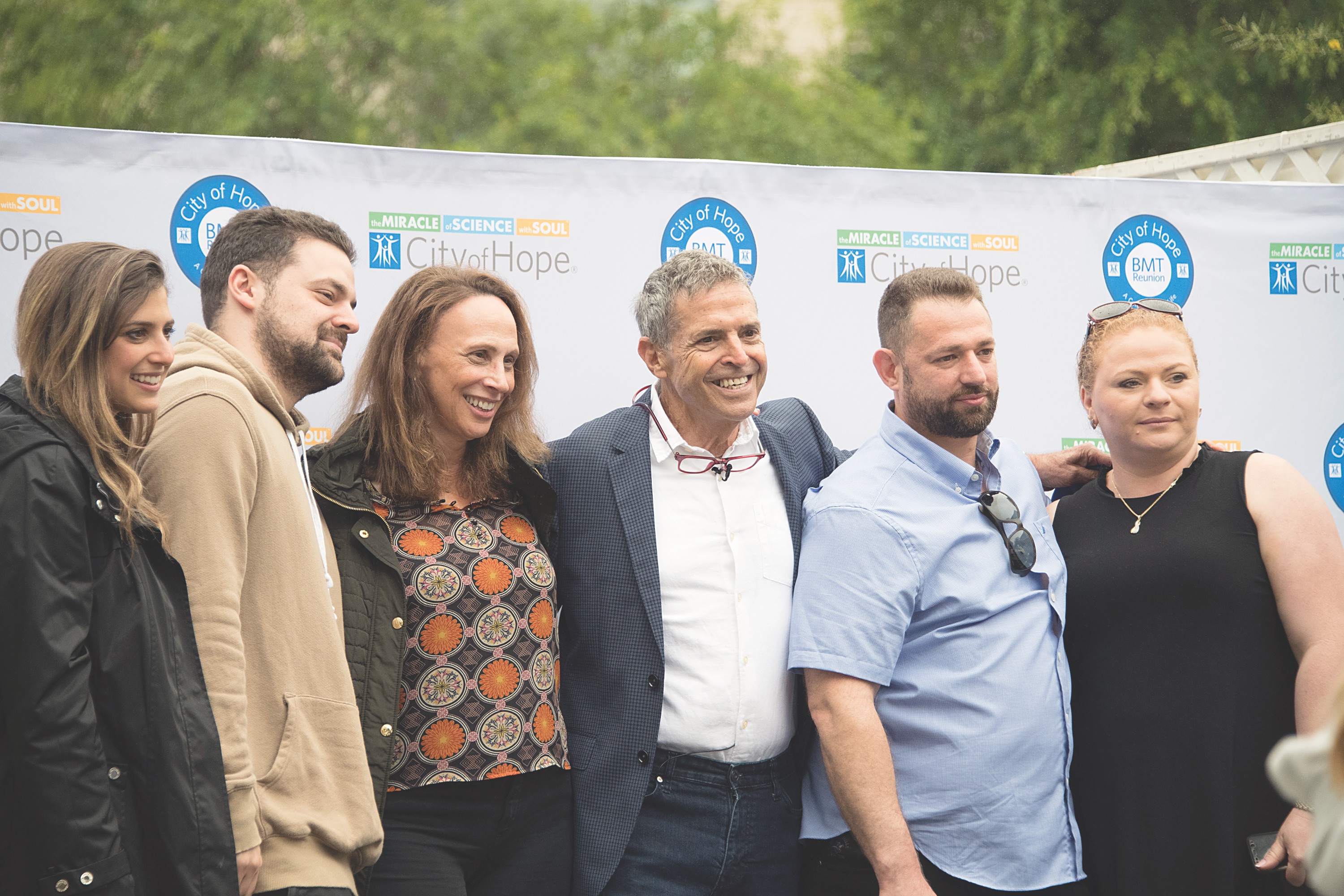
Marina Del Rey public relations executive Gary Stromberg (fourth from left) met his bone marrow donor, Israeli citizen Alex Kikis (fifth from left), as part of City of Hope’s 42nd annual bone marrow transplant reunion event at the hospital’s Duarte campus.
As co-founder of Gibson & Stromberg, a large and influential public relations firm, Gary Stromberg, 76, has rubbed shoulders with clients such as the Rolling Stones, Muhammad Ali and Barbra Streisand. But on May 11, Stromberg, who lives in Marina del Rey, had perhaps his most memorable face-to-face encounter when he met Israeli Alex Kikis — his bone marrow donor.
They met as part of City of Hope’s 42nd annual Bone Marrow Transplant Reunion event at the medical center’s Duarte campus. During a press conference attended by nearly 4,000 patients and their families, donors, medical staff and supporters, Stromberg delivered emotional remarks about the lifesaving bone marrow transplant he received at City of Hope in 2012 that eradicated his acute myeloid leukemia.
“When City of Hope informed me that I had been selected to meet Alex and that they were bringing him and his wife, Larisa, to our BMT Survivors Reunion, I was elated,” Stromberg said. “I’ve been dreaming about this day since I found out I had a donor, almost six years ago.”
Kikis, a 33-year-old manufacturing specialist for Intel Corp., flew from Israel with his wife for the event. In Israel, where bone marrow donation is strongly encouraged, practically everyone in the Israeli military is entered into a bone marrow registry, which is how Kikis became part of the National Marrow Donor Program’s “Be The Match” campaign nearly 20 years ago.
Prior to the event, Kikis quoted Talmud to City of Hope officials in explaining why he agreed to donate stem cells to a complete stranger thousands of miles away. “Jews have a saying: ‘If you save one life, it’s like you saved the whole world,’ ” he said. “Why not help if possible?”
In concluding his remarks at the press conference, Stromberg expressed his gratitude to Kikis on behalf of his two adult children, David and Emily, and his ex-wife, SherriRalph, who were in attendance.
“My family and I thank you from the bottom of our hearts for the impact you’ve had on mine,” he said.
First stop, math competition. Next stop, Hollywood?
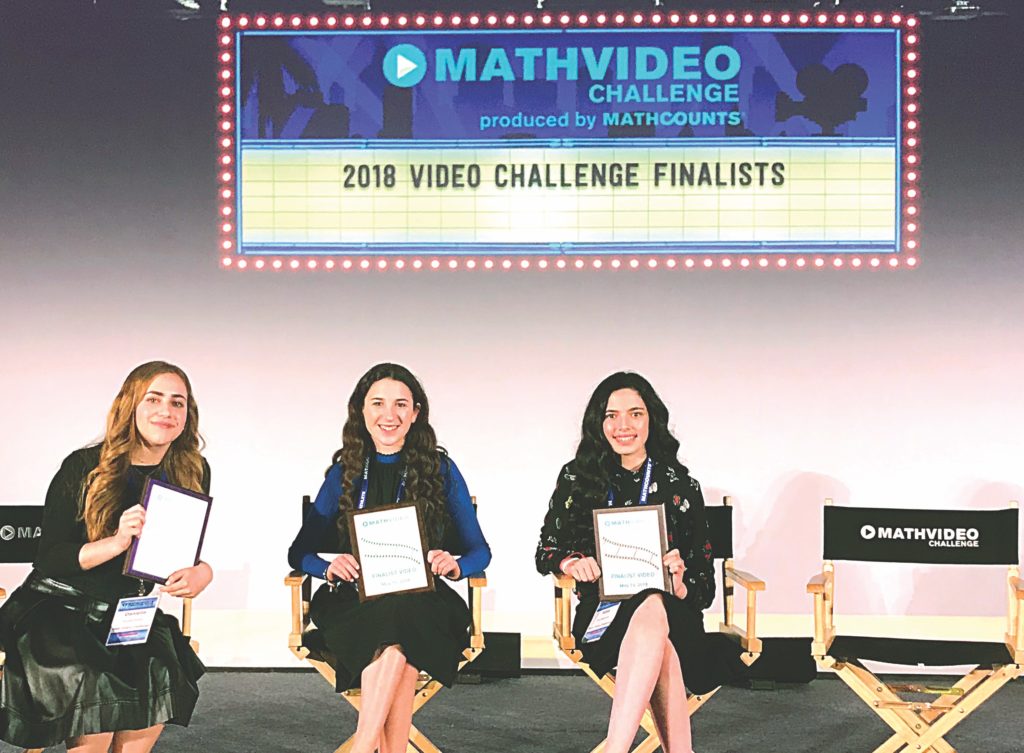
Four Yavneh Hebrew Academy middle school students were among three runners-up in a video competition that asked them to build a storyline around a word problem.
Yavneh Hebrew Academy eighth-grade students Talia Alter, Aliza Nissanoff, Talia Sacks and Daniella Zisblatt created the video, “Recipe for Success,” which was a finalist in the MATHCOUNTS National Competition, a program that challenges students to develop their math, communication and technology skills in a collaborative video project.
The girls’ video follows two sibling bakery owners, Katherine and Sophie. Katherine makes six cakes per hour, while Sophie makes four cakes per hour. Much to Katherine’s chagrin, she is paid $11 less than Sophie for each cake she makes. The two attempt to figure out how much Sophie must be paid for each cake for them to earn the same amount.
The characters employ a guess-and-check problem-solving strategy as well as an algebraic equation to solve the problem. The girls find that Sophie needs to be paid $33 per cake for the siblings to make the same amount.
Sharon Ryan, chair of the math department at Yavneh Hebrew Academy, served as the adviser on the project. “It’s a sizable competition and it’s from all over the country,” Ryan said. “I think it was an incredible honor they were chosen.”
The girls wrote the script for their video and shot it in February on Super Bowl Sunday in the kitchen of their Hancock Park Orthodox day school.
The video features some special effects, with Sophie and Katherine shrinking to miniature versions of themselves, similar to “Alice in Wonderland,” after they drink a concoction they created for a party being catered by Yavneh Cakes.
After submitting their video, the girls accumulated enough votes from the general public to place their submission among the top 100 videos. After a panel of judges ranked them as one of the four finalists, they were flown to the MATHCOUNTS National Competition in Washington, D.C., which was held from May 12-15.
I think it was an incredible honor [the girls] were chosen.” — Sharon Ryan
Ryan was worried the girls would not be able to attend because the competition began on Shabbat. However, the girls flew to Washington on May 13. Their schedule included touring the capital’s famous sites and presenting their video to the competition’s voters.
“The girls were convinced from the beginning they had a good video, and I thought they had a good video, but there were lots of good videos,” Ryan said. “It was great they could experience the whole thing even though they are in an Orthodox school.”
First place went to “Little Figures,” a video produced by students from San Antonio, Texas, which was inspired by the film “Hidden Figures.”
While the Yavneh students’ video demonstrated their math chops and production skills, Ryan said she was most impressed by the girls’ follow-through, from conception to the contest.
“Math doesn’t just teach us how to sort numbers, it teaches us how to think, how to problem-solve,” Ryan said.“And that’s really what we are trying to do with children — not
just trying to make them calculate correctly. We’re trying to make them think through a problem.”
Israeli Prime Minister Benjamin Netanyahu released a new video on May 31 criticizing the Iranian regime for inhibiting the country’s Silicon Valley-esque potential.
Netanyahu began his video by declaring that the Iranian people are “among the most gifted and successful people in the world.”
“In Silicon Valley, entrepreneurs of Iranian heritage are among the founders and CEOs of Uber, Ebay, Dropbox, and many other outstanding companies,” Netanyahu said.
And yet, Iran is an impoverished nation thanks to the regime in Tehran.
“Iran’s dictators plunder the country’s wealth. Isn’t it a shame that Iran doesn’t invest in its people?” Netanyahu said. “Instead, they divert tens of billions of dollars to their nuclear program, to the spread of terror around the world, to their aggression throughout the Middle East. Meanwhile, the Iranian people are the ones that suffer.”
Netanyahu concluded the video by stating that hopes that the day will come where the Iranian people “don’t need to go there to build the most successful companies in the world.”
“Imagine Iranian and Israeli entrepreneurs working together, in Iran and Israel, for the betterment of all humanity,” Netanyahu said. “That’s my hope. That is my vision. And that can be our future.”
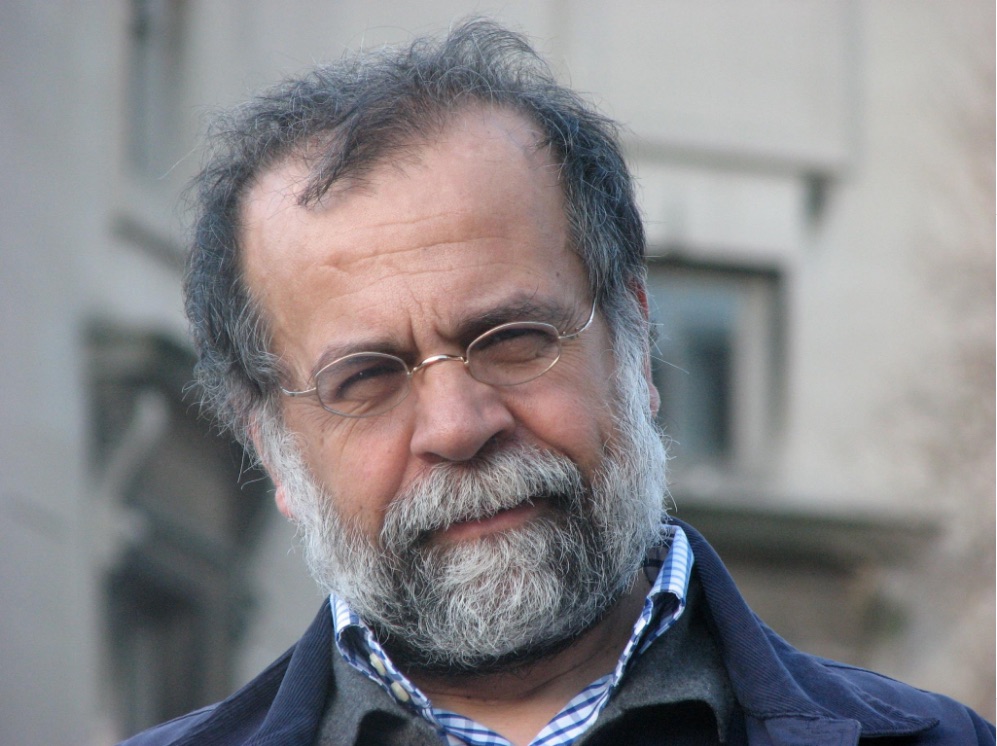
Columbia University is facing pressure to discipline Iranian Studies and Comparative Literature professor Hamid Dabashi after he referred to Zionists, among other things, as “hyenas.”
On May 8, Dabashi posted on Facebook, “Every dirty treacherous ugly and pernicious happening in the world just wait for a few days and the ugly name ‘Israel’ will pop up in the atrocities.”
Also on Facebook, Dabashi referred to Iran-deal critics as “Fifth Column Zionists working against the best interest of Americans and for the best interests of Israelis,” And, “These laughing hyenas — the Zionists the Saudis and the US neocons that are f***** with the wrong country [Iran].”
According to the pro-Israel watchdog Canary Mission, Dabashi has a history of anti-Semitic attacks, including calling Israel Justice Minister Ayelet Shaked “Neo-Nazi scum” in 2015, claiming Israel has engaged in “ethnic cleansing” and comparing Israel to ISIS. As the Journal has previously reported, Dabashi has also referred to Zionists as “master thieves.”
After Dabashi’s latest Facebook posts, the Anti-Defamation League’s New York regional director, Evan Bernstein, wrote in an email to the Journal: “Columbia Professor Hamid Dabashi’s statements accusing Israel of being behind ‘Every dirty treacherous ugly and pernicious act happening in the world’ are clearly anti-Semitic and deeply problematic. Statements like these don’t belong in academia, or anywhere, and there is no justification for this kind of hurtful rhetoric, particularly from someone who is entrusted with shaping young minds at such a respected institution of higher learning.’ ”
Alums for Campus Fairness, a pro-Israel watchdog, sent a letter to Columbia President Lee Bollinger calling on him to “confront” Dabashi.
“Professor Dabashi’s statements echo the common anti-Semitic canards and meet the working definition of anti-Semitism that the State Department has been using for years,” the letter states. “The International Holocaust Remembrance Alliance definition of anti-Semitism, which has been adopted by the US and 30 other member states, clearly states that ‘accusing Jewish citizens of being more loyal to Israel, or to the alleged priorities of Jews worldwide, than to the interests of their own nations’ is anti-Semitic.”
The letter then issued four requests to Bollinger: denounce Dabashi’s comments; make it clear that Jewish and pro-Israel students are welcome on campus; discuss how campus climate can be improved; and forbid Dabashi from teaching at the school until he ceases his “anti-Semitic rhetoric.”
“This is not a free speech issue trying to prevent Professor Dabashi from espousing his personal opinions on his own time,” the letter states. “He does not, however, have the right to create a hostile environment on campus for Jewish, Israeli and pro-Israel students who are entitled — like every student — to a safe and welcoming learning environment.”
The signatories on the letter include representatives from StandWithUs, The Lawfare Project, the Simon Wiesenthal Center and Students Supporting Israel as well as numerous Columbia faculty and staff.
“Having professors at major US universities that demonize Israel is more the norm today but depicting Zionists, including donors, colleagues, and students is beneath contempt,” Rabbi Abraham Cooper, associate dean and global action head of the Simon Wiesenthal Center wrote in an email to the Journal. “Columbia and other institutions of higher learning are going to have to come up with strategies to respond to this ongoing demonization of the Jewish people.”
One signatory, Columbia’s Chabad co-director Rabbi Yonah Blum, told the Journal in a Facebook message, “My wife Keren and I have been fielding an increasing amount of student complaints: Students feeling intimidated by the growing anti-Israel and as of recent a more blatant anti-Jewish sentiment, on campus.”
“Comments from tenured faculty in the classroom and on social media, like the recent statements of Prof. Dabashi carry a different weight of legitimacy than the those from fellow students,” Blum wrote.
Dabashi and Columbia did not respond to the Journal’s requests for comment.
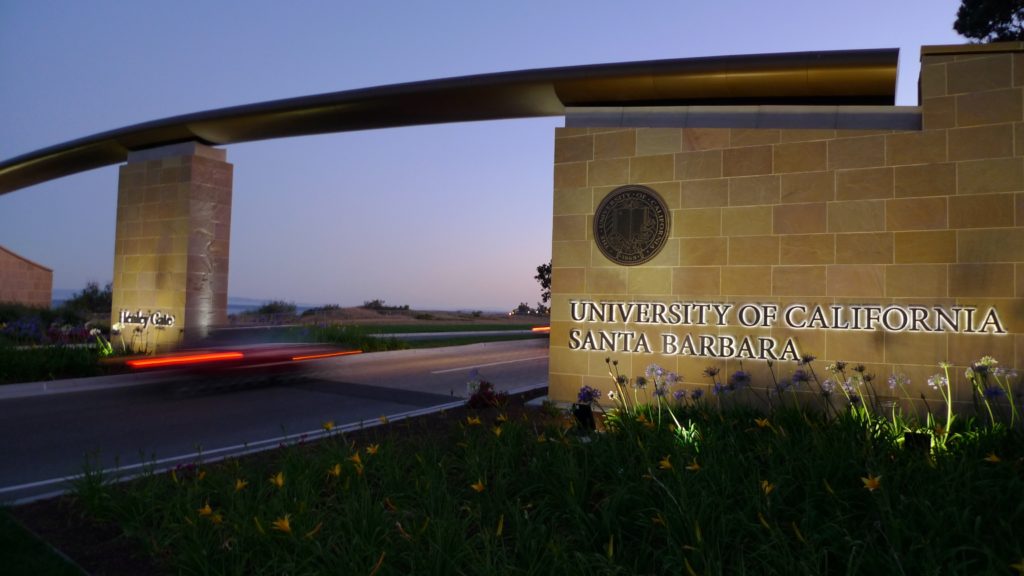
As the 2017-18 academic year comes to a close at UC Santa Barbara, a resolution to divest from companies that do business with Israel has officially failed yet again.
According to a press release from StandWithUs, the UCSB’s Associated Student Senate did not bring up the divestment resolution for a vote in its final meeting before summer break over procedural matters.
“We are incredibly proud of the students who worked tirelessly to make their voices heard on this issue,” StandWithUs Campus Strategist & Campaign Manager Sarah Tagger, former Student Board President of Santa Barbara Hillel, said in a statement. “While it is unfortunate that this campaign of hate surfaced on campus yet again, UCSB continues to stand on the right side of history.”
Rabbi Evan Goodman, executive director, told the Journal in a Facebook message on May 25, “Santa Barbara Hillel always stands with our students in firm opposition to BDS resolutions. We are pleased that this year’s 68th UCSB Student Senate is now complete and BDS once again failed.”
On May 16, the student senate had changed the divestment resolution to requiring a two-thirds majority vote to pass instead of 50 percent plus one vote of the senate. In response, 12 of the 25 student senators walked out of the meeting and the resolution never came for a vote.
As the Journal has reported, on May 23 the meeting to swear in the new board was derailed by anti-Israel protesters angry at the change in designation of the resolution. An emergency meeting was held the following night to swear in the new board and now the divestment resolution will not be brought up to a vote for the rest of the academic year.
Madeleine Isenberg has a special skill. She translates and extracts information from Jewish tombstones to help people connect with their families’ pasts.
“I’m not good at matchmaking people who are living,” Isenberg said. “I do matchmaking between living people and their ancestors.”
A former software engineer who now lives in Los Angeles, the 70-something Isenberg was born in London, has a bachelor’s degree in mathematics from UCLA and an “all-but-master’s-thesis” in computer science from the Technion, the Israel Institute of Technology.
Isenberg calls herself a stelaeglyphologist. “Stelae are monuments that are taller than they are wide, glyphs are the things that are scribed, and an ologist is someone who studies it,” she explained.
“A tombstone, like an obituary, has very narrow margins,” she said. “There’s just so much you can cram in, so you use symbols. There are so many [that] if you don’t understand [the context], you can get really messed up.”
Isenberg noted there could be up to 14 or 15 ways to indicate an abbreviation. She cited one example on a Sephardic tombstone that employed the letters Kaf, Hay, Resh. “If you translated it directly, it would be, “Like a mountain,’ ” she said. “It was actually an abbreviation that read “Honorable rabbi.’ ”
Deciphering tombstones requires translating inscriptions and collecting information, and cross-referencing against birth, marriage and death records, Isenberg said. She also employs resources such as JewishGen.org and the Jewish Online Worldwide Burial Registry.
“It’s amazing to be able to put these pieces together,” she said. “It’s solving puzzles.”
Her interest in reading tombstones dates back to 1996. Isenberg, together with her husband, traveled tothe Kezmarok cemetery in Slovakia, where they met up with her cousin in an attempt to locate family members who may have been buried there. Isenberg’s father grew up in Kezmarok and most of her Holocaust-surviving family members eventually emigrated from there to Israel in 1948.
Armed with a hand-drawn map, they made their way through the overgrown cemetery, where Isenberg discovered her great-grandmother’s grave. “It was beshert (meant to be),” she said. The weathered headstone was difficult to read, but it confirmed the history Isenberg knew: Her great-grandmother had died young while giving birth to her third child. Her father’s name was also on the headstone.
A few years later, when Isenberg wanted to get the stone restored, a cousin introduced her via email to Mikulas “Miki” Liptak, a small book publisher in Kezmarok, who would use markers to highlight the lettering on the gravestones and then send photos of them to Isenberg to decipher.
In 2004, Dr. Josef Jordan, a veterinarian in Kezmarok, received funding to preserve the Jewish cemetery. Liptak took pictures of all 550 tombstones. He reached out to Isenberg to translate the stones, and a working relationship ensued. Since then, Isenberg has read and deciphered several thousand tombstones from around the world. She continues to help people track down relatives and decipher their tombstones.
In August, Isenberg will be a guest speaker at the 38th International Association of Jewish Genealogy Societies (IAJGS) conference, which will take place in Warsaw, Poland, for the first time. She will be speaking on what can be gleaned from the Hebrew inscriptions on tombstones.
“I’m attempting to help beginning researchers who barely know the Hebrew alphabet to find and recognize certain pieces of information that should be of genealogical value as they research and build their family trees,” Isenberg said.
This work, she added, gives her purpose. “[It’s fun] finding something or being able to help somebody who has been searching.”
Seventeen-year-old Liana Seidenfeld feels like she’s living in a dangerous world.
The Yeshiva University of Los Angeles Girls School (YULA) student told the Journal in a phone interview, “As a woman, I constantly feel vulnerable. Whether I’m walking home alone, getting into a cab or doing any activity on my own, I lack the confidence and ability to feel safe wherever I go.”
That feeling, especially in the time of #MeToo, led Seidenfeld, along with two other YULA Girls students, Jennie Peled, 15, and Ilana Aslan, 17, to create a safety device called HERO. The device, which sits inside a customized 3D printed bracelet, enables the wearer to trigger a recording via a preprogrammed panic word and call for help in an emergency.
The girls invented HERO, which is not an acronym but alludes to the device’s protective nature, earlier this year as part of a STEAM (Science, Technology, Engineering, Art and Mathematics) initiative at YULA. The program, founded by Sheri Schlesinger of the nonprofit organization Genesis, aims to give students an interdisciplinary education and provide them with business acumen they can use in the real world.
“A Genesis educator helped mentor the girls and their idea development, then worked with the team through the design process,” Schlesinger said.
As part of the program, Schlesinger took the students to the International Consumer Electronics Show (CES) in Las Vegas in January, where they came up with the idea for HERO. They attended Girls’ Lounge, where a group of professional women gathered to network at CES. There, the girls decided to focus on an issue that would help women with personal safety.
Unlike other devices on the market, HERO can be concealed in stylish bracelets. “Once our company progresses further, though, we plan to expand to more lines for all demographics,” Schlesinger said.
In April, Peled, Seidenfeld and Aslan took their HERO prototype to UCLA’s Founders Bootcamp — a startup accelerator program that provides high school students with entrepreneurial training and helps them get their inventions off the ground. There, Founders Bootcamp pledged a $50,000 investment with a 5 percent equity in HERO. It also valued HERO at $1 million.
The YULA Girls team was one of eight that won awards in a competition that saw 1,100 applicants from five continents.
As part of their prize, the students will participate in a Founders Bootcamp program this summer at a WeWork office and at the Anderson Graduate School of Business on the UCLA campus. There, they will continue to develop HERO and post updates about it on their website, wearhero.me, and learn about becoming successful entrepreneurs.
“We’re going to work full force during the summer and be completely dedicated to HERO,” Seidenfeld said. “Next year, if we do reach the kind of success [and it requires] more [time] than we imagine right now, we’ll find a way around it. We’re still going to school, but maybe we’d have a larger curriculum in school to allow us to work on the project.”
Ethan Piliavin, director of educational technology and STEAM at YULA, said that STEAM education is the future, and that YULA is leading the way for day schools in Los Angeles. “It’s important to have this type of education and success and give our girls inspiration,” he said. “We want to prepare our students to be the best they can be.”
YULA Girls Head of School Rabbi Joshua Spodek said HERO also encapsulates Jewish concepts. “It brings all these subjects together with a Jewish lens,” he said. “Our mission is to fuse the worlds of science, technology, culture and Judaism. [The students’] whole mission is to make the world a safer place. If that’s not Judaism, I don’t know what is.”
Seidenfeld said the girls hope to “expand the HERO lines to boys being bullied at school and older people. We can offer it to everyone in the future.” Peled added, “Even if HERO doesn’t become worldwide, if it can make even one woman feel safe, we’ve reached our goal.”