For many of us who grew up in Southern California, one of our favorite experiences was a dark ride in Disneyland’s Tomorrowland that we called the “Monsanto” ride, sponsored by the giant chemical company. The real name of the ride was “Adventure Thru Inner Space.” The attraction was supposed to provide the rider with a simulation of shrinking to a size smaller than an atom and entering a gigantic microscope to view snowflakes, getting smaller and smaller as the ride progressed.
I especially liked when the ride took you inside an atom and the only thing visible was this cheesy pulsating red light with the voice-over saying, “And there is the nucleus of the atom. Do I dare explore the vastness of its inner space? No, I dare not go on. I must return to the realm of the molecule, before I go on shrinking … forever!”
At the end of the ride, the snowflakes melted into water and we were able to see the hydrogen and oxygen molecules, suspended in the air. Water always looked different to me after that ride.
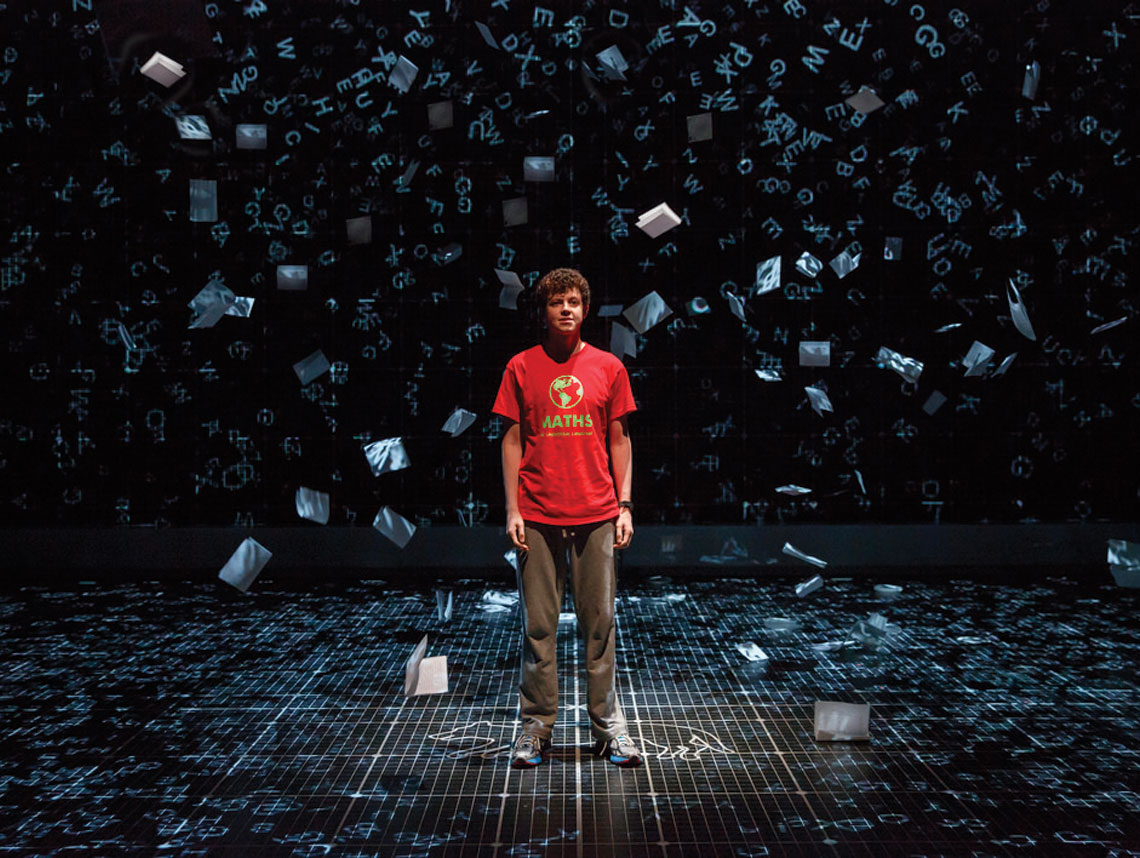
I was reminded of that ride while watching the play “The Curious Incident of the Dog in the Night-Time” last week at the Ahmanson Theater in Los Angeles. Based on the mystery novel published in 2003 by British author Mark Haddon, the play’s central figure is 15-year-old Christopher Boon, who lives in Swindon in southwest England with his dad. He excels in math and other academic subjects, but due to his unstated high-functioning autism, he has great difficulty connecting with and understanding the people around him. He doesn’t easily pick up on the social cues of others and has trouble interpreting facial expressions. Loud sounds, flashing lights and even some food textures are upsetting to him. To combat his ever-present anxiety, he recites prime numbers. His life is interrupted abruptly by the unfortunate killing of a neighbor’s dog, Wellington, and after he is wrongly accused of the crime, he decides to become a “detective” and figure out who is the culprit, following in the footsteps of his role model, Sherlock Holmes.
I read the book so long ago that I had completely forgotten the plot lines and the eventual discovery of who killed the canine, but I do remember hearing Benjamin’s very authentic voice in my head, since the book was written in the first person. In the theater version, there’s a teacher/therapist who reads from Benjamin’s journal and provides the same function as his first-person narrative in the novel. But what was so remarkable about the live production was the way the high-tech “cube” stage, with its many LED lights and razzle-dazzle technology, was able to get us into Christopher’s head, showing the world through his perspective in terms of what he was seeing, hearing and feeling. When he ends up traveling to London by himself in search (spoiler alert) of his mother, we experience what is going on in his head — the sensory overload of too many people talking all at once, the din of overlapping public announcements, plus the blizzard of digital and static signs, posters and advertisements. The combined audio output was so loud that I found myself covering my ears.
In the book, Haddon never mentions that Christopher has autism, and that was very much on purpose. That also holds true for the stage version. As Hadden told Terry Gross in a June 2003 NPR interview, “If he [Christopher] were diagnosed, he would be diagnosed as having Asperger’s syndrome, which is a form of autism. … He has difficulty with life in that he really doesn’t empathize with other human beings. He can’t read their faces. He can’t put himself in their shoes. And he can’t understand anything more than the literal meaning of whatever’s said to him, although I’m very careful in the book not to actually use the word ‘Asperger’s’ or ‘autism.’ … Because I don’t want him to be labeled, and because, as with most people who have a disability, I don’t think it’s necessarily the most important thing about him.”
At the end of the play, I felt I would never look at autism the same way again.
MICHELLE K. WOLF is a special needs parent activist and nonprofit professional. She is the founding executive director of the Jewish Los Angeles Special Needs Trust. Visit her Jews and Special Needs blog at jewishjournal.com/jews_and_special_needs.