What is the mainstream expression of Jewish power? When superstars with millions of followers like Kanye West and Kyrie Irving exhibit antisemitic behavior, more often than not, it revolves around a sinister view of Jewish power. Jews are the bosses. They own the record labels, the movie studios and the sports teams. They run the world.
These stereotypes are not just sinister and antisemitic, they are also insultingly materialistic. They overlook a whole other view of Jewish power, one that has little to do with material wealth and everything to do with Jewish wisdom and universal values.
When Judaism teaches, “What is hateful to you, do not do to your neighbor” and that all of God’s children are “created in the image of God,” there is a special ethical power in those ideas, the kind of power that moves our hearts.
When Jews helped found some of our most important civil rights organizations, including the NAACP, the Leadership Conference on Civil and Human Rights and the Student Nonviolent Coordinating Committee (SNCC), that also was Jewish power.
When, between 1910 and 1940, more than 2,000 primary and secondary schools and 20 Black colleges were established in whole or in part by Jewish philanthropist Julius Rosenwald, that also was Jewish power.
When Jews made up half of the young people who participated in the Mississippi Freedom Summer in 1964, and Jewish leaders were arrested with Rev. Dr. Martin Luther King, Jr. after a challenge to racial segregation, that also was Jewish power.
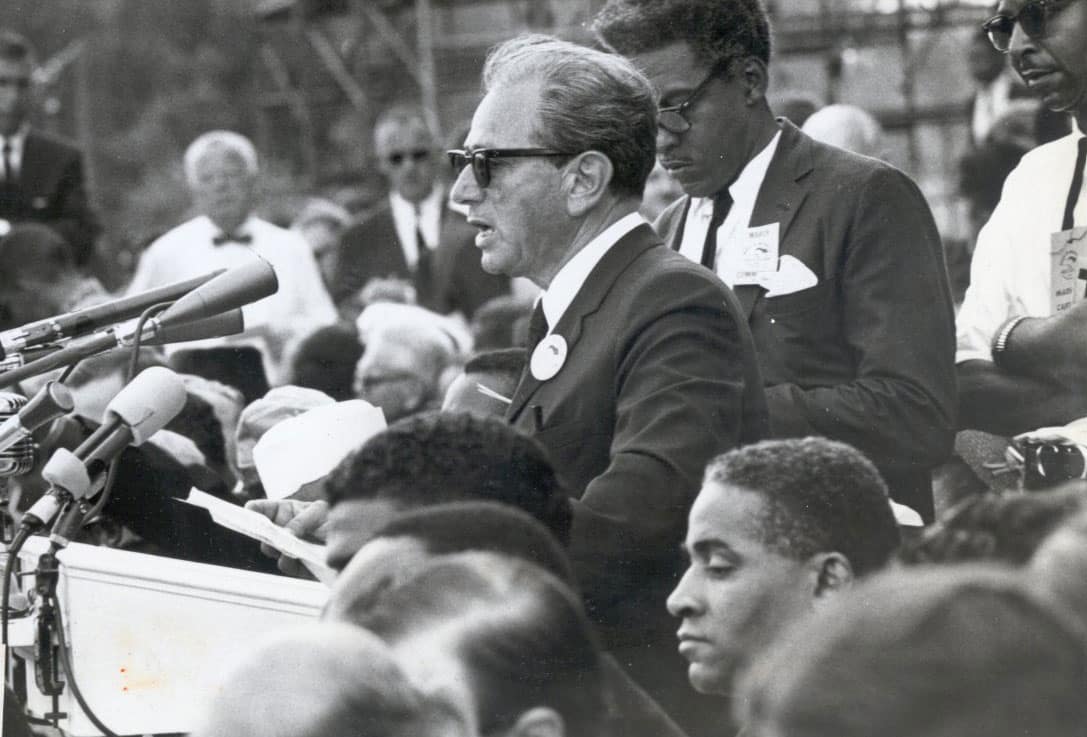
The power of Jewish wisdom during the era of racial upheaval was perhaps most evident when Rabbi Joachim Prinz spoke right before King’s famous “I Have a Dream” speech at the Washington Mall in 1963. In front of one of the largest civil rights marches in our country’s history, Prinz started by saying, “I speak to you as an American Jew.”
Then, with brevity worthy of an Abraham Lincoln address, he shared the universal wisdom of his tradition:
“We share the profound concern of millions of people about the shame and disgrace of inequality and injustice which make a mockery of the great American idea.
“As Jews we bring to this great demonstration, in which thousands of us proudly participate, a two-fold experience — one of the spirit and one of our history.
“In the realm of the spirit, our fathers taught us thousands of years ago that when God created man, he created him as everybody’s neighbor. Neighbor is not a geographic term. It is a moral concept. It means our collective responsibility for the preservation of man’s dignity and integrity.
“From our Jewish historic experience of three and a half thousand years we say:
“Our ancient history began with slavery and the yearning for freedom. During the Middle Ages my people lived for a thousand years in the ghettos of Europe. Our modern history begins with a proclamation of emancipation.
“It is for these reasons that it is not merely sympathy and compassion for the black people of America that motivates us. It is above all and beyond all such sympathies and emotions a sense of complete identification and solidarity born of our own painful historic experience.”
There is a profound, elevating power in those words and in the actions so many American Jews have taken to live up to them.
That’s why it saddens me that this humanistic view of “Jewish power” gets totally lost in the modern media circus when power is measured in dollars and clicks, rather than values and wisdom.
I saw parts of the documentary, “Hebrews to Negroes: Wake Up Black America!” that Kyrie Irving posted on Twitter and that triggered his downward spiral. I saw in the film the demonizing of Jews and outrageous lies denying both Jewish biblical history and the Holocaust.
Someone should encourage Irving and West to watch another film: Rabbi Prinz’s heartfelt solidarity speech from the 1963 march. These two megastars both say they want to share their “light” with the world and seek a higher level of understanding. They can start by learning more about a deeper power that is anything but sinister—the one rooted in the universal wisdom of the Jewish tradition.
Then they can tweet Rabbi Prinz’s speech to their millions of followers.