If you ever wanted to experience what a healthy Jewish communal life might look like post-COVID, you might want to visit the ancient, mystical city of Tsfat, high up on a hill in the northern Galilee region of Israel.
I say this for one primary reason—Tsfat reminds me what it’s like to experience life in person. It’s odd to even have to mention this, but after two years of COVID lockdowns, prolonged isolation and endless Zoom meetings, the simple notion of doing things in person has become a big deal.
Tsfat is the ultimate in-person town, the very antidote to the virtual.
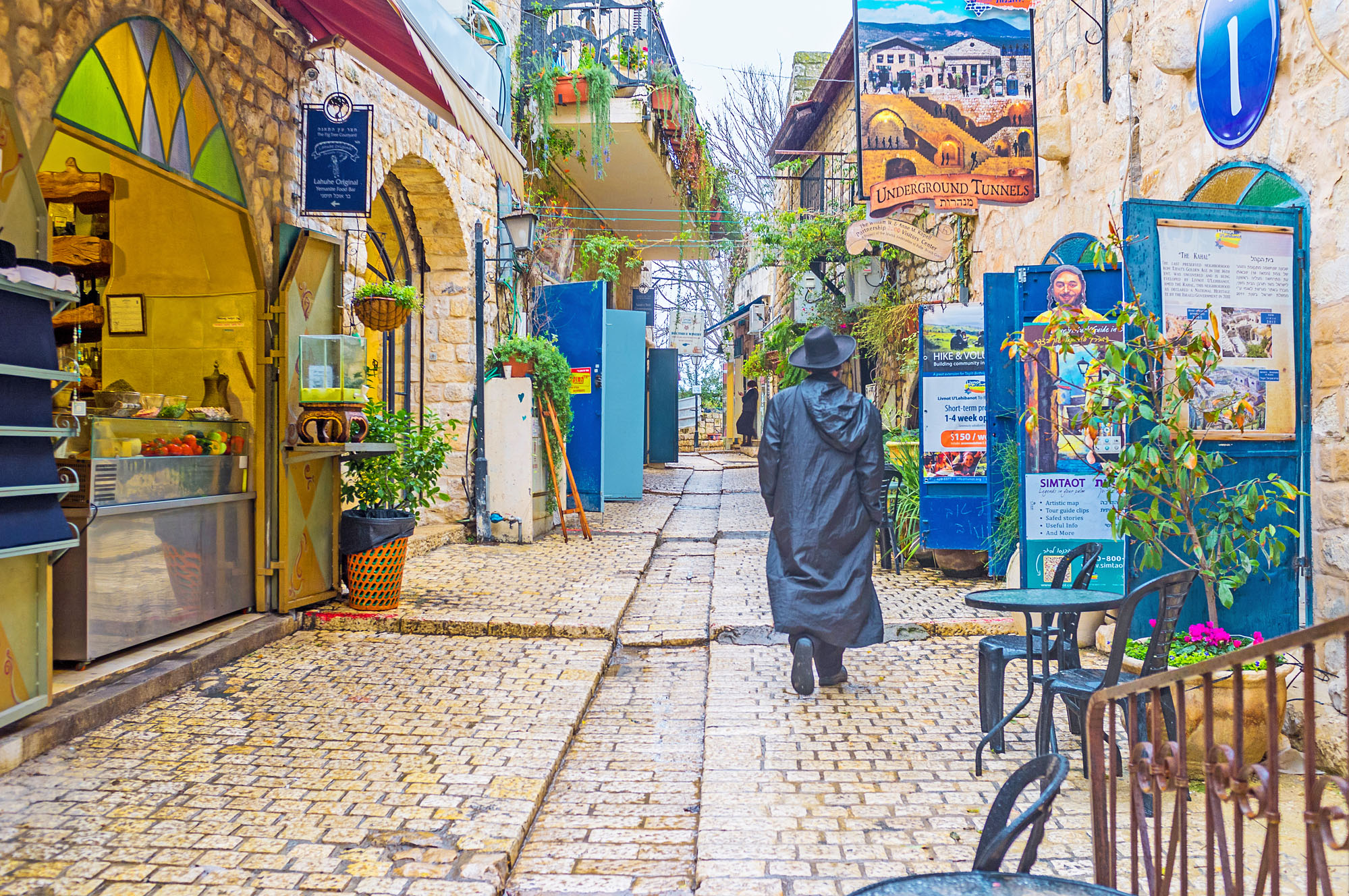
The town encourages the simple art of walking. Its central attraction is the “old city,” where ancient synagogues blend in with art galleries in narrow, meandering alleyways with stone steps that can pop out of nowhere. Old stones are everywhere and come in all sizes—on the walls, on arched ceilings, on the streets.
Everyone is walking, either with a purpose or just to stroll. Many of the locals are religious Jews walking to their synagogues or going food shopping, while tourists and secular Jews will stroll through the art colony and hang out at cafes or juice bars.
The point is: You don’t feel a need to do anything virtual in Tsfat, because everything feels so real and so close. You can taste life.
There is nothing I’ve done in Tsfat over the past week that I would have wanted to do online. I want to go to the cafes and feel the crowds. I want to sit with others to hear a Torah class in the lobby of my bed and breakfast. I want to stroll through the art galleries and attend a ceremony for a new Torah scroll. I want to meet the healers and the rabbis and the artists in person, in real time.
Of course, I can’t bring Tsfat with me when I return to Los Angeles. Every city is different; every city looks different. Tsfat, with its denseness and street intimacy, may be the very opposite of Los Angeles, with its expansive urban sprawl.
And yet, regardless of where we live, we will need to find ways of recreating communal intimacy if we are to thrive in a post-COVID world. The one thing we know is that communities can’t sustain themselves virtually. Yes, Jewish learning has grown exponentially thanks to the miracle of digital spaces, but learning is no substitute for human connection.
Jewish learning has grown exponentially thanks to the miracle of digital spaces, but learning is no substitute for human connection.
This is true individually and communally. We’re much happier when we connect with others in person, and communities come alive when their members come together.
In many ways, people have it easy in Tsfat. The town is like a magnet that beckons you to come out, walk around and feel life. In America, it’s as if our homes have become our magnets. We’re drawn to the conveniences of online living, the easy home deliveries, the comfort of doing so many things virtually.
The price we pay for this virtual life is the silent hole it leaves inside of us. We’re human, after all. The real will always be more satisfying than the virtual.
We’ll need to figure out how to sprinkle a spirit of Tsfat throughout our communities. The first step is both the hardest and the easiest—going offline. And there’s no better time to start than on Shabbat.
Shabbat shalom.