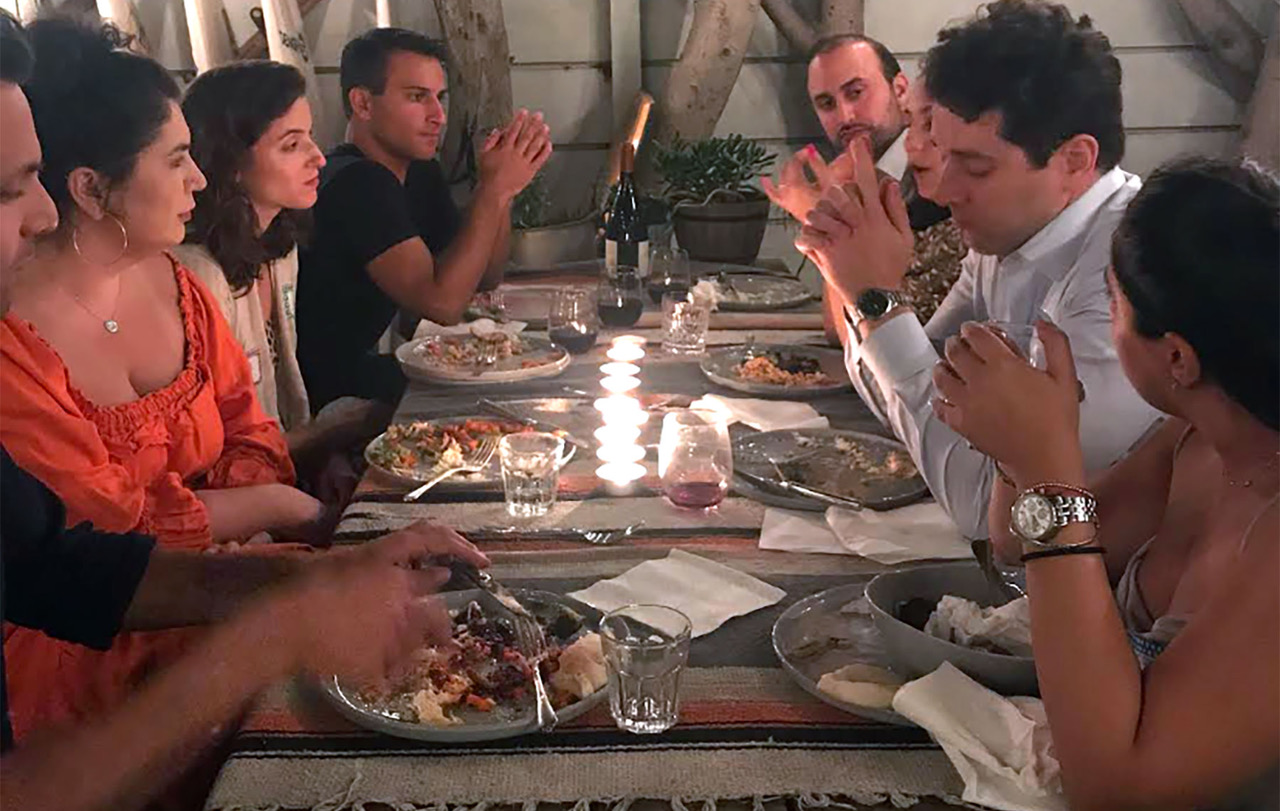
Forty years ago, thousands of Jews fled Iran after the Islamic Revolution, settling primarily in Los Angeles. One of our first priorities as immigrants and refugees? Establishing our own infrastructure that served the immediate needs of a community traumatized by conflict and unprepared for life in La La Land.
In L.A., we didn’t even mind traffic on the freeways because we were finally free.
After social services were launched, Iranians set up necessities ranging from supermarkets to driving schools. I have fond memories of a driving instructor begging my mother in Persian, “For the love of God, BRAKE!”
We went beyond surviving to thriving in fields that enabled us to become a successful immigrant community, except one: We didn’t stop along the way to ask, “Now that we’ve survived in the U.S., how are we really doing in this new and free country?”
It wasn’t long before a new generation of Iranian American Jews began to experience isolation and malaise, suffocating family pressures and a toxic lack of understanding between parents and children.
This was especially true with women. Yes, there were Persian-Jewish clergy, therapists and even experts on radio talk shows who aimed to increase people’s understanding of themselves and their children. But young Iranian American Jewish women, in particular, had little peer support and freedom from suffocating cultural norms.
Enter Dorsa Beroukhim Kay, 31, Nicole Nowparvar, 30, and Farah Shamolian, 30.
In 2014, they created the Jewish Iranian Women’s Foundation with the goal of “empowering the Jewish Iranian community by deepening one’s sense of self and cultivating meaningful connection.” In 2018, it became a nonprofit called Chaya.
“Chaya is a kabbalistic term for one of the five levels of your soul that functions for the betterment of your community,” said Nowparvar, Chaya’s executive director.
Chaya addresses community challenges ranging from cultural divides between traditional parents and more Americanized children to hurtful stereotypes about Persian Jews.
The organization began hosting a bimonthly event called “Dinner With Strangers,” choosing five young men and women to break bread and speak about controversial topics, facilitated by an expert.
Recently, Chaya held a “Dinner With Strangers” program for mothers and daughters. “It was a freeing experience that left us uniquely bonded to the mother-daughter pairs who were there, while also shedding another layer in the relationship my mom and I have with each other,” said Sharona Daneshrad, who attended the event with her mother.
It also launched Women on Purpose, which promotes career networking between generations, as well as the New Mother’s Club and Chaya Plus. The latter promotes unity among all Jews, and offers opportunities for non-Persian Jews to ask questions such as, “What are the stories of Iranian Jewry?” and “Why do you all beat one another with scallions at the Passover seder?”
It tackles issues with the help of speakers drawn from the community who help people communicate their needs in healthy, compassionate ways on topics such as fertility, mental health, self-care and relationships.
Chaya also embraced a crucial segment of Persian Jews that had been overlooked: Iranian-born mothers in L.A. whose mothers had been raised in a generation of unquestioned conformity to cultural norms, including strict obedience to elders and few options for women beyond motherhood.
Chaya’s founders soon learned there were many things to air out regarding inter- and intra-generational relationships.
Chaya will host its first fundraiser on Sept. 12 at a private residence in Beverly Hills, also marking the first time fathers will be invited to join the conversation. The program will feature psychologist Nazanin Ramzi Shamtobi as well as live music and visual art. Information can be found at chayacommunity.com.
“Chaya signifies a movement recognizing becoming the best version of yourself in a community struggling to break free of conformity and outdated social norms,” said Sharon Peykar, who is a regular at Chaya events. I’m starting to see a pattern here.
We may have spoken too soon in believing we were immediately free as soon as we escaped Iran.
As it turns out, it would take another 40 years to begin to remove the shackles, and the keys were in the hands of our women all along.
Tabby Refael is a Los Angeles-based writer and speaker.