PREVIOUSLY: Ernie makes a hard confession about his one and only love.
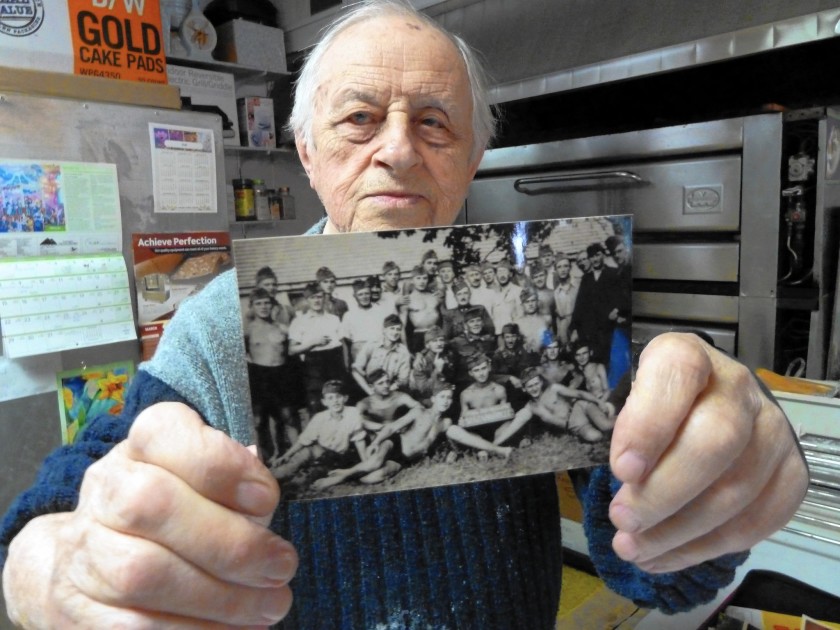
Good and bad, Ernie’s long life is captured in scores of pictures, the now-dated photographs and mementos he keeps in scrapbooks in his kitchen.
There’s the one of his long-dead mother Sarah in her kitchen, in the good years before the war, standing amid a group of forty.
A man carries a saxophone. A young Ernie is there in the first row.
They’d all come together to celebrate Sarah’s cooking.
And there’s the picture of Ernie standing with Helen on the boat as it chugs toward Israel. He’s wearing a chef’s hat and she’s squinting toward the sun.
They look so young and in love, enough to break your heart.
There are photos of Lucenec taken before Ernie was born, when his grandfather made his rounds among farmers with his horse-drawn cart.
There’s even a shot of his great- grandparents, on his mother’s side.
There’s a picture of Ernie taken in 1945, right after the war, when he returned to Lucenec.
He’d bought a blue silk shirt and white jacket from the Americans, the first time he’d had enough money to buy nice clothes.
There’s the picture of Ernie and his famous sheet cake, topped by a replica of the Cyprus prisoner-of-war camp with barbed wire and an Israeli flag.
There are British officers standing nearby. Everyone is marveling at the cake.
Ernie looks happy.
There’s a snapshot Ernie took of the memorial that now hangs in Lucenec honoring the residents who died in the Nazi concentration camps, including Sarah and Alex, his mother and brother.
There’s lettering in Hebrew, English and even Arabic.
There’s one of the cake Ernie made in the Cyprus camp when he and Helen were married; the cake topped with the Star of David.
There’s also a shot of the cake Ernie baked for Israeli President Ben Gurion on the Jewish state’s ninth anniversary.
The cake has four pillars, with a glove and a map of Israel.
Ernie has a plan for these photographs, as well as his legacy.
After 50 years in business, he has put the bakery up for sale, along with the living quarters upstairs. A synagogue in nearby Reno says it has plans to perhaps buy the building and turn it into a museum.
“That bakery, and the place Ernie lived, should serve as a museum so people will not forget his sacrifices,” said Rabbi Mendel Cunin of the Reno Chabad.
“It represents what generations of people have endured. But this message is not a sad one. This one has a positive ending. Ernie was scrappy and he survived into his 90s, helped by his faith.”
As Ernie knows, once you’ve survived the Nazis, everything else is a piece of cake.
NEXT WEEK: Ernie gets a comeuppance.