What do the arts tell us about the era we’re living in? A performance last week at New York’s Lincoln Center Festival brings that question back to mind.
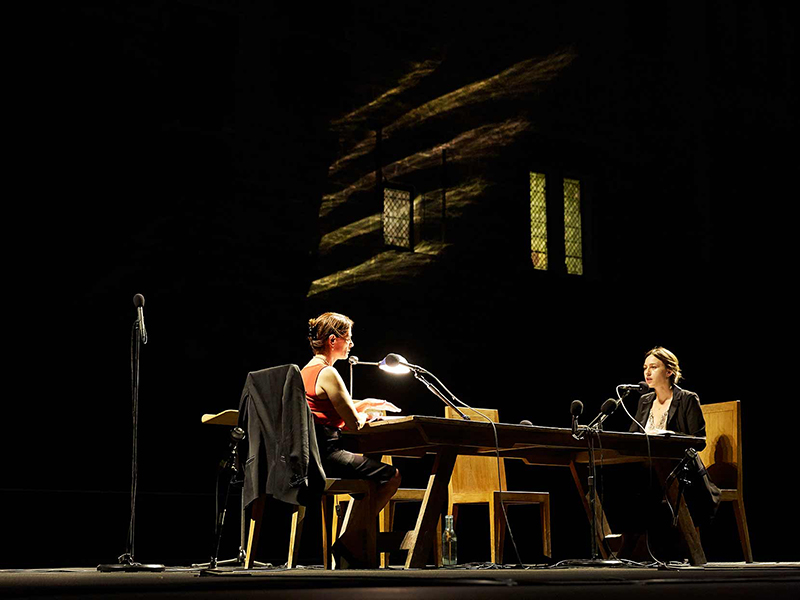
The multimedia work Yitzhak Rabin: Chronicle of an Assassination treats the same subject that its creator, Amos Gitai, explored in his film Rabin, the Last Day (2015). Here he uses live actors and musicians, together with video montage, to tell the familiar story of the tragic events of October-November, 1995.
The production brings to mind the Christian Passion play, an Easter tradition that tells the story of the trial and death of Jesus. Indeed some of the music in Chronicle is by Johann Sebastian Bach, whose Passion According to St. Matthew is one of the greatest musical Passions. It’s a natural model for telling the tale of a redeemer who fell victim to a political execution.
In a Passion play the story may be told by a narrator called the Evangelist. Here that role is filled by the words of Leah Rabin, spoken as news footage of the time unspools on giant screens at the back of stage. The hopes surrounding a Labor Party peace rally in Tel Aviv build in counterpoint to the rage against Rabin at a Likud Party rally in Jerusalem’s Zion Square. Some in the angry crowd call for “Death to Rabin”; in the St. Matthew Passion the chorus cries, “Lass ihn kreuzigen” – “Let him be crucified.”
Any morality tale needs a villain, and both stories have a betrayer. In Gitai’s narrative it’s Benyamin Netanyahu, who stepped up to address the Likud rally, and who became prime minister a year later. Gitai implies that history might have been different had Netanyahu not added fuel to the flames that night.
Gitai’s creativity falters as the work reaches its final moments. He borrows gravitas from Shakespeare, quoting Mark Antony’s words over the body of Julius Caesar as if it were a prophecy for Israel. Antony foresees “domestic fury and fierce civil strife…Caesar’s spirit, ranging for revenge…shall cry ‘Havoc’ and let slip the dogs of war.” The show concludes with other words we know: the verses from the book of Kohelet/Ecclesiastes about “a time to love, and a time to hate; a time for war, and a time for peace.”
In a Director’s Note for this production Amos Gitai writes, “For me, the best tribute an artist can give his own culture is to be critical.” He’s not alone in that view, of course. But if an artist becomes critical by reflex, won’t he or she lose some originality and independence of thought? Chronicle of an Assassination rehearses a familiar view of a pivotal event. If Gitai expresses something different from his peers’ sympathy for Rabin’s aspirations and dislike for Netanyahu, that wasn’t apparent.
But perhaps Gitai is not to be blamed. In this historical moment, it’s become the norm to recycle accepted ideas—perhaps in a louder voice, in a more urgent vocabulary, or with more extreme expectations—but recycle nonetheless. We seem headed for what the poet saw a hundred years ago: “The best lack all conviction, while the worst are full of passionate intensity.”
Yeats continues, “Surely some revelation is at hand.” After decades of expressing views about the arts and society that have become predictable, can our artists challenge their own assumptions and surprise us by revealing something new? It seems about time.